
People who live in extremely cold or hot regions know that electronics, particularly batteries, are vulnerable to very low or very high temperatures. Thankfully, a new thermal switch made from graphene foam could help deal with both by dynamically trapping heat when it’s cold out or allowing heat to escape when it’s too warm.
Graphene is a two-dimensional sheet of carbon, a single atom thick. But don’t let its simplicity fool you. The material is incredibly versatile, with vast potential in many areas. For example, it can improve solar panels, make stronger concrete, make lenses more precise, be used as circuits to generate unlimited clean energy for electronics, make lithium-ion batteries 18 times more potent, make carbon fiber 225% stronger and 184% stiffer, and make hair dye safer.
That’s not all; ultra-high-density hard drives made with graphene can store ten times more data, the world’s tiniest microchips are made from graphene sheets folded like origami, and the list goes on.
Lithium-ion batteries are advised only to be used between 32 and 113°F (0 and 45°C), especially when charging. Anywhere beyond that range, and you risk degrading the battery’s performance. Keeping components from overheating is vital in electronic devices, which emit plenty of heat of their own. However, when the external temperature drops, it would be helpful to preserve that heat trapped in the device to keep it from getting too cold.

Xiulin Ruan, the study’s co-corresponding author, explained:
As electronic devices get smaller and more powerful, managing heat becomes a more crucial issue. Most devices use passive thermal management, such as conduction and convection, to move excess heat. But this system isn’t tunable or adjustable and doesn’t help at all in cold conditions.
Now, Purdue University researchers have developed a way to handle extreme temperatures. The key is, you guessed it, the overachieving graphene. While the material is usually an excellent heat conductor, graphene foam acts as an insulator due to the many air pockets. Therefore, the team tapped into that dual nature to create a layer that switches back and forth between conductor and insulator.
The Purdue team placed a graphene foam sample between a heat sink and a heater and measured the temperature and heat flow when the foam was relaxed or compressed. They found that it acts as an insulator when it starts 1.2mm thick, but when it’s flattened to 0.2mm, it becomes up to eight times more thermally conductive. “It functions like a resistor in an electrical circuit. But, instead of varying the amount of current flow, it varies the amount of heat it allows to pass,” added Amy Marconnet, the study’s co-corresponding author.
In other tests, the researchers simulated real-world ambient temperatures of between 32 and 86°F (0 and 30°C), with the graphene foam placed on a heat source that simulated an electronic device. Again, the results were promising; the material stabilized the device’s operating temperature across the entire range of ambient temperatures.
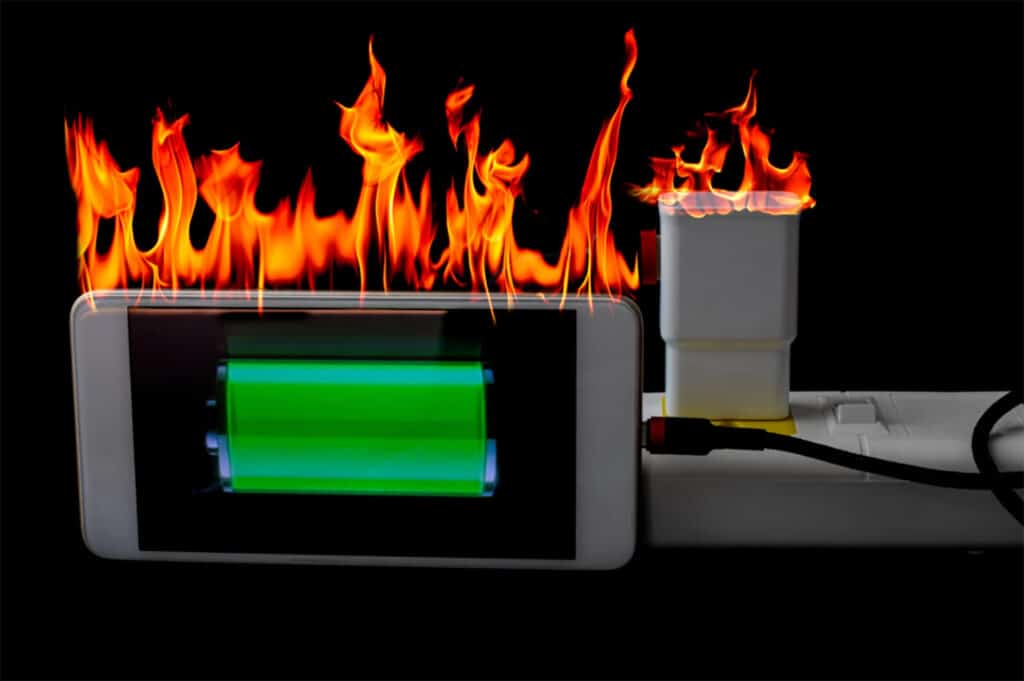
The team highlighted that this system would be most beneficial for small electronics like phones. However, they added that it could eventually be scaled up to more prominent components such as electric vehicle batteries, which are particularly sensitive to ambient temperatures since they are exposed to them more. The findings were published on August 13, 2021, in Nature Communications.
There is a growing need for creative solutions for storing excess renewable power from sources that are intermittent by nature, like wind and solar. Molten salt batteries (commercially known as sodium-sulfur batteries) are one potential solution already in use. They offer advantages that lithium-ion batteries don’t, albeit having a few cons of their own. For one, they typically operate at a high 520 to 660°F (270 to 350°C).
However, in July, scientists at Sandia National Laboratories made a new design, rethinking the battery’s chemistry altogether to get it to work at a much lower temperature; 230°F (110°C). One of the design innovations that enabled the lower operating temperature was developing a catholyte – a liquid mixture of sodium iodide and gallium chloride. They’re liquid also means they have an extended life compared to other types of batteries. Commercial molten sodium batteries have 10-15 years’ lifetimes, significantly longer than lithium-ion batteries or standard lead-acid batteries.
The Sandia team’s molten salt battery is cheaper and stores more energy. It could be one of the solutions for grid-scale energy storage the world needs.


