
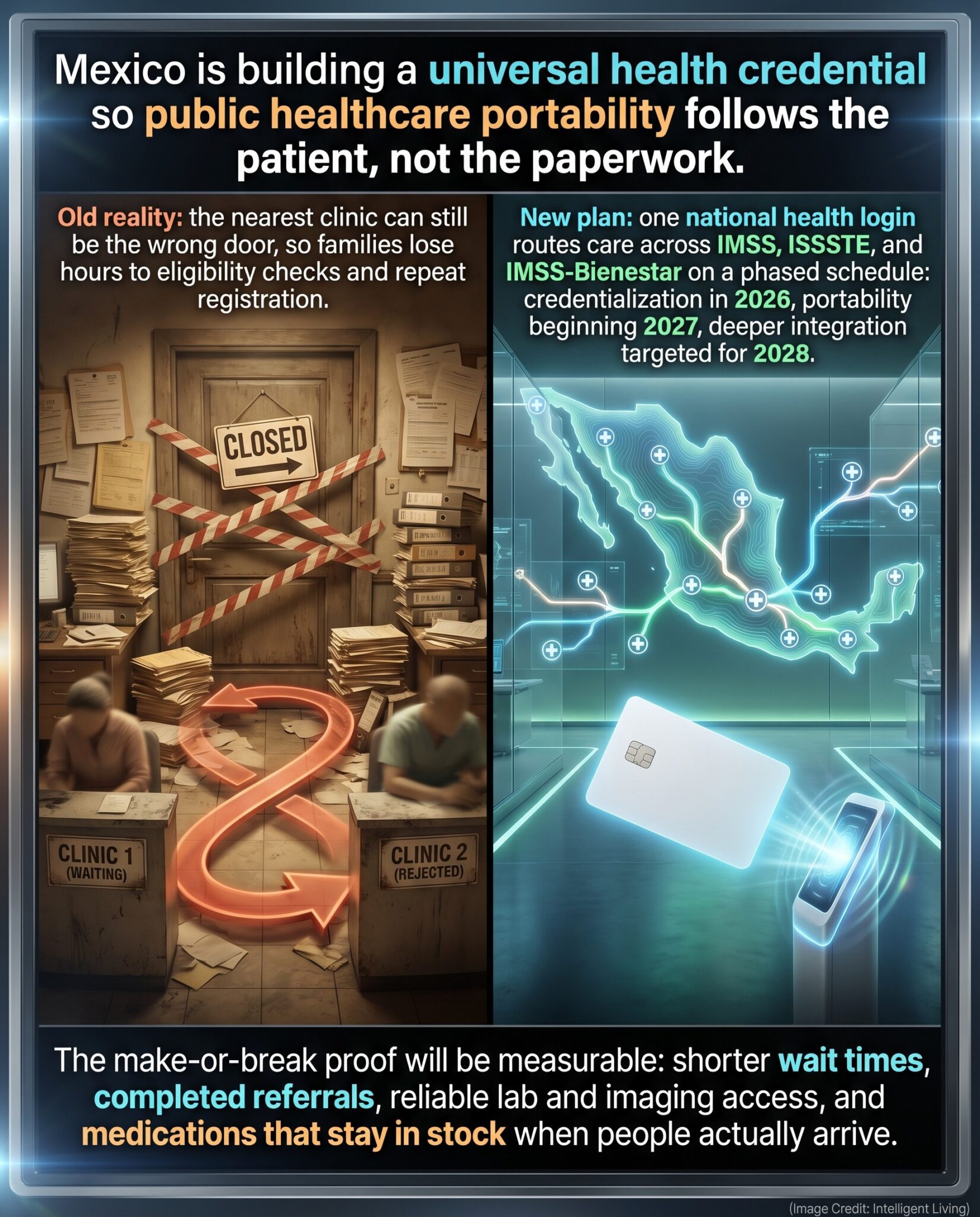
Mexico’s federal government has initiated a transformative phased plan to establish a Mexico universal healthcare portability shift, effectively linking the nation’s primary public systems. Strategic integration of a universal health credential creates a streamlined interoperability layer designed to route patients across the IMSS, ISSSTE, and IMSS-Bienestar networks. This fundamental change addresses long-standing barriers by ensuring eligibility follows the patient rather than the employer, maintaining medical history and access rights regardless of the treatment location.
Strategic universal health credential integration establishes a streamlined interoperability layer that routes patients across IMSS, ISSSTE, and IMSS-Bienestar networks. This national health login simplifies the patient journey by verifying entitlement status in real time. Our breakdown examines the official Servicio Universal de Salud decree, the operational mechanics of the new health login, and the direct impact of this phased rollout on families nationwide.
Achieving true Mexican health portability requires more than just a new card; it demands a fundamental change in how clinics interact with one another. Success hinges on the reliable execution of the phased plan for portable public health care, ensuring that every IMSS-Bienestar clinic access point and high-tech urban hospital can communicate seamlessly. The following guide serves as a practical roadmap to understanding these changes and preparing for the arrival of the universal health credential.
Mexico’s Universal Health Service: What was Announced and Who it Affects
Quick Facts: Mexico’s Servicio Universal de Salud
Mexico’s Servicio Universal de Salud functions as a universal healthcare portability shift, ensuring public care accessibility across IMSS, ISSSTE, and IMSS-Bienestar. This framework eliminates the need for patients to restart registration when moving between institutions.
- What: A Servicio Universal de Salud that aims to make public care portable across IMSS, ISSSTE, and IMSS-Bienestar.
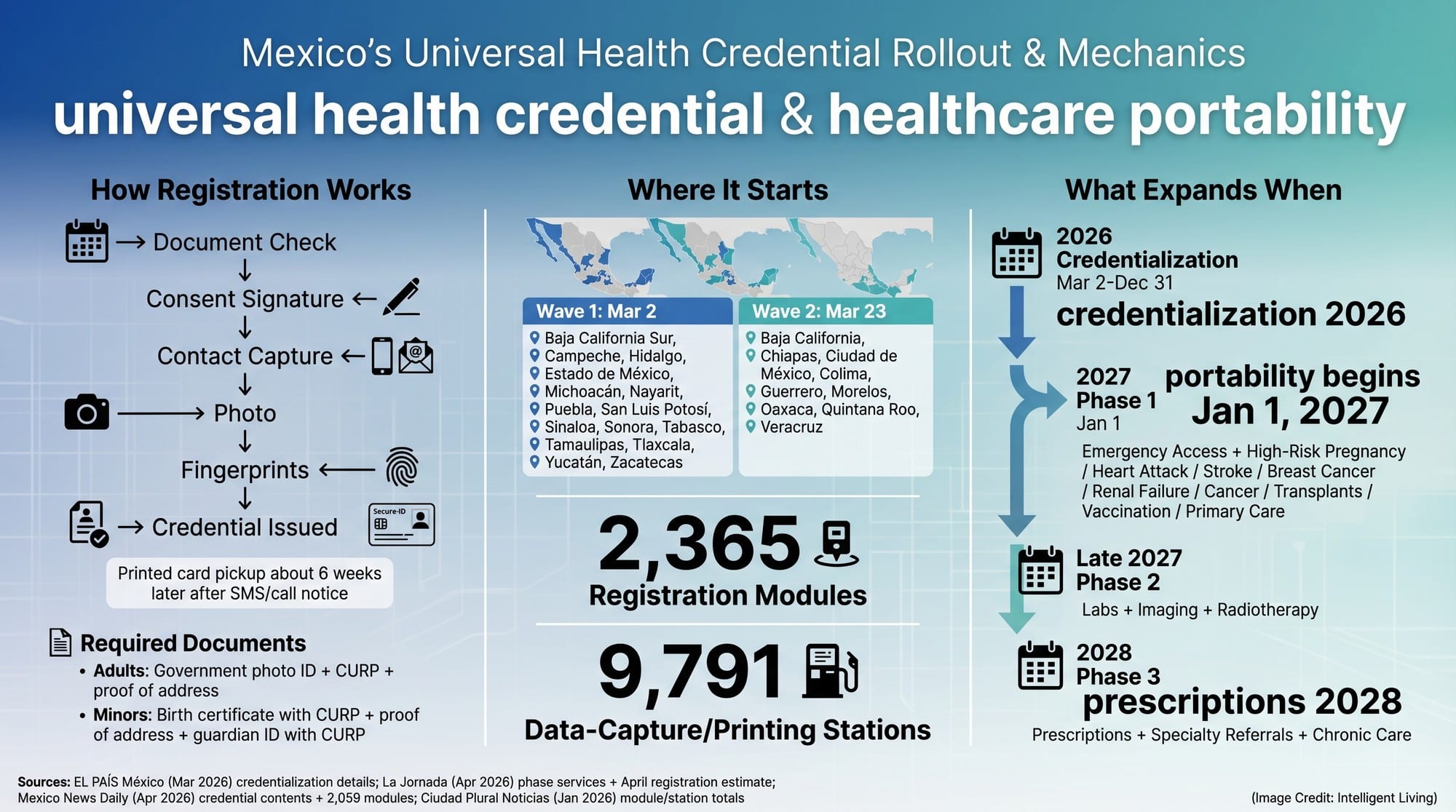
- Credentialization Window: Registration and credential issuance occur throughout 2026 as part of the official Mexico universal healthcare credentialization timeline, with enrollment staged by location.
- Phase 1 Start: January 1, 2027; limited service portability focused on urgent care, continuity for key conditions, and vaccination access.
- Phase 2: Second half of 2027; expanded shared services such as labs, imaging, and radiotherapy.
- Phase 3: 2028; Prescriptions, specialty referrals, and chronic-care continuity targeted for integration.
- Reality Check: Portability can cut “wrong-door” delays, but baseline capacity and staffing levels are the constraint most likely to shape lived outcomes.
Patients stuck in clinic lines due to paperwork mismatches stand to benefit from a reform that turns the nearest public entrance into the correct door. Success depends on whether the credential genuinely routes people to care or merely creates a different queue.
What Mexico Actually Announced (And Who it Connects)
The Portability Promise in Plain Terms
Early April 2026 marked the official decree for Mexico’s universal health service, outlining a strategy to make public care portable across major systems rather than locking patients to single institutions based on employment. Portability is the core idea: someone who normally uses IMSS because they work in the formal sector should be able to use an IMSS-Bienestar clinic when it is closer, faster, or simply the only available option. The promise is not that every clinic becomes identical overnight, but that access rules become less brittle when real life gets messy.
Who IMSS, ISSSTE, and IMSS-Bienestar are Built For
Public health provision in Mexico rests on three foundational pillars, each serving a distinct demographic through specific entitlement rules. Navigating these systems requires a clear understanding of who each institution supports:
- IMSS: The social security health system primary linked to those in formal employment.
- ISSSTE: A dedicated network focused on the healthcare needs of state employees.
- IMSS-Bienestar: The public framework designed for citizens outside formal employment, including those in rural communities.
Establishing this interoperability layer ensures that these separate lanes can finally communicate, allowing the universal health credential to route patients efficiently regardless of their primary provider.
What Changes without a Full Merger
The practical target remains the ‘wrong-door’ problem, where patients are bounced between facilities due to registration mismatches. Suburban families or border-town commuters often lose half a day of productivity simply refiling paperwork.
Similarly, for a grandparent traveling to visit family, this system can be the difference between refilling a chronic medication on time and delaying care until they return home.
Universal Health Credential Implementation: Timeline and Mechanics
Strategic Rollout Schedule: 2026 through 2028
A comprehensive phased healthcare rollout schedule establishes January 2027 as the starting point for cross-system accessibility. Operations begin with standardized services across facilities before scaling into complex administrative areas like prescriptions and specialty referrals.
2026: Universal Access Credentialization and System Infrastructure
Implementation involves nationwide enrollment modules and data stations prioritized for high-need groups through 2026. Activating these digital identifiers prepares the system to route records and referrals across institutions.
Localized accessibility serves as the primary indicator of success. Patients can easily find health credentialization modules to check operating schedules and locations within their specific municipality.
January 2027: Phase 1 Service Portability and Urgent Care Access
Initial objectives prioritize triggering valid pathways to care through rapid credential scans. Clinicians gain immediate access to essential data, removing the need to rebuild patient records during urgent consultations.
Health system planners anticipate that initial credential scans will function like a digital light switch, where some patient files appear immediately while others require manual follow-up during the system’s early testing phases. Identifying this friction helps pinpoint the technical gaps. Phase 1 must resolve before expanding into complex services.
Late 2027: Phase 2 Diagnostics and Shared Specialty Services
Phase 2 aims to connect specialty support services across networks: lab tests, imaging, and selected specialist referrals. In practical terms, this is where portability starts to touch diagnostics, the part of care that can determine whether a condition is caught early or missed.
Credential scans enable clinicians in one network to order radiographs from neighboring facilities in real time. Digital results flow seamlessly between institutions as long as both systems maintain unified identity matching and billing protocols.
2028: Phase 3 Prescription Fulfillment and Chronic Care Integration
Operational complexity increases as prescription and chronic-care plans require unified formularies and refill rules. Standardizing clinical documentation ensures patients no longer need to carry contradictory paperwork between separate health institutions.

Universal Health Credential: Interoperability Login Layer
What the Credential Is, and What it Isn’t
View the credential as a lightweight health login layer. It is not a promise to build new hospitals. It is a routing key that answers a basic question in real time: which public services can this person use, and how should their request be handled at this facility?
Every credential contains entitlement status, core identifiers, and a digital QR key for routing records. Shared identity layers provide the essential coordination needed to prevent care delays within a fragmented national system.
Records, Referrals, and the Interoperability Problem
Routing requires data plumbing: secure record lookup, identity verification, and shared rules about what each system will honor. Bridging the disparity between data claims and clinical records ensures that clinicians can trust the information retrieved during patient consultations.
Functionally, the credential serves as a national interoperability contract rather than a mere card. Achieving this requires reliable digital health infrastructure that integrates governance, workflow design, and consistent patient identity across institutions.
Governance, Privacy, and the People Who Make it Work
System reliability depends on coordinating clinical referral rules between facility directors. This synchronization ensures that triage protocols and documentation standards remain consistent across all participating networks.
In a rural waiting room, a mother watching her child’s fever climb does not care which institution owns the clinic. She cares whether the credential scan pulls up the right vaccination history fast enough to guide the next step. Efficiency gains often stem from integrated telemedicine and urgent care workflows that minimize the time between symptom onset and professional guidance.

Capacity Analysis and Global Benchmarks: Healthcare Portability Realities
Reality Check: Portability Doesn’t Magically Create Beds, Nurses, or Time
Mexico’s Capacity Baseline in Numbers
Portability fixes a user-experience problem: the “wrong-door” phenomenon that forces people to travel or wait while paperwork is checked. But it does not create clinical capacity where none exists.
Mexico operates under low per-capita health spending and limited clinical resources compared to other OECD nations. Current bed and nurse ratios per 1,000 people place a rigid ceiling on how quickly care delivery can accelerate. Analyzing health spending share of GDP series for Mexico helps frame what capacity gains are realistic without sustained financing.
Why Reform Churn Still Shapes Access
Long-term stability in entitlement rules determines whether patients and clinicians can truly rely on Mexico’s universal healthcare portability. Consistent governance ensures that families trust the system throughout its phased implementation. Evidence shows that uninsured rates in Mexico can rise sharply when institutional shifts and reform churn create unclear enrollment pathways.
When Portability Turns into Queue Shifting
If a rural hospital lacks imaging equipment, a credential will not create a radiology suite. What the credential can do is route a request to a nearby facility that does have capacity, provided that facility has spare capacity and a clear funding arrangement. Managing staffing levels and bed turnover rates remains the deciding factor in whether new access rules actually speed up patient care.
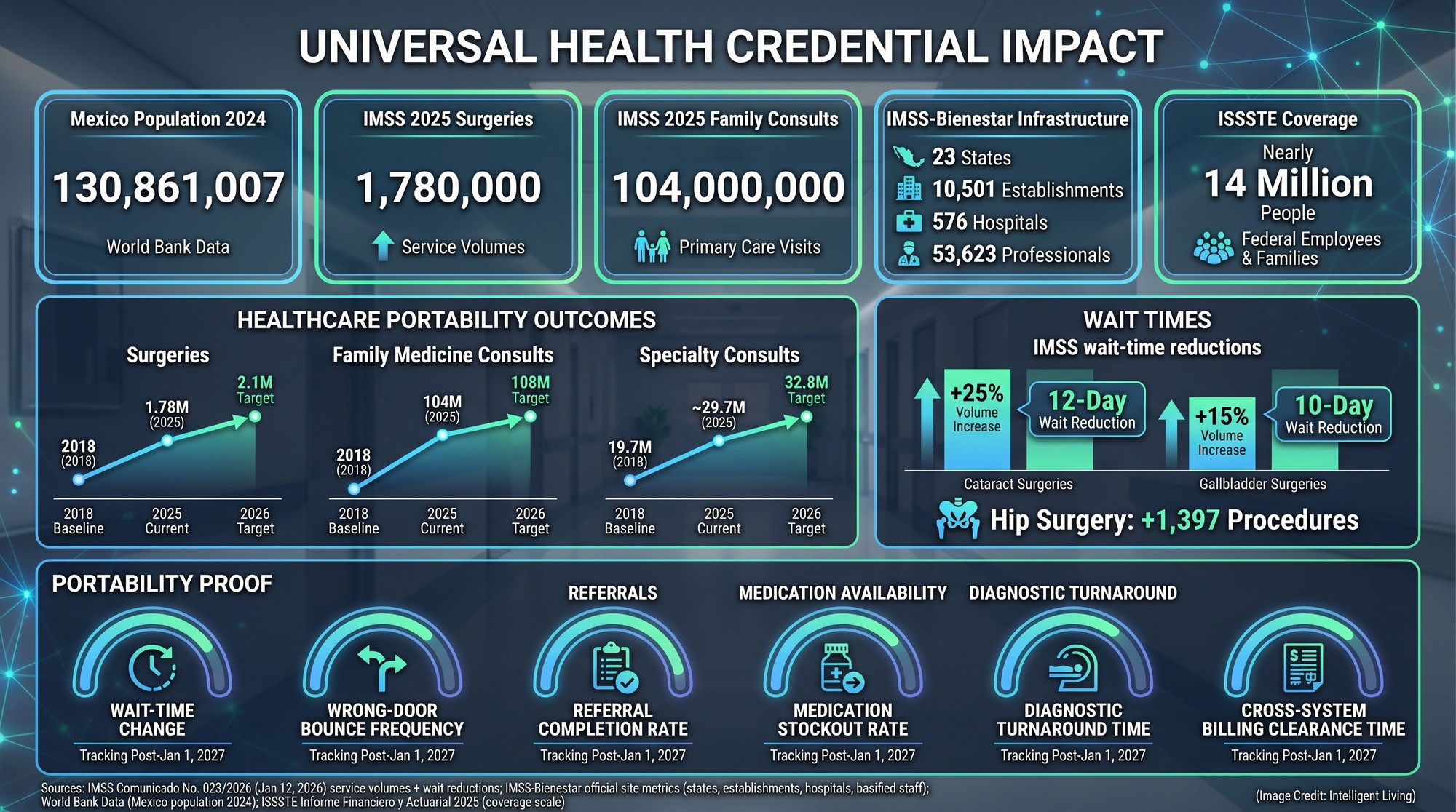
Real-world success at the clinic counter will be evidenced by shorter waits, completed referrals, and consistent medication availability.
Comparison Box: How this Differs from the NHS and Canada’s Medicare
- England (NHS): England operates a tax-funded national healthcare model that grants citizens shared rights across a single, integrated brand. NHS eligibility remains tied to residency, ensuring care feels like a single national system even when delivered through local facilities. Understanding NHS funding and entitlement structures clarifies how centralized systems standardize patient pathways.
- Canada: In North America, Canada’s provincial health administration manages public funding through interprovincial portability rules. Federal cash contributions depend on meeting the baseline health principles for medically necessary services outlined in national legislation. Many Canadians still experience separate coverage realities for prescriptions and dental care, which helps illustrate how “universal” can be narrow or broad depending on what is included.
- Mexico: The plan links distinct public networks through a credential and interoperability layer. Mapping Mexico’s parallel public coverage channels illustrates why IMSS and ISSSTE have historically functioned as separate lanes. The portability promise is that the universal health credential lets patients cross lanes without getting stranded in the median.
What This Means for Patients: Real-Life Impacts and What Comes Next
Key Benefits: Impact of the Universal Health Credential on Daily Care
- Fewer Wrong-Door Referrals: People near a clinic will be less likely to be told to go elsewhere solely because of their registration.
- Faster Emergency Access: Scanning the credential can speed triage when time matters.
- Continuity for Chronic Conditions: Patients who move cities can maintain medication routines more easily.
- Shared Specialty Capacity: Labs and imaging can be used more efficiently if neighboring networks accept routed orders.
- Simpler Vaccination Campaigns: A national identifier makes mass immunization records easier to verify in the field.
- Digital Triage and Teleconsults: Clinicians can share records for remote specialist advice, reducing travel for patients.
- Visible Metrics for Accountability: High-quality usage data generated by the credential identifies specific resource gaps, ensuring that future investments target the areas where patient need is greatest.
Rural clinic workers and school staff often coordinate vaccination histories using memory and physical paper records. Introducing a single shared record clarifies whether coverage gaps stem from outreach failures or administrative errors, providing the practical insights needed to improve local public health.
Critical Success Metrics and Future Indicators
- Interoperability Tests: Are systems actually sharing records reliably under live loads?
- Supply Signals: Medicine stock levels and imaging availability in the first six months after Phase 1.
- Wait-Time Metrics: Are patients spending less time before treatment, or are queues shifting?
- Billing Agreements: Do cross-system funding arrangements remove financial surprises for clinics?
- Transparency and Trust: Successful system uptake requires privacy-first data flow design to ensure patient consent remains predictable and secure. Maintaining trust-by-design transparency norms prevents new digital access portals from feeling like a black box to the public.

Realizing the Vision of Mexico Universal Healthcare Portability
Universal health credential integration marks a pragmatic shift toward accessible public care across institutional boundaries. Measure success through the reduction of friction at the point of care and the ability of chronic patients to maintain treatment continuity. While advanced interoperable digital health infrastructure bridges the gap between policy and practice, long-term impact requires parallel investments in clinical staffing and medical supplies.
Leveraging a modern healthcare technology stack is critical for ensuring that referral routing translates into actual clinical visits. Although the credential functions as the essential access key, the ultimate utility of the system rests on the readiness of clinicians to adopt these new digital triage and teleconsulting workflows. Ensuring that rooms are equipped and staff are trained is what will ultimately turn this digital login into a lifesaver for the millions who depend on the public health network.
Frequently Asked Questions: Navigating the Servicio Universal de Salud
How do I register for the Mexico universal health credential?
Visit a designated enrollment module at any public clinic; registration is being rolled out in phases starting with high-priority groups.
Can I use an IMSS-Bienestar clinic if I have IMSS?
Yes, the portability shift is designed to allow patients to use the nearest facility across IMSS, ISSSTE, or IMSS-Bienestar networks.
When does healthcare portability officially begin?
Phase 1 begins on January 1, 2027, focusing on urgent care, vaccinations, and basic chronic condition continuity.
Does the new health login cover prescriptions?
Full cross-system prescription fulfillment is scheduled for Phase 3, which is targeted for implementation in 2028.
Will the credential work in emergency rooms?
Yes, the universal health credential speeds up emergency triage by providing clinicians with immediate access to your eligibility and records.
Portability is a component of the WHO global standards for universal health coverage, which also prioritize financial protection. Progress is tracked through the SDG 3.8 universal health coverage framework, measuring both accessibility and affordability.


