
Algorithmic systems currently touch every corner of daily life, from suggestion engines to medical triage tools, yet public anxiety about AI remains a significant barrier to adoption. Public reactions often lean toward unease rather than curiosity because algorithm aversion triggers a defensive reflex when systems make visible errors. That unease is not random; it follows predictable psychological patterns where fear spreads quickly and lingers. Such friction feeds into a broader strain across home and work life, turning skepticism into a reflex. It’s the compounding pressure of pervasive automation that solidifies this defensive mindset.
Solutions to AI public mistrust require a shift toward AI ethics and governance that prioritizes human experience over raw efficiency. We can reduce negative reactions by deploying a three-part Control Stack: user agency and autonomy, trust-by-design, and essential AI literacy skills. Aiming for a trustworthy AI environment does not mean asking people for blind love; it means helping users engage with tools without losing control of decisions, privacy, or a sense of what is real.

Essential Insights into Algorithm Aversion and AI Public Mistrust
Current research into algorithmic behavior highlights several psychological roadblocks that prevent widespread acceptance:
- Algorithm Aversion is the tendency to reject an algorithm after seeing it make mistakes, even when it outperforms people in the same task; controlled experiments on predictive model failures show how quickly trust collapses after visible error.
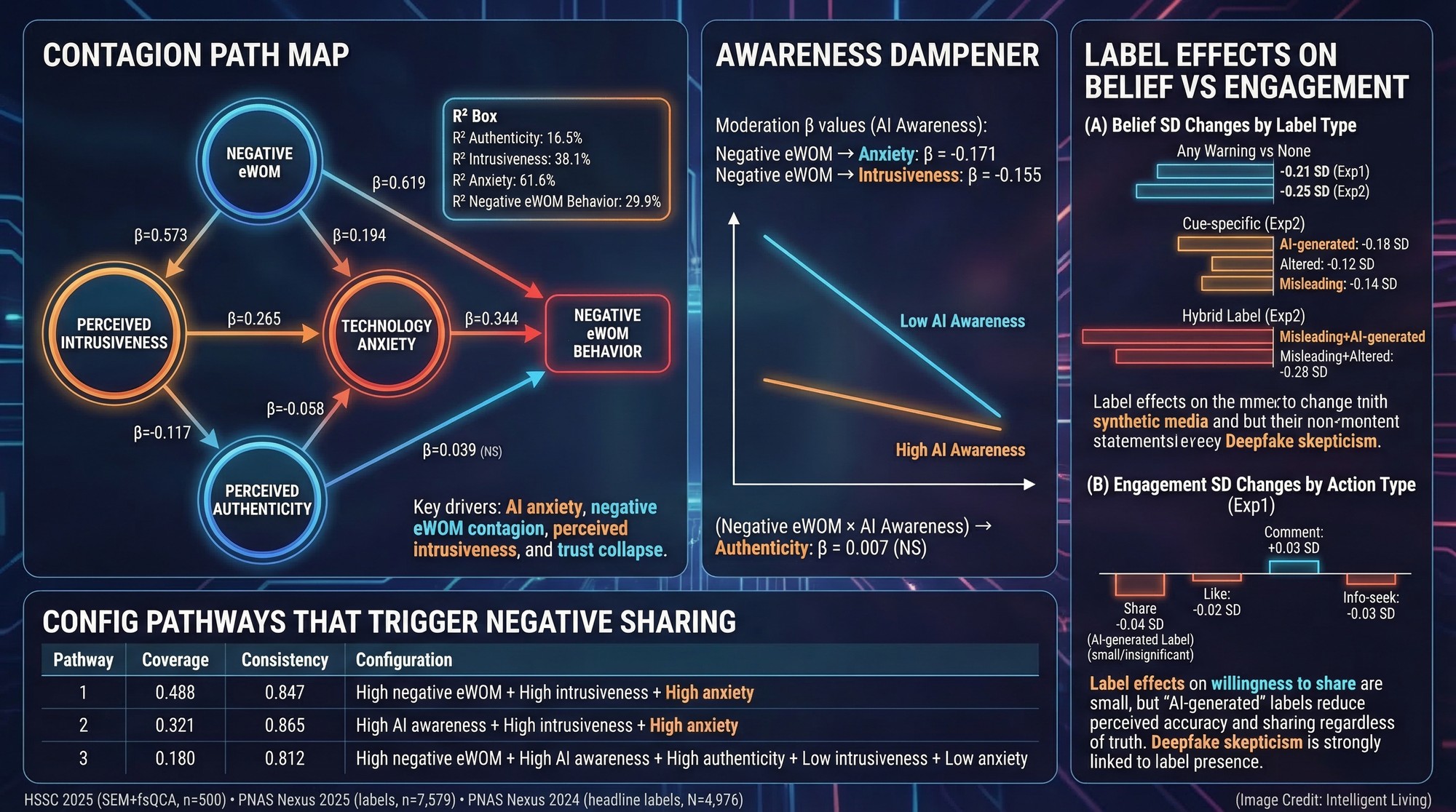
- Negative eWOM Contagion describes fear spreading through social sharing; a model exploring how synthetic media triggers social alarm links perceived intrusiveness and authenticity concerns to anxiety and onward negative sharing.
- Trustworthy AI Frameworks turn trust into engineering requirements; a practical baseline utilizes government-standard safety protocols to prioritize governance, measurement, and ongoing risk controls across the AI lifecycle.
- Label Tradeoffs matter because disclosure can reduce belief in fakes; experiments show warning labels on misleading AI images can reduce belief and sharing, while unclear labels can also trigger blanket skepticism.
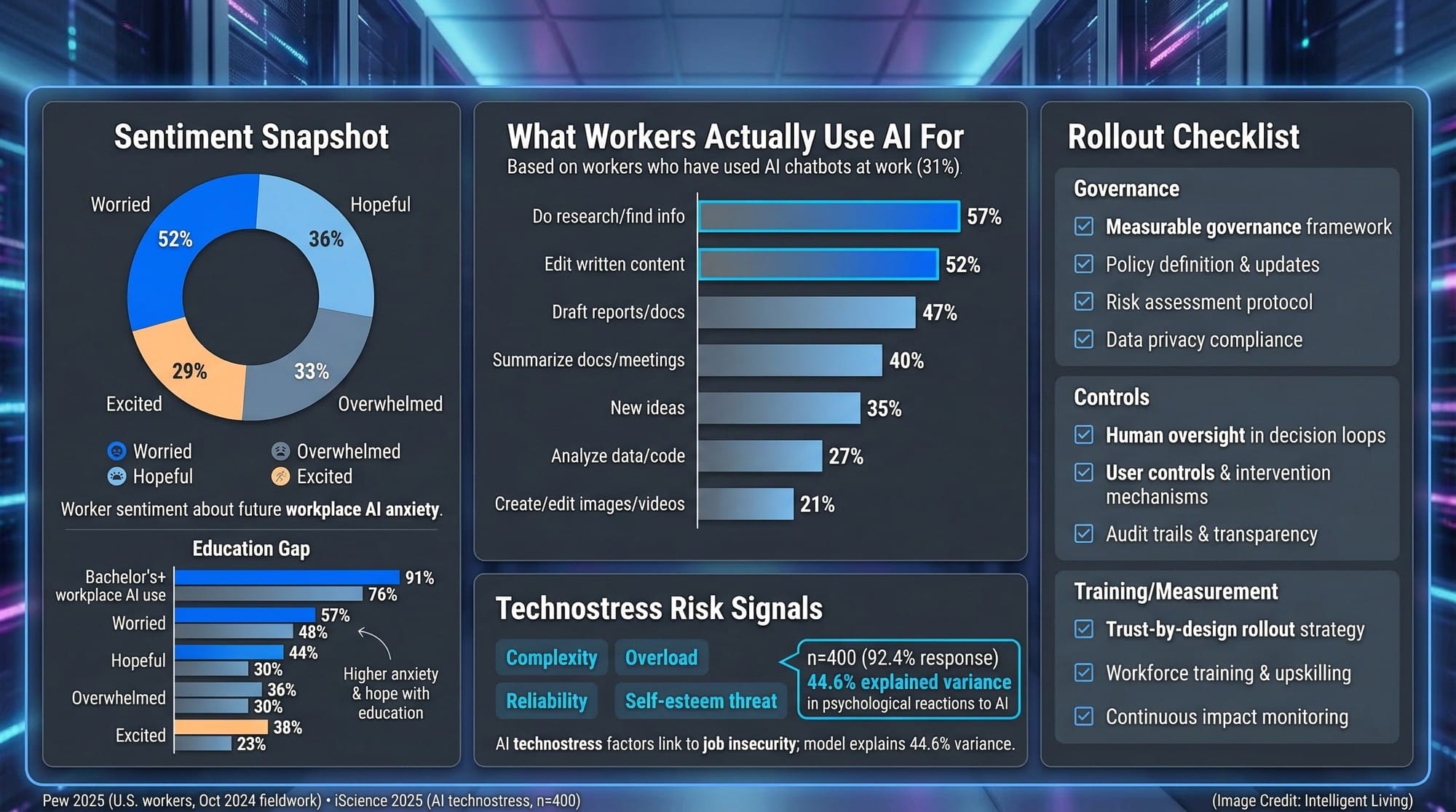
- Workplace Fears accelerate public anxiety because job insecurity shapes first impressions; surveys find U.S. workers are more worried than hopeful about AI in the workplace when it comes to opportunity, pressure, and control.
The Psychology of AI Anxiety: Why Public Mistrust Spreads Rapidly
The Contagion Engine: Negative eWOM, Intrusiveness, and Authenticity Anxiety
Societal skepticism often expands like a contagion as alarm outpaces nuance in digital environments. The face-swap and deepfake era offers a clear example: when convincing fakes circulate, people worry about authenticity and personal intrusion. Research on face-swapping anxiety suggests that negative online word of mouth can shape perceived intrusiveness and authenticity, increase anxiety, and then reinforce more negative sharing.
Observing a typical social scenario clarifies how social contagion triggers authenticity anxiety in digital spaces:
- The Initial Shock: A neighborhood group chat shares a clipped video of a local official that appears outrageous.
- The Rapid Spread: Several participants forward the clip to other groups before verifying the original context.
- The Residual Mistrust: Later, even after a factual correction, the psychological discomfort lingers.
The brain tends to prioritize the initial emotional shock over the subsequent factual footnote, cementing a false narrative.
In the synthetic media era, the most reliable mindset is not constant suspicion. It is a repeatable proof workflow built around reverse-image checks, context verification, and metadata cues; a practical synthetic media verification checklist keeps the process fast enough for real life. When provenance survives the pipeline, a content history standard like cryptographic media signing can preserve an auditable record of how media was created and edited.
Pre-Existing Biases in Forecasting Tasks and AI Interactions
Users rarely arrive as blank slates, often carrying a psychological weight of recurring worries that shape how every new tool feels. Specifically, three primary concerns tend to dominate the initial user experience:
- Workplace Displacement and Technostress: the fear that automation will cut opportunities or that learning pressure will rise without support is part of how AI and automation are redefining work at the day-to-day level.
- Authenticity Doubts: face swaps and synthetic video are no longer niche, and consumer tools that enable casual synthesis of realistic media can collapse confidence in what eyes and ears report.
- Algorithm Aversion After Error: one visible mistake by an AI can make a user discard the tool entirely, and the pattern is strong enough that evidence on reversing the rejection of automated systems treats perceived agency as the hinge.
These anxieties are connected. Job insecurity makes people more receptive to alarming social content, and authenticity doubts make personalization feel intrusive. That combination can turn mild skepticism into a reflex.
At the same time, not every decision triggers rejection. Some studies find the opposite effect, where people prefer algorithmic advice in certain estimation and forecasting contexts; evidence for increased user reliance on objective models helps explain why acceptance rises when a tool feels objective and controllable.

Deploying Responsible AI Frameworks: The Three-Part Control Stack Solution
The evidence points to a three-part solution stack that is practical, traceable, and testable. Start by restoring agency so tools feel optional and correctable. Engineer trust structurally so reliability is not just a promise. Teach essential literacy so people can verify outputs without sliding into either panic or blind faith.
In practice, this stack mirrors responsible AI governance that stays ethical and auditable by treating transparency and control as default product requirements, not as crisis responses.
A useful way to think about the Control Stack is as an upgrade path. Instead of asking for instant trust, it gives people steps that earn confidence gradually. A small example is common in daily life: a navigation app becomes trusted not because it never errs, but because it offers reroutes, shows context, and lets the user override it.

Layer 1 — Agency: Make AI Feel Optional, Adjustable, and Correctable
How Granular Controls Accelerate Algorithmic Acceptance
Prioritizing user agency and autonomy provides the most direct path toward sustainable algorithmic acceptance. When people can adjust or correct an output, the tool stops feeling like a verdict. It starts feeling like a draft. That shift matters because control restores dignity and reduces the feeling of being acted upon by opaque systems.
A typical product improvement illustrates this effect clearly. A writing assistant might allow users to select specific tones, request rationales for claims, or revert to earlier drafts. Even when the underlying model stays the same, the experience feels fairer.
A short anecdote: in a small nonprofit, staff who felt overwhelmed by an automated résumé filter became more trusting once they could flag edge cases and correct a few decisions. Accuracy did not become perfect, but the system stopped feeling like a locked door.
The Agency Toolkit: Practical Features to Build or Ask For
- Opt-Outs and Granular Controls: clear ways to turn automation off or choose the level of automation.
- Adjustable Outputs: simple toggles or sliders that let users prefer cautious or creative behavior.
- Recourse Paths: easy appeals when an automated decision affects a person.
- Human-in-the-Loop Options: human review for high-stakes outputs.
- Network-Level Control for Always-On Devices: privacy can improve when home AI devices are isolated and traffic is controlled using IoT VLAN segmentation and traffic control. This technical isolation ensures that sensitive data remains within a secure perimeter, preventing unauthorized external access.
Measuring Agency in the Wild
Fortunately, user agency is measurable. Development teams regularly test control features to track long-term retention, override frequency, and perceived fairness. Experimental evidence shows that small user edits can reduce rejection, and the mechanism is demonstrated in studies of user-influenced predictions rather than requiring full acceptance or full dismissal.

Layer 2 — Trust-By-Design: Integrating Risk Management Into AI Engineering
What Trustworthy AI Looks Like in Practice
Trustworthiness functions as a technical outcome rather than a marketing goal. Standard engineering follows the NIST AI RMF 1.0 baseline to frame safety through governance, detailed context mapping, and rigorous risk management.
Comparable guidance appears in ISO risk management guidance for AI systems, which emphasizes integrating risk work into design, deployment, and operations rather than treating safety as a one-time checklist.
A plain-language translation looks like this: define what the system is allowed to do, map where it can fail, measure those failures with real metrics, and manage the risk over time. In consumer life, this is the difference between a device that quietly changes behavior and a device that clearly states what it does, what it collects, and what happens when it is wrong.
A short, relatable example: a bank’s conversational assistant can feel trustworthy when it explains why a transaction was flagged and gives a simple path to human review, which matches how conversational AI shifts finance and banking workflows when transparency is treated as a functional requirement.
A second reality check is structural: organizations that build trust tend to treat documentation and evidence capture as operational infrastructure, and enterprise information controls built for regulatory compliance show how audit trails and evidence collection reduce friction when accountability matters.
Transparency Without Overload: The Calibration Principle
Explainability adds value only when it remains usable. Excessive technical detail often overwhelms users, inadvertently creating an impression of secrecy. The best practice is calibrated transparency: explanations that match the user’s goal and the risk level of the task.
For example, a medical triage tool should show why it suggested an outcome, what evidence it used, and where uncertainty is high, in line with WHO guidance on the ethics and governance of AI for health that governs safety. A creative writing tool may only need a short note about whether it is inventing, summarizing, or quoting.
Evidence reviews emphasize that explainability does not guarantee trust on its own. Outcomes vary by design and context, and a comprehensive analysis of clinical decision tools highlights the risk of under-trust, over-trust, and confusion when explanations are poorly matched to the user.
Labels, Watermarks, and the Transparency Dilemma
Labels and watermarks can reduce belief in manipulated content, but they also carry a risk: people can treat a label as a shortcut for judgment. When “AI-generated” is read as “fabricated,” trust can drop even for true content, and that can corrode the information environment.
Experiments show that headlines labeled as AI-generated often suffer from a lack of calibrated trust, being judged as less accurate even when true. This psychological mechanism is documented in research on skepticism triggered by AI-generated labels.
The practical takeaway is not to hide disclosure. It is to make disclosure intelligible. A label should say what the label means: whether AI assisted writing was used, whether media was altered, and whether a human verified claims. Under Article 50 transparency obligations, the EU has pushed toward machine-readable marking and disclosure through a code of practice for labeling AI-generated or manipulated content.
Trust-by-design also depends on shared norms. The OECD principles for trustworthy AI reinforce baseline expectations around transparency, robustness, and accountability.
A simple human-facing example appears in finance and operations: synthetic receipts and altered documents are easier to create than ever, and teams increasingly treat verification as a workflow step, similar to how AI-assisted fraud prevention pairs automation with human judgment.
Layer 3 — AI Literacy Skills: Reducing Anxiety Through Practical Understanding
Why Literacy is Measurable and Useful
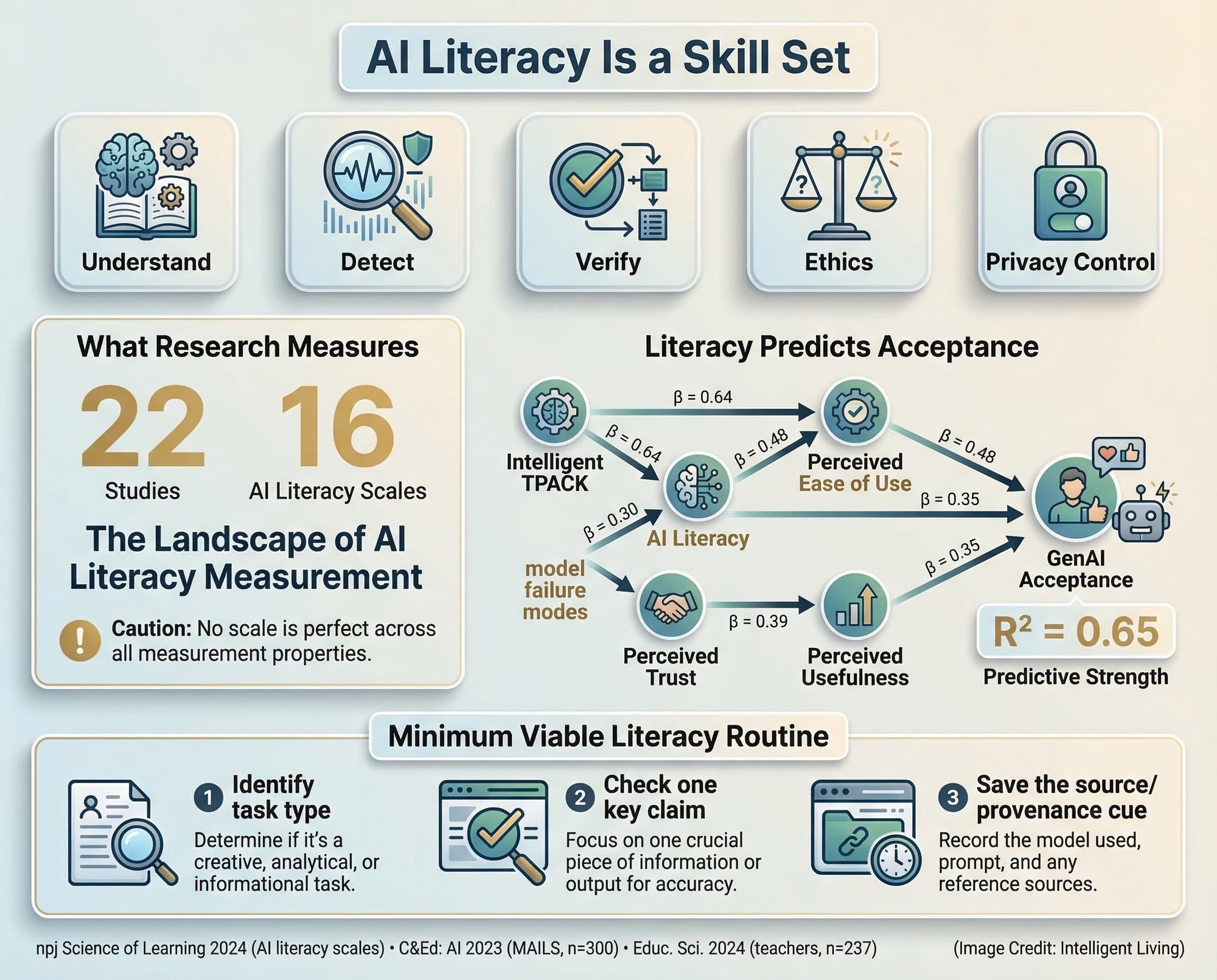
AI literacy represents a set of practical skills for predicting model behavior and verifying outputs efficiently. Building these skills lowers public anxiety by transforming technical surprises into manageable risks.
Households and classrooms usually hit a behavioral gap before a technical one. People need to know when AI is guessing, how to spot confident nonsense, and how to check a claim without spending an hour. A familiar moment captures this: a student pastes an AI answer that sounds perfect, then a teacher asks one simple question. Where did that fact come from? If the student cannot answer, the tool has not earned trust yet.
Applied education research tests these interventions, including structured checking routines and critical review patterns; one example is education research on AI literacy and learning outcomes.
The Minimum Viable Literacy Checklist
- Understand the Task: know whether the AI is being used for objective analysis or subjective recommendations.
- Know Common Failure Modes: hallucinations, biased outputs, and overconfident language.
- Use One Verification habit: cross-check one key claim against a primary source or a trusted database.
- Control Data Sharing: review and adjust privacy or personalization settings.
A brief anecdote: a class that runs a weekly verification challenge often sees skepticism become a habit. Students stop sharing first impressions and start asking for provenance in the same way they ask for a receipt.
A Simple Three-Session Literacy Plan
- Session 1: What AI Does and Where It Fails: clarify what models generate, why hallucinations happen, and why a confident tone is not evidence.
- Session 2: Verification and Provenance: teach one reliable workflow for checking sources and identifying manipulation.
- Session 3: Privacy and Control Settings: explain what data gets collected, how personalization works, and what local-first options exist.
For families and schools, this coaching approach is increasingly common as classrooms treat adults as AI coaches. For adults who want skills that translate directly to employability, the same mindset shows up in data science learning paths shaped by AI tools, where verification discipline and model understanding become part of career resilience.
In everyday use, one practical literacy lever is input discipline. Clear constraints reduce hallucination risk and make outputs easier to verify, a pattern reinforced by prompt clarity habits that reduce hallucination risk.

Actionable Implementation Strategies for Building Trustworthy AI Habits
For Individuals: Five Simple Steps
Individual users can regain autonomy by adopting a structured checking routine. Try these five simple steps this week:
- Start Small: Pick a low-risk task such as drafting an email subject or summarizing an article.
- Toggle Control: Use any available setting to reduce automation and observe how outputs change.
- Verify One Claim: Check one factual statement against a trusted source.
- Keep a Short Log: Note when the AI helps or hinders to build pattern awareness.
- Escalate for High Stakes: For legal, medical, or financial matters, always require human review.
Following these habits consistently turns a passive user into an active supervisor of algorithmic outputs.
Everyday interactions provide opportunities to sharpen verification discipline. A user might draft a complaint email using AI, only to notice an invented policy reference. Logging and correcting that single error builds a habit that prevents more significant failures later.
One fast shortcut for search-like tasks is to treat prompts like queries and require the model to cite where claims come from, a habit that fits the real-time prompt patterns for search-like AI use.
One More Practical Habit: timebox evaluation. After two weeks of using a tool for one chosen task, review the log and measure whether it saved time, reduced effort, or introduced errors. Evidence-based adoption reduces anecdote-driven rejection.
For Educators and Parents: A Simple Coaching Pattern
Coaching the next generation requires a shift toward critical inquiry. Educators and parents should teach these three micro-habits in short, focused sessions:
- Questioning: Ask one clarifying question before accepting an AI output as truth.
- Provenance: Check the origin or source of at least one claim during each session.
- Toggling: Practice using one control toggle to see how model behavior shifts.
These habits build foundational confidence without inducing unnecessary paranoia or fear.
Prebunking is an effective mental model here. A short exercise where students learn how manipulation works can reduce susceptibility to later misinformation, a concept that matches how interactive digital literacy training reduces susceptibility to later misinformation.
For Workplaces and Product Teams: A Ten-Point Rollout Checklist
- Map Use Cases by risk and impact.
- Deploy Human Oversight for higher-risk decisions.
- Add Adjustable Settings so users can choose automation levels.
- Define Recourse so people can appeal automated outcomes.
- Train Staff on Verification Habits rather than only tool features.
- Monitor Technostress with short pulse surveys and workload metrics.
- Field-Test Labels and Disclosures with real users before rollouts.
- Measure Trust Over Time using surveys plus behavioral signals such as overrides and appeals.
- Publish Governance Summaries tied to measurable controls.
- Update and Iterate in short cycles based on evidence.
Workplace anxiety is more than just a temporary mood. Organizational research links rapid adoption and workload pressure to technostress and job insecurity. An empirical study of technostress and job insecurity in AI-driven work settings helps explain exactly why rollout design matters.
In many offices, teams accept a drafting assistant faster when it is framed as a collaborator and paired with training, a dynamic consistent with discussions about 40 jobs AI can’t replace microsoft ai.

Limits, Equity, and Next Steps
What this Won’t Fix (And What Still Matters)
Some distrust is rational, especially when AI affects high-stakes decisions. The Control Stack is not a replacement for strong governance, regulation, or independent oversight. For domains such as criminal justice, healthcare, or critical infrastructure, rigorous audits, legal protections, and enforceable accountability remain essential.
Social inequality also shapes who benefits from AI and who is harmed. Without deliberate inclusion and remediation, systems can amplify existing harms and deepen skepticism among underrepresented communities.
Consequently, building trust requires structural safeguards. Practical steps include independent audits, community-facing appeal channels, and transparent reporting of known limitations to ensure equitable outcomes.
Ethical guidance frameworks reinforce this broader responsibility. The international consensus on ethical oversight makes clear that accountability is not an optional feature.
Trust systems also need operational discipline. When organizations treat governance as a continuous practice rather than a compliance checkbox, public-facing credibility tends to improve, a logic that overlaps with advanced corporate safety strategies where credibility improves through measurable practice.
Resolving Public Mistrust in AI Models
Solving public mistrust is a human challenge requiring a fusion of engineering, policy, and educational fixes rather than an abstract technical problem. Successful responsible AI governance depends on this integration.
Regaining control remains rooted in a simple choice: pick one tool, activate a single control toggle, and adopt one verification habit to verify synthetic media authenticity. Trust stabilizes when AI transparency is earned through small, repeatable checks rather than through marketing hype. Ask yourself, ‘Is there a way to control AI privacy?’—and then use the settings available to make it happen.

Frequently Asked Questions About AI Trust and Safety
Why do I feel uneasy about using AI?
Unease often stems from algorithm aversion, job security fears, and the rapid spread of negative social contagion. These factors combine to create a protective barrier against unfamiliar technical shifts.
How to spot AI-generated content?
Spotting AI-generated content requires identifying synthetic media authenticity cues like unusual textures or mismatched metadata, often paired with a repeatable verification checklist.
What is trust-by-design in AI?
Trust-by-design is an engineering approach where transparency and safety are built directly into the software as functional requirements.
Can AI replace my job in the future?
AI is more likely to redefine roles through automation and augmentation; building supervisory skills is the best path to career resilience.
Is there a way to control AI privacy?
Yes, most platforms offer user agency through granular opt-outs, VLAN segmentation for devices, and adjustable data-sharing settings.


