
Global energy systems already rely on sustainable fuels, but the technical complexities of the 2026 transition demand immediate stakeholder attention. While some Sustainable Aviation Fuel (SAF) and Renewable Diesel appear as invisible background blends at the pump, significant volume is concentrating in dedicated fleet depots where long-term procurement contracts are secured. In the aviation sector, a distinct lane is forming as strict mandates and CORSIA-eligible fuel standards pull demand forward, often outpacing the current scalability of industrial production.
Comprehensive 2026 guide maps market reach, from E15 gasoline blends to high-performance e-Fuels. Identifying specific signals within 2025 to early‐2026 milestones indicates a shift from localized pilots toward repeatable, bankable production models like Ethanol-to-Jet (ETJ) and Hydrotreated Vegetable Oil (HVO).
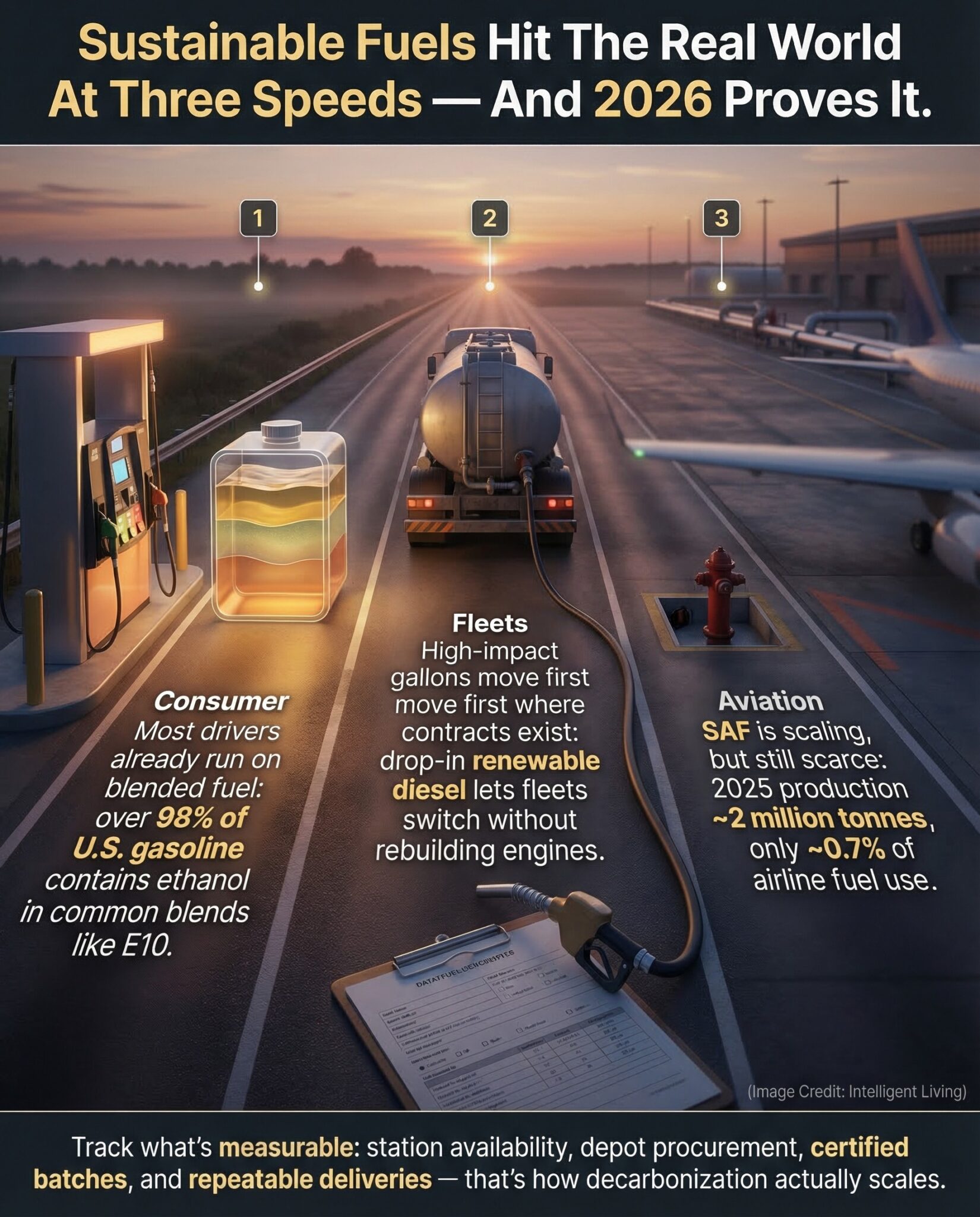
2026 Industry Snapshot: Key Data on SAF, Renewable Diesel, and Ethanol Blends
Deciphering the alternative fuel landscape depends on distinguishing between physical market availability and ongoing development cycles. The 2026 snapshot reveals a market dominated by background blending, where consumer accessibility depends heavily on regional infrastructure and federal policy.
- Most U.S. drivers already use ethanol blends; in the U.S., ethanol usage in gasoline accounts for more than 98% of the market in common blends such as E10.
- Distinct “choose it on purpose” options are less common; nationwide station data show the footprint of alternative fuel stations offering E85, renewable diesel, and biodiesel is far smaller than conventional gasoline coverage.
- Aviation is still early in the transition; global SAF production reached roughly 2 Mt in 2025, which represents only 0.7% of airline fuel use.
- The SAF Grand Challenge aims for 3 billion gallons per year by 2030 and 35 billion by 2050.
Industrial scalability remains the primary hurdle between current output and ambitious 2030 decarbonization targets. Strategic investment in production capacity remains the primary lever for moving these fuels from background components to primary energy sources.
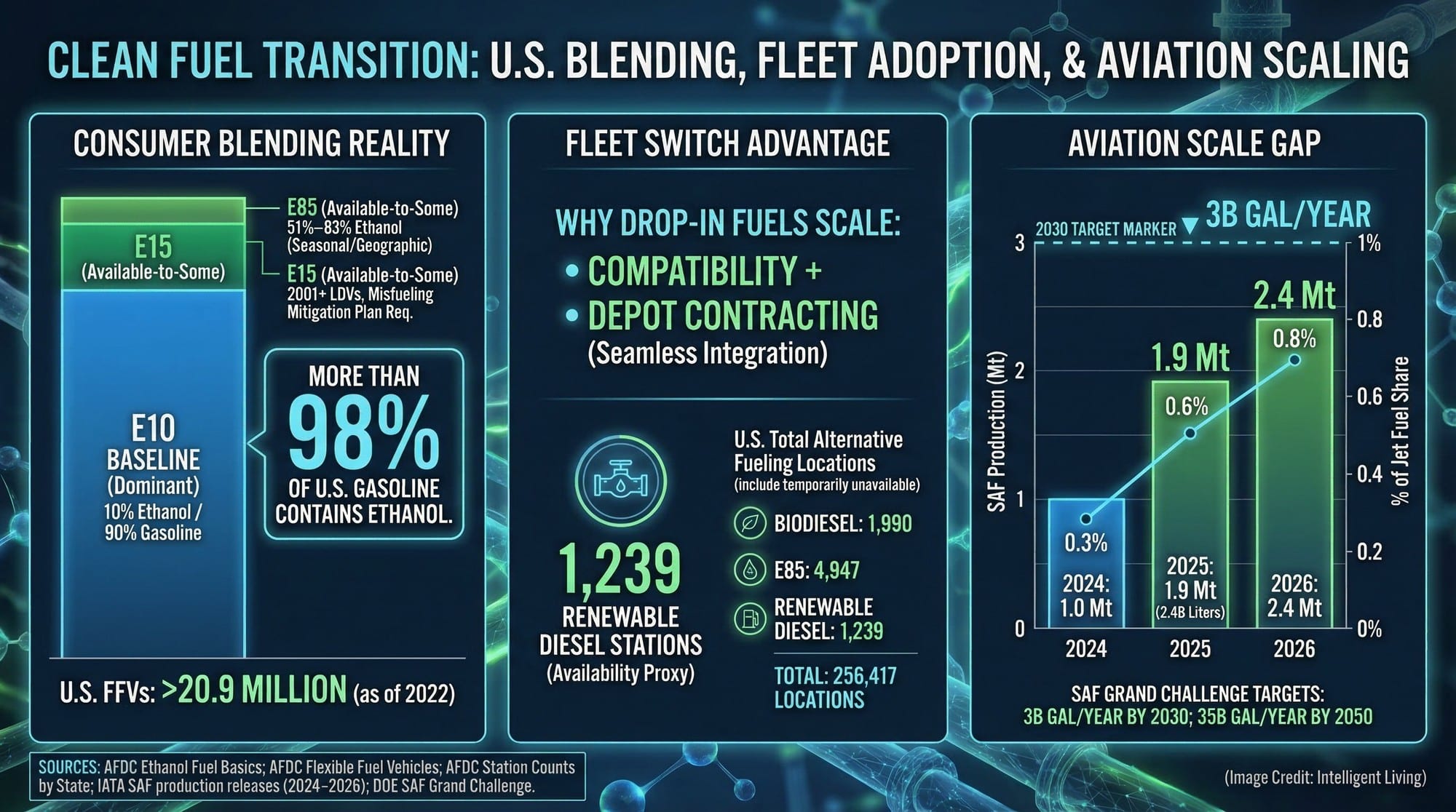
Decarbonization Dynamics: Analyzing the Three-Speed Transition for Sustainable Fuels
Sustainable fuel adoption accelerates at three distinct speeds, as each sector navigates unique logistical and regulatory constraints. Market forces, infrastructure availability, and regulatory pressures dictate the pace of adoption across different transportation domains.
- Consumers: U.S. gasoline supplies already integrate biofuel components through standard background blending, ensuring drivers utilize these fuels without equipment changes or new vehicles. While distribution remains broad, the sustainability narrative often stays invisible at the retail pump.
- Fleets: Centralized operations simplify supply contracts and documentation verification, allowing managers to adopt high-impact alternatives like Renewable Diesel (HVO) when supply is stable and performance consistency can be maintained across expansive vehicle fleets.
- Aviation: Certification, safety, and energy density constraints explain the gap between rapid paper-based supply growth and the actual, minimal market share for SAF currently represented in the sector.
Sector-specific landscapes remain distinct even as newer aircraft platforms are being designed around higher sustainable-fuel compatibility targets and are engineered for higher sustainable-fuel compatibility targets.
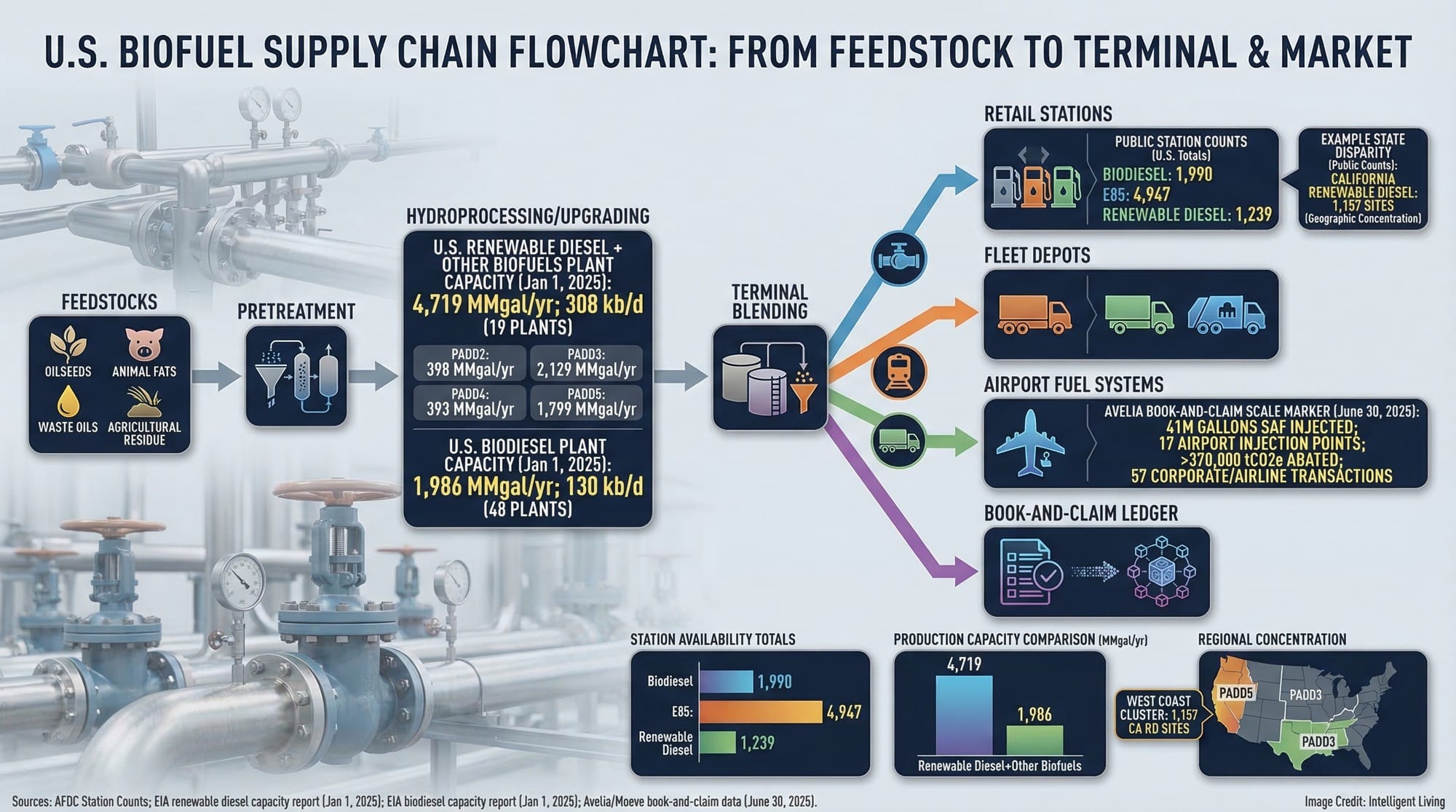
Integrated Distribution Networks: Bridging the Gap Between Consumer Retail and Commercial Fleet Deployment
Consumer Pumps: The “Invisible Sustainable Fuel” You Already Buy
Drivers already utilize fuel containing a biofuel component. In the United States, the common gasoline blend is E10, which mixes 10% ethanol into conventional gasoline. While ethanol became widespread as an oxygenate and octane booster, its sustainability profile varies. Real-world outcomes depend heavily on production methods, land-use choices, and agricultural inputs.
High-blend options like E85 remain accessible to a limited driver segment equipped with flexible-fuel vehicles built to handle ethanol blends up to 83%. Real‐world bottlenecks persist even when E85 infrastructure is present; for instance, a Midwestern family with a flex-fuel vehicle might still rely on standard gasoline if the nearest high-blend pump sits outside their daily routine.
E15 Market Penetration: Navigating Seasonal Volatility and Policy Shifts
E15 blends incorporate 15% ethanol to strategically lower petroleum consumption per gallon. Historically, E15 access has faced constraints due to summer volatility rules tied to smog-related chemistry limits.
Federal directives in 2025 saw the EPA use emergency authority to support expanded E15 availability during peak summer months, which matters because seasonal rules can determine whether a local station sells the fuel at all.
Retail Infrastructure Analysis: Mapping Station Counts for Alternative Fuels
Station counts help readers separate nationwide headlines from neighborhood reality. The AFDC locator is powered by a structured dataset that defines biodiesel listings as B20 and above and renewable diesel listings as R20 and above, which prevents low‐blend background use from being mistaken for dedicated fueling access. Standardized station definitions separate high-blend access from background blending, making the map more useful for people trying to understand what can actually be purchased.
Consumer choice usually centers on what a station offers and what a vehicle can accept, rather than theoretical fuel existence.
Commercial Fleet Logistics: Scaling High-Impact Decarbonization Pathways
Fleets such as transit agencies, waste collection operators, and freight carriers fuel from centralized depots. Centralized operations simplify supply contracts, documentation verification, and performance consistency across expansive vehicle fleets.
Operational barriers drop when alternatives perform like conventional diesel. Early adoption clusters in regions where low-carbon fuel standards (LCFS) incentivize lower-carbon pathways, creating stark geographic disparities in fleet transition speeds. For transit maintenance leads, reliability outweighs branding. When alternative fuels ensure smooth morning starts and on-time routes, the transition shifts from an abstract climate goal to a tangible operational victory.
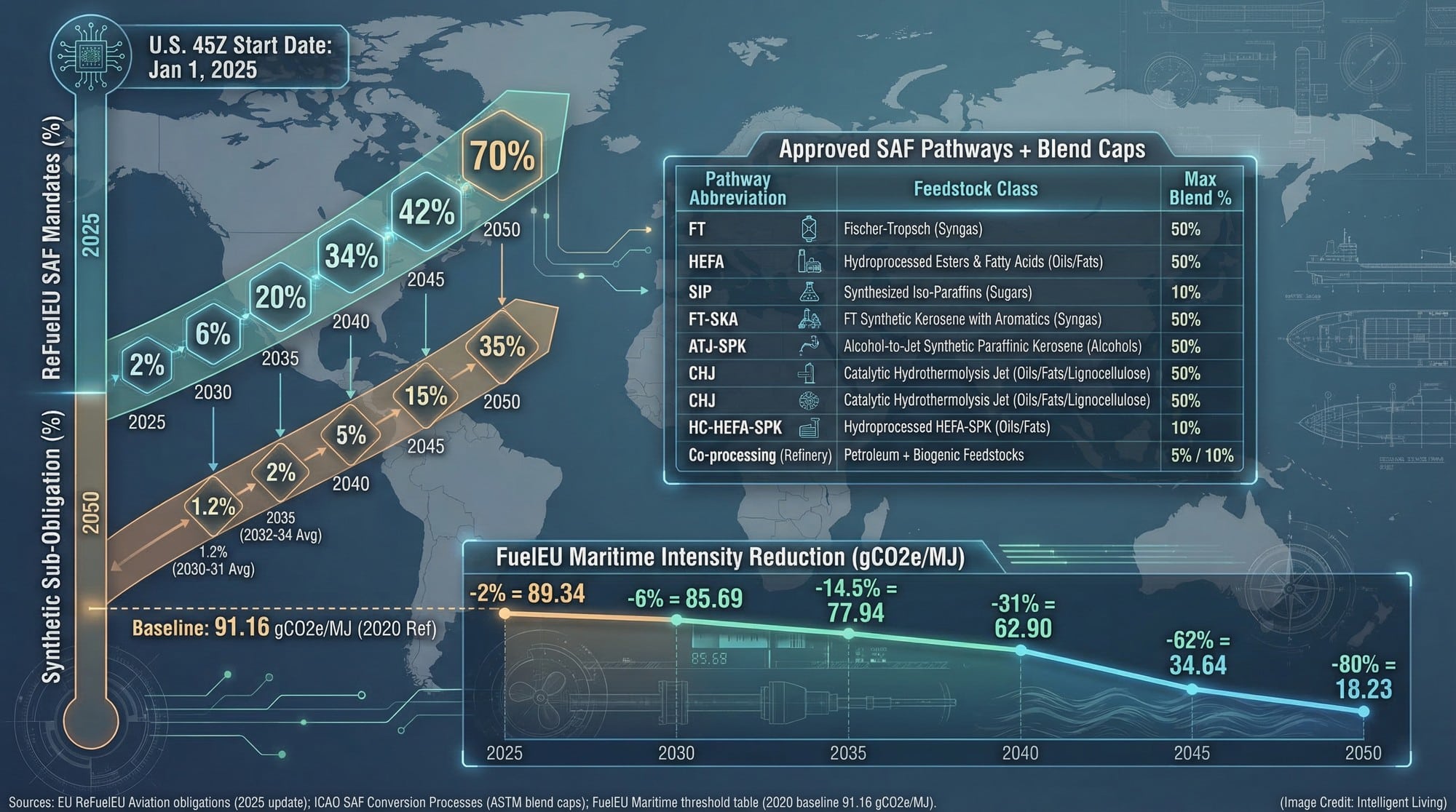
Global Infrastructure and Compliance: Scaling SAF and Renewable Diesel Through Technical and Policy Optimization
HVO vs. FAME: Technical Differentiators Between Renewable Diesel and Biodiesel
Renewable Diesel (HVO) provides a chemically analogous alternative to petroleum, allowing for immediate drop-in use in existing engine architecture. Seamless technical compatibility allows renewable diesel to move into fleet operations without the infrastructure overhaul that many alternative fuels still require, which is central to renewable diesel production standards.
Chemistry determines storage, blending, and engine performance, forcing fuel strategies to prioritize compatibility over accounting. Analysis of fuel chemistry differences indicates that renewable diesel and biodiesel behave differently in storage, blending, and engine use.
Feedstock provenance and land-use risk dictate lifecycle outcomes, making traceability a practical requirement for buyers. Lifecycle emissions analysis for HVO focuses on whether hydrotreated vegetable oil really lowers emissions, depending on feedstocks, traceability, and land-use risk as a core question for fleet buyers regarding feedstock traceability.
Supply Chain Optimization: Regional Procurement Realities for Low-Carbon Fuels
Supply is not uniform. Early adoption clusters in regions where low-carbon fuel standards (LCFS) incentivize lower-carbon pathways, creating stark geographic disparities in fleet transition speeds.
Modern fleet procurement centers on auditable evidence of carbon intensity and chain-of-custody documentation. Buyers tend to ask for three things: carbon intensity documentation, chain‐of‐custody clarity, and performance specs that match duty cycle needs. Without that, claimed emissions reductions may not hold up under lifecycle accounting.
Aviation Decarbonization: Scaling SAF Amid Scarcity and Regulatory Mandates
Sustainable Aviation Fuel is a category, not a single product. The most common commercial SAF today has come from HEFA pathways using waste oils and fats, while newer routes such as alcohol-to-jet and power-to-liquids expand potential feedstock and geography.
Aviation fuel standards are strict, and approved SAF pathways and their blending limits define which production routes qualify.
Aviation is constrained by certification, safety, and energy density. Certification, safety, and energy density constraints explain the gap between rapid paper-based supply growth and the actual, minimal market share for SAF currently represented in the market. Sustainable fuel pledges frequently encounter fulfillment gaps, as demand for physically verified supply continues to outpace production.
Policy Accelerants: Evaluating Mandates and Incentives for Fuel Production
Strategic policy frameworks mitigate buyer uncertainty and facilitate project financing for new production facilities.
- In the EU, ReFuelEU mandates for a minimum 2% SAF blend starting in 2025 shape how suppliers and airlines plan fuel procurement.
- In the U.S., the Clean Fuel Production Credit became available beginning January 1, 2025, giving producers a more concrete incentive framework.
Policy-driven market eligibility mitigates buyer uncertainty and stabilizes plant financing. While these frameworks shift investor risk math, they do not resolve global supply constraints overnight.
Terminal Logistics: The Physical Infrastructure of Sustainable Aviation Fuel
Even when fuel is certified, it still has to reach the right tanks. SAF often moves through refineries and terminals and is blended to meet specifications.
Airport fuel networks can handle sustainable fuel without rebuilding everything from scratch. Renewable jet fuel distribution via multi-product pipelines demonstrates that existing infrastructure can accelerate adoption once certified supply arrives.

Industrial Milestones: 2025-2026 Proof Points for Synthetic Fuel Scalability
Operational plants, signed offtake agreements, and maturing price benchmarks signal the industrialization of the sustainable fuel market. These twelve proof points demonstrate the shift from pilot projects toward repeatable, large-scale production in 2026.
Captured CO2 is becoming a feedstock for synthetic fuels, explaining why carbon molecules anchor modern energy strategies. Similarly, turning CO2 into liquid fuel molecules utilizes existing storage tanks and pipelines. Green ammonia and e-fuels are being positioned for heavy industry and transport because they store renewable energy effectively.
- Commercial Ethanol‐to‐Jet Production: Alcohol-to-jet is expanding beyond pilots, and the opening of the first commercial ethanol-to-jet plant matters because it opens a new SAF pathway beyond waste oils and fats.
- Refinery‐Scale Renewable Diesel and Neat SAF Capability: Industrial renewable feedstock processing and SAF capability are now being built into existing refining footprints, including Rodeo’s renewable diesel and SAF operations, which demonstrates how legacy refining assets are being repurposed for lower-carbon fuel production.
- DOE Loan Program Finance as a Scale Lever: Project finance and loan-backed expansion have become a visible scale tool, and federal financing for Montana fuel expansions designed to scale SAF output shows how policy support moves projects from expansion plans into large-scale construction.
- Signed Delivery Volumes That Turn Plans Into Supply: Multi-year SAF delivery agreements involving tens of millions of gallons provide the kind of contract language lenders and procurement teams can actually use.
- Power‐to‐Liquids Plants Moving Into Operation: Industrial e-fuel production of up to 2,500 tonnes per year represents a meaningful industrial proof point for a pathway that once lived only in demonstrations.
- Commercial e‐Methanol Reaching Offtakers: The inauguration of a 42,000-tonne e‐methanol facility now supplying industrial offtakers shows that synthetic fuel demand is no longer limited to aviation.
- Book‐and‐Claim Scaling as Market Infrastructure: Digital SAF injection records for over 41 million gallons show how market plumbing can move faster than physical airport-by-airport supply.
- Price Discovery for eSAF: Contracting becomes less speculative when reference pricing exists, such as the launch of electrolytic eSAF pricing indexes, which gives buyers and lenders a clearer benchmark for negotiations.
- eSAF Projects Under Construction With Defined Output: Concrete construction milestones matter more than vague roadmaps. The eFuels facility under construction in Texas proves the technical viability of Fischer-Tropsch fuel synthesis at scale.
- Policy Certification Pathways for e‐Fuels: Market eligibility can unlock financing, such as a U.S. approval for an e‐fuels design pathway for e‐fuels described in industry reporting.
- Shipping Regulation Clocks Starting in 2025: Compliance pressure is a quiet accelerant, and FuelEU Maritime compliance beginning January 1, 2025 shows how maritime demand is accelerating.
- Industrial‐Scale Context for Synthetic Fuels: Bankable synthetic fuels move from scattered breakthroughs toward global scaling. Plant operations and signed offtake agreements turn emerging technologies into stable markets.
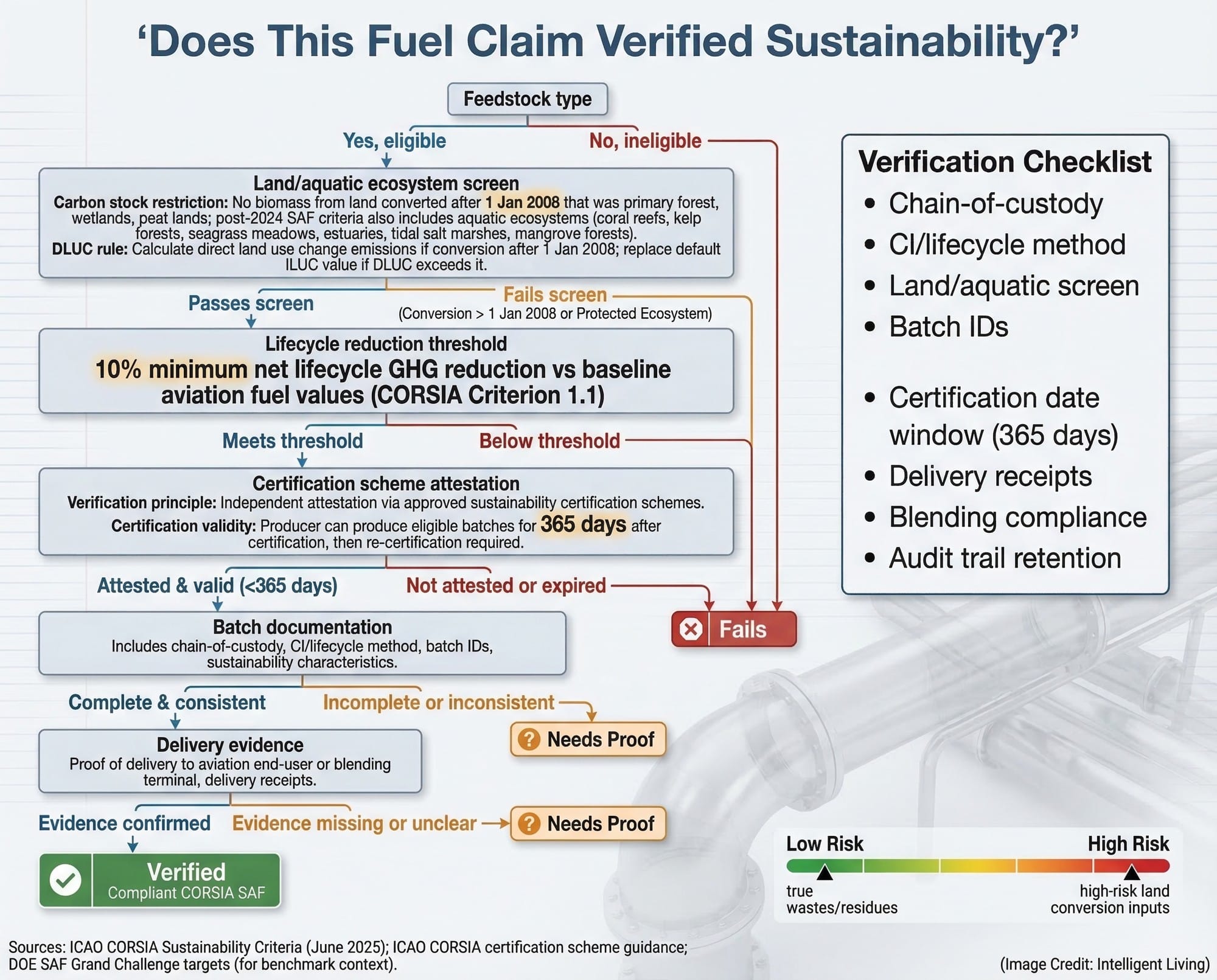
Compliance and Market Integrity: A 2026 Guide to Sustainable Fuel Verification
Lifecycle Integrity: Establishing Standards for Sustainable Fuel Veracity
Authentic sustainability begins at the source; fuels derived from waste residues offer superior lifecycle decarbonization compared to pathways involving land-use conversion or virgin oils.
CORSIA lifecycle rules for aviation fuels set eligibility standards for reductions and restrict minimum lifecycle rules for CORSIA-eligible aviation fuels biomass sourcing from certain high-carbon-stock lands.
Land-use risk is not theoretical. Some governments have already adopted Norway’s palm‐oil biofuel ban in certain European regions, illustrating how policy reacts to land‐use risk.
Auditable Supply Chains: Certification and Chain-of-Custody Protocols
Not all verification systems are equally strict. Certification and chain‐of‐custody systems document feedstock origin, processing methods, and lifecycle scoring, and they are increasingly central to whether airlines and corporate buyers can claim emissions reductions.
The CORSIA eligibility framework shows why audit trails now shape credible buyer claims and reflects the CORSIA framework for eligible fuels, verification, and lifecycle accounting.
Strategic Insights: Key Indicators for the 2026 Sustainable Fuel Market
The clearest sign the transition is real is repeated deliveries that match contract claims. Watch for multi‐year offtakes, terminal injection records, and consistent production, because those are the building blocks for credible emissions accounting.
The true turning point for procurement officers occurs when suppliers move beyond broad claims to provide batch-level documentation, rendering it usable in audited reporting.
- Geographic availability: Concentration remains in specific regional pockets across consumer pumps, fleet depots, and airports.
- Household verification: Compatibility check for high-level ethanol blends is required before use, as local supply constraints vary significantly.
- Small business tracking: Utilization of logs and batch data justifies premiums for verified fuels and secures long-term, bankable supply contracts.
- Fleet procurement: Success depends on rigorous traceability and matching fuel specifications to specific duty cycles.
The threshold becomes easier to picture once audited SAF certification batches begin moving through the system, connecting traceability to physical volumes and reflecting certified SAF batches moving through audited accounting systems.
Markets scale faster when buyers can benchmark offers and lenders can underwrite projects with clear assumptions. Price indexes, standardized lifecycle methodologies, and well-to-wheels (WTW) analysis reduce uncertainty and shorten the path from concept to construction.

The 2026 Outlook for Sustainable Aviation Fuel (SAF) and Renewable Diesel Scalability
Sustainable fuels are already in the system, but the 2026 story is about where verified gallons actually land: blended gasoline, depot fueling contracts, certified SAF supply chains that can scale, and the hydrogen infrastructure behind green industrial fuel corridors that connect clean molecules to industrial demand hubs.
The most immediate decarbonization victories in 2026 stem from centralized fuel users leveraging verified Renewable Diesel and Sustainable Aviation Fuel (SAF) supplies. As regional supply clusters stabilize around low-carbon fuel standards, transit fleets can adopt drop-in HVO pathways with minimal infrastructure friction. Simultaneously, airports are integrating eSAF into existing logistical terminals, proving that certified molecules can move through the ‘plumbing’ of the real world once CI scoring and feedstock provenance are clearly documented.
Seasonal E15 availability and background blending define the consumer experience, while multi-year offtake agreements drive the industrial scale-up. Moving forward, the credibility of any energy transition story will depend on transparent lifecycle accounting and batch-level documentation. Verified deliveries rather than announcements ensure procurement teams and travelers alike that their support for synthetic fuels drives genuine, measurable emissions reductions.
2026 Guide to Sustainable Fuels: Common Questions on SAF and Renewable Diesel
Can I buy SAF at an airport like normal jet fuel?
No. Sustainable Aviation Fuel (SAF) is usually distributed via terminals through long-term corporate agreements or book-and-claim accounting rather than retail pumps.
Is renewable diesel the same as biodiesel?
No. Renewable Diesel (HVO) is a drop-in hydrocarbon identical to petroleum diesel, whereas biodiesel is an ester fuel requiring specific blending limits.
Are e-fuels commercially available now?
Yes, in growing industrial volumes. Synthetic fuels like e-Methanol and e-SAF are reaching off-takers as new Power-to-Liquids (PtL) plants enter operation.
How can fleet managers verify sustainability claims?
Managers should require batch-level documentation, lifecycle CI scoring, and contract language that specifies feedstock provenance and auditability.
What should travelers look for to support SAF without greenwashing?
Prioritize programs using CORSIA-eligible fuels and audited accounting systems that provide clear aviation sustainability certification guidance rather than generic marketing.


