
Bad News
The University of Cambridge researchers helped launch a browser game called Bad News back in February of 2018 as part of a study. It is an online game in which people play the role of propaganda producers to help them identify real-world disinformation. Little did the people playing know, they were actually receiving a “vaccine” against false propaganda! The research has been published in the journal Palgrave Communications.
Jon Roozenbeek, the study co-author, said:
“We are shifting the target from ideas to tactics. By doing this, we are hoping to create what you might call a general ‘vaccine’ against fake news, rather than trying to counter each specific conspiracy or falsehood.”
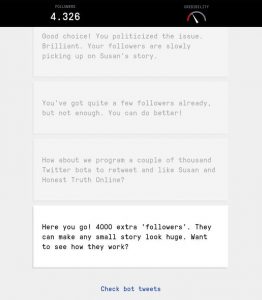
What does that mean? Well, by playing the game, the person received a dose of the tactics reporters use to manipulate viewers which increased their resistance to fake news. How? Players stoke anger and fear by manipulating news and social media within the simulation: deploying Twitter bots, photoshopping evidence, and inciting conspiracy theories to attract followers — all while maintaining a “credibility score” for persuasiveness.
Directions

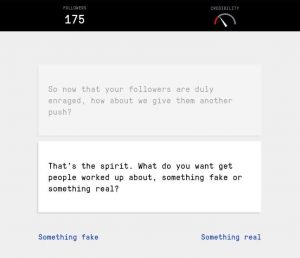
The game directions are as follows: You take on the role of fake news-monger and drop all pretense of ethics. You are required to choose a path that builds your persona as an unscrupulous media magnate. Through it all, you have to keep an eye on your ‘followers’ and ‘credibility’ meters. The objective is to get as many followers as you can while simultaneously building up (fake) credibility as a news site. If you tell obvious lies or disappoint your supporters, you lose.
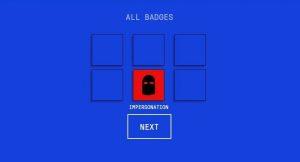
To complete the game, you have to earn six “badges”. Each badge reflects a common strategy used by creators of fake news. In addition, there are in-game questions that measured the effects of Bad News deployed for four* of its featured fake news badges.
The six badges are as follows:
IMPERSONATION*
- This technique involves mimicking trusted personalities on social media.
- Playing the disinformation tactic of “impersonation” in the game results in reduced perceived reliability of the fake headlines and tweets by 24% from pre- to post-gameplay.
CONSPIRACY*
- This technique involves the spreading of false narratives blaming secretive groups for world events.
- By playing the disinformation tactic of “conspiracy”, perceived reliability is reduced by 20%.
POLARIZATION*
- This technique involves causing (a group of) people to have opposing positions.
- The game reduces the perceived reliability of deliberately polarizing headlines by about 10%.
DISCREDITING SOURCES*
- This involves attacking a legitimate source with accusations of bias.
- The tactic of “discrediting sources” reduces perceived reliability by 19%.
TROLLING
- This is the art of deliberately, cleverly, and secretly upsetting people using dialogue.
EMOTIONALLY PROVOCATIVE CONTENT
- This requires hitting on key elements of the human psyche, triggering strong emotions like joy, sadness, fear, or excitement.
To play the game yourself, CLICK HERE.
I played it and it is really fun and very interesting! Here are a few screenshots along the way to get an idea of what it’s about (and yes, I allowed my data to be used for the study):



The Study
The game was a hit and soon thousands of people had participated by spending fifteen minutes playing and getting immunized. To gauge the effects of the game, players were asked to rate the reliability of a series of different headlines and tweets before and after gameplay. They were randomly allocated a mixture of real (“control”) and fake news (“treatment”). When the game was over, many of the players allowed the data to be used for a study. The researchers then gathered and analyzed data from 15,000 players.
The Results
The results showed that the game really worked – Bad News succeeded in increasing the participants’ “psychological resistance” to fake news. Therefore, it is possible for an online game to work like a “vaccine” and increase skepticism towards fake news by giving people a weak dose of the methods behind disinformation campaigns.
Dr. Sander van der Linden, Director of the Cambridge Social Decision-Making Lab, said:
“Research suggests that fake news spreads faster and deeper than the truth, so combating disinformation after-the-fact can be like fighting a losing battle.
We wanted to see if we could preemptively debunk, or ‘pre-bunk’, fake news by exposing people to a weak dose of the methods used to create and spread disinformation, so they have a better understanding of how they might be deceived. This is a version of what psychologists call ‘inoculation theory’, with our game working like a psychological vaccination.”
Roozenbeek added:
“Our platform offers early evidence of a way to start building blanket protection against deception, by training people to be more attuned to the techniques that underpin most fake news.”

The game worked so well that the perceived reliability of fake news before playing the game had reduced by an average of 21% after completing it. Yet the game made no difference to how users ranked real news. The game was almost equally effective across age, education, gender, and political persuasion. However, it did make the most impact on those who registered as most susceptible to fake news headlines at the outset.
Van der Linden said:
“We find that just fifteen minutes of gameplay has a moderate effect, but a practically meaningful one when scaled across thousands of people worldwide, if we think in terms of building societal resistance to fake news.”
Bad News Jr.
The game is available in several languages including, English, Czech, Dutch, German, Greek, Esperanto, Polish, Romanian, Serbian, Slovenian, and Swedish. The researchers have also developed a special “junior version” for children aged 8-10, available in ten different languages so far. “We want to develop a simple and engaging way to establish media literacy at a relatively early age, then look at how long the effects last,” said Roozenbeek.


