
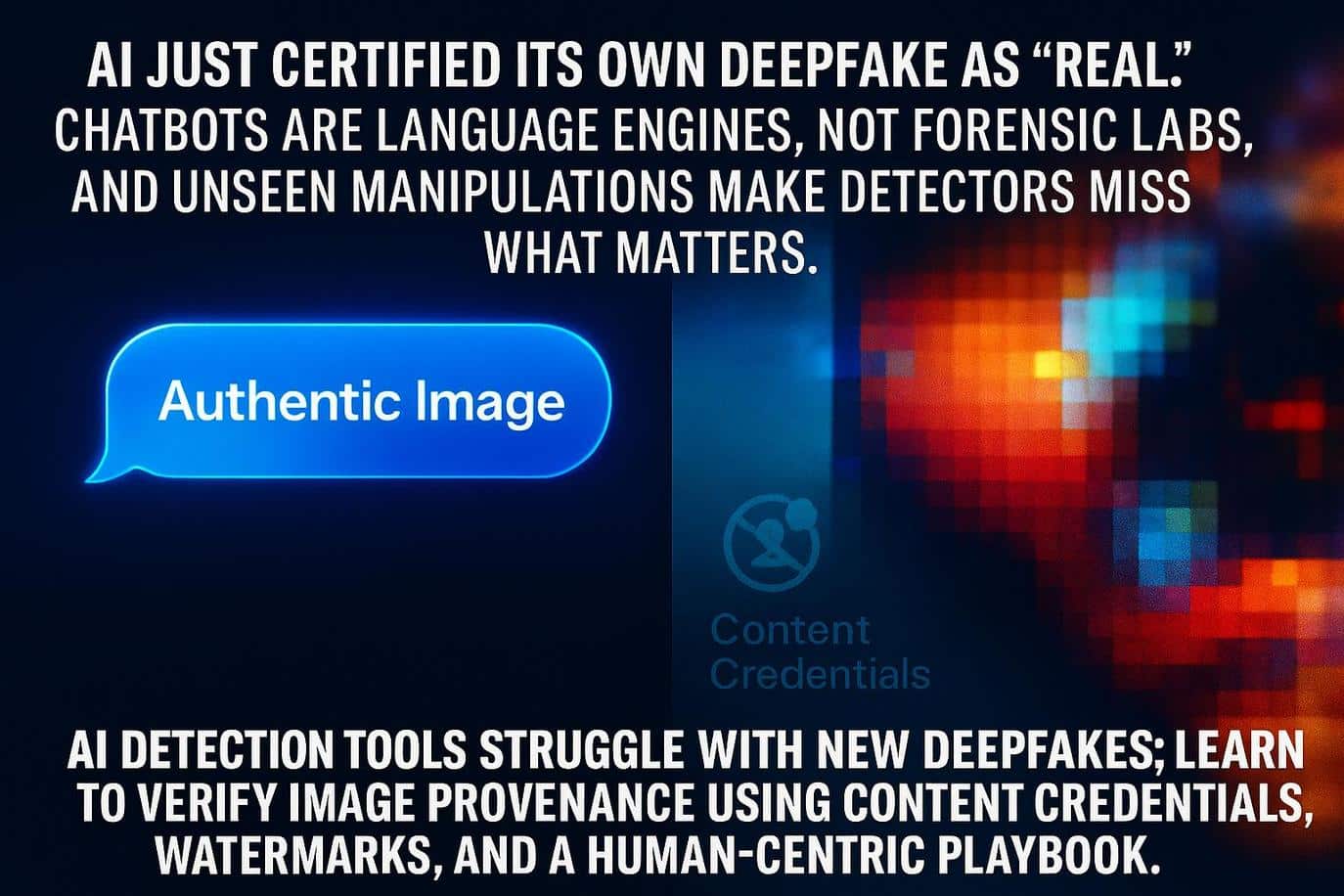
A core paradox of the generative era is that the tools creating synthetic media also struggle in their detection of them. This failure was highlighted when a viral image of a public figure in the Philippines ricocheted across social media: thousands asked an AI chatbot to verify the photo’s authenticity, and the system confidently—but incorrectly—answered that the image was real, despite being generated by its own model family.
This miss was not an isolated incident. Recent reporting and research show that general-purpose AI assistants are frequently unreliable at image provenance, which is the history of how a picture was created and edited. The outcome is a failure of verification: polished answers feel authoritative yet often fail on the very fakes these tools helped create. Recent case studies documented how assistants blessed fabricated photos as authentic.
The following analysis explains the causes of this failure, defining what today’s deepfake detectors can and cannot achieve and how provenance labels and watermarks fit into the broader picture. We close with a practical playbook for content verification that can be used immediately. Realism is the goal, as no single tool is sufficient for the task. Instead, readers must combine human judgment with targeted checks, standards-based provenance, and cautious use of detectors that are transparent about their limits.
Quick Facts
- Chatbots are not forensic detectors: Independent testing found that leading assistants struggled to confirm where and when real news photos were taken, underscoring a citation and verification gap.
- A news investigation documented cases where chatbots labeled AI-generated photos as authentic, even for images akin to their own model families.
- State-of-the-art benchmarks show strong results on familiar manipulations but weaker performance on novel ones. The 2025 dataset known as DFBench highlights this generalization problem.
- New research demonstrates better cross-dataset results using parameter-efficient CLIP adaptations, but even those methods acknowledge persistent gaps; a 2025 cross-benchmark study.
- Watermarks and provenance labels help when they survive the pipeline. Labels can be stripped by screenshots or heavy edits, so treat them as helpful signals, not proof.
- TikTok, for example, auto-labels some externally created AI content using Content Credentials.
- For everyday users, the safest workflow blends reverse-image search, provenance checks, and cautious use of detectors.
- This workflow includes a willingness to stop sharing if uncertainty regarding image provenance remains.
The Verification Mirage: Why Chatbots Fail at Provenance
The New Reflex: “Ask the Chatbot”
Asking a chatbot to judge an image feels efficient. The problem is that the underlying system is optimized for language, not forensic signal analysis.
In practice, chatbots can be confidently wrong on high-stakes items, including AI-generated photos that resemble outputs from their own model families. A recent investigation provides the clearest illustration: it traced specific fakes and then asked multiple assistants to verify them; several responded that the images were real. A detailed investigation into misclassified AI images traced specific fakes and found assistants calling specific fakes real.
Why the Architecture Misleads Users
Large language models are trained to predict words and compose explanations. Image provenance requires a different skill set: pixel-level artifacts, compression patterns, editing traces, and, ideally, tamper-evident metadata.
Without that context, a chatbot often falls back on pattern-matching and probability-based reasoning. Answers can sound authoritative while skipping the very checks a human fact-checker would perform, such as a reverse-image search, contact with the original publisher, or an inspection of content credentials when available.
Evidence from Research
Academic and newsroom testing reinforce the caution. The Tow Center for Digital Journalism compared several AI search and assistant tools and found that they often struggled with basic citation hygiene and could not reliably ground claims in verifiable sources. This finding directly impacts image verification tasks, where the system must establish who created a photo, where and when it was captured, and how it has traveled since. A Tow Center analysis explaining AI search citation failures summarizes those results.
Everyday Spillover on Mobile Editing
Fast, consumer-grade editing tools make the problem worse. Modern apps let anyone alter backgrounds, remove objects, and relight a scene in seconds, which raises the bar for detectors and increases the odds that provenance signals will be lost during export or sharing. This acceleration shows up in everyday feeds, with AI photo edits and quick mobile creations outpacing moderation cues.

Deepfake Detectors vs. Reality: Brittleness on Unseen Manipulations
What Benchmarks Really Show
In 2025, researchers introduced a large, varied dataset to evaluate deepfake image detection with large multimodal models. The core result is sobering. Models tend to perform well on the kinds of manipulations they have seen before, yet their accuracy drops on unfamiliar forgeries, new model families, or content that has been re-encoded, upscaled, or style-transferred. You can review the technical setup and results in the DFBench paper, which frames this gap as a core challenge for deployment beyond lab conditions.
Cross-Dataset Generalization is Still a Frontier
A separate 2025 study reports stronger cross-benchmark performance using a parameter-efficient adaptation of a CLIP vision encoder: the approach tweaks a tiny fraction of model parameters and uses a hyperspherical feature constraint to discourage shortcut learning. While promising, this approach does not erase the central problem that detectors can be blindsided by novel manipulations. Details are in a cross-benchmark study on generalization.
Watermarks Help, But Are Not Universal
Two families of signals matter here. Provenance labels, such as content credentials, record how media was created and edited when participating tools preserve metadata. Invisible watermarks, such as Google’s SynthID, embed patterns that a detector can later search for. These signals are useful, yet both have limits when content is screenshotted, compressed, relit, stylized, or translated across formats. For an overview of the text watermarking method, the Nature paper on SynthID-Text, and for current image watermark work at the internet scale, see the 2025 SynthID-Image preprint.
Where Commerce and Security Meet Real-World Proof
Away from social feeds, content verification often looks more like a layered investigation, combining metadata, device logs, and behavioral analysis. That is the model used in fraud disputes and platform integrity work, where provenance is one signal among many. These layered checks mirror real incident workflows typical of AI-powered fraud prevention workflows.

Standards with Gaps: Provenance, Labels, and Where They Break
What Content Credentials Actually Are
Content credentials are a provenance framework that records how media was created and edited when participating tools agree to write and preserve that history. Often described as “C2PA,” the system refers to the underlying open standard.
It does not prove truth by itself. It only documents a chain of custody that can help investigators understand where a file came from and how it changed over time. The framework is defined in the Content Credentials standard.
Platform Labels in the Wild
Some platforms now surface provenance labels when the signals are present. TikTok, for example, can automatically label certain externally created AI media when content credentials are detected, which helps ordinary users understand that a clip or image used synthetic tools at some point in its lifecycle.
The approach is promising but still partial: not every creation app writes the signals, and not every sharing pipeline keeps them intact; TikTok’s policy on automatically labeling AI-generated content outlines the approach.
Break Points in the Pipeline
Even when provenance is written correctly, the signal can fail to survive a normal day on the internet. Meanwhile, consumer-grade generative tools—including viral deepfake apps that mimic popular movies—amplify distribution pressure and increase the odds that signals are lost.
Screenshots, exports to social platforms that strip metadata, messaging apps that compress files, aggressive upscales, and format conversions can all disrupt the chain of custody. Therefore, investigators still rely on a mix of methods, including reverse-image search and targeted forensic checks, rather than trusting any single provenance badge.
Image-to-Image and Style Transfer
If a photo is reimagined by another generative model, the new file may carry its own signature while losing the original audit trail. The break makes it harder to tie the image back to its first creator without additional reporting.
Crops, Frames, and Re-Encodes
Manipulations like tight crops, collage frames, or export through an editor can remove or alter provenance data. Heavy compression creates noise patterns that confuse both watermark detectors and some forensic cues.
Messaging and Platform Hops
Content that travels through group chats, repost apps, or download-reupload workflows often loses embedded metadata entirely. The best path forward is to triangulate context, locate the earliest known upload, and search public repositories for matching frames.
Governance Shift: Fact-Checkers, Community Notes, and Automation Limits
The 2025 Pivot
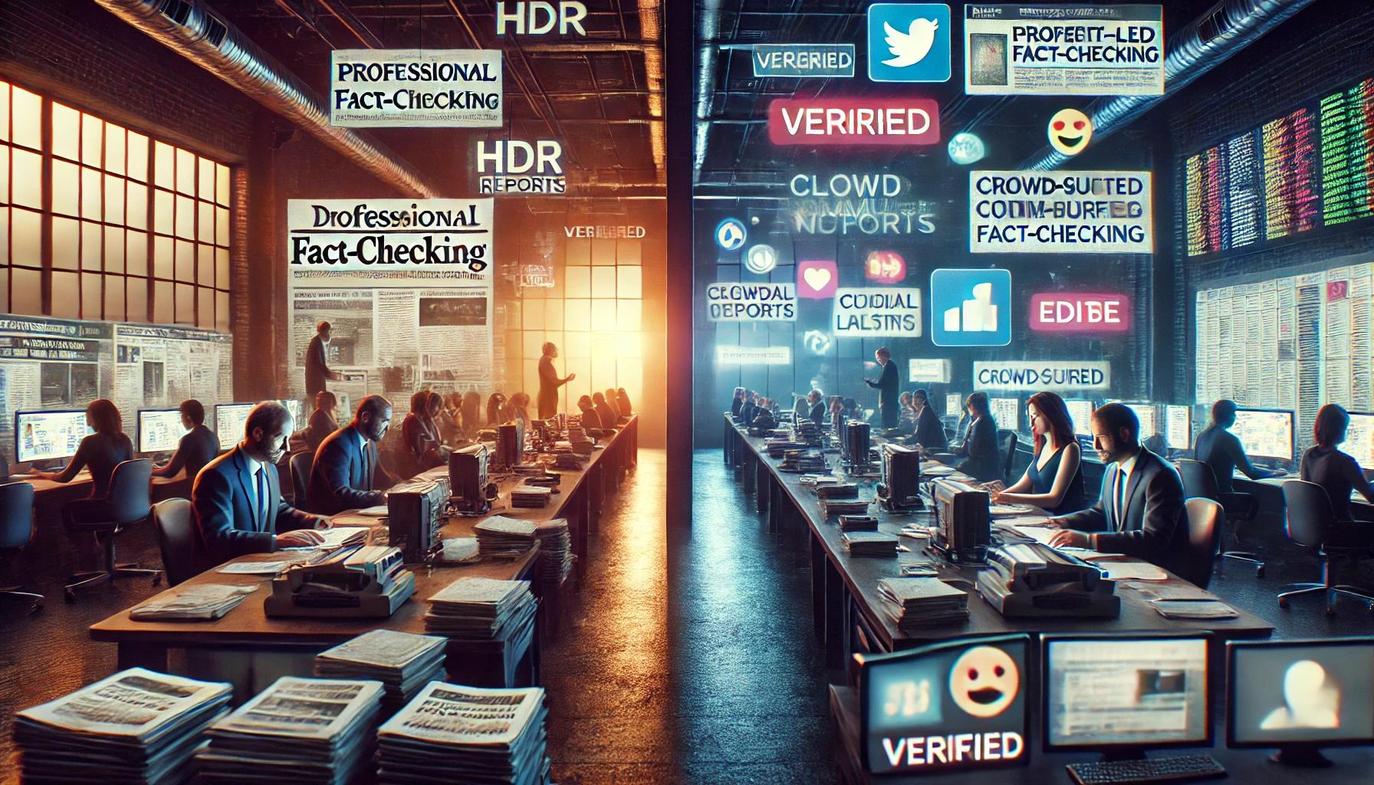
In the United States, major policy changes in 2025 reduced the visibility of third-party fact-checking on some large social platforms while expanding community-note-style systems.
The effect on everyday users is subtle but significant. Instead of an official label tied to a dedicated fact-checking partner, readers increasingly encounter short context notes that may appear below a post and can be edited or voted on by other users.
What that Means for Readers
Community notes can be fast and helpful on recurring hoaxes, yet they are inconsistent for new or highly technical fakes, especially when source media is being edited and re-uploaded in real time. Treat such notes as one signal among many, and still rely on independent verification steps.
Short-video ecosystems illustrate these tensions in the platform governance trade-offs around ByteDance and TikTok.
Why Automation Alone Will Not Carry the Load
As professional fact-checking becomes less visible in feed design, more pressure lands on automated labels and general-purpose assistants. Evidence shows that chatbot answers can be confidently wrong and detectors can stumble on unfamiliar manipulations.
A sustainable path keeps humans in the loop and rewards platforms that preserve provenance and share source data for independent review, and it strengthens digital journalism that fosters positive change.

A Reader’s Playbook: Safely Verifying Content in the Age of Deepfakes
Start with Context
Determine who is posting the image, examine their track record, and consider why the claim matters today. Search for earlier mentions of the same scene, and look for the earliest known upload. If you can find the original publisher or photographer, note the date, location, and caption details before you move on.
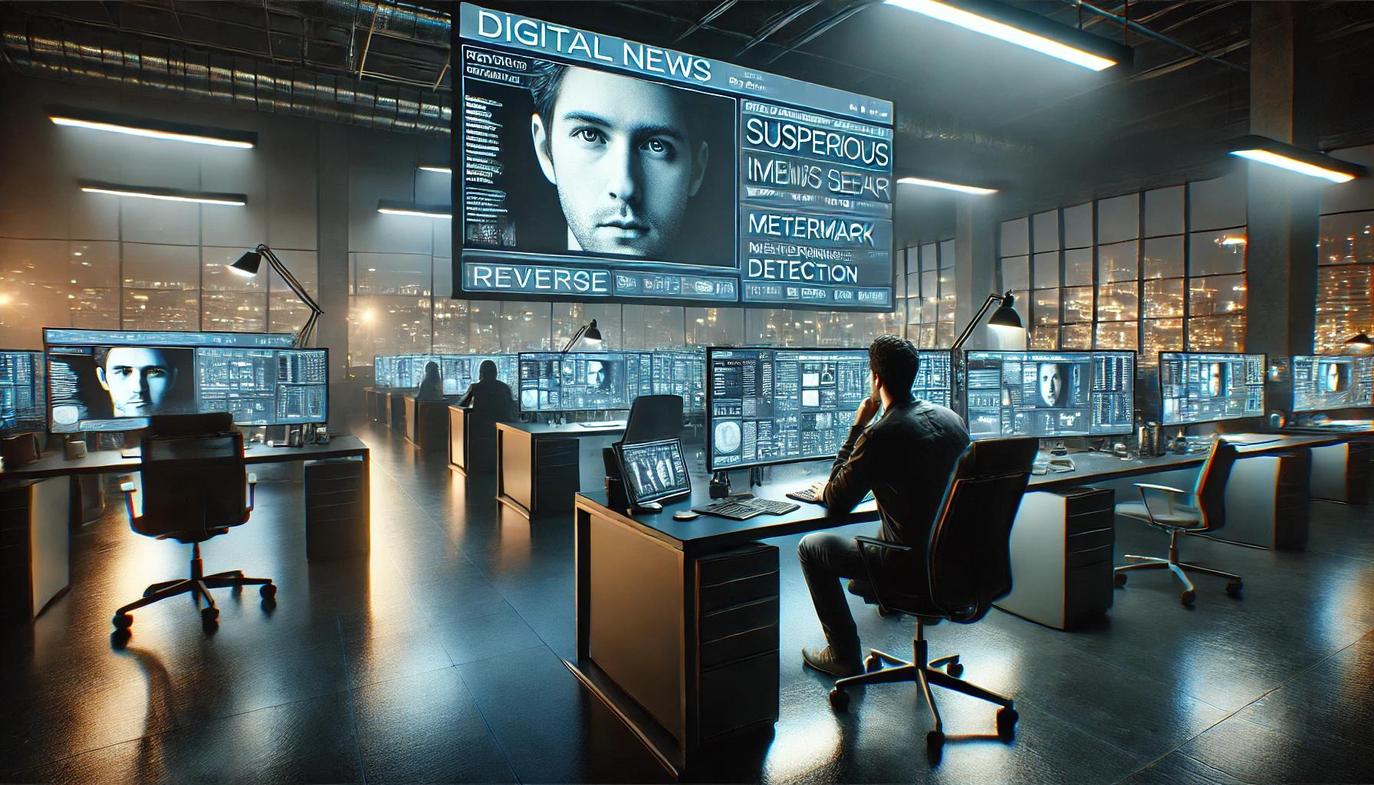
Run Reverse Image and Frame Searches
Run searches using more than one engine. For video, grab still frames and search those as well. Small differences in crop or aspect ratio can change results; try a few variants. When results cluster around a prior news event or stock photo, you likely have a recycled image.
Check for Provenance Signals
If a platform or app exposes Content Credentials, open the details to see which tool created the media and whether edits were recorded. View the presence of a badge as initial context, not a final verdict, and remember that screenshots and exports can remove the signal entirely.
A general introduction to what these pins represent appears in the Content Credentials standard.
Use Specialized Detectors Sparingly
Detectors are helpful as triage. They are less reliable when faced with manipulations that differ from their training sets. Gather clues using detectors, then cross-check the findings with other methods. Hardware may also raise the ceiling: a UCLA team has demonstrated an optical processor that screens deepfake video with light at nearly 98% accuracy, designed as a fast, hard-to-fool first-pass filter. For background on why performance can drop on unfamiliar forgeries, review the 2025 benchmark results in DFBench.
Put Watermarks in Perspective
Invisible watermarks and text-watermarking methods can help identify synthetic media under certain conditions, but they are not universal and can be weakened by edits and format changes. To perform a reality check, compare different encodings or look for places where a platform discloses that AI tools were used.
For the research background, the SynthID-Text method.
Know When to Stop Sharing
If you cannot confirm who made the image, when it first appeared, or how it changed along the way, you should consider withholding amplification. In close calls, ask whether the claim would change a real-world decision. If it would, escalate to more rigorous checks or wait for professional verification.
Practical Literacy for Everyday Tools
Watermark removal tutorials and quick-fix editing apps are everywhere, which is precisely why readers benefit from understanding their limits and the ethics involved. Given that watermark removal tutorials and quick-fix editing apps are everywhere, readers benefit from understanding their limits and the ethics involved. For a media-literacy context, a primer on watermark removers and their limits.

The Layered Defense and Human Judgment Against Deepfakes
The current technological landscape requires a fundamental shift in how trust is evaluated online. The core issue is the generalization gap: automated tools excel at detecting familiar patterns but remain critically brittle when confronted with novel, unseen manipulations created by emerging generative models. This inherent vulnerability means that relying solely on AI assistants or detection software for image provenance is functionally inadequate. Instead, content verification must be recognized as a layered process where human skepticism and analytical skills provide the essential, final point of failure protection.
Rebuilding trust in the digital ecosystem depends on broad adoption of provenance standards, transparent benchmarking of detection tools, and platform incentives that reward accurate context over viral spread. While systems like content credentials offer valuable digital audit trails, they are not impervious to disruption and only act as a starting point for inquiry.
Readers must be empowered with simple, reliable verification playbooks that combine reverse-image search, analysis of contextual signals, and cautious use of detectors. This combined approach ensures that individuals remain the central, most reliable AI detection mechanism against sophisticated deepfakes—aligned with responsible AI practices that prioritize transparency and safety.
Answering Essential Questions on Deepfakes and Image Provenance
Why Are AI Chatbots Unreliable for Deepfake Detection?
Chatbots are optimized for language prediction, not forensic analysis of pixels or compression artifacts, making them fundamentally unable to reliably verify image provenance.
What is the Generalization Gap in Deepfake Detection?
The generalization gap describes a detector’s failure to maintain accuracy when faced with manipulations created by new or unfamiliar generative models, as demonstrated in benchmarks like DFBench.
How Do Content Credentials Help Verify Media?
Content credentials (C2PA) provide a record of how media was created and edited, offering a verifiable chain of custody that supports image provenance but does not guarantee truth.
Can Watermarks Be Removed from Synthetic Media?
Yes. Watermarks, both invisible and visible, can be weakened or removed entirely by common processes like screenshots, compression, editing, and style transfers.
What is the Safest First Step for Verifying a Suspicious Image?
The safest first step is always to run a reverse-image search to locate the original source or photographer and establish the earliest known upload date.


