
For years, a persistent worry has shadowed the UK’s transition to net zero: the fear that widespread heat pump adoption would overload local electricity network grids. Planners worked under the assumption that on the coldest winter evenings, every household would demand maximum power simultaneously, requiring massive and costly grid reinforcement. However, the first live data from a pioneering pilot in Birmingham tells a radically different, and far more optimistic, story.
Monitoring seven new-build, all-electric homes in Project 80 revealed that real-world demand is far lower than worst-case models predict. Equipped with air-source heat pumps and rooftop solar, these homes demonstrated a diversified evening peak—the actual strain placed on the local grid—that was a fraction of planning assumptions. Alongside this, residents achieved strong daytime self-consumption of their own generated power, proving that smart fabric and technology can effectively decouple comfort from grid stress.
This article unpacks what the meters actually recorded and why these results are shifting UK policy from outdated models to new, data-driven standards. We draw primarily on a peer-reviewed Project 80 case study in Energy & Buildings, supported by plain-language coverage and official documentation. By connecting these technical findings to practical choices, we illustrate how better envelopes, right-sized heat pumps, and clear controls can keep both energy bills and neighbourhood peaks firmly in check.
Quick Facts
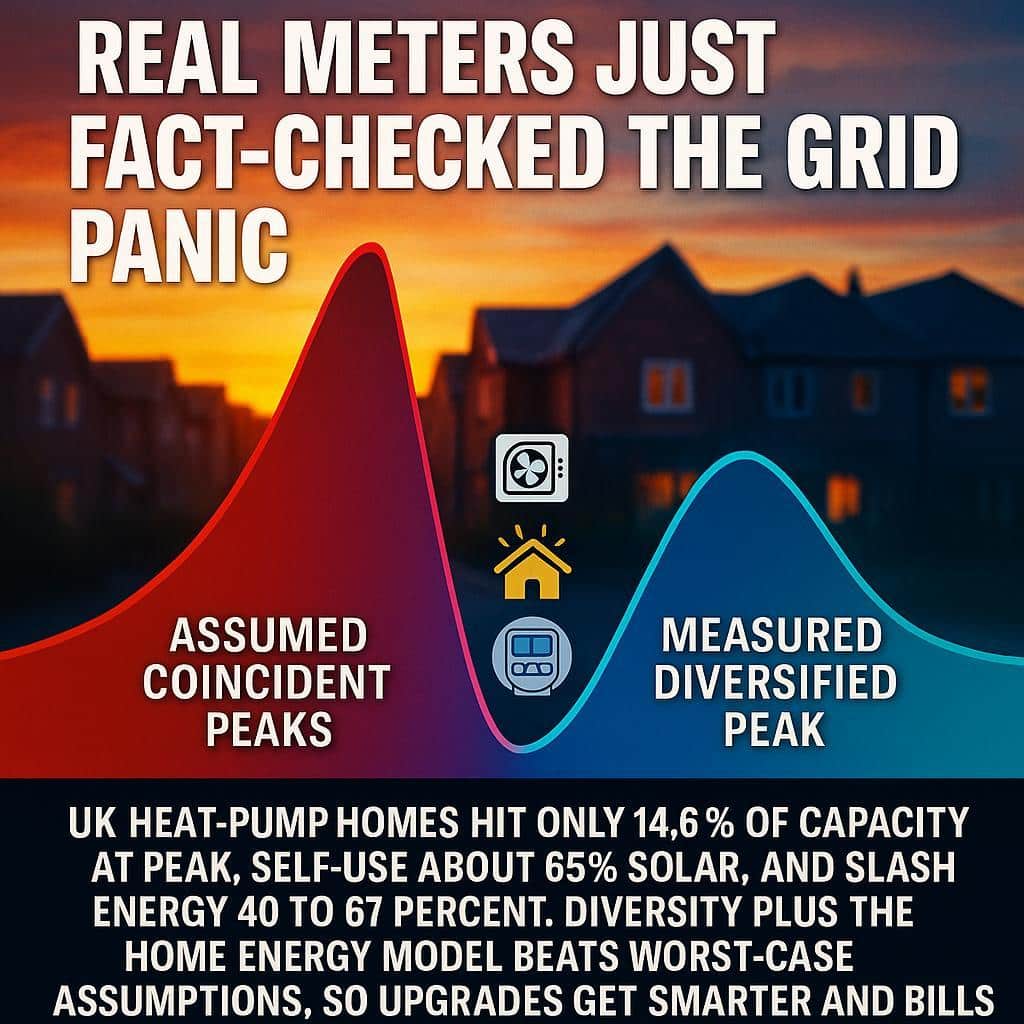
- Measured diversified peak: 14.6% of total installed design capacity across seven monitored homes. Such an aggregate measure shows that household peaks occur at different times rather than all at once.
- What dominated the peak: Heating and cooking together accounted for more than 80% of instantaneous peak load across the sample.
- Solar self-consumption: Roughly 65% of on-site photovoltaic generation was used in the homes directly, with the balance exported to the grid during surplus periods.
- Annual energy use: Total energy consumption in these homes was reported as 40% to 67% lower than the current UK average for similar dwellings, reflecting both fabric improvements and high-efficiency equipment.
- Policy direction: The UK government is replacing the long-standing Standard Assessment Procedure with the Home Energy Model. The new approach is designed to reflect time-of-day effects and lived performance with higher fidelity.
- Scaling lens: National scenarios indicate heat pumps can shift a substantial share of their load outside system peaks when paired with smart controls and tariffs.

The Bottom Line: What the Meters Found
What Was Measured and Where
Researchers monitored seven net-zero-ready social homes in Birmingham’s Project 80 over a full year, each designed with a fabric-first envelope, air-source heat pumps, and rooftop photovoltaics. The study is documented in a peer-reviewed paper in Energy & Buildings that reports the electrical profile of these dwellings from hourly to sub-hourly perspectives, including how end uses contribute to local peaks and how on-site solar is absorbed within the home.
Peaks were Lower because People are Different
The key finding is the diversified peak. In plain terms, a diversified peak is the combined maximum at the street or feeder level when many homes are aggregated. If each household’s individual peak happens at a slightly different time, then the community total is much smaller than the sum of individual worst cases. In this sample, the diversified peak registered 14.6% of total installed design capacity. Heating and cooking together contributed more than four-fifths of that instantaneous maximum. These numbers align with the pilot’s measured profiles rather than with broad assumptions that every household cooks, showers, washes, and requests full heat at exactly the same minute.
Solar Helped Shape Daytime Demand
The homes consumed about 65% of their PV output on-site, reducing grid import during daylight hours and leaving the remainder for export. This self-consumption rate matters for local networks because it lowers daytime feeder loading without requiring batteries and reflects how solar panels power household circuits. Readers weighing deeper autonomy can explore how solar battery storage increases self-use and can further smooth evening imports when economically justified for a specific home.
What Residents Experienced
Lived experience reporting from national media of the project noted substantially lower annual energy use—40% to 67% below the UK average—along with comfort gains such as no dampness or mould in monitored homes. Those human outcomes are part of the grid story. Dry, warm, efficient buildings let heat pumps run steadily, avoiding the sharp spikes that come from thermostat overshoots or resistance-heater fallbacks. The reporting also surfaced a caution. Misuse of immersion heaters or manual overrides of controls can erode efficiency, which is why clear interfaces and simple guidance matter as much as the equipment itself.
Why This Is Not the Last Word
The monitored group is small and does not include home batteries, and the study was not designed to analyse the most aggressive electric-vehicle charging coinciding with heat demand. Even so, the dataset is powerful because it demonstrates that real homes with modern envelopes and heat pumps can keep local peaks modest under ordinary operation. For scaling to tens of thousands of homes, system planners should pair this microscale evidence with national-level flexibility studies that quantify how quickly and how far heat pumps can shift load with automation and tariffs.
Further Reading and Lay Synthesis
For a plain-language recap of the technical findings, a plain-language summary captures the headline result that the homes placed less demand on the grid than planners expected. For project context, the Project 80 programme page explains aims, partners, and the rationale for testing these designs ahead of future building standards.

From SAP to HEM: Updating the Rules to Match Reality
Why the Modelling Framework Is Changing
The Standard Assessment Procedure has long underpinned how the UK estimates the energy performance of homes for policy and compliance. However, as electrification and on-site generation spread, a purely static approach struggles to represent when energy is used and how households actually behave. The government is therefore introducing the Home Energy Model, a more granular methodology that is intended to reflect time-of-day patterns, equipment operation, and diversity across dwellings with higher resolution.
What the New Model is Supposed to Do
Government materials describe the Home Energy Model as a replacement for SAP that will support multiple policies across housing, fuel poverty, and climate objectives. The consultation package includes an accessible overview and a detailed policy response setting out what will change and why those changes matter for design assumptions, compliance tools, and future standards.
Why Project 80 speaks to HEM
Diversity is not an abstract parameter. It is a measurable property of lived energy use. The Project 80 case study offers field evidence that diversified peaks in well-designed, all-electric homes can be far below worst-case assumptions. Such data represents precisely the type of real-world signal a modern model should encode. When models reflect the timing of how people actually cook, heat water, and space-heat their homes, planners can right-size reinforcement rather than assume coincident spikes that never arrive.
What Scaling Looks Like in National Scenarios
In parallel with updates to building-level modelling, national system planners have published Future Energy Scenarios 2025 showing that heat pumps can shift a large share of load outside peak periods when paired with smart tariffs and automation. That flexibility is the system-level counterpart to the street-level diversity revealed in Project 80. These combined findings suggest a path where better envelopes, right-sized equipment, and simple controls reduce the need for expensive last-mile upgrades.
Practical Takeaways for Households
For most homes, the first wins come from the building fabric and steady, right-sized heat pumps that avoid short-cycling. Rooftop solar improves the daytime picture by letting households serve a portion of their needs directly. Batteries can boost evening self-use in the right tariff and price context, but they are not a prerequisite for seeing benefits. For a broader view of layouts, materials, and comfort, explore our overview of sustainable home design that reduces waste while improving day-to-day living.
Where the Policy Goes from Here
As the Home Energy Model replaces SAP, expect compliance tools and guidance to evolve. That means:
- Acknowledging diversity in household behaviour.
- Crediting steady, efficient operation over peak bursts.
- Using measured performance to tune assumptions over time.
Project-level pilots will continue to matter because they reveal how people actually use energy in modern homes. A 95-home follow-on scheme informed by the Birmingham experience is planned, which will widen the dataset and help test how well the new model reflects lived reality across more sites and seasons.

How These Homes Were Built to Behave
Fabric First
The homes were designed to hold heat with minimal loss, which lets air-source heat pumps run steadily at low flow temperatures rather than cycling. That steady operation limits short bursts of high power that can occur when systems chase comfort after large temperature swings. The approach mirrors best practice in sustainable home design by prioritising airtightness, insulation, and thermal bridging control. Simultaneously, it maintains healthy ventilation through mechanical systems with heat recovery.
Right-sized Heat Pumps
Engineers selected units that match each dwelling’s calculated heat load rather than oversizing for rare extremes. Right-sizing avoids frequent on-off cycling and reduces the need for electric resistance backup. It also improves seasonal efficiency because compressors stay in their sweet spot. The Energy & Buildings field study documents how these design choices translated into the electrical profile of space heating and hot water across the year.
Solar that Households Actually Use
Rooftop PV served a meaningful share of daytime demand. On average, households self-consumed about two-thirds of what they generated, which cut imports during sunlight hours and left the rest for export. In neighbourhoods with suitable tariffs, adding solar battery storage can lift self-use further and smooth early evening imports, although the Birmingham results show batteries are not a prerequisite for modest peaks.
Controls and User Experience
Simple interfaces and good defaults keep systems efficient. Project reporting highlighted that misuse of immersion heaters or manual overrides can raise consumption. Clear labelling, temperature caps, and basic tutorials reduce those pitfalls, and they help residents understand why steady operation feels different from traditional boilers yet keeps bills predictable while encouraging seasonal HVAC optimisation.

Scaling the Signal: What Happens at 100K or 1M Homes?
Street Level vs. System Level
The Birmingham sample illustrates diversity at the feeder scale. At a national scale, planners look at how millions of heat pumps can shift load with automation and tariffs. The Future Energy Scenarios 2025 analysis finds that electric heating can move a large share of demand away from the highest-stress hours. This shift occurs when households respond to price signals or when aggregators coordinate fleets of devices.
What Diversity and Flexibility Mean for Upgrades
Diversity lowers the chance that every household peaks at once, and flexibility shifts some of the remaining load to shoulder hours. Together they can delay or reduce last-mile reinforcements. As the Home Energy Model replaces SAP, local planning assumptions can better reflect timing and behaviour rather than worst-case coincidence. That alignment allows distribution network operators to target upgrades where the evidence points rather than across the board.
A Simple Scenario Sketch
Imagine a street of net-zero-ready homes similar to the Birmingham design. Without batteries, PV already trims daytime imports. With time-of-use tariffs:
- Hot-water tanks preheat before the system peak.
- Thermostats allow small temperature glides in the evening.
Modest automation can spread residual peaks over an hour or two, which reduces the aggregated maximum without affecting comfort.
Limits and Caution
EV fast charging, cold snaps, and clusters of large dwellings can raise localised peaks. Consequently, planners combine micro-evidence from pilots with national modelling, and that is why ongoing monitoring remains important as adoption grows.
What to Watch Next
Bigger Sample, Richer Seasons
A planned follow-on monitoring programme covering roughly 95 homes will expand the dataset across more households, layouts, and behaviours. It should clarify how winter extremes, holidays, and school schedules affect diversity and self-consumption.
Policy Milestones
The phased rollout of the Home Energy Model will reshape compliance software and inputs used by builders and assessors. Expect guidance on time resolution, equipment libraries, and how to credit demand shifting. Building control bodies will need training materials that translate the new model into practical checklists.
Distribution Network Practice
DNOs are testing flexibility services that pay households for shifting use during constraint windows. Results from those trials will indicate how much peak reduction can be purchased per pound compared with reinforcement. Look for standardised APIs that allow heat pumps and hot-water tanks to enrol with minimal friction.
Resident Experience
Comfort, noise, and running costs determine adoption. Watch for manufacturers to simplify control menus and for housing providers to issue short setup guides. Education explaining why ‘set-and-forget’ works best with heat pumps will help protect measured diversity. This understanding keeps community peaks modest.

The Path to a Smarter, Lighter Grid
Field data from modern, fabric-first homes points to a practical and affordable path for national electrification. When houses are built to retain heat, heat pumps run efficiently without surging, and rooftops can cover a meaningful slice of daytime needs. Most importantly, the data confirms that people live different daily rhythms; their maximum energy draws rarely align, meaning the aggregate load on the grid is far smoother than static models suggest. Recognising this diversity allows for smarter, targeted upgrades rather than expensive, blanket reinforcement.
As the Home Energy Model replaces older standards, the priority must shift to maintaining this balance at scale. Keeping designs human-centred, ensuring assumptions are tied to real-world measurements, and making flexibility tools easy to use will be critical. With the right framework, the transition to green homes will not break the grid—it will reveal just how resilient and adaptable our local networks can be.
Frequently Asked Questions About Heat Pumps and Grid Impact
Do heat pumps really overload local electricity networks?
Real-world data suggests they do not, provided homes are energy-efficient. In the Project 80 study, the actual peak demand from seven homes was only about 14.6% of the theoretical maximum, proving that diversity in usage patterns naturally flattens the load.
How does the Home Energy Model differ from the old SAP?
The Home Energy Model (HEM) is designed to be dynamic, accounting for time-of-day usage, smart technology, and variable grid carbon intensity. Unlike the static Standard Assessment Procedure (SAP), HEM better reflects how modern low-carbon technologies actually perform in lived-in homes.
Is a home battery required to reduce grid strain?
No. The Birmingham pilot achieved low grid peaks and high solar self-consumption without batteries. However, adding solar battery storage can further increase independence by storing daytime surplus for evening use, offering additional savings depending on the tariff. What that storage does to household energy habits and emissions is more complicated than the savings alone suggest.
What is the most important factor for efficiency?
A ‘fabric-first’ approach is paramount. High levels of insulation and airtightness reduce the heat load, allowing the heat pump to run steadily and efficiently. This minimises the sharp spikes in power demand that stress the grid.


