
The integration of large language models (LLMs) into educational settings marks a profound transition, fundamentally altering the roles of both educators and parents. This shift is not merely technological; it is pedagogical. In a world where AI can instantly generate explanations, draft content, and summarize complex concepts, the focus moves away from knowledge delivery and toward sophisticated guidance.
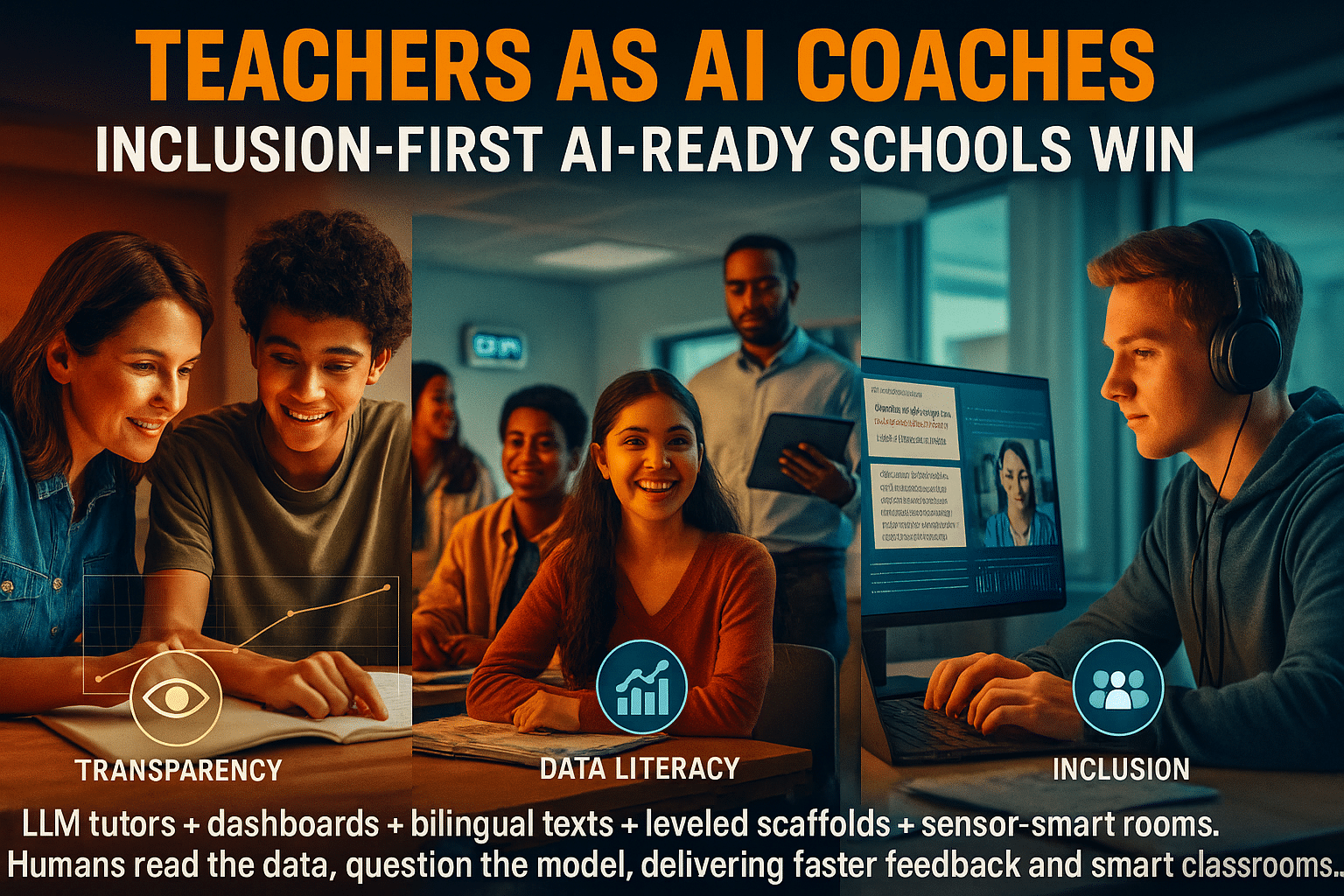
Adults must now function as AI coaches, teaching students how to challenge, verify, and ethically leverage powerful digital tools in environments ranging from the private homeschool setting to sensor-equipped public classrooms. This new competency, centered on data literacy and critical evaluation of algorithmic outputs, defines the frontier of modern learning, especially given the history detailed in how technology has changed education.
This article provides a detailed analysis of three primary educational ecosystems—homeschooling, online schooling, and ambient-intelligent smart classrooms—where AI is quickly being adopted. We explore how LLMs facilitate personalized learning paths, how continuous data analytics inform teacher judgment, and how inclusion is becoming a practical outcome of these tools for diverse student populations.
Importantly, we address the persistent debate about which educational model is superior. Research suggests that outcomes rely less on the label (public, private, or home) and more on the quality of the learning structure, feedback loops, and the adult capacity to manage this new generation of smart tools, a conclusion supported by this data-driven review of homeschool, private, and public outcomes.
Current Trends in AI Adoption and Educational Technology
- Teen AI use is mainstream: The percentage of U.S. teens who report using ChatGPT for schoolwork doubled from 13% to 26%, according to Pew Research’s 2025 analysis.
- Homeschoolers are early adopters: Higher ChatGPT uptake is evident among homeschool educators than among classroom teachers, reflecting fewer institutional barriers and faster trial-and-error cycles.
- Teacher dashboards are evolving: Clicks, quizzes, and open-ended work are compressed by learning-analytics systems into actionable signals, with LLMs increasingly translating data into plain-language summaries for busy educators.
- Data literacy is now essential: The knowledge, skills, dispositions, applications, and behaviors that help adults use data well are set out by a growing research base.
- Smart spaces aim to help teachers, not replace them: Air, light, and noise are adjusted by ambient-intelligent classrooms to support comfort and focus while keeping human judgment in control.
- Inclusion is the hinge: Leveled texts, bilingual explanations, and step-by-step scaffolds can be generated by LLMs when adults coach students on how to question the model.
AI-Ready Ecosystems: Homeschool and Online Learning
Ecosystem Quality Over Labels
The strength of the learning environment matters more than school labels. Intentional routines, high instructional quality, and responsive feedback loops consistently drive educational outcomes.
Context and structure emerge as the decisive factors in a data-driven review of homeschool, private, and public outcomes. Similarly, consistency and design shape performance, highlighted by a complementary comparison of homeschool and traditional outcomes.
Early AI Practices at Home and Online
Learning stacks controlled by families tend to move first. Rapid experimentation with LLMs for lesson ideas, leveled explanations, and targeted practice is reported by homeschool communities. This trend is reflected in reporting on homeschool AI adoption.
Flexibility and individualized pacing are cited by parents choosing online schools for their children, creating conditions that simplify piloting AI-assisted study without waiting for system-wide approvals.
Continuous Feedback and Tutoring Loops
Online programs pair dashboards with teacher feedback. LLMs integrate smoothly into this instructional loop. Dashboards flag where a student is stuck; subsequently, adults generate targeted prompts, quick checks, or alternative explanations for the next session. Similar educational gains are shown by higher-education pilots, including Harvard’s physics course experiment with AI tutoring. Lightweight loops help teachers protect instructional time for conversation and coaching, becoming essential as online education continues to grow.

Adults Becoming Data-Literate AI Coaches
From Content Deliverer to Algorithm Interpreter
Teachers and parents shift from being primary deliverers of content to interpreting algorithmic suggestions. The shift does not mean ceding authority to software.
The following practical questions are essential: What is the model measuring, what is it missing, and how should today’s instruction change? Streams of activity are translated by LLMs into digestible insights for a busy adult, but those summaries only matter when a human challenges the output and chooses the next step.
What Teacher and Parent Data Literacy Involves
A useful checklist for anyone coaching with AI is offered by a recent systematic review. It highlights five dimensions:
- Knowledge about Data: Understand common data types, limits, and error sources.
- Skills in Using Data: Clean, compare, and visualize information well enough to see patterns and outliers.
- Dispositions toward Data Use: Maintain healthy skepticism and a growth mindset about evidence.
- Applications of Data: Use insights for instruction, communication, and student support in ways that respect context.
- Data-Related Behaviors: Build routines that make evidence-informed decisions normal rather than exceptional.
Translating Literacy into Practice
The practical application of these dimensions transforms both home and school practice. Data literacy is not a distant, abstract theory; instead, it is clearly visible in the everyday interactions between adults, students, and AI tools. Real-world examples demonstrate how these concepts translate into coaching moments:
- A parent models skeptical comparison by asking an LLM for three distinct explanations of the same idea.
- A teacher practices triangulation by cross-checking a dashboard trend against recent student writing.
- These habits also complement evidence-based lesson-planning strategies that many educators already use before AI enters the picture.
- This approach effectively connects new tools to established pedagogical routines.
Everyday Coaching Scenarios
Three common patterns are considered:
- Clarify, then Practice: Confusion by proportional relationships is experienced by a child. The adult requests a simpler analogy, a diagram idea, and two short practice sets from an LLM, after which the adult listens to the child explain the reasoning back. This keeps thinking visible and prevents over-reliance.
- Translate a Dashboard into Action: Three students struggled on inference questions, which a teacher observes. Rather than reteaching a whole lesson, the teacher asks an LLM for targeted prompts and a short formative check, after which the teacher adjusts groups for the next day based on student talk, not just scores.
- Support for Inclusion: A dense passage is read by a multilingual student. The adult requests a side-by-side plain-language version and vocabulary scaffold, teaches the student how to question the model, and uses the tool as a bridge to independence, not a substitute for instruction.
Across these cases, LLMs and dashboards surface possibilities, but people decide what to trust and what to do next. That is the core of being a data-literate AI coach.

Inclusive AI in Smart Classrooms: Ambient Intelligence and Accessibility
Scaffolds for Diverse Learners
Friction is reduced by LLMs for students who need different on-ramps to the same ideas. Adults can request plain-language rewrites, bilingual explanations, or stepwise practice that fades as confidence grows, aligning with best practices for inclusive AI practices for classrooms. The primary objective is support without shortcutting thinking: explanations become clearer while reasoning remains visible.
Sensor-Aware Spaces with Human Control
Sensors are used by ambient-intelligent classrooms to adjust air, light, and noise so cognitive load stays manageable. The environment informs instruction yet keeps decisions with people. This teacher-centric approach is outlined in ambient-intelligent classrooms that keep teachers in charge. Comfort and pacing improve when the room responds to students and the teacher remains the final authority.
Dashboards with LLM Narration
Clicks, quizzes, and open-ended work are compressed by learning-analytics platforms into signals that a teacher can act on. Narration is added by LLMs so educators can ask plain questions and receive concise, next-step suggestions. This capability is described in learning-analytics translation by AI.
The human loop must remain an active, closed system: teachers still listen to student talk, read recent work, and adjust recommendations to fit classroom culture.
Practical Guardrails
Access gains are kept from turning into new harms by three simple norms that promote transparency and integrity. Adults must proactively embed these guardrails early in the student’s journey to prevent over-reliance or academic dishonesty:
- Show the steps and have students reproduce them to maintain transparency.
- Triangulate key claims against trusted texts before grading.
- Fade supports as skills solidify so tools build independence rather than dependency.

Risks, Ethics, and the New Homework Politics
Surveillance, Privacy, and Algorithmic Labeling of Kids
Tools that watch students can mislabel them. Quiet focus may be confused with disengagement by engagement algorithms. Unfounded claims about authorship can be made by writing detectors, which harms trust.
Accountability and Policy Requirements
Privacy policies that minimize collection, restrict retention, and specify who can access raw data are needed by schools. Knowledge of how to appeal a label and how to correct a record should be known by families. Clear language about what the system can and cannot infer is also deserved by students so they are not left guessing how to behave.
Who Gets a Good AI Coach, and Who Gets a Black Box?
Inequity is seen when some students have adults who can translate AI outputs and others meet only a dashboard. Homeschool families often report faster iteration with tools because they face fewer procurement hurdles. Classroom teachers, conversely, may wait for approvals.
Districts can close this gap through training staff in data-literate coaching and by building time for teacher collaboration.
Communities that invest in continued learning adapt norms faster, reducing inequities in how families navigate AI tools. Community workshops for parents can help families ask better questions of school platforms and support homework without doing it for the child.
Family Norms, School Policies, and the Line Between Help and Cheating
Predictable AI use is achieved by establishing clear boundaries and open communication. When policies are transparent and co-designed, the line between helpful assistance and cheating fades. Here are two examples of effective boundaries:
- House Rules: Students might be required to outline ideas without a model before asking for feedback or to cite the prompt they used when a tool shaped an essay.
- Class Policies: Translation and vocabulary scaffolds can be permitted, while full-text generation is banned for graded assignments.
Conflicts fade when schools explain policies in accessible language and invite families to co-design norms that preserve integrity while recognizing how students already study at home.

The New Literacy: AI Coaching and Educational Integrity
The future of learning is less dependent on a single school label and more defined by whether adults can effectively read, question, and translate AI outputs in ways that encourage deep student thinking.
LLMs have already demonstrated the capacity to deliver clearer explanations, more targeted practice, and more humane learning environments when adult guidance remains central. This reality is evident across homeschool settings, online programs, and sensor-aware classrooms.
The practical work ahead requires building AI-ready ecosystems founded on transparency. This means ensuring that tools are fully visible to users, that adults are confidently data-literate, and that inclusion for all learners becomes the established default rather than a remedial afterthought.
Frequently Asked Questions: LLMs, Coaching, and Learning
Is ChatGPT a Teaching Tool or a Shortcut for Cheating?
It depends on how it is used. When adults require students to explain ideas in their own words, show steps, and apply concepts in new contexts, LLMs function like responsive textbooks. Problems arise when answers are copied without understanding or when no one checks the model for errors.
How Can Parents Become Effective AI Coaches?
Start with three habits. Ask the model to show its steps, compare two explanations, and cite sources you can verify. Keep a simple log of prompts and decisions so that help remains visible to the learner.
Will Smart Classrooms and Dashboards Replace Teachers?
No. Sensor-aware spaces and analytics help with comfort and triage. Teachers still decide what to teach next, how to group students, and when to ignore a suggestion that does not match classroom reality.
Can LLMs Help Diverse Learners?
Yes, when adults use tools to reduce friction and keep thinking active. Examples include bilingual explanations, leveled texts, and step-by-step practice with fading hints.
What Are the Biggest AI Privacy and Bias Concerns?
Look for unnecessary data collection, long retention timelines, and black-box scoring that families cannot appeal. Schools should publish data maps, audit models for bias, and let students correct records when a label is wrong.


