
A growing chorus of regulators, designers, and technologists now treats buildings as organized inventories of valuable materials rather than static structures. Within the landscape of sustainable construction in Europe, the focus has shifted from simple disposal to proving the long-term value of internal components. A 2024 World Economic Forum assessment of circular principles defines the systems challenge. It suggests that verification costs, reuse demand, and deconstruction logistics are the primary factors in transforming construction waste management into a profitable material recovery stream.
Treating the built environment as a retrievable resource requires a fundamental change in how we perceive asset lifecycles. When a structure serves as a warehouse of secondary raw materials, the traditional demolition phase evolves into a sophisticated deconstruction process. Transitioning ensures that high-value elements—from structural steel to modular panels—are preserved for future projects instead of being downcycled into low-grade aggregate. Embracing logic allows developers to minimize environmental impact while securing the residual value of their investments.
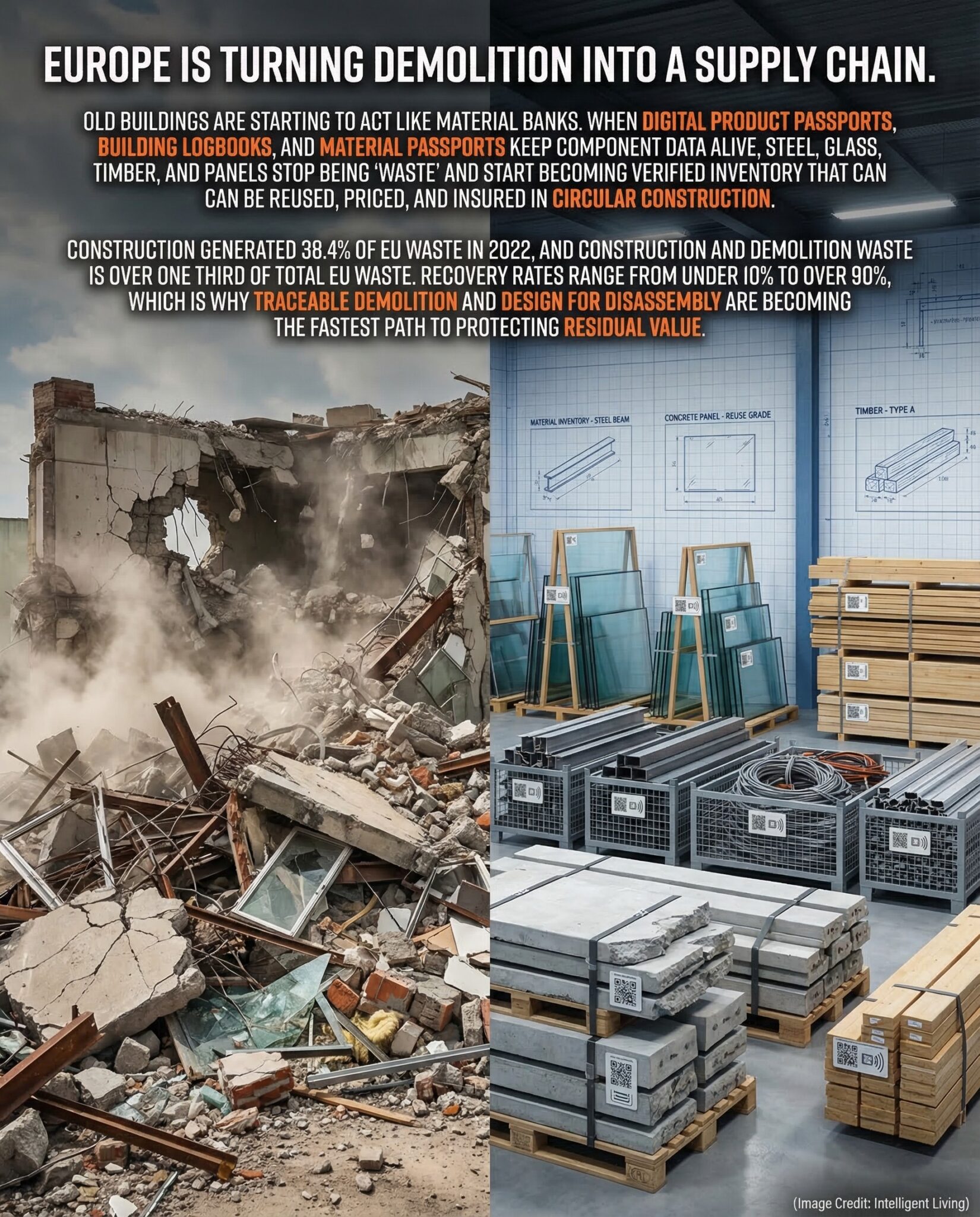
Key Insights: Buildings as Inventories for Secondary Raw Materials
- A building can function like a labeled warehouse: Recording components with composition and condition data transforms demolition into a planned inventory recovery process. Arup’s principles of retaining asset value treat the shift as value retention rather than simple disposal.
- Service-based housing models sharpen the incentive to recover materials: Approaches like long-term building systems frame structures as enduring assets rather than one-time products.
- Passports lose utility if data fails to survive renovations or ownership changes: Without continuous updates, a record serves only as a museum label instead of a functional operational tool.
- Economic Transformation: Verifying and valuing materials transforms salvage from a speculative guess into a measurable financial asset.

Material Banking Dynamics and European Policy Momentum
The Big Idea: A Building Isn’t Just Real Estate, It’s a Future Inventory
A building that is documented with component-level data becomes a retrievable store of materials. A structure serves as a labeled inventory instead of concluding its life as mixed rubble. It might include beams, windows, and floor slabs, each documented with its specific composition and reuse potential.
A maintenance manager who catalogs tiles and light fittings after a renovation often discovers significant value. If a buyer in another city requires reclaimed finishes for a restoration project, the value of those tiles alone might exceed the total waste-removal cost. Scenarios provide a clear business case for adopting a material banking strategy.
The Vital Role of Component-Level Inventory Data
Inventory provides three essential functions: it identifies the component, verifies its current condition, and establishes its original provenance. These data points are necessary for pricing, insuring, and approving reclaimed materials for use in modern projects.
The inventory typically links Building Information Models (BIM) with environmental product declarations and inspection records.
In EU briefings on improving building performance, buildings are consistently framed as a core lever for cutting energy demand and emissions. The Ellen MacArthur Foundation’s strategic built environment overview estimates that a circular approach could reduce CO2 emissions from building materials by 38% in 2050.
Why Now: Europe Is Assembling the Policy Stack for Circular Buildings
Europe’s policy timeline is pushing traceability from a pilot curiosity to a compliance reality. Specific regulatory pillars now drive environmental transparency:
- Circularity Agenda: Primary momentum stems from the strategic reuse of secondary materials to strengthen markets for recovered inputs.
- Legislative Timelines: The upcoming Circular Economy Act introduces demand-side rules to simplify the procurement of circular materials.
- Digital Data Framework: Rules enabling digital product passports create a legal backbone for digital product tracking across the EU.
- Sustainability Governance: Updated construction product governance tightens environmental reporting standards.
- Building Directives: The recast European buildings directive establishes the framework for staged renovation planning and digital building logbooks.
These intersecting policies ensure that sustainability data moves from a voluntary disclosure to a core market requirement.
Market Signals and Procurement Shifts
When these rules intersect, they create both obligations and market opportunities. A contractor who can provide verified product data and a reliable building record can be better positioned for renovations where lifecycle reporting has become a selection factor. In public tenders, green building design standards already reward clearer lifecycle documentation and lower-impact specifications.
A former procurement officer in a mid-sized city observed a pivotal shift when tenders began requiring lifecycle data fields. Change allowed a smaller manufacturer with meticulous product documentation to secure multiple significant contracts. Modern procurement standards demonstrate that digital data requirements rapidly reorganize market leadership.
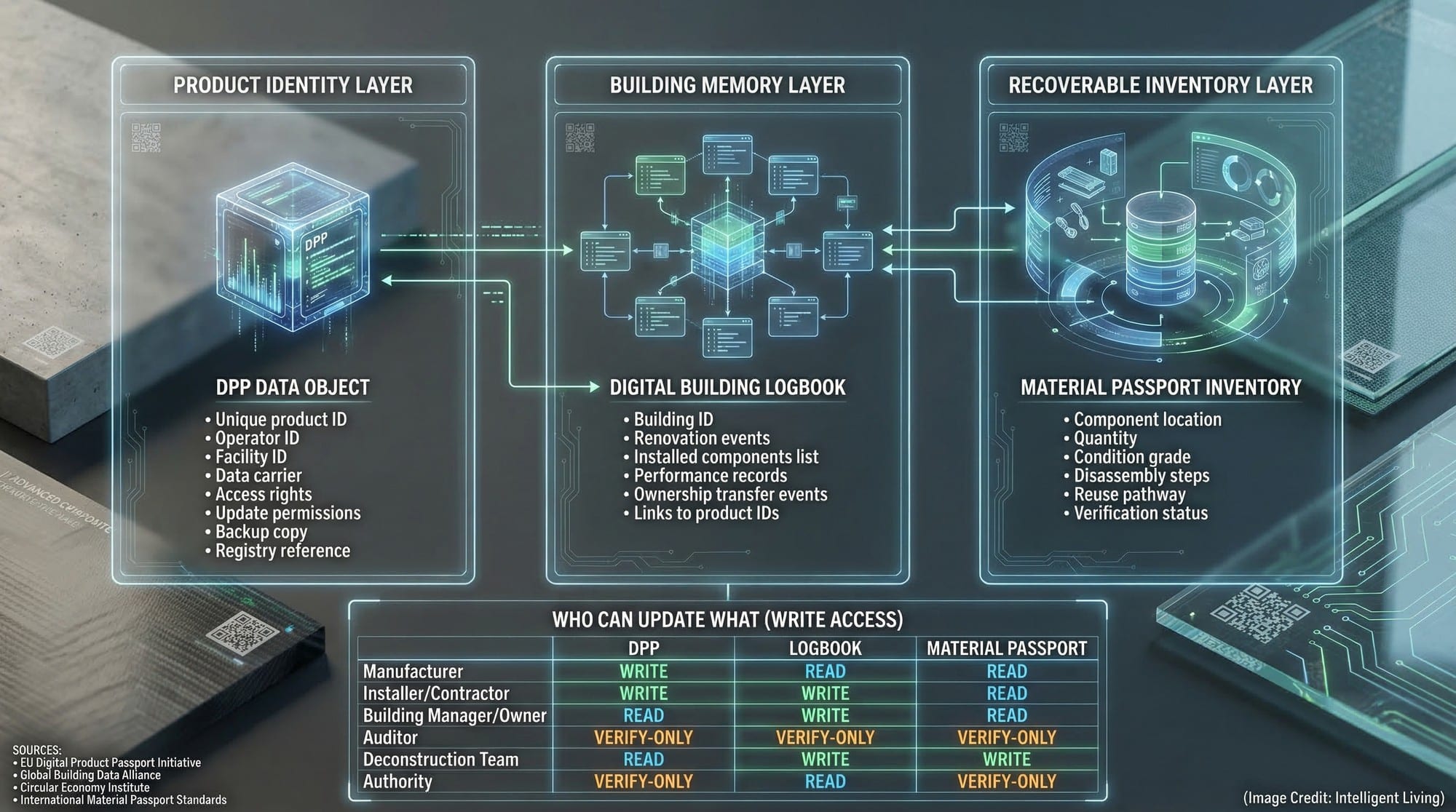
Traceable Infrastructure: Linking Digital Product Passports to Building Logbooks
Traceability Tools: Distinguishing Passports from Digital Building Logbooks
Passport logic follows familiar supply-chain protocols. These three tools overlap but play distinct roles in a circular building ecosystem.
Product Passport (Digital Product Passport)
A digital product passport serves as a component-focused record, detailing material composition, origin, and end-of-life instructions alongside embodied carbon metrics. Logic follows familiar supply-chain rules. Digital supply-chain identity ensures documentation travels with the shipment rather than relying on vendor promises. Similar data fields are now appearing in energy storage through pilot battery passport programs.
Building Logbook (Digital Building Logbook)
A building logbook operates at asset scale. The logbook aggregates renovation history, performance data, and, where available, links to installed product records. Logbooks become the practical “memory” of a building as ownership changes and upgrades occur. In practice, accessible building data repositories are intended to keep critical building information consistent across owners, financiers, and public authorities.
Material Passport (Bridge Layer)
Material passports translate product-level records into an asset-level inventory. Passports record what is installed where, in what quantities and condition, plus notes on disassembly and reuse suitability. The BAMB framework describes preserving recovery value by mapping characteristics and reuse potential.
A design consultant noted a pilot where a material passport identified a façade system using reversible fixings. This specific detail enabled the recovery of entire panels and significantly reduced deconstruction labor. Precise documentation transforms circular theory into tangible salvageable value.
What a Material Passport Contains
Material passports are only as useful as the data inside them. A pragmatic passport contains at minimum: component identification, material composition, quantity, installation date, performance metrics, maintenance history, safe handling notes, and recommended disassembly steps.
Essential Metrics for Accurate Material Passport Documentation
- Component ID and Location: Where the item sits in the building, plus a unique identifier that links back to BIM or floor plans.
- Material Composition: Composition data proves vital for salvage operations, especially when permanent adhesives complicate component recovery.
- Condition and Service Life: Measured or assessed condition, which influences reuse value.
- Disassembly Instructions: Fastener types, accessible joints, and recommended tools.
- Environmental Metrics: Environmental declaration references or global warming potential estimates when available.
A small-scale contractor noted that early passports captured only procurement paperwork. Reaching “good enough” data quality required deliberate post-installation checks. Inspection is often the hidden cost in creating a durable passport.
Where the Data Comes From
The challenge lies in harmonizing diverse data sources into a single searchable record, particularly for older structures lacking digital history.
Research on passport data availability identifies missing as-built information and inconsistent product data as the primary bottlenecks for implementation.
For older or informally documented buildings, passports require field surveys and testing. Upfront costs increase, but surveys unlock salvage markets and more accurate whole-life costing.

Resource Strategy: Material Recovery through Urban Mining and Circular Design
Urban Mining: Converting Construction Waste into Resource Streams
Construction currently sits at the top of Europe’s waste hierarchy. The European Commission identifies the management of demolition waste as one of the region’s largest flows. Regional statistics on sector waste confirm that construction remains the primary contributor to total waste, meaning even minor reuse gains have significant environmental value.
A maintenance crew in an older neighborhood once cataloged hundreds of meters of salvaged timber during a controlled strip-out. Within weeks, a local restoration studio purchased the timber for custom furniture. Local demand shortened the recovery loop and preserved value.
Material passports function like a matchmaking tool. Passports expose quantities and quality to buyers who need specific grades and verified properties. Some of the lowest-friction circularity today happens when demolition byproducts become inputs for new binders. Using recycled fines in cement feedstock and scaling hybrid binder solutions can keep more demolition material in the construction loop while reducing demand for carbon-intensive clinker.
Design for Disassembly: Principles of Recovery
Design choices determine whether components are recoverable. A structure built for speed and sealing with permanent adhesives is harder to reclaim than one designed with mechanical fasteners and modular interfaces. Principles from adaptability and disassembly standards treat recoverability as an early design decision, not a demolition afterthought.
Core Design Rules
Strategic design habits ensure that components remain recoverable at the end of their service life:
- Accessible Joints: Connectors must remain reachable to facilitate non-destructive disassembly and component recovery.
- Standardized Modules: Repeatable element sizes simplify future remanufacture and reuse.
- Separable Materials: Avoiding irreversible composites preserves the purity of the material stream.
- Integrated Documentation: All connectors and material substitutions must be logged within the digital passport.
Reversible design principles transform a building from a fixed asset into a flexible assembly of future resources.
Technologies that Help
Off-site prefabrication and modular systems often simplify later recovery because parts are standardized and documentation is easier to maintain, including automated modular construction methods. Standardized modules can still feel personal and lived-in, as shown by high-quality modular housing, which matters when reuse-ready design needs mainstream adoption.
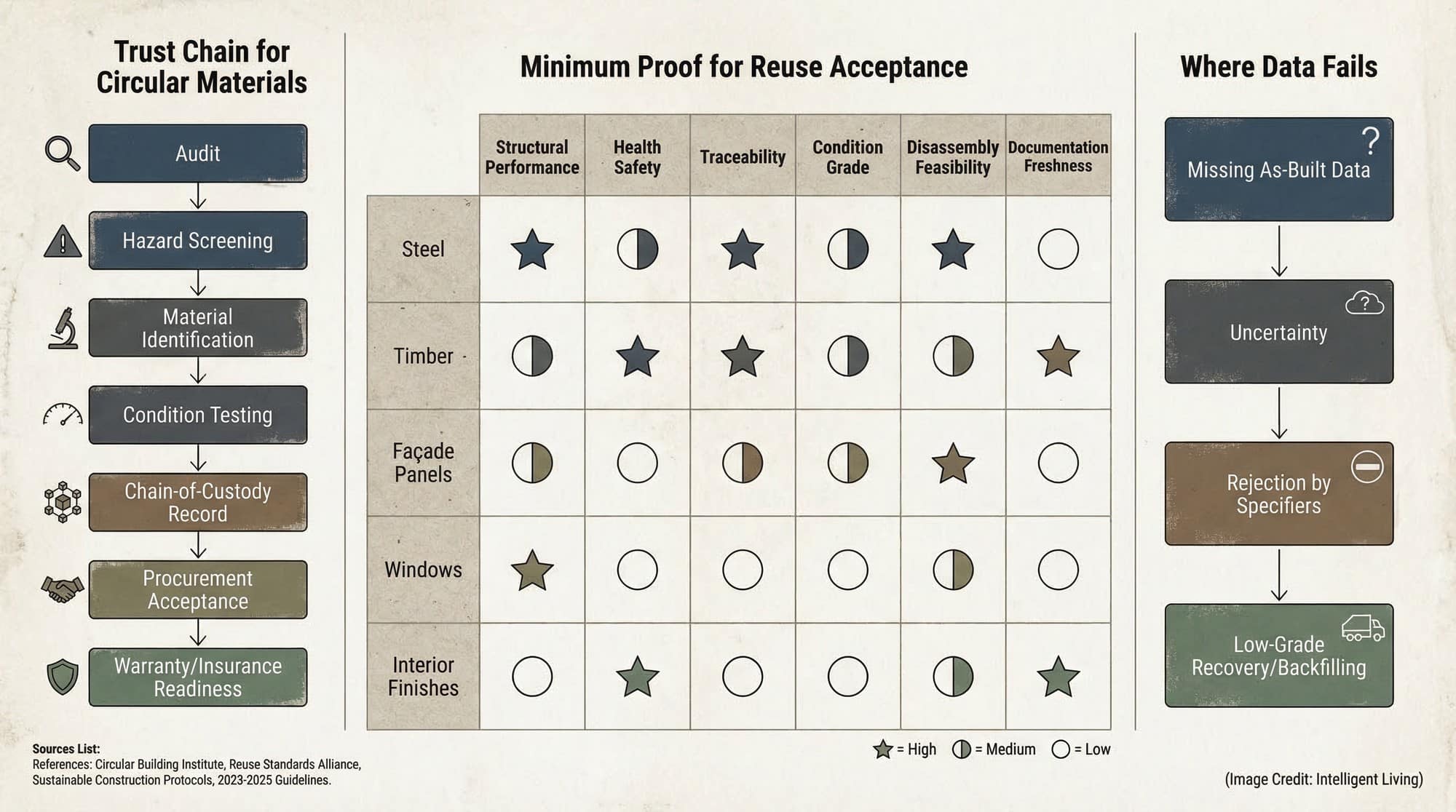
Implementation Standards: Establishing Trust in Circular Building Ecosystems
Field Insights: Lessons from Material Cadastres and Pilot Scaling
Proof-of-concept projects show passports and reversible design can work, but they also highlight the heavy lifting needed to scale.
- Data Models Work: Materials passport templates and reversible design methods are no longer theoretical.
- Inventory Can Be Searchable: Cadastre-style inventories show how components can be organized for future recovery.
- Operational Hurdles Persist: Data upkeep, ownership transfers, and verification remain sticking points.
One pilot team reported that the most time-consuming activity was resolving ambiguous as-built documentation. Old drawings often took weeks of interviews and inspections to reconcile, which helps explain why pilots do not translate overnight into city-scale programs.
At the program level, the Buildings as Material Banks research initiative shows how materials passports and reversible design were tested as a structured pathway to reuse. At the building level, the Triodos headquarters has been mapped as a recoverable asset inventory.
Market Integrity: Managing Liability and Standards in Circular Procurement
If passports and logbooks make materials visible, standards and procurement policies decide whether those materials can be trusted. Trust sits at the intersection of certification, procurement rules, and legal liability for reclaimed components.
Liability and Verification
Buyers need assurance that reclaimed materials meet structural and health standards. Assurance requires third-party testing, traceable supply chains, and standards that specify acceptable reuse cases. A systems view in the Circular Built Environment strategy treats reuse readiness as a blend of design choices, procurement rules, and verified information rather than a single technical fix.
Reused materials were once excluded from public housing projects due to procurement rules requiring new certifications. Standards evolved only after a certified pathway for reclaimed components was established, effectively normalizing large-scale reuse.
Standards and Interoperability
For passports to be portable across projects, they must use interoperable data standards and remain readable through software changes. Harmonized environmental metrics can help align product emissions data with passport fields. At the EU level, the assessment language for lifecycle performance provides a shared framework for circular thinking, which helps keep reporting consistent across projects.
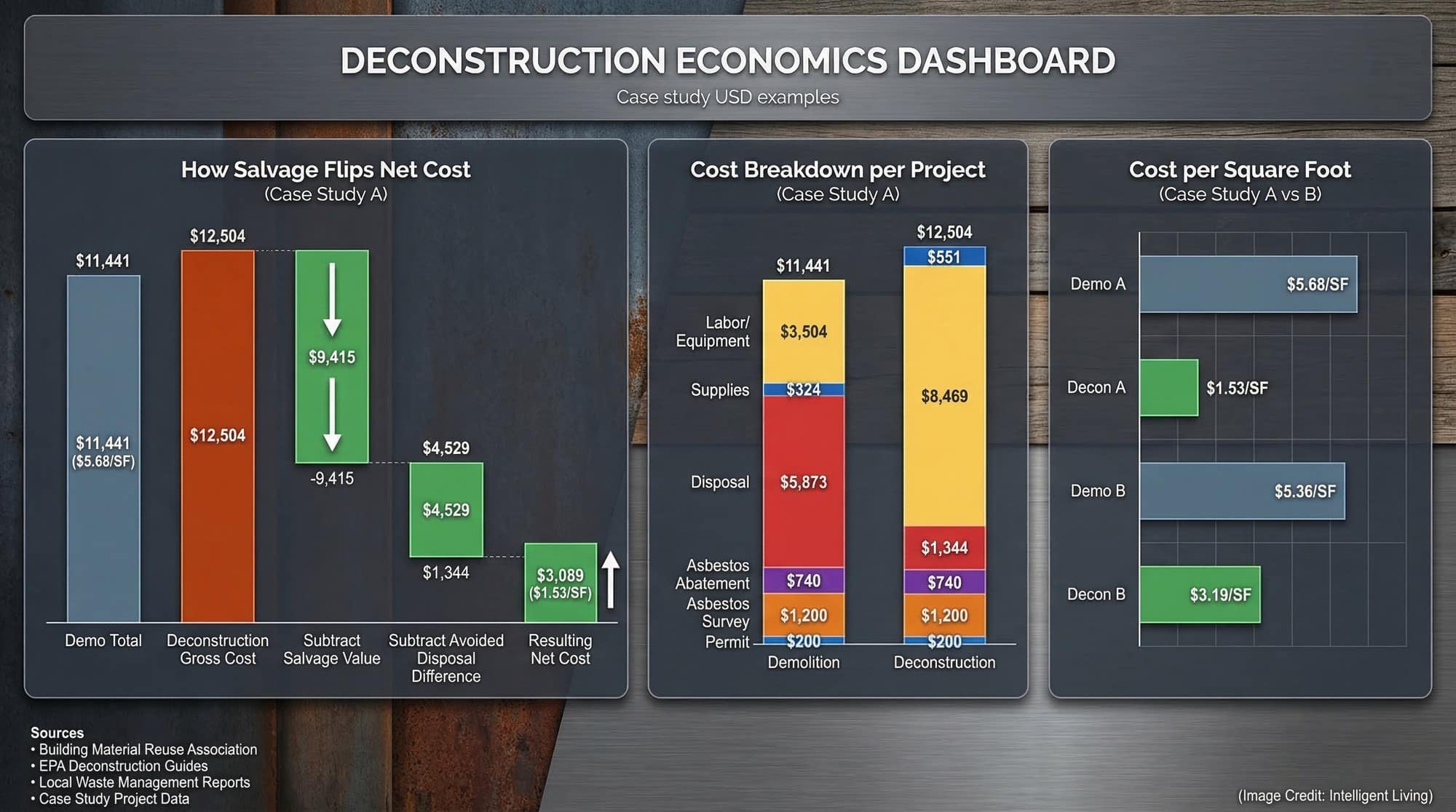
Financial Markets: Residual Value and the Roadmap for Investable Assets
Economic Logic: Materials as Collateral and Salvage Value Assessment
Verifiable inventories enable a more sophisticated approach to real estate finance and valuation:
- Salvage Valuation: Credible passports allow appraisers to calculate residual value rather than viewing demolition as a total loss.
- Alternative Financing: Provenance data makes component leasing and salvage-backed lending viable business models.
- Precision Risk Pricing: Insurers can better calibrate deconstruction risks when reliable material records are available.
Data-driven logic moves circularity from a sustainability goal to a measurable financial asset. Policy briefings on traceable inventory and risk pricing connect inventories to residual value logic, while a guide to maintaining construction asset revenue frames maintenance as a revenue structure.
What to Watch Next (2025–2027): Key Implementation Milestones
A short watchlist for owners, designers, and civic leaders tracking the implementation phase.
- Delegated Acts Under ESPR: These will determine which product groups require passports and what fields become mandatory.
- National Renovation Passport Schemes: Member State rollouts will determine how consistent building-level records become. Commission guidance on renovation passport roadmaps and required elements is already shaping how staged upgrades are documented.
- Secondary Materials Market Maturity: The practical signal will be stable demand for reclaimed components with verified properties.
Product passport thinking is already spreading across sectors, with emerging verification infrastructure shaping how identity and reporting become routine.

Strategic Implementation: Practical Steps for a Circular Built Environment
Closing the Loop: How Owners, Designers, and Policymakers Can Act Today
For owners: Property owners should initiate an as-built audit prior to any major renovation. Even a basic passport that documents primary components can significantly improve salvage outcomes.
For designers and contractors: Designers and contractors must prioritize reversible connections and standardized modules. Investing a small portion of the budget in documentation yields long-term returns through efficient deconstruction. Material choices matter too, and sustainable building materials are easier to track, certify, and recirculate when specifications stay consistent from purchase to installation.
For policymakers and procurers: Require passport-friendly documentation in tenders and create pathways for certified reuse in public procurement.
A municipal building commissioner described how a single clause in a procurement framework favoring traceable material sources shifted local suppliers toward better documentation habits. Small legal nudges like that can reshape supply ecosystems.
Practical field-level measures can also be organized into a checklist of material loss reduction strategies.
Future Outlook: Reclaiming Cities as Scalable Material Banks
Evolving buildings into material banks is less a technological hurdle and more a systems design challenge. It requires a synergy of interoperable data, market development, and a commitment to urban mining. Europe’s current regulatory push provides a vital window to scale these efforts, ensuring that secondary raw materials are captured efficiently. Components only transition from waste to reusable inventory when their digital documentation remains active and accurate throughout the asset’s life.
The shift toward circularity signals a new era for real estate valuation and risk management. As digital product passports become standard, the ability to verify material provenance will directly influence a building’s marketability and insurance profile. This data-driven approach removes the guesswork from salvage operations, making the recovery of resources both predictable and investable. Success in circular construction depends on maintaining a transparent and reliable record of the materials forming urban environments.

Strategic FAQ: Material Banking and Circular Construction
How does material banking reduce construction waste?
Material banking treats buildings as inventories, ensuring components are deconstructed and reused as high-value resources instead of being sent to landfills.
What is the role of a digital product passport in reuse?
A digital product passport provides verified data on material composition and condition, allowing buyers to trust the performance and safety of reclaimed components.
Are digital building logbooks mandatory in Europe?
EU directives are currently establishing digital building logbooks as a standard for tracking renovation history and energy performance across member states.
Why is urban mining considered the future of construction?
Urban mining retrieves valuable materials from existing structures, reducing the demand for carbon-intensive virgin resources and lowering the industry’s environmental footprint.
How can developers benefit from documenting material salvage value?
Documenting salvage value allows for more accurate residual value estimates, potentially improving loan terms and reducing overall lifecycle costs for property owners.
How Do Material Choices Connect to Prefab and Low-Tox Builds?
Material banking works best when components are standardized and documented early, which aligns with prefab selection strategies that prioritize repeatable assemblies and verified materials, including modular construction inputs, where standard sizing and documented assemblies make future reuse more realistic.


