
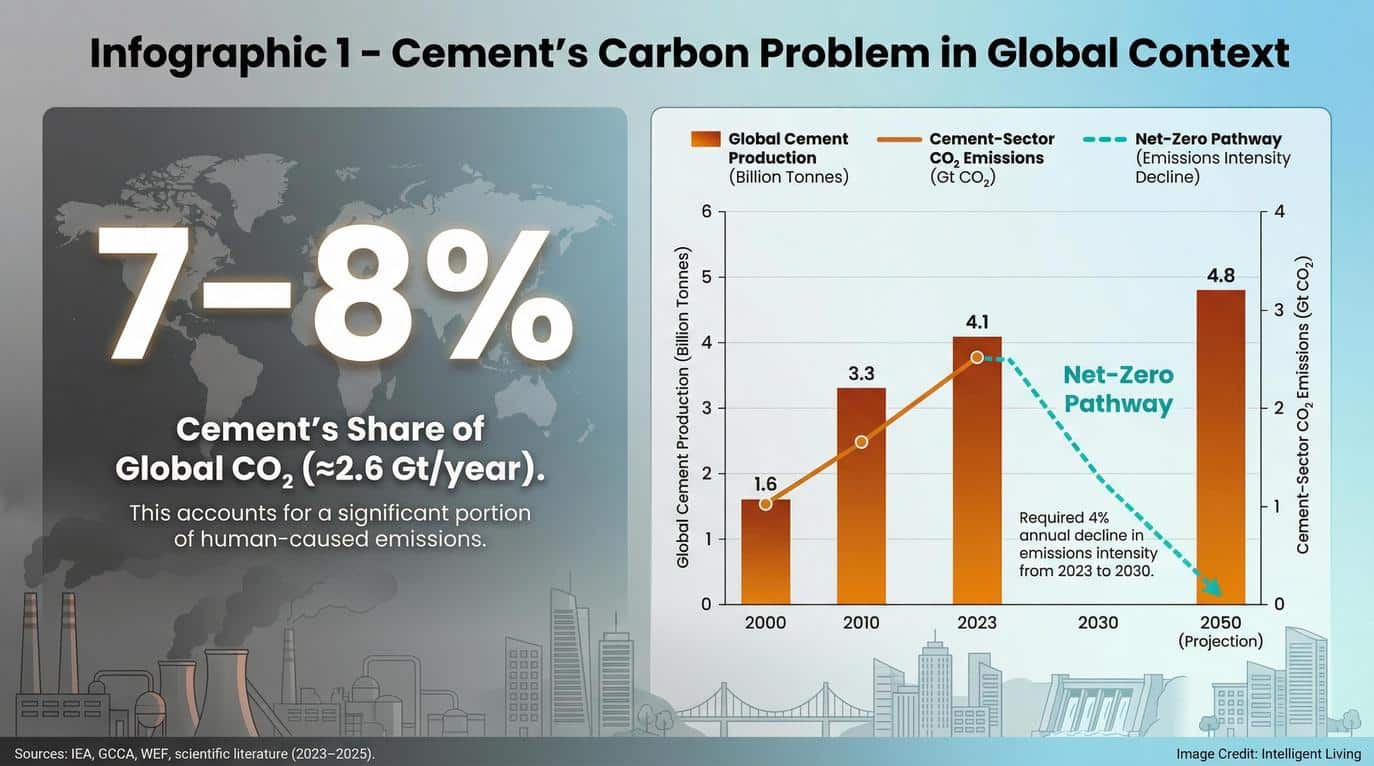
Every year, the world produces billions of tons of construction and demolition waste—the concrete remnants of old buildings, roads, and bridges that once defined our skylines. Traditional methods typically discard these remnants in landfills or downcycle them into low-grade aggregate for road foundations. Simultaneously, global cement manufacturing generates approximately seven to eight percent of worldwide carbon dioxide emissions, primarily driven by the intense energy requirements of high-temperature kilning.
Advancements in engineering demonstrate that recycled concrete fines (RCF)—fine particles recovered during crushing—effectively transform into high-value raw material for low-carbon cement production. Repurposing these fine particles transforms demolition dust into the building blocks of the next generation of sustainable infrastructure.
Closing the material loop represents more than a mere engineering breakthrough. It represents a complete rethinking of how we build and rebuild cities. Closing the concrete loop has emerged as a true innovation for the construction industry, establishing a complete rethinking of how we rebuild urban environments by proving that waste can be an asset for a cleaner future.

Essential Data on Recycled Concrete Fines and Sustainable Cement Innovation
Meeting the urgent requirements of international climate agreements necessitates a rapid transformation in how the industry handles basic building blocks. The following highlights provide a clear overview of why material scientists are prioritizing recycled concrete fines as a primary decarbonization tool:
- Cement’s Carbon Footprint: Manufacturing processes account for approximately seven to eight percent of worldwide emissions, anchoring the urgency for industrial change.
- Construction Waste Volume: Annual global generation of over ten billion tons of demolition debris creates an immense logistical and environmental burden for urban development projects.
- Recycled Concrete Fines (RCF): These microscopic particles are recovered from crushed waste to partially replace clinker, the most carbon-heavy ingredient in cement.
- UK Pilot Success: Recent industrial trials by Holcim UK confirm that RCF effectively replaces 20% of clinker while meeting all necessary structural performance requirements.
- Circular Construction: This methodology establishes a closed-loop system that preserves resources and drastically lowers industrial waste output.
Understanding these fundamental metrics allows developers to appreciate the massive scale of the circular opportunity. Moving from theoretical research to practical application is the next critical phase for sustainable infrastructure.
Addressing the Dual Crisis of Industrial Emissions and Demolition Waste
Cement Production as a Primary Source of Global Industrial CO₂
Cement serves as the essential binder for modern development, anchoring the infrastructure that defines global urban landscapes. Unfortunately, conventional manufacturing remains energy-intensive and ecologically demanding. Heating limestone to over 1,400°C to produce clinker triggers massive carbon dioxide release, stemming from both fossil fuel combustion and the chemical calcination of the stone itself.
According to the Global Cement and Concrete Association roadmap for decarbonization, reaching climate goals demands a multifaceted mix of strategies ranging from carbon capture to alternative material chemistries. Directly repurposing waste concrete as cement feedstock offers a uniquely efficient and circular alternative to traditional decarbonization methods.
The Global Construction and Demolition Waste Mountain
Rapid urbanization combined with constant infrastructure renewal results in the demolition and replacement of immense concrete volumes. Global estimates suggest that over 10 billion tons of construction and demolition waste (C&DW) are generated every year, and concrete represents a significant share of that total.
Current industrial practices typically crush these remnants into coarse aggregate for roadbeds or divert them into overburdened landfills. The finer material—recycled concrete fines—is often considered unusable due to its high water demand and inconsistent chemical composition.
New research is proving that these perceptions are outdated. Recent breakthroughs in recycled concrete fines as a supplementary cementitious material indicate that these recovered particles serve as high-performance binders in modern mixes. Furthermore, industrial teams are currently perfecting hybrid waste concrete utilizing recycled aggregates and plastics to demonstrate that demolition fines effectively replace a significant portion of traditional clinker.
Why Demolition Dust Matters
The ability to reuse the fine fractions of old concrete is crucial because it targets two problems simultaneously: waste and emissions. Unlike conventional downcycling, processing recycled concrete fines enables engineers to isolate and recover the active reactive compounds essential for cement strength. This not only prevents landfill accumulation but also displaces the need for fresh limestone mining and high-temperature kilning—two major sources of emissions.
Technical teams are currently evaluating diverse waste-derived binders, such as cement made from food waste and green concrete reinforced with PPE waste fibers. These breakthroughs, combined with the development of stronger concrete produced from shrimp shell biopolymers, emphasize the global shift toward viewing waste streams as high-value inputs for low-carbon cement.
Optimizing these waste streams delivers substantial environmental gains: reduced mining activity, minimized landfill volume, and significantly lower carbon output.

Composition and Technical Potential of Recycled Concrete Fines
From Crushed Concrete to Fines: What’s in the Mix
Demolition and crushing operations produce a mixture of materials ranging from coarse aggregates to microscopic fine powders. These recycled concrete fines, typically smaller than 150 microns, comprise several critical elements:
- Original Cement Paste Remnants: The primary source of latent hydraulic reactivity.
- Fine Sand Particles: Natural byproducts of the original concrete mix.
- Unhydrated Cement: Particles that have not yet fully reacted with water.
- Small Aggregate Fragments: Micro-debris that adds volume to the mix.
Previously categorized as unusable debris, recycled concrete fines are now recognized as valuable technical assets due to breakthroughs in material science. Recovered particles retain significant hydraulic potential for new cementitious bonding. Recovering these compounds ensures that demolition dust effectively anchors the next generation of sustainable infrastructure.
Why Fines Are Hard to Use in Traditional Concrete
Despite their potential, RCFs pose challenges for conventional concrete production. Their small particle size increases surface area, which leads to higher water demand and potential workability issues. Variations in the composition of fines depend significantly on the specific demolition source, such as building foundations versus bridge decks.
Historically, this inconsistency made it difficult to integrate fines into new concrete without compromising quality. However, improved sorting technologies, advanced washing and separation methods, and chemical admixtures are helping to standardize RCFs for reuse. With proper processing, these fines can now achieve the consistency and reactivity required for cement manufacturing.
The Circular Idea: Treating Fines as Clinker Feedstock
The real innovation lies in using RCF not just as an additive but as a direct clinker replacement. Pre-treating and co-calcining recycled fines allows researchers to produce a low-carbon clinker that significantly lowers process and energy emissions. This process mimics traditional cement production but starts with a feedstock that has already undergone partial hydration and decarbonation—meaning less energy is required to reprocess it.
Strategic urban mining initiatives reimagine modern cities as active reservoirs of future building materials, allowing producers to harvest feedstock from demolished structures. Instead of quarrying new limestone and clay, we can harvest raw materials from demolished structures, closing the loop between old and new construction. The result is a truly circular approach to one of the world’s most resource-intensive industries.

Industrial Validation: UK Pilot Success in Clinker Replacement Technology
Who’s Involved and What They Tested
A UK-based consortium led by Holcim UK and the Materials Processing Institute has successfully transitioned this circular concept into large-scale industrial trials. Their project tested the use of recycled concrete fines as a substitute for a portion of traditional clinker in the cement-making process. The trial was conducted at a commercial ready-mix facility, marking one of the first industrial-scale demonstrations of this technology.
The results were encouraging. RCF replaced about 20% of the clinker in a standard CEM II cement formulation without reducing strength or performance. According to the research team, this substitution translates to a substantial reduction in embodied carbon while maintaining full compatibility with existing production infrastructure.
The 20% Clinker Replacement Result and What It Means
Substituting 20% of clinker with recycled fines represents a significant technical milestone with major implications for global emissions targets. Clinker is responsible for nearly 90% of the CO₂ emissions associated with cement production. A 20% reduction at scale could save millions of tons of carbon dioxide annually. The recycling process requires no specialized equipment or exotic materials, as it leverages existing industrial infrastructure.
Inherent compatibility makes RCF exceptionally promising when compared to capital-intensive decarbonization methods like carbon capture and storage. Instead of overhauling entire factories, producers can adapt their current systems to integrate recycled fines, achieving meaningful emissions cuts with lower barriers to adoption.
How RCF-Based Cement Performs in Practice
Early performance tests show that RCF-blended cement can deliver comparable compressive strength and durability to conventional mixes. Researchers attribute this to the reactive phases remaining in the recycled fines and their ability to participate in hydration reactions during curing. The resulting microstructure is dense and resilient, with reduced porosity compared to standard Portland cement.
RCF-blended cements exhibit enhanced sustainability metrics that extend well beyond simple carbon reduction. Blended cements promote local sourcing, decrease landfill dependency, and slash transportation emissions tied to raw material acquisition. In practical terms, that means shorter supply chains and more resilient regional construction economies.
The UK trial represents a pivotal moment in material innovation—a glimpse of a construction industry capable of building with its own remnants. As the findings continue to undergo validation and scaling, recycled concrete fines could soon become a cornerstone of the global shift toward circular, low-carbon construction.

Strategic Pathways for Comprehensive Cement Decarbonization
Mapping the Pathways to Decarbonization
Reaching net-zero targets in the cement industry demands a multifaceted portfolio of integrated technological breakthroughs. Several key approaches are currently reshaping the industry’s future:
- Limestone Calcined Clay Cement (LC3): Adopting limestone calcined clay cement (LC3) technology reduces emissions by 40% through lower-energy boosters.
- Carbon Capture and Storage (CCS): Deployment of carbon capture systems at the Brevik facility demonstrates the industrial feasibility of removing hundreds of thousands of tons of CO₂ annually.
- Electric Arc Furnace Recycling: Innovative electric arc furnace recycling of cement paste allows steel manufacturers to simultaneously produce new clinker from demolition waste.
- Recycled Concrete Fines (RCF): Harvests reactive dust from urban mining sites.
Each methodology offers unique advantages in terms of cost, scalability, and regional availability. Implementing these technologies in tandem ensures a robust and resilient path toward full industrial decarbonization. Reaching net-zero targets demands a transition toward revolutionary sustainable concrete technologies, while implementing green cement and concrete innovations ensures that modern infrastructure meets the highest standards of ecological responsibility.
Where Recycled Concrete Fines Fit In
Recycled concrete fines complement these other technologies by targeting the most carbon-intensive component of cement: clinker. Unlike CCS, which adds complexity and cost, or LC3, which requires access to specific clay minerals, RCF relies on a waste stream every city already generates.
Experimental carbon-negative concretes replacing clinker with olivine and recent developments in organically generated limestone-based binders further show how alternative chemistries can work alongside RCF to cut process emissions even more. Recycled fines represent one of the most geographically adaptable and cost-effective instruments available in the decarbonization toolkit.
Integrating multiple approaches—including RCF, LC3, CCS, and alternative fuels—could slash the industry’s carbon intensity by up to 70% by 2050. The key will be aligning innovation, regulation, and market incentives to ensure these technologies scale in tandem rather than compete for limited investment.

Regulatory Frameworks and Scalability Challenges for Circular Materials
Testing and Certification Challenges
Despite the success of initial UK trials, transitioning toward full-scale commercial adoption involves navigating intricate regulatory and technical barriers. New cement formulations must pass rigorous performance tests for strength, durability, and safety before they can be approved for structural use.
National certification bodies maintain rigorous safety standards, often requiring multi-year evaluation periods before updating established building codes, while certification bodies are currently evaluating new guidelines for supporting industrial sustainability in construction by aligning building codes with circular material standards.
In Europe, the European Committee for Standardization (CEN) is evaluating guidelines for incorporating new supplementary cementitious materials, including RCF. Once standards are established, large-scale commercialization will accelerate, but until then, most RCF use will remain in pilot or non-structural applications.
Mitigating Chemical Variability in Diverse Demolition Sources
Inherent variability remains a primary challenge for RCF adoption. Demolition concrete originates from diverse sources, leading to fluctuations in chemical composition across different batches.
Advanced sorting systems and rigorous chemical analysis are successfully mitigating these consistency issues. Regional collection centers further ensure quality by processing and certifying RCF feedstock before it reaches commercial cement plants.
Infrastructure and Policy Alignment
Scaling circular materials like RCF requires supportive infrastructure and public policy. Governments can encourage adoption through recycled-content mandates, landfill restrictions, and tax incentives for low-carbon construction materials.
In regions with ambitious climate targets, such as the EU and UK, integrating RCF into national decarbonization strategies could play a crucial role in meeting emission goals. Policy shifts are emerging in tandem with global construction trends toward closed-loop supply chains, facilitating the move from pilot projects into mainstream use.
Global Regulatory Trends and Financial Risks in Sustainable Construction
Regulatory Momentum and Corporate Commitments
Regulators and global investment groups are intensifying their oversight of carbon intensity in the cement manufacturing sector. The Global Cement and Concrete Association and its members have pledged net-zero by 2050, establishing critical intermediate milestones for 2030.
Legal Accountability and ESG Metrics in Material Procurement
Governments are responding by implementing strict embodied carbon limits on public infrastructure projects. Green procurement policies now actively reward circular solutions and low-carbon material integration. In the wider built environment, emerging housing-as-a-service and circular building models demonstrate how procurement policies support business frameworks that prioritize material recovery.
Companies like Holcim are positioning innovations such as RCF as part of broader sustainability strategies, aligning with ESG reporting and risk mitigation. Demonstrating tangible progress toward emissions targets helps producers maintain investor confidence while avoiding regulatory penalties.
Climate Litigation and Financial Risk
As climate accountability tightens, major producers face growing legal and reputational risks. Lawsuits and public campaigns targeting carbon-intensive industries emphasize the need for proactive innovation. Circular solutions like RCF provide not only a technical pathway to decarbonization but also a narrative of responsibility—proof that companies are acting rather than waiting.
Policy Synergy: Turning Regulation into Opportunity
Forward-thinking policies can turn compliance into a competitive advantage. Public procurement standards that favor low-carbon materials could rapidly scale demand for RCF cement. Similarly, carbon pricing mechanisms that reward emissions reductions can make recycled feedstocks more profitable than traditional clinker. The alignment of market incentives with environmental goals will define which solutions succeed in the coming decades.
Socioeconomic Impact for Builders, Municipalities, and Local Communities
For Builders and Engineers
For construction professionals, RCF-based cement offers an opportunity to meet sustainability targets without overhauling project designs or materials sourcing. Builders can specify low-carbon concrete mixes compatible with existing production methods, making this transition both practical and affordable. Specifying high-performance sustainable construction materials on major infrastructure projects allows contractors to strengthen their ESG credentials and secure green infrastructure work.
Municipal Urban Mining Programs and Local Green Job Growth
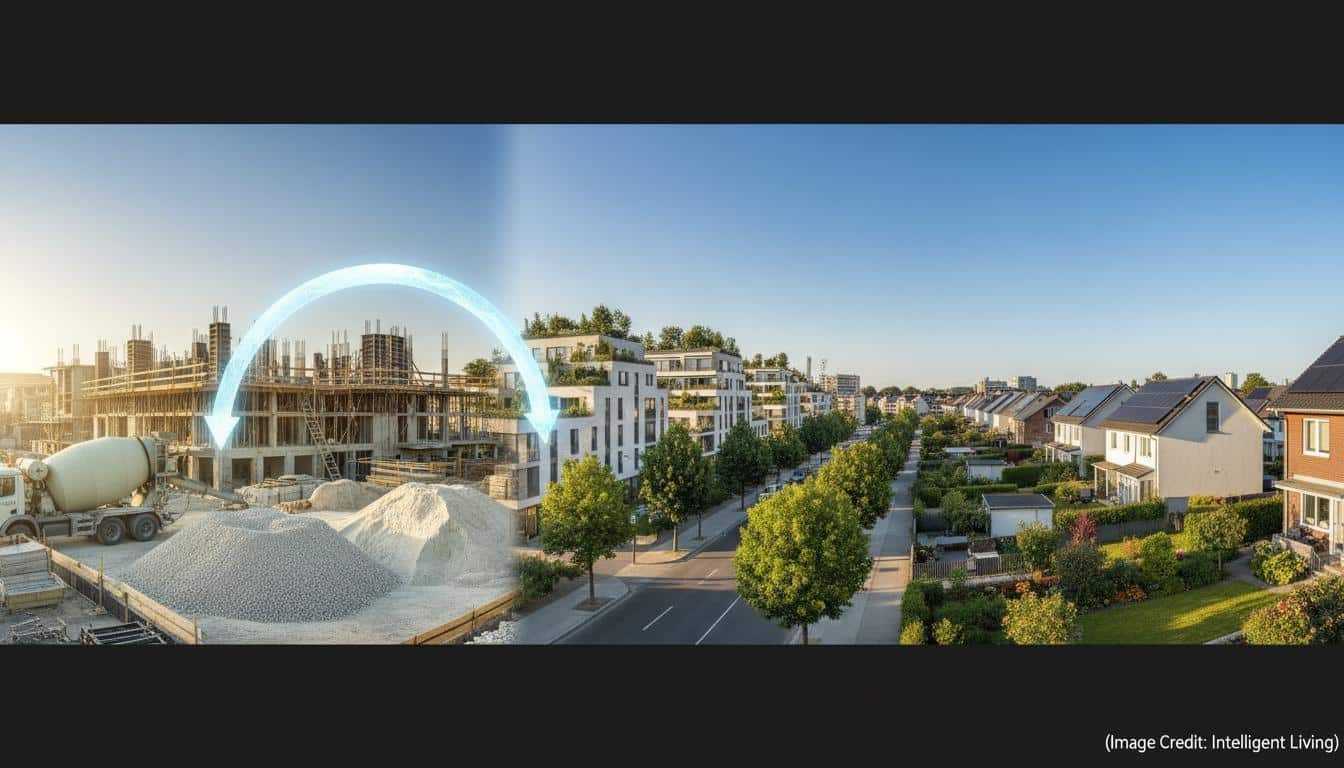
Municipalities stand to benefit enormously from adopting circular construction policies. Urban mining programs that reclaim materials from demolition sites can create local supply chains, reducing landfill dependence and transportation emissions. Implementing RCF-based cement in public infrastructure allows cities to meet carbon reduction goals and stimulate local green job growth. Adopting eco-friendly building materials facilitates a shift toward circular construction where lifecycle carbon takes priority over upfront costs.
For Homeowners and Communities
Homeowners may not see RCF cement labeled on store shelves, but its impact will reach them indirectly. As sustainable concrete becomes the industry standard, the development of green buildings with lower material emissions will fundamentally decrease the carbon footprint of future cities.
Even structural maintenance can contribute to decarbonization through low-carbon foundation repair and underpinning strategies that minimize cement use over a building’s lifetime. Promoting awareness of low-carbon materials, alongside the expansion of sustainable real estate options in smaller cities, significantly influences consumer demand and fosters a virtuous cycle of urban sustainability.
Scalable Pathways for Circular Cement and Urban Mining
Realizing a net-zero future for the built environment requires a fundamental shift in how engineers perceive demolition waste. Recycled concrete fines provide a technically viable and geographically adaptable solution that bridges the gap between traditional manufacturing and circular economics. Implementing these circular strategies allows producers to lower their carbon intensity while simultaneously addressing the global crisis of construction debris.
Success in the UK pilot trials demonstrates that performance and planet-friendly practices can coexist without compromising structural integrity. Future advancements in sorting technology and regulatory alignment will be critical for moving these low-carbon binders into the mainstream market. Technological and environmental necessity is currently redefining the future of concrete construction by transforming once-discarded waste into a resilient foundation for sustainable global infrastructure.

Critical Insights into Recycled Concrete Fines and Sustainable Building
1. How do recycled concrete fines differ from traditional aggregates?
Fines consist of microscopic particles smaller than 150 microns that retain reactive cement paste, whereas aggregates are larger inert stones used for volume.
2. Can RCF-based cement meet international strength standards?
Extensive industrial trials confirm that replacing up to 20% of clinker with processed fines maintains the compressive strength required for standard building applications.
3. What environmental benefits does clinker replacement offer?
Lowering the clinker-to-cement ratio directly reduces CO₂ emissions by minimizing limestone calcination and decreasing the fossil fuels needed for high-temperature kilning.
4. Are these circular materials currently available for large-scale projects?
Ongoing efforts in certification and building code updates are accelerating commercial availability across global markets, following successful pilot demonstrations.
5. Does urban mining increase the overall cost of construction?
Leveraging local demolition waste often reduces transportation costs and landfill fees, making RCF a competitive alternative to increasingly expensive raw limestone.


