
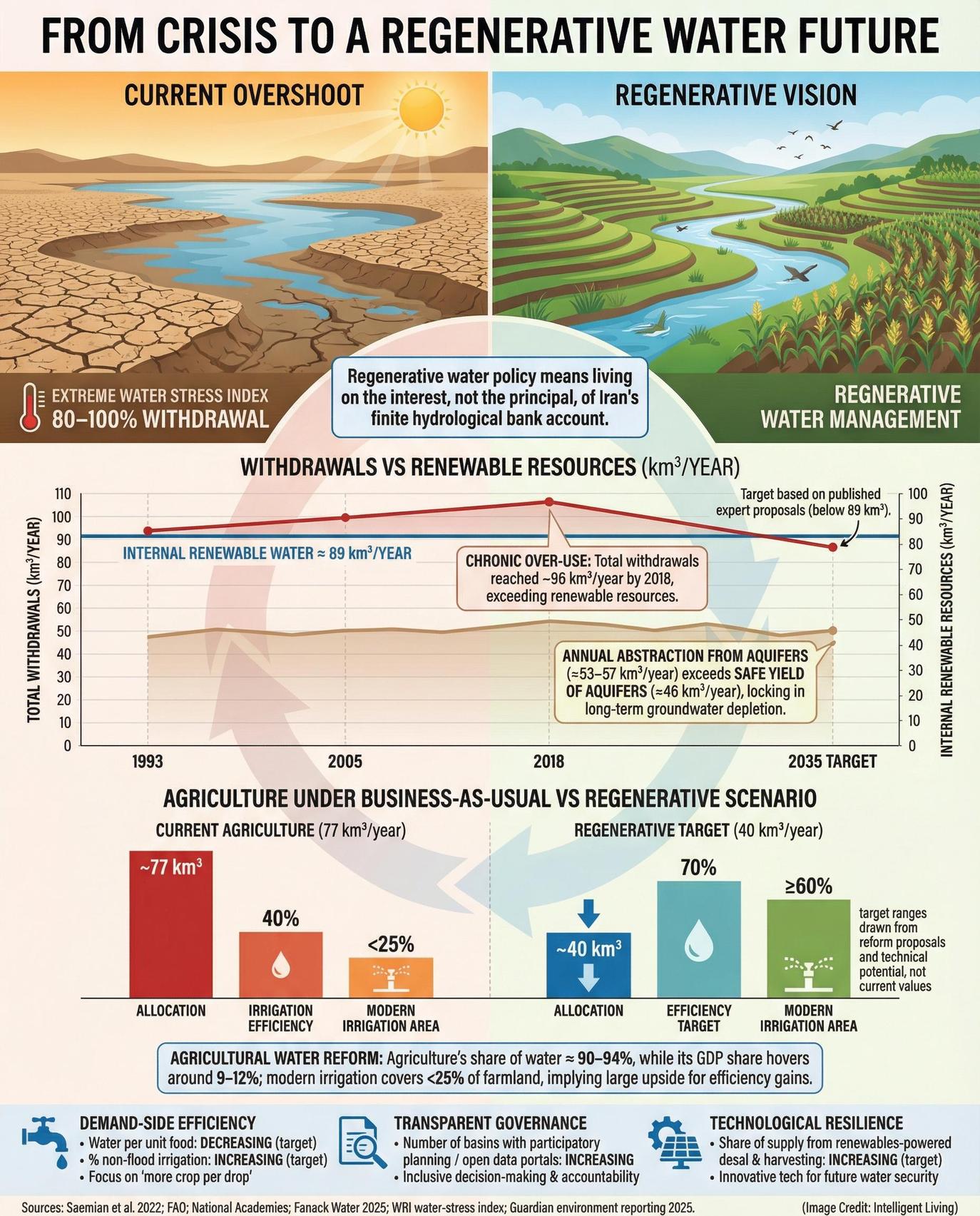
When the taps in Tehran sputter and fall silent, residents don’t just lose water—they lose time, security, and trust. Across Iran, parched riverbeds trace the outline of a nation that has drawn too deeply from its natural reserves. Scientists now warn that Iran has entered a state of water bankruptcy—a condition in which withdrawals from groundwater and surface water far exceed what nature can replenish. Persistent over-extraction proves the nation has effectively drained its hydrological savings.
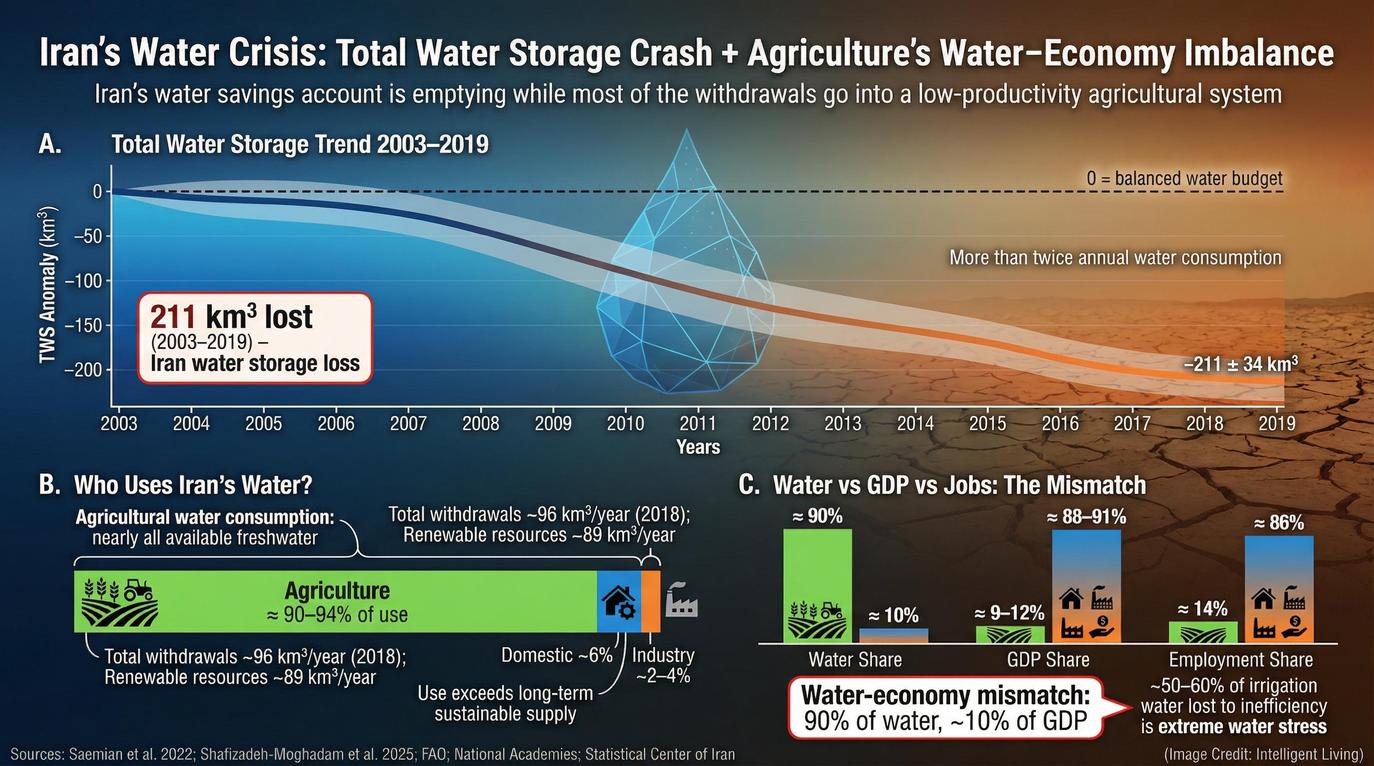
Data from the national-scale hydrology study using GRACE satellite data indicates Iran lost over 200 cubic kilometres of water storage between 2003 and 2019. This massive reduction represents roughly twice the country’s annual renewable freshwater supply. This unsustainable consumption is largely rooted in decades of policy decisions aimed at food self-sufficiency and industrial expansion—choices that, while economically motivated, ignored ecological balance.
But Iran’s crisis is not just local. The United Nations recently warned that the world is entering an era of global water bankruptcy, where consumption and climate pressures push entire regions past sustainability thresholds. Iran may simply be among the first to face what many other semi-arid countries will soon confront if practices don’t change.
The good news? Solutions exist. From smarter agriculture and transparent governance to advanced technologies such as AI-driven water safety monitoring and aerogels that harvest water from air, Iran could transform itself from a cautionary tale into a model of regenerative water management.
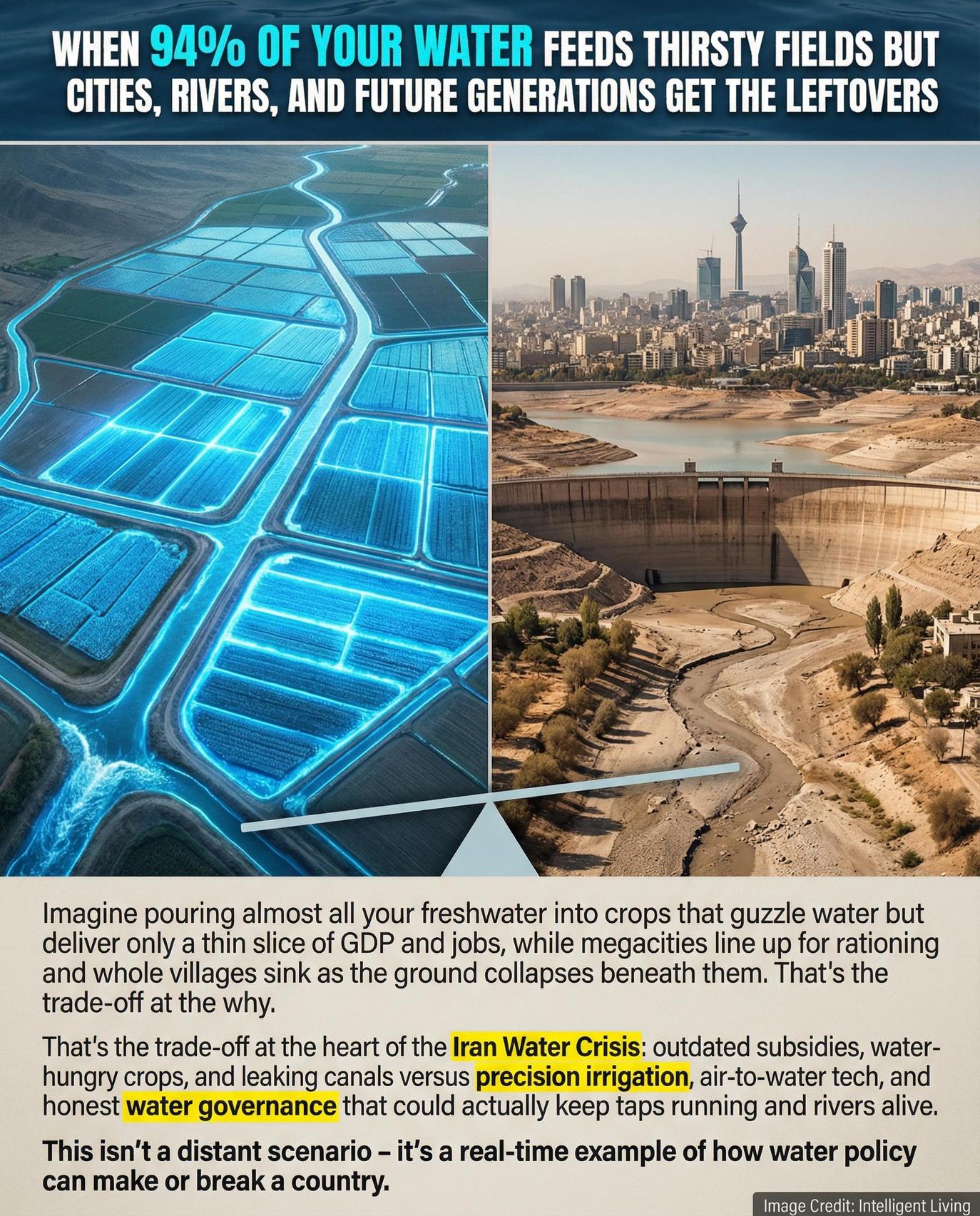
Quick Facts About Iran’s Water Crisis and the Push Toward Regeneration
- Iran has lost more than 200 km³ of water in the last two decades—the equivalent of draining Lake Ontario.
- Agricultural activities account for 90% of all water use, yet the sector contributes less than 10% of GDP.
- Over 31,000 square kilometres of Iranian land is sinking due to groundwater extraction, permanently damaging aquifers.
- Lake Urmia, once one of the largest hypersaline lakes in the Middle East, has shrunk to less than 10% of its original size.
- Climate models show Iran warming at 1.8°C above global averages, intensifying droughts and evaporation losses.
Historical Roots of Groundwater Depletion and Hydrological Mismanagement in Iran
Iran’s relationship with water has always been a story of innovation meeting adversity. For centuries, the country relied on qanats—ancient underground canals that transported groundwater to cities and farms without causing depletion. But in the past fifty years, this sustainable system was replaced by a modern, energy-intensive model built around dams, canals, and mechanical pumps.
Over 600 major dams currently operate across the country, channelling water to agricultural zones miles away from their natural sources.
Investigations into water-related limits to growth for agriculture in Iran show that these projects significantly altered the natural hydrology of entire basins. These interventions disrupted recharge cycles and directly contributed to the drying of vital wetlands. In places like the Zayandehrud River Basin, overreliance on dams and irrigation canals has led to rivers running dry, cities facing rationing, and farmers watching crops wither.
The Transition From Traditional Qanats to Industrial Infrastructure
The real turning point came when agricultural expansion collided with policy incentives for food self-sufficiency. Rice, sugar beet, and alfalfa—some of the most water-demanding crops on Earth—were planted in arid regions through heavy government subsidies. Heavy subsidies shifted the landscape so drastically that agriculture now consumes 92% of the nation’s blue water (surface and groundwater), even as yields lag behind global averages. In contrast, the industrial and residential sectors together use less than 8% of available water.
Adding to this imbalance is groundwater overexploitation. Satellite data from NASA’s GRACE mission reveal that Iran’s aquifers are being drained faster than almost anywhere else in the world. Non-renewable groundwater withdrawals have grown from 66 million cubic metres in 1965 to over 130 billion cubic metres by 2019. The result: dried-up wells, collapsing soils, and entire villages relocating as land becomes uninhabitable.
Climate change further amplifies these stresses. Iran has warmed nearly two degrees Celsius in the past three decades, outpacing global averages. Evaporation from reservoirs now rivals rainfall input in some basins, meaning even large-scale infrastructure projects can no longer guarantee a stable supply.
To reverse this trajectory, Iran must pivot from hydraulic expansion to hydrological restoration—protecting aquifers, modernising irrigation, and integrating AI-based forecasting systems. Combining ancient qanat wisdom with advanced water inspection and safety protocols could be the key to balancing efficiency and preservation.

The Visible Debt: Accelerated Land Subsidence and the Decline of Lake Urmia
Few places make Iran’s water debt visible like its sinking cities and dying lakes. Across the central plateau, land subsidence has reached catastrophic rates. The physical reality of groundwater depletion is most visible in the accelerating land subsidence across the central plateau. Remote sensing work identifying irrecoverable aquifer depletion zones highlights several critical danger zones:
- More than 31,400 km² of land is currently sinking faster than 10 millimetres per year.
- The ground in regions like Varamin and Rafsanjan drops by as much as 30 to 35 centimetres annually.
- Structural failures are widespread, with sinking earth cracking roads, damaging homes, and fracturing vital pipelines.
Irrecoverable Aquifer Depletion and the Impact on Urban Infrastructure
Permanent soil compacting effects mean the aquifers beneath these sinking cities can never truly recover. This collapse isn’t merely surface-level—it’s structural. Once groundwater is pumped out, empty pore spaces in soil compact under the weight above. These aquifers can never fully recover, meaning the damage is permanent.
The Ecological Collapse and Potential Restoration of Lake Urmia
Perhaps the most haunting emblem of this crisis is Lake Urmia in northwest Iran. Once spanning nearly 6,000 square kilometres, the lake has lost about 90% of its area since the 1990s. Satellite imagery shows retreating shorelines and salt flats spreading like pale scars across the landscape. The causes are clear: intensive dam construction and irrigation projects diverted river inflows, while climate change reduced mountain snowfall.
The environmental fallout has been staggering. Displaced rural families left the area in large numbers as soil salinity rose and tourism vanished. Attempts at restoration, including releasing dammed water and banning certain crops, have had limited success due to inconsistent enforcement and competing political interests.
Yet, hope remains. In 2024, Iranian researchers and NGOs began collaborating on AI-based monitoring programmes to track inflow patterns and prioritise regenerative watershed management. If paired with technologies that extract drinking water from air, such projects could help restore both ecological balance and community livelihoods.

Social Stability and the Crisis: Forging Participatory Water Governance in Iran
Water scarcity in Iran is no longer just an environmental concern; it’s a matter of national stability. In the southwestern province of Khuzestan, residents have taken to the streets demanding access to clean water as rivers like the Karun and Karkheh run dry. In Isfahan, farmers staged sit-ins along the Zayandehrud River, holding signs that read, “Let the river run.” These aren’t isolated incidents—they’re symptoms of a deeper social rift between citizens and the state.
Cultivating Public Trust Through Participatory Governance
The link between water management and public trust is increasingly evident. When promises of restoration go unmet, frustration grows. Policy experts suggest that water scarcity as a political pressure could become one of the defining internal challenges for the government over the next decade.
Systemic inequity further exacerbates the crisis, as wealthier urban centres often receive preferential access to water for industry, and rural communities face recurring shortages despite the availability of efficient agricultural tech that could optimize local water consumption. Poor transparency in data sharing exacerbates mistrust. Residents rarely know how water is allocated or why certain projects proceed despite ecological red flags.
Forging a new social contract around water demands solutions that extend far beyond physical pipelines. It calls for participatory governance, where farmers, scientists, and local councils collaborate on basin-level decisions. This community-centred approach echoes successful models in other arid nations that have combined traditional knowledge with digital transparency tools, such as public dashboards displaying real-time water use.
By aligning citizen engagement with data-driven accountability, Iran can transform water from a trigger of unrest into a catalyst for unity. Transparency itself becomes infrastructure—a foundation upon which resilience can be built.
Agricultural Transformation: Unlocking Efficiency Through Precision Farming and Smart Systems
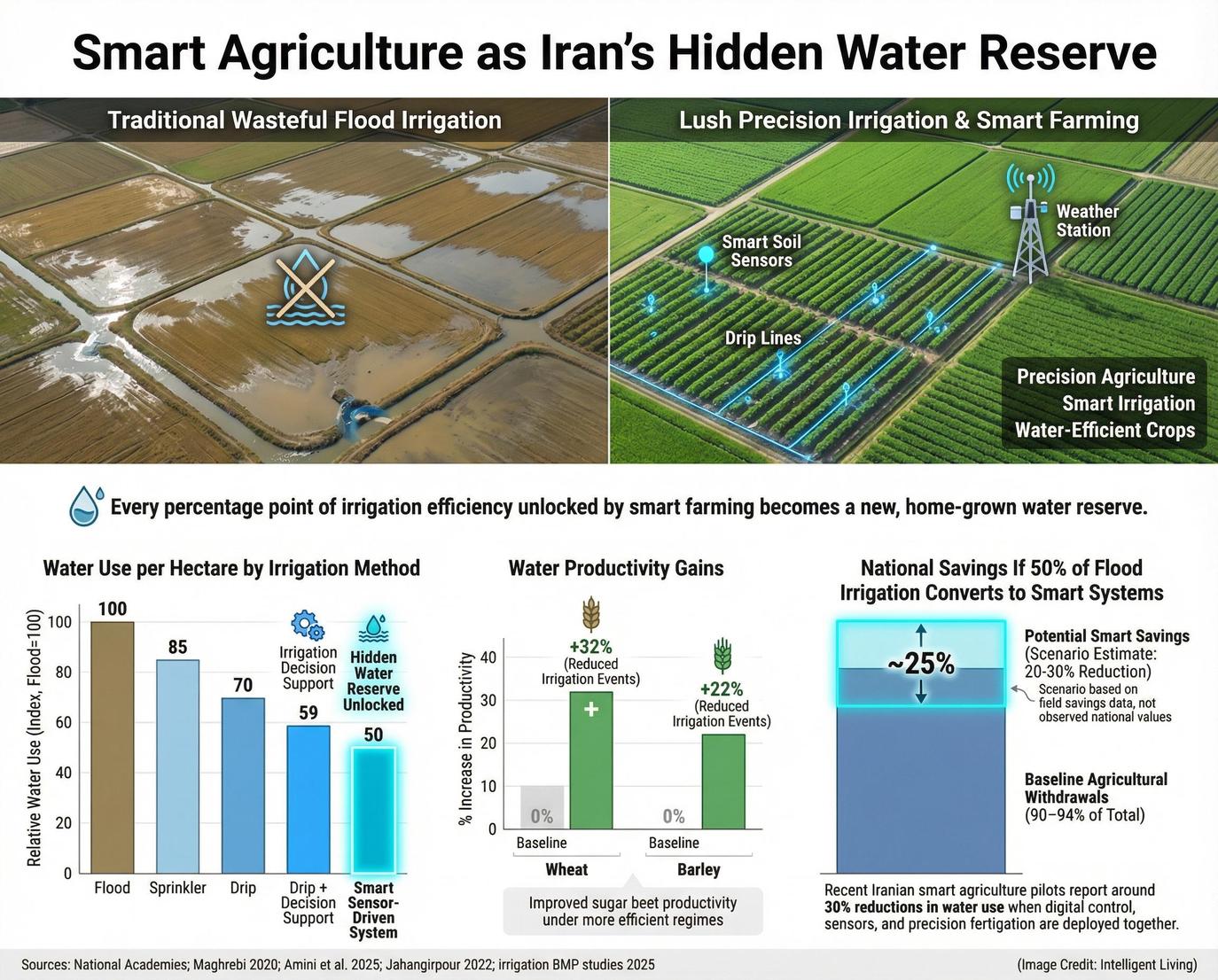
If Iran’s water crisis has a root cause, it is the way the country grows its food. Agriculture consumes nearly 90% of available freshwater, yet its productivity remains below global averages. Paradoxically, the path to a sustainable water future may lie in farming itself.
Integrating precision agriculture with soil-moisture monitoring could unlock vast “hidden reserves” of water through efficiency gains. For example, switching from flood irrigation to drip systems can reduce water use by up to 50%, while boosting yields by 30%. Yet adoption remains limited. Most farmers still rely on subsidies that favour traditional methods, leaving little incentive to modernise.
Reforming Agricultural Subsidies for Drought-Resistant Crop Allocation
Researchers specialising in next-generation irrigation systems suggest that reallocating just 10% of irrigated farmland could save billions of cubic metres of water. This transition requires a shift toward drought-resistant crops like barley, lentils, or pistachios. Significant economic hurdles remain, as water-intensive crops such as rice and sugar beets continue to dominate due to government support. Targeted subsidy reform could finally make efficiency profitable for local farmers.
Integrating Precision Technology and Decentralised Farming Systems
Technology could ease this transition. AI-powered platforms utilising precision vertical farming techniques now help farmers determine exact watering times based on satellite imagery, local weather data, and soil conditions. These systems, already used in parts of India and Morocco, can be integrated into Iran’s agricultural infrastructure to improve decision-making while conserving water.
Domestic conservation efforts allow households to contribute by embracing water-recycling indoor microgardens, which effectively reuse nutrients and moisture, and by installing systems that recycle household wastewater to clean shower and laundry water for immediate reuse. By adopting decentralised water recycling and smart farming tools, Iran could effectively create new water without new rainfall.
Advanced Technological Solutions for National Water Resilience and Recovery
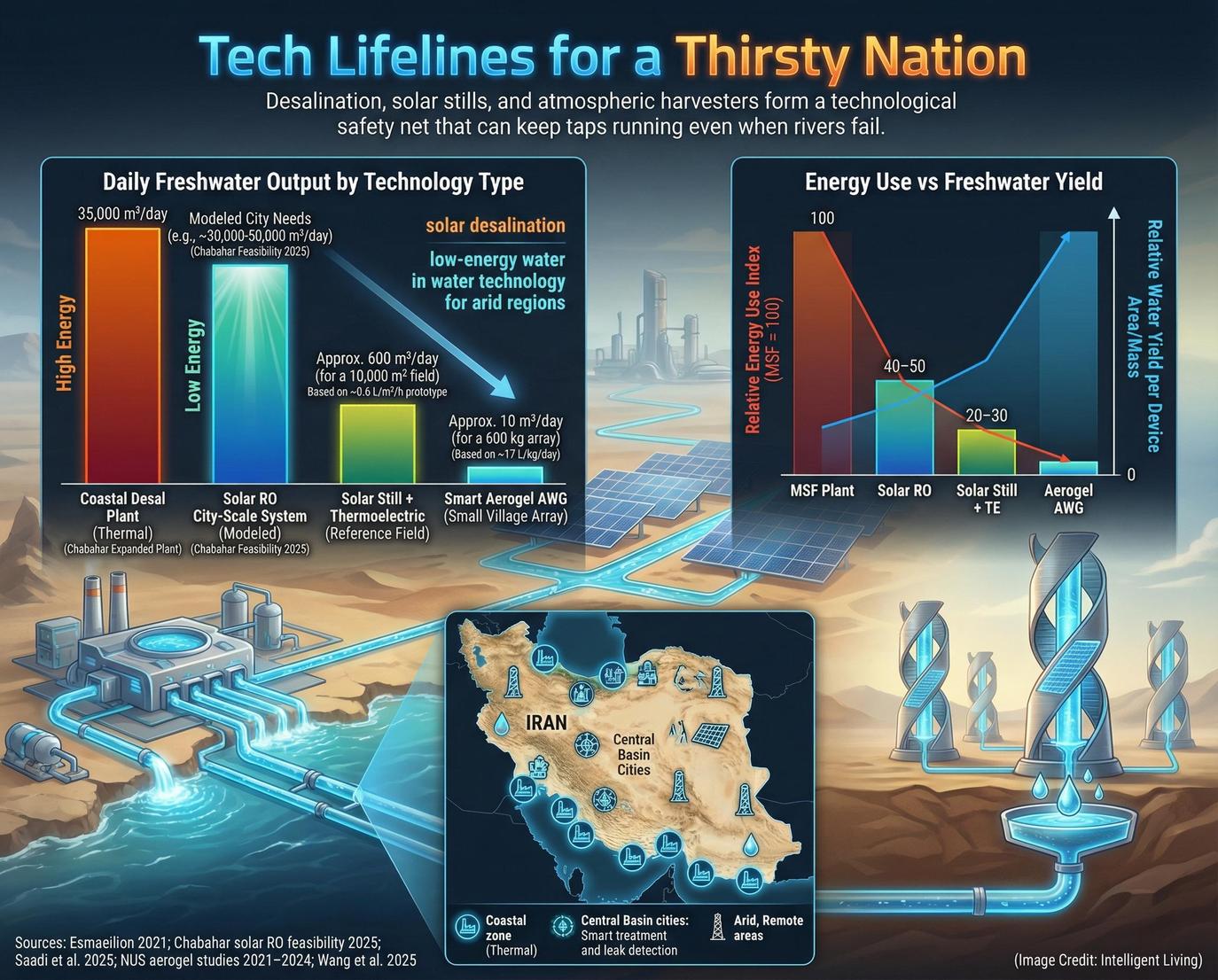
Agriculture holds the key to demand-side reform, but technology will determine the efficiency of purification and redistribution. The next generation of modernised water management tools is already taking shape, ranging from AI-driven analytics to advanced water-harvesting materials.
Monitoring and Early Warning Systems
Smart monitoring infrastructure forms the backbone of any water-secure future. Highly efficient automated water safety monitors can detect contaminants faster than manual testing, allowing authorities to respond before crises escalate. Satellite-based tools, such as NASA’s GRACE mission, track groundwater changes in near real time to supplement local data. Iran could expand its network of in-situ sensors to fuse this data with local field reports, creating a national water intelligence platform that integrates hydrology, climate, and infrastructure data.
Decentralised Filtration and Desalination
Large desalination plants are costly and energy-hungry, but modular, low-energy alternatives are emerging. Portable purification systems and nanomaterial membranes can now turn brackish or saline water into safe drinking water in minutes.
Decentralised Desalination and Atmospheric Harvesting for Arid Zones
New nanomaterials for low-energy desalination could transform small villages along Iran’s coasts. Researchers continue to explore high-efficiency solar desalination methods to ensure these systems remain cost-effective and energy-independent.
Not all water must come from the ground or sea. Advanced materials such as aerogels that passively pull moisture from air produce clean water without the need for external power. Scaling atmospheric harvesting devices could supplement remote and desert communities where pipelines are unfeasible. Combined with solar microgrids, these systems promise energy-independent hydration.
Future urban centres could integrate platforms designed for carbon-smart resource tracking to detect leaks and recycle wastewater automatically. When these technologies converge, they turn scarcity into a data problem—one solvable through innovation rather than extraction.
Institutional Integrity: Strengthening Transparency and Institutional Oversight in Water Management
Even the best technology cannot succeed without governance built on transparency and trust. Iran’s history of fragmented water management—divided among multiple ministries and agencies—has long hindered coherent policy execution. To ensure new systems achieve their potential, decision-making must become participatory and data-driven.
Establishment of an integrated water authority with access to real-time analytics would allow Iran to coordinate across sectors, though technical structure alone cannot replace the need for political legitimacy. Citizens need to see where water goes and why. Public dashboards displaying usage, supply, and policy outcomes could bridge the gap between government agencies and local communities.
Data Accountability and Ethical Monitoring Frameworks in Iran
Equally important is ethical data management. AI-based monitoring and resource allocation should follow the same transparency standards now used in sustainability tracking worldwide. Iran could adapt automated systems for verifying environmental data to ensure that hydrological reports are publicly accessible and corruption-resistant.
Participatory water governance—where farmers, scientists, and citizens co-design policies—has proven effective in countries like Spain and Australia. Applying this model locally could transform Iran’s water crisis into an opportunity for civic renewal, aligning state legitimacy with ecological responsibility.
Securing a Resilient Hydrological Legacy for Iran
Transitioning from a state of water bankruptcy to a regenerative future necessitates a fundamental shift in how the nation perceives its natural capital. Success hinges on moving away from the extractive mindset of the past half-century and embracing demand-side efficiency within the agricultural sector.
When policy supports drought-resistant crops and precision irrigation, the ‘hidden reserves’ of the landscape begin to emerge, offering a path toward stability that does not rely solely on unpredictable rainfall. A regenerative water future is built on the pillars of transparency, innovation, and collective accountability. Integrating decentralised technologies, such as electricity-free solar desalination systems, ensures that every citizen becomes a stakeholder in the country’s survival.
Distinct strategic pillars define this transformation: demand-side efficiency, transparent governance, and technological resilience. As these strategies take root, people pursuing professional roles in water resource management can help protect Iran’s shared inheritance for generations, turning a cautionary tale of depletion into a global blueprint for climate resilience.

Essential Insights into Iran’s Water Crisis and Recovery
1. What defines the state of water bankruptcy in Iran?
Water bankruptcy occurs when the total withdrawal from aquifers and surface sources consistently exceeds the natural recharge rate, leading to permanent structural damage.
2. Why is groundwater depletion in Iran accelerating so rapidly?
Decades of heavy subsidies for water-intensive crops and the installation of over 600 major dams have disrupted natural cycles, forcing an overreliance on non-renewable aquifers.
3. How does smart agriculture contribute to water regeneration?
Integrating AI-powered vertical farming and precision soil-moisture monitoring allows for a reduction in agricultural consumption by up to 50% while maintaining food security.
4. Can Lake Urmia be saved through current restoration efforts?
Partial recovery is possible through regenerative watershed management and consistent enforcement of bans on water-intensive crops, provided upstream inflows are prioritised over dam storage.
5. What role does technology play in resolving the Iran water crisis?
Innovations such as atmospheric water harvesting and smart leak detection systems allow for the creation and preservation of water without further depleting natural reserves.


