
Global urbanisation and escalating material prices have forced the housing market into a critical state of transition. Shifting toward industrialised construction provides the high-volume output necessary to address this growing shortfall.
Implementing robotised modular factories allows for the rapid assembly of residential units without the traditional unpredictability of outdoor job sites.
Residential development is evolving into a precision manufacturing discipline. Automated modular systems enable a level of consistency and quality control that manual site work simply cannot replicate. These advancements reduce the time-to-market for affordable housing while drastically lowering the carbon footprint of the entire building lifecycle.
Integrating smart city infrastructure with modular density creates a pathway for truly sustainable urban growth. Precision engineering through Building Information Modelling (BIM) ensures every factory component meets strict energy and structural standards. Strategic alignment between industrial capacity and public policy remains the key to unlocking this potential at scale.
Recent research in industrialised construction, from factory cost analyses to green construction trends in California’s energy-efficient housing market, shows that fully automated modular systems can slash production time by nearly 40% per housing unit, cut labour costs by almost 70%, and still pay for high-end robotic systems within just a few years. That is an impressive claim, but it also demands scrutiny. Could automation truly reshape the economics of housing, or is it another tech promise waiting to be tested against the realities of policy, energy costs, and human labour?
This deep dive explores the numbers behind the innovation, unpacks what other studies and prototypes are showing, and examines the broader implications for energy efficiency, job creation, and climate goals. The findings point to a future where housing factories operate more like car plants: efficient, intelligent, and increasingly sustainable.

Quick Facts: Automated Modular Construction and Affordable Housing
- 40% Faster Production: Automated modular factories can build housing modules in nearly half the time of traditional construction.
- 69.7% Lower Labour Costs: Robotic manufacturing reduces dependence on manual labour, allowing teams to focus on quality control and design oversight.
- 11.6% Lower Energy Use: Automation optimises machinery and material usage, leading to less waste and smaller energy bills.
- Three-Year Payback: Despite high upfront costs, factories can recoup investments within about three years when operating at scale.
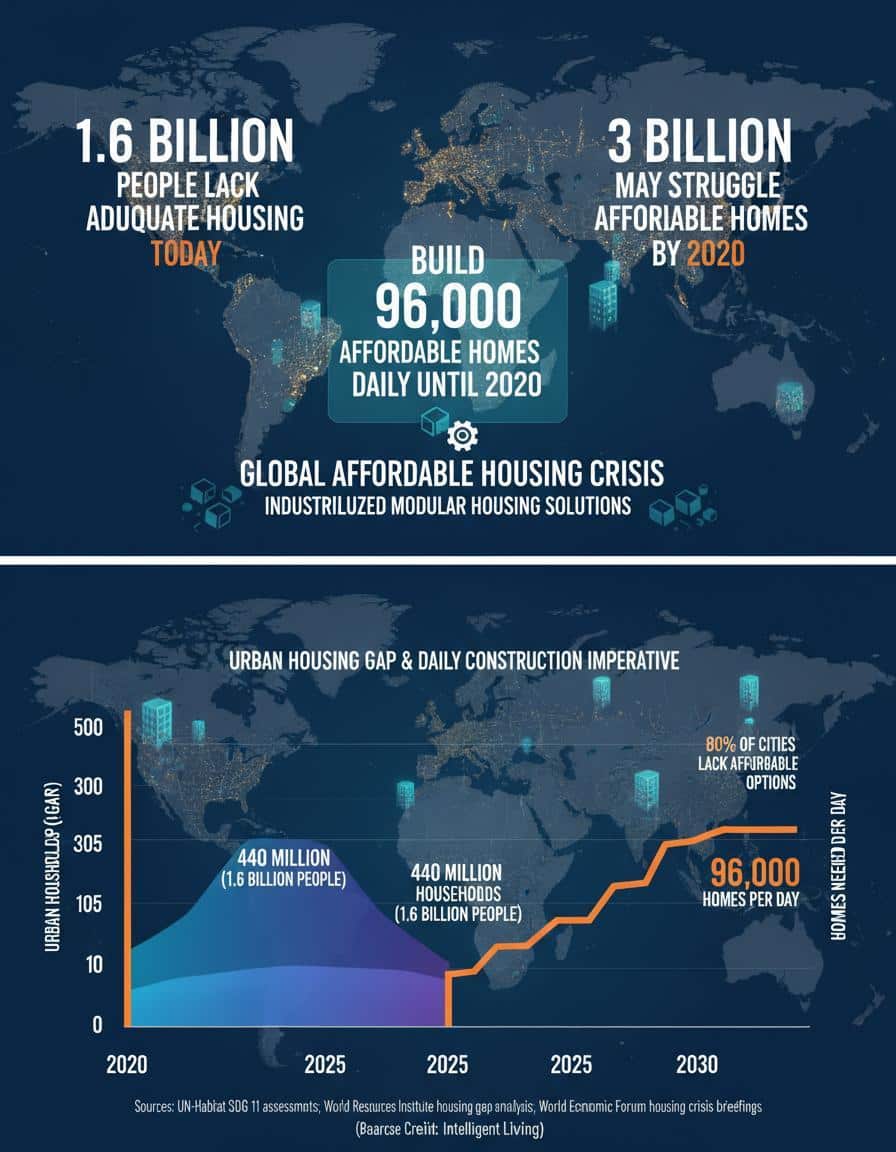
- 3 Billion People Need Homes by 2030: Meeting global housing needs requires building nearly 96,000 affordable units every day.
- Up to 90% Less Construction Waste: Modular automation and precise cutting techniques, paired with innovative eco-friendly building materials, can drastically reduce environmental impact.
Engineering Solutions for the Global Affordable Housing Crisis
Affordable housing is no longer just a social issue; it is an engineering challenge. By 2030, nearly 3 billion people, or about 40% of the world’s population, will require adequate housing, according to a United Nations housing assessment of global housing need that highlights an urgent, widening shortfall in decent homes worldwide. Time-tested but static building methods struggle to provide the sheer volume of high-quality homes required to bridge this massive widening gap.
Urbanisation is accelerating in regions like Southeast Asia, Latin America, and Africa, while developed nations face their own affordability crunch. Several systemic factors contribute to this tightening market:
- Severe Labour Shortages: A shrinking skilled workforce drives up site-work costs.
- Regulatory Bottlenecks: Outdated zoning and slow approvals delay project timelines.
- High Material Prices: Global supply chain volatility impacts traditional building budgets.
Addressing Productivity Gaps through Design Automation
Construction productivity has barely improved in decades, lagging far behind manufacturing or logistics. Encouraging results from small-city sustainable real estate strategies offer a clear look at what happens when visionary planning meets local housing needs.
That is why modular construction, where buildings are produced in factory settings and assembled onsite, is drawing so much attention. It offers 20% to 70% faster project timelines and up to 20% lower costs than traditional methods when projects are well-coordinated. Combine that with robotic automation, and the potential scales dramatically.
However, the challenge is not just about technology. Scaling automated modular housing requires stable financing, supportive zoning laws, and standardised design codes. Without these, even the most advanced factories cannot operate at full capacity. Policymakers are beginning to recognise this, exploring how modular automation could align with the United Nations goal for sustainable cities and communities, which calls for safe, affordable, and climate-resilient housing in rapidly growing cities.
The pressure is clear. If cities are to solve housing shortages while also cutting emissions and improving resilience, they must reimagine homebuilding as an industrial process. This shift echoes broader conversations about smart city housing infrastructure, and robots might be the missing workforce that makes those ambitions real.
Evaluating the Economic Feasibility of Automated Modular Systems
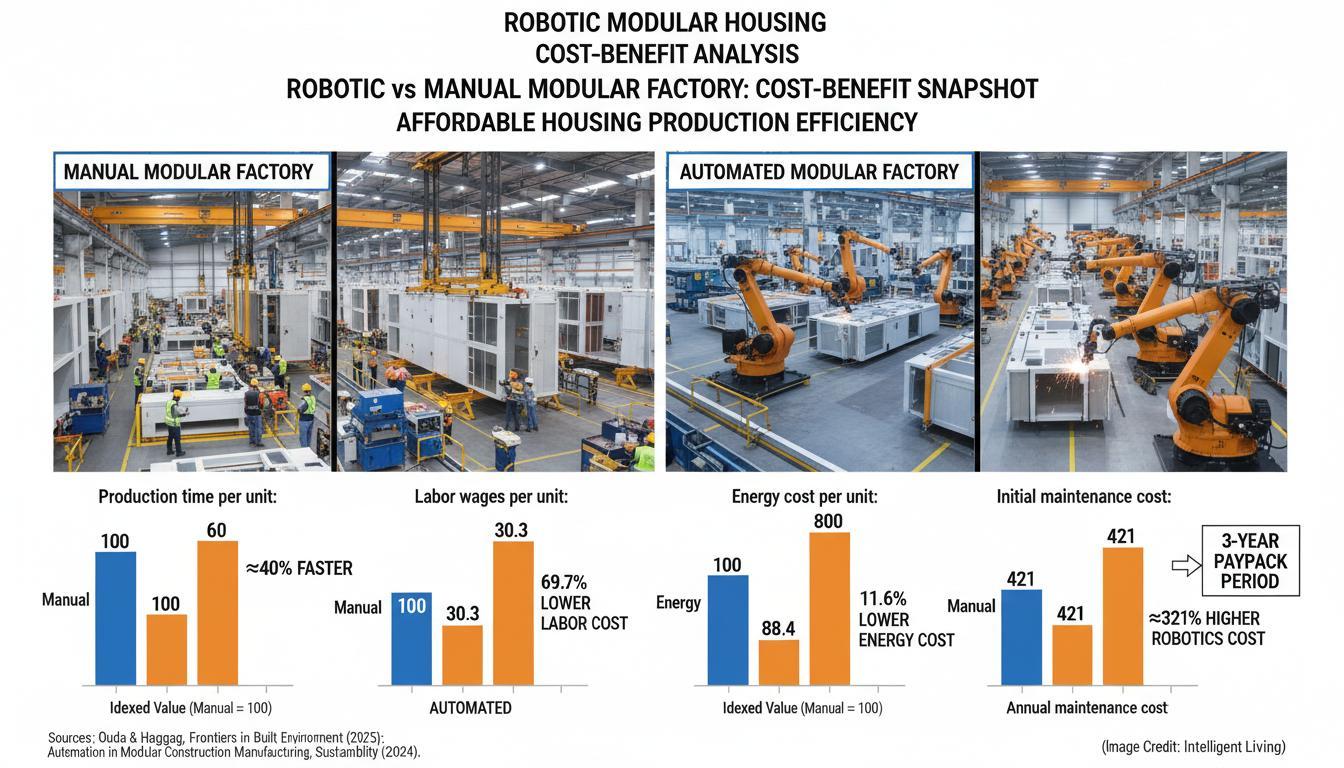
A landmark modular construction cost-benefit study by researchers Enaam Ouda and Mahmoud Haggag modelled a side-by-side comparison between a manual modular factory and a fully automated one producing affordable housing units. The results are both striking and cautiously optimistic.
The automated setup provided a significant measurable advantage over traditional modular manufacturing. The model highlighted three primary gains in efficiency:
- 40% Reduction in Production Time: Homes are produced in nearly half the standard duration.
- 69.7% Plunge in Labour Costs: Automated systems manage the repetitive, precision-based tasks found in robotic fabrication of modular plywood blocks for configurable spaces.
- 11.6% Drop in Energy Consumption: Improved coordination and reduced machinery idle time lower the environmental footprint.
These figures prove that integrating precision manufacturing into industrialised ecosystems allows robots to maintain flawless assembly standards while maximising resource efficiency.
The tradeoff is a significant increase in capital expenditure. Building a robotic modular factory requires about 321% more upfront investment than a conventional setup. Yet even with that cost, the financial model found a payback period of roughly three years, assuming steady project flow and moderate energy prices.
The research used discounted cash flow analysis to evaluate feasibility, calculating net present value (NPV) and benefit-cost ratios (BCR). Under consistent production volumes, the authors concluded that automation is not only sustainable but also profitable.
Still, the study noted key limitations. The model focused narrowly on manufacturing efficiency, excluding land, logistics, and full life-cycle emissions. While the financial projections appear solid, the real work lies in aligning these theoretical gains with actual urban policy and large-scale production.
Real-World Validation of Industrialised Construction and Design Automation
If the Frontiers study offered a theoretical foundation, subsequent research and pilot projects provide real-world validation. A 2024 analysis of modular automation in the journal Sustainability found that robotic systems in modular assembly lines further boost efficiency, especially in standardised factory environments. When combined with design automation tools such as Building Information Modelling (BIM), these systems can track every cut, weld, and connection with sub-millimetre accuracy.
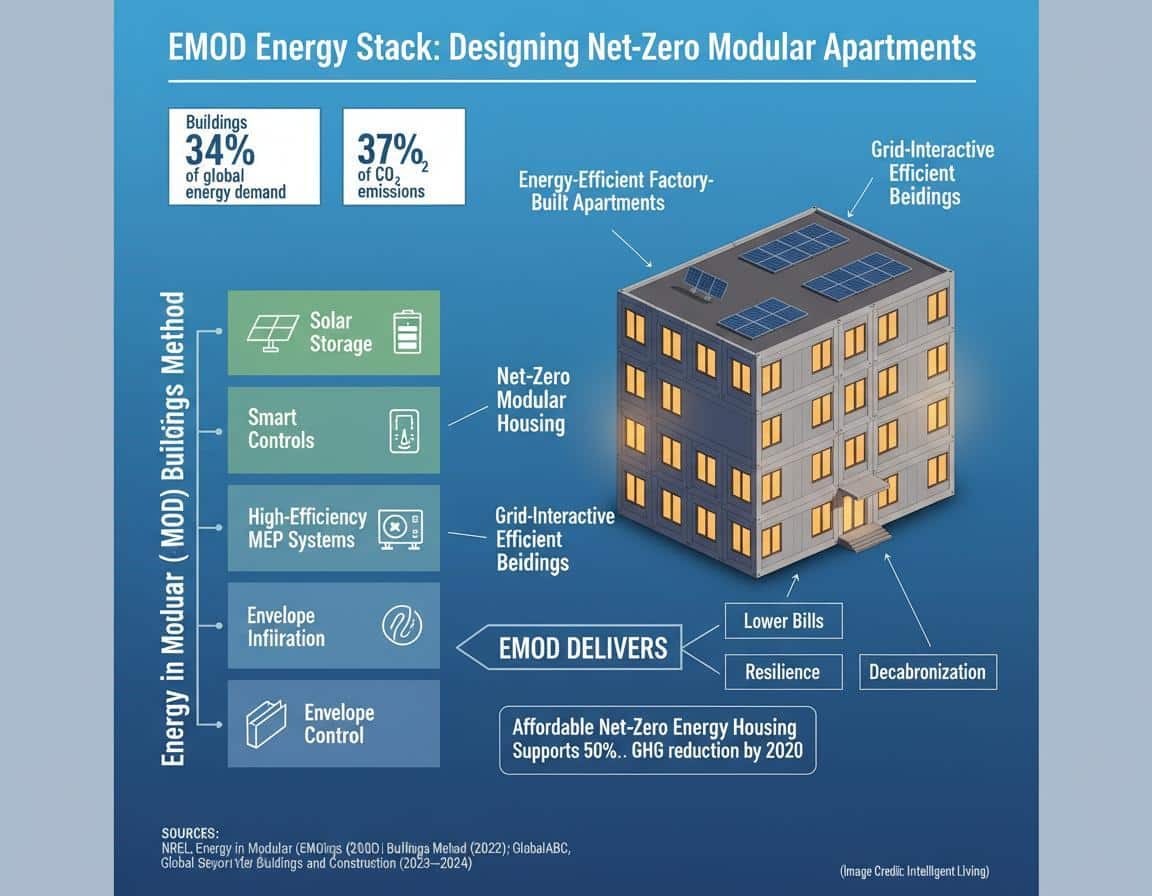
Engineers at the U.S. Department of Energy’s National Renewable Energy Laboratory (NREL) have successfully tested modular prototypes like the iUnit. This compact housing module features integrated heating, cooling, and hybrid power systems.
Standardising Performance through Predictive Analytics
Mass-producing these units through industrialised construction methods leads to significantly lower operational energy use. This process is documented in the Energy in Modular Buildings (EMOD) framework, which utilises predictive analytics to model performance.
Scaling these systems does far more than just trim budgets; it fundamentally improves the environmental footprint and everyday liveability of the modern home. Automated factories can standardise quality, minimise waste, and integrate green technologies such as solar panels and water-saving systems directly into modules before they leave the factory floor.
Across Europe and Asia, similar initiatives are taking shape. In Singapore, modular housing factories are working alongside robotics firms to address workforce shortages, while in Scandinavia, automated timber-frame systems are being developed to meet both housing demand and carbon neutrality goals. These experiments fit into a wider shift toward modular, low-waste building systems and advanced construction materials and modular systems that treat buildings as long-lived, upgradeable assets rather than one-off projects.
Automation may be complex, but its potential is simple: turning construction into manufacturing. The faster this transition happens, the closer cities come to solving the intertwined crises of affordability and sustainability.
Financial Models and Market Barriers for Robotic Modular Plants
If a factory maintains steady production volume, it spreads fixed costs across more units, ensuring that robots stay profitable. However, if demand dips or projects stall because of zoning delays or financing gaps, those same robots become expensive idle assets.
Labour costs also play a defining role in this financial model. The higher the prevailing wages in a region, the faster automation pays for itself. Conversely, in lower-wage markets, the financial advantage of robotic integration narrows.
The Impact of Volatile Energy Markets on Factory Feasibility
Volatile energy markets introduce a significant variable into the feasibility equation. The 11.6% savings from the Frontiers model assume moderate energy prices. In countries with volatile electricity markets or fossil-fuel-heavy grids, those gains can erode quickly. Meanwhile, the financing structure determines whether developers can afford the 321% capital outlay. Access to low-interest loans, government-backed guarantees, or public-private partnerships often makes or breaks the business case.
Policy alignment is essential. Without updated building codes, standardised approvals, and factory-friendly zoning, automated modular construction faces bureaucratic drag. Enterprise Community Partners, in a report on scaling off-site housing construction, and HUD have both identified financing misalignment—the mismatch between factory upfront costs and traditional milestone-based payment schedules—as one of the biggest barriers to scale.
In short, the robotics math works under the right conditions: steady demand, high labour costs, reliable energy, and supportive policy. When those elements align, the results can redefine the economics of housing. When they do not, the machines sit still, and so does progress.
Industrialised Construction as Sustainable Climate-Resilient Infrastructure
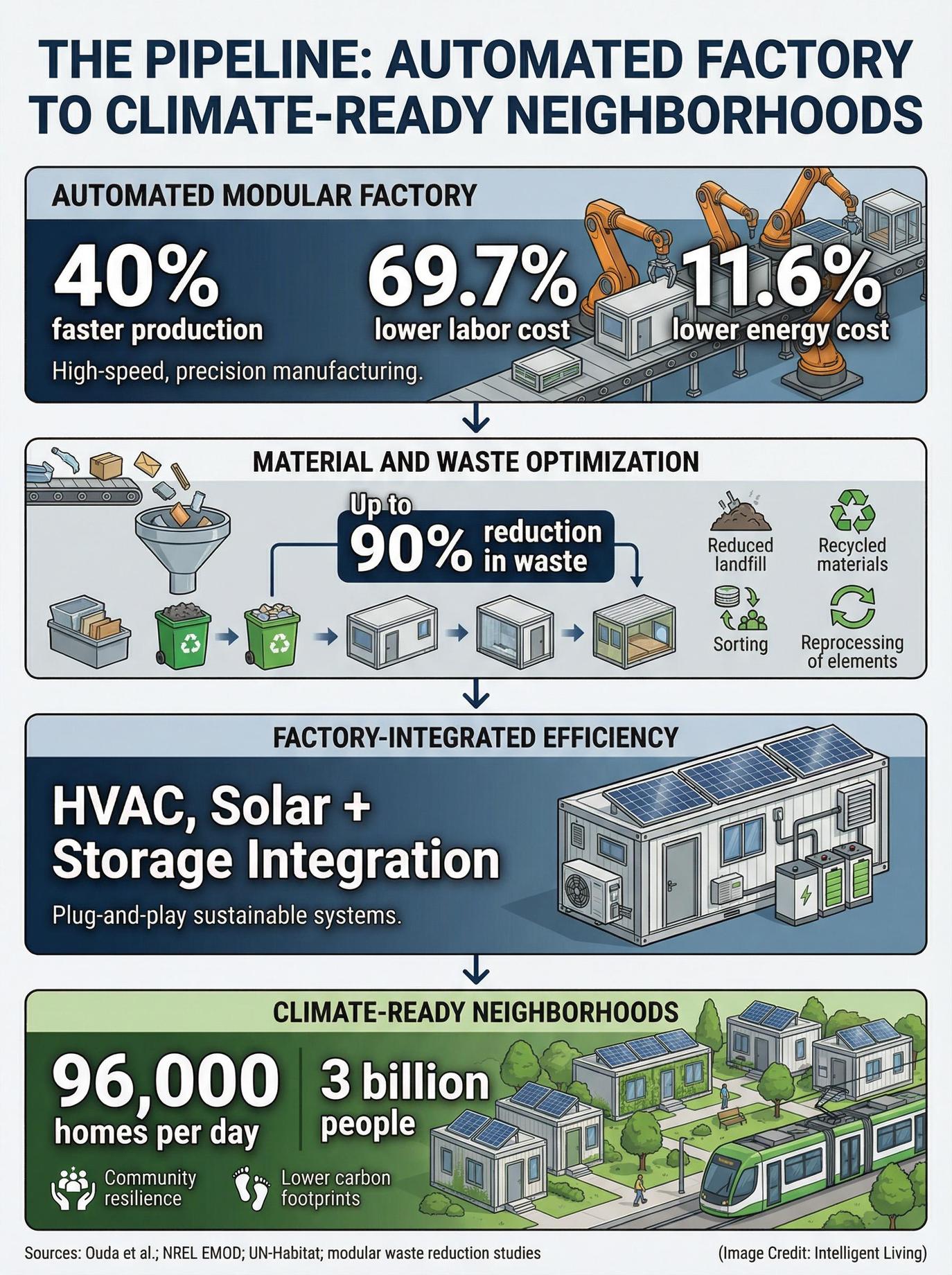
Beyond cost efficiency, automated modular factories have the potential to serve as vital climate infrastructure. Advanced robotics integrate seamlessly with low-emission concrete wall innovations and solar-powered modular apartments.
These technologies drastically reduce emissions across the entire building lifecycle. Instead of constructing homes on-site with unpredictable waste, these facilities function as closed-loop ecosystems where every component is optimised.
Automated modular systems allow for precise control over material usage, often reducing industrial waste by up to 90%. These facilities support a wide range of sustainable innovations:
- Advanced Materials: Systems utilise hybrid waste concrete, recycled PET modular structures, and startups turning ocean plastic into building materials.
- Integrated Energy Systems: Pre-wired solar panels and smart thermostats are installed directly on the line.
- Water Conservation: Precision plumbing and water-saving systems are embedded before modules leave the factory floor.
Decarbonising the Grid through Factory-Built Housing
These internal processes ensure that every home meets rigorous sustainability standards prior to site arrival. When powered by renewable energy sources, these facilities can dramatically lower the carbon footprint of the housing sector.
Real-world data from UK net-zero housing projects shows how efficient building envelopes and rooftop solar can flatten grid peaks while lowering bills, a pattern that aligns naturally with factory-built, high-performance housing. As nations invest in decarbonising infrastructure, turning housing factories into clean-energy production hubs represents one of the most practical paths forward.
Systemic Barriers and Regulatory Friction in Modular Manufacturing
Despite clear technical advantages, automated modular housing still faces systemic barriers. The most common is financial structure. Traditional lending models release funds incrementally based on on-site milestones, while modular factories need significant upfront capital to cover machinery and materials. This mismatch limits developer participation and delays scale.
Overcoming Financial Misalignment and Lending Bottlenecks
Regulatory systems present an additional hurdle, as building codes often favour traditional site-built methods over modernised alternatives. These frameworks frequently treat factory-built homes as unconventional, leading to delayed approvals, conflicting local codes, and limited inspection options that effectively slow industrial adoption.
The workforce transition also plays a role. Policymakers and labour unions must collaborate to reskill workers for automation-era construction. Finding the right talent is difficult when education systems lag behind technology, leaving developers to search for specialised technicians capable of managing these complex robotic production lines.
Some cities are making progress. Los Angeles and Singapore have introduced pilot programmes for modular factory approvals and pre-checked building templates that reduce bureaucratic friction. In the United States, federal and local initiatives are beginning to integrate transit-aligned affordable housing, showing how carefully designed policy packages can align land use, climate goals, and new models of industrialised construction.
Globally, however, most jurisdictions have yet to align incentives, finance, and workforce training with industrialised construction. In many places, automation is not being held back by technology; it is being held back by legacy systems that were never designed for factory-built housing.
Workforce Transformation within Robotic Modular Factory Ecosystems
While the rise of automation frequently triggers concerns about displacement, moving from the job site to the factory floor represents an evolution in how we work, rather than a total replacement of the workforce. Rather than replacing humans, robotic modular factories redefine their roles.
Factory environments are safer, more predictable, and less physically demanding than outdoor job sites. Workers shift from hauling materials to supervising precision equipment, performing quality inspections, and managing digital workflows. These jobs require new skills in robotics maintenance, PLC control systems, and Building Information Modelling (BIM).
Scaling Technical Education for Industrialised Construction
In the United States, a modular construction workforce case study shows how Department of Energy technical assistance can weave workforce training directly into modular factory ecosystems. Workers receive cross-disciplinary education that combines construction fundamentals with data analytics and automation technology. This approach creates a steady flow of expert builders who are just as comfortable with data analytics as they are with structural engineering.
Union engagement and educational investment are critical to ensuring this shift benefits workers. Instead of job displacement, the future of automated modular construction could create safer, higher-paying technical careers, supporting a more sustainable and equitable industry.
Reimagining Modular Factories as Essential Public Infrastructure
What if cities treated modular factories as essential public infrastructure, similar to water treatment or public transit systems? With rising housing demand and the proven cost-benefit math, automated modular production could be reimagined as a civic utility that complements tiny homes built from recycled wind turbine components and other circular housing experiments.
Governments could co-own regional modular plants, guaranteeing throughput for public housing projects and reducing per-unit costs. Such models ensure continuous production even when private demand fluctuates.
This public-private approach makes automation economically stable. It also addresses the urgent need for affordable housing in disaster-prone and high-density regions.
Some prototypes already hint at this future. National programmes in Japan and Sweden have experimented with government-backed modular plants designed to serve both private and public sectors, while private experiments range from 3D-printed housing pilots serving homeless communities and space missions to sustainable geodesic dome communities designed to solve the housing crisis. These projects show how alternative housing systems and civic partnerships can work together when factories are treated as climate and social infrastructure.
Treating housing factories as civic utilities could unlock new funding models through green bonds or climate infrastructure investment, blending affordability and environmental impact under a single policy goal. It transforms modular automation from a niche innovation into a cornerstone of equitable urban development.

Integrating Circular Economics and Modular Automation for Urban Growth
If the housing sector is to meet global demand and climate obligations, it must industrialise intelligently. Automated modular factories prove that speed, sustainability, and affordability are not mutually exclusive; they are interdependent. When robotics, policy reform, and human expertise converge, cities can create homes faster, cleaner, and smarter than ever before, especially when guided by integrated self-sufficient city design, which treats housing as part of an integrated urban systems blueprint.
Deploying Off-grid Energy Stacks in Modular Residential Units
The most successful housing models in the next decade are likely to come from integration rather than isolated innovation. Factories powered by renewables, supported by reformed financing systems, and staffed by highly trained technicians will define the blueprint for a liveable, climate-conscious future that can plug into circular housing-as-a-service models and off-grid energy stack innovations to keep homes resilient even when central grids are under stress.
In the end, automation in modular construction is not just about making homes cheaper. It is about reshaping how humanity builds its future efficiently, responsibly, and for everyone. A real-world test of those economics is playing out at Boxabl, the company behind Elon Musk’s much-discussed $50,000 Boxabl tiny house, which completed its Nasdaq listing as BXBL in July 2026.
Industrialising the Future of Global Housing Resilience
Moving toward automated modular systems represents a fundamental shift in the economic structure of the construction industry. High-capacity robotic plants stabilise supply chains and provide a reliable framework for delivering affordable units in volatile markets. Success in this field requires a synchronised effort between financial innovators, tech developers, and urban planners.
Sustainability and affordability are increasingly linked through the lens of manufacturing efficiency. Modular factories reduce environmental impact by centralising production and minimising on-site disturbance. Adopting these advanced ecosystems is essential for creating a built environment that is both socially equitable and ecologically responsible.
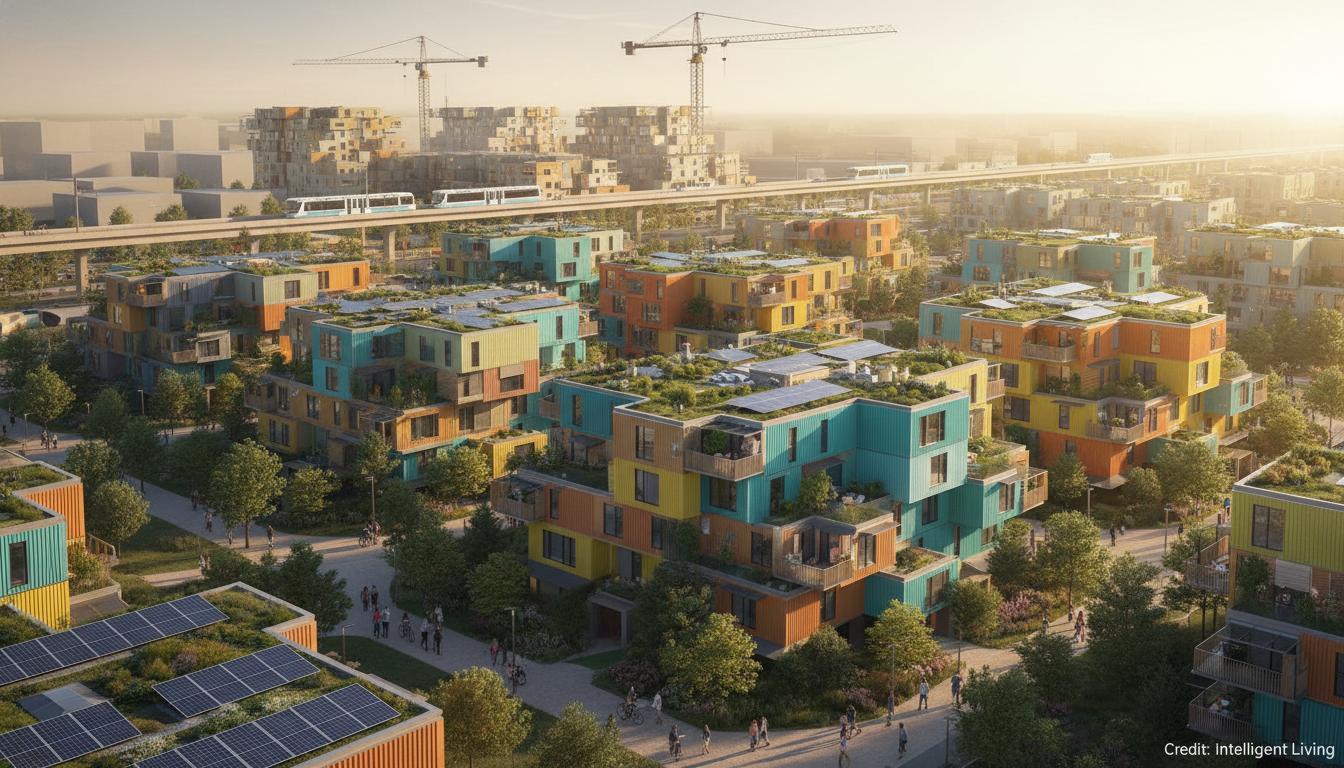
Common Enquiries Regarding Automated Construction Ecosystems
What defines robotised modular factories?
High-precision manufacturing facilities utilise automated systems to produce standardised residential modules in a controlled environment.
How does industrialised construction lower housing costs?
Increased production speed and reduced labour dependency allow developers to spread fixed costs across more units.
Why are automated modular systems better for the environment?
Centralised production significantly minimises material waste and allows for the pre-installation of high-performance energy systems.
Can robotic construction solve the global housing crisis?
While technology provides the necessary scale, success also depends on reforming zoning laws and financial models.
What are the primary barriers to scaling modular automation?
Legacy zoning laws and traditional mortgage models aren’t designed for the heavy upfront capital investment required to build and scale modular housing infrastructure.


