
Imagine a home that turns sunlight into more electricity from the same roof area and converts last night’s leftovers into useful energy or nutrients—this is the promise of a circular home stack.
The energy side is led by perovskite–silicon tandem solar modules, which have recently crossed important efficiency, durability, and certification milestones that matter for residences. While not every product is on store shelves, the technology’s trajectory is clear: higher output per square foot, expanding pilot programs, and early certifications. Oxford PV and Fraunhofer ISE reported a full-size tandem perovskite module at 25% efficiency, showing why rooftops with limited space could soon make more power with fewer panels.
At the same time, the “waste-to-resource” movement is closing loops around the home. Household digesters already turn organic scraps into cooking gas and liquid fertilizer, and enzymatic recycling plants are coming online to turn bottles and textiles back into feedstock. Those stories come later. First, let’s ground the rooftop piece in facts a homeowner can verify.

Key Milestones and Essential Considerations
- Module-level record you can cite: A full-size perovskite–silicon tandem module reached 25% efficiency in collaboration with Fraunhofer ISE, using processes compatible with mass production. This is module data, not just a tiny lab cell.
- Durability testing is advancing: Qcells reports its tandem modules completed a suite of IEC and UL stress tests with independent confirmation by TÜV Rheinland, a key step toward real-world use.
- Early safety listings exist: Chinese maker UtmoLight says its perovskite modules passed UL 61730/CSA 61730 testing and achieved a JPAC listing in Japan, indicating progress on safety credentials that homeowners and installers can look for.
- Real-world stability data is emerging: A three-year field study on perovskite submodules reports small performance loss under outdoor operation, complementing lab-based stability work.
- National push for building-applied films: Japan is funding commercialization of ultra-thin perovskite films suitable for walls, awnings, and light roofs, a signal for residential building-integrated PV.
Risks and Caveats
- Availability and warranties: Tandem modules are transitioning from pilots to limited releases. Expect selective regional launches and evolving warranty terms while manufacturers build long-term data.
- Long-term stability: Perovskites are improving, but field life comparable to top-tier silicon still needs broader proof. Ongoing work focuses on better encapsulation and identifying degradation pathways.
- Lead management: Most high-efficiency perovskites use lead. Industry mitigation relies on robust encapsulation and chemical traps that immobilize lead if a module breaks. Homeowners should verify a brand’s stated mitigation strategy.

The Latest Advances in Rooftop Perovskite Technology
Higher Output from the Same Roof
Traditional silicon cells are approaching practical efficiency limits. Perovskite–silicon tandems stack two photovoltaic materials that capture different parts of the solar spectrum, lifting conversion efficiency at the module scale.
In mid-2024, Oxford PV + Fraunhofer ISE announced a full-size tandem module with 25% efficiency and 421 W output on 1.68 m², demonstrating gains a homeowner would notice on space-constrained roofs.
The Homeowner Advantage: Maximizing Limited Roof Space
If your roof cannot fit many panels, a higher-efficiency module means more annual kilowatt-hours without changing your array footprint. Oxford PV’s public roadmap also signals targets beyond 25% at the module level in the following years, which, if realized, would further improve payback where roof area is the bottleneck.
From Lab Cells to Real Modules
While the industry once announced breakthroughs at the small-scale cell level, its focus has now shifted toward full-size modules and processes compatible with mass production. Fraunhofer ISE explicitly used industry-relevant module equipment for the 25% result, which helps bridge the gap between R&D and rooftops.
Building-Integrated Options are Coming
Ultra-thin perovskite films can be applied to curved or lightweight structures where glass modules are difficult to mount. Japan’s large investment program is pushing these films toward commercial deployment in urban settings, a development to watch for building-integrated PV on homes and small buildings.
Can They Last—and Are They Certified Yet?
What “Durability” Means for Homeowners
Module durability is usually proven by standardized stress tests and by field data. Recent signals are encouraging on both fronts:
- Standardized tests: Qcells reports its tandem modules completed IEC and UL durability test suites with independent confirmation from TÜV Rheinland. While that is not the same as a retail launch everywhere, it shows tandems can meet the same style of reliability gauntlet that silicon modules pass.
- Field performance: A three-year outdoor study of perovskite submodules documents modest performance loss, adding real-world evidence beyond the lab. Expect more multi-year datasets as pilots mature.
Safety Listings You Can Look For
Residential products typically carry safety listings such as UL 61730 (and equivalents). UtmoLight reports perovskite modules that passed UL/CSA 61730 testing and achieved JPAC listing in Japan. If you are evaluating early offerings, ask for the specific standard and the testing body on the spec sheet and warranty.
Lead Risk, Managed in the Stack
High-efficiency perovskites often use lead, which raises a fair question: what happens if a panel breaks? Multiple studies and reviews describe encapsulation strategies and chemical absorbers that immobilize lead and dramatically reduce potential leakage. When shopping, verify that a vendor describes its mitigation approach and disposal plan in writing.
The Near-Term Reality Check
Widespread availability of tandem modules is not expected in every market this year, so homeowners should monitor regional product launches. Watch for products backed by IEC/UL listings, independent lab verification, and clear warranty terms. Also follow national commercialization pushes, like Japan’s, that tend to catalyze supply chains for building-applied formats relevant to homes.

From Scraps to Fuel: The Power of At-Home Biodigesters
The concept of turning kitchen leftovers into clean energy is no longer futuristic, as at-home biodigesters have become a tangible reality for households. These compact systems let households transform food scraps into renewable biogas for cooking or heating. Instead of sending waste to landfills, families can create a self-sustaining energy loop while reducing methane emissions. For homeowners, it’s a way to cut utility bills and participate directly in climate solutions without needing a rooftop solar array.
How It Works
An at-home biodigester uses naturally occurring microbes to break down organic matter—think vegetable peels, stale bread, or coffee grounds.
The process produces two valuable outputs: biogas, a mix of methane and carbon dioxide, and a nutrient-rich liquid fertilizer. The gas can fuel a stovetop, while the fertilizer supports gardens or indoor plants, closing the resource loop at the household level.
These systems offer significant benefits, including free renewable cooking fuel, reduced landfill emissions, and a natural fertilizer by-product for home gardens. However, they also present challenges, as the units require steady organic input, regular maintenance, and an upfront investment that may deter some households. To address this, governments and startups are exploring subsidies and community-scale models that could make biodigesters as common as compost bins.
Beyond Downcycling: Enzymatic Recycling for True Circularity
Plastic bottles and polyester clothing are notoriously difficult to recycle effectively. Most end up “downcycled” into lower-quality products or sent to incineration. Enter enzymatic recycling—a process that uses engineered enzymes to break plastics down to their molecular building blocks. Companies like Carbios and startup spinoffs from university labs have shown that enzymes can depolymerize PET plastics and polyester fabrics, creating pure feedstock for new, high-quality materials.
Why This Matters
Mechanical recycling degrades material quality over time. In contrast, enzymatic recycling enables true circularity. Bottles and T-shirts could be broken down and rebuilt into identical new products, potentially eliminating the need for fresh petroleum-based inputs.
Progress and Remaining Barriers
- Success Stories: Pilot plants are already operating in Europe, demonstrating proof-of-concept at industrial scales.
- Technical Hurdles: Enzyme stability, processing costs, and scaling logistics still present obstacles.
- Consumer Impact: In the near future, consumers may return worn clothing or used bottles to collection points, knowing those items will be reborn as brand-new products.
From Concept To Commercial Viability
This innovation, if scaled, could transform fashion and packaging into closed-loop industries, aligning them with broader sustainability goals.
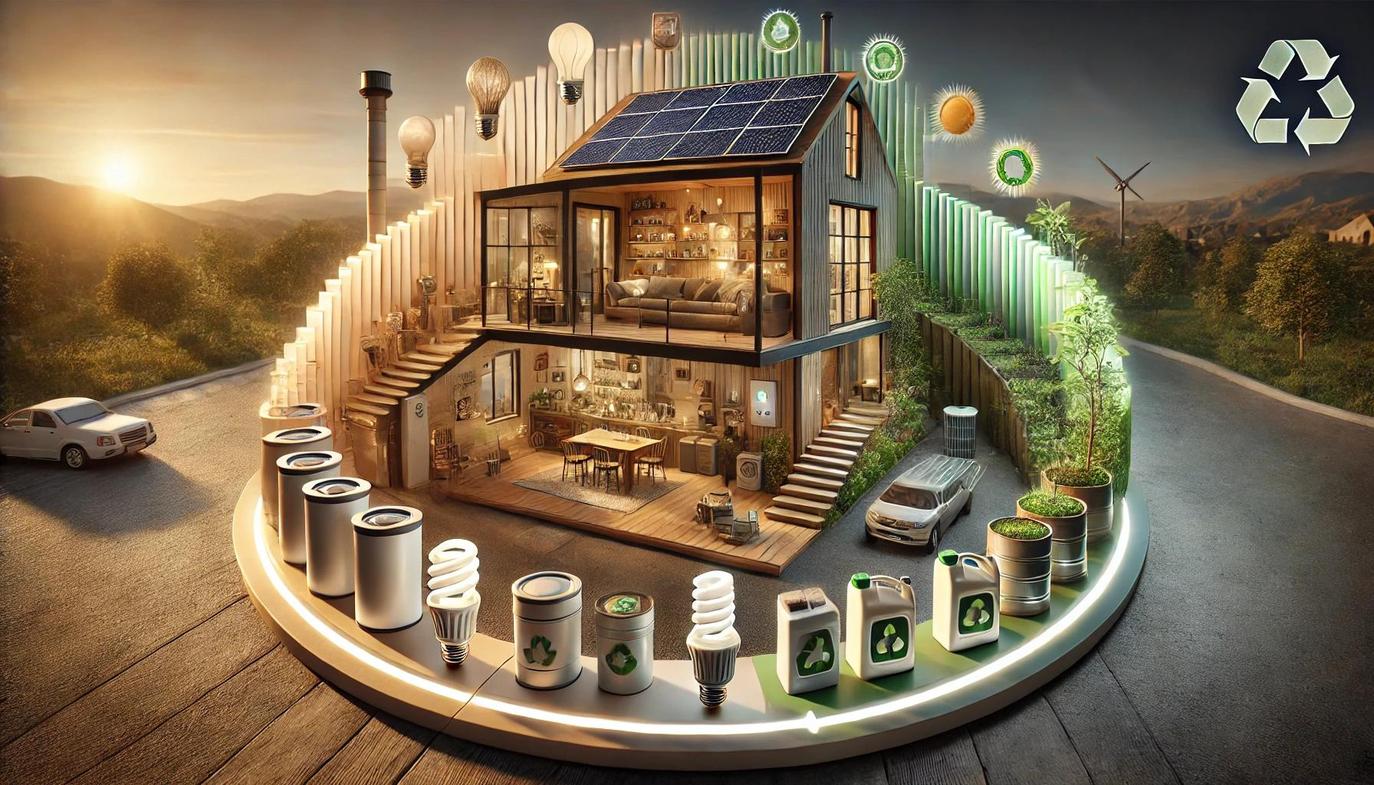
Building a Circular Home Stack: Plan Your Next 12–36 Months
Creating a sustainable household doesn’t happen overnight—it’s more like assembling a stack of interoperable solutions.
A circular home stack integrates technologies like rooftop solar, at-home biodigesters, rainwater capture, and smart appliances into one self-reliant ecosystem.
Step 1: Start Small
Begin with accessible changes like swapping to LED lighting, compostable garbage bags, or reusable cleaning products. These initial steps provide an immediate impact by reducing waste and generating cost savings.
Step 2: Medium-Term Upgrades (6–18 Months)
Consider installing a biodigester or experimenting with enzyme-based recycling through community drop-off programs. Add smart thermostats or efficient water systems to cut consumption.
Step 3: Long-Term Integration (18–36 Months)
Invest in rooftop solar, perovskite-integrated panels (once certified), or home batteries. Link these with existing systems to create a resilient, circular ecosystem where energy, water, and waste cycle locally rather than flowing outward.
By phasing changes over time, households avoid financial strain and steadily move toward independence from centralized grids and waste systems.

Charting Your Path to a Self-Sustaining Home
The journey toward a circular lifestyle begins with deliberate, incremental changes. By integrating emerging technologies like high-efficiency perovskite solar, at-home biodigesters, and enzymatic recycling, you can build true household resilience. Start by choosing a single system that fits your home, explore regional incentives that may fund sustainability projects, and build momentum from there. Each choice compounds, moving you closer to a home that produces as much as it consumes, closing the loop on energy, waste, and resources.
Key Questions on Perovskite Solar and Home Biotech
What Is a Circular Home?
A circular home is designed with the principle of reusing resources locally, transforming waste into inputs for new processes, such as energy, water, or materials.
How Much Does an At-Home Biodigester Cost?
Small systems start around $1,000–$1,500, though costs vary depending on size and installation. Some regions offer subsidies.
Can Enzymatic Recycling Handle All Plastics?
Currently, enzymes are most effective on PET plastics and polyester. Research is expanding to other plastic types.
How Soon Will Perovskite Solar Panels Be Available for Homes?
Several companies expect certifications and commercial products within the next two to five years, though durability testing is ongoing.
Do Circular Home Systems Require a Lot of Maintenance?
Most systems are designed for simplicity, but biodigesters and solar panels need regular checks to ensure performance.


