
Nightmares are among the most distressing symptoms of post-traumatic stress disorder (PTSD), a condition that can develop after a person experiences a disaster, serious accident, violence, combat, or another severe trauma. During sleep, people with PTSD often relive the event in vivid detail, waking in panic and sometimes becoming afraid to go to bed. Available medications provide limited relief, and no drug has been approved specifically for trauma-related nightmares. That may be about to change.
Researchers at Charité – Universitätsmedizin Berlin have found that a prescription medication containing THC, one of the active compounds in cannabis, significantly reduces trauma-related nightmares. The findings, published in Nature Medicine, showed that more than half of participants responded to the treatment, and more than one-third reported that their nightmares disappeared completely.
PTSD affects millions of people worldwide, and nightmares are among its most common and stubborn symptoms. Studies estimate that between 50% and 70% of people with PTSD experience recurrent, trauma-related nightmares. These nightmares can persist for years, even decades, after the original trauma. For many patients, the fear of falling asleep becomes a secondary source of suffering.
Why PTSD Nightmares Are So Difficult to Treat
When someone experiences a terrifying or life-threatening event, the brain sometimes fails to process the memory properly. In PTSD, these memories can return involuntarily, both during the day and at night. While sleeping, a person may repeatedly relive the trauma until they wake in panic.
Antidepressants and blood pressure medications are sometimes prescribed, but their effectiveness is limited and they often do little to address the nightmares themselves. In Germany, where the study took place, no medication has been approved specifically for trauma-related nightmares. This treatment gap led Prof. Stefan Röpke and his team at the Department of Psychiatry and Neurosciences at Charité to explore whether THC could help.
Current treatment options for PTSD nightmares include:
- Prazosin: A blood pressure medication sometimes used off-label, though clinical trial results have been mixed and its effectiveness remains debated.
- Antidepressants (SSRIs): Can reduce overall PTSD symptoms but often do not specifically target nightmares.
- Imagery Rehearsal Therapy (IRT): A cognitive behavioral approach where patients rewrite their nightmare scripts and mentally rehearse new endings during the day.
- Cognitive Processing Therapy (CPT): A trauma-focused therapy that addresses distorted beliefs related to the trauma.
Despite these options, many patients continue to suffer from nightly trauma replays, highlighting the need for targeted pharmacological solutions.
How THC Affects Sleep and the Brain
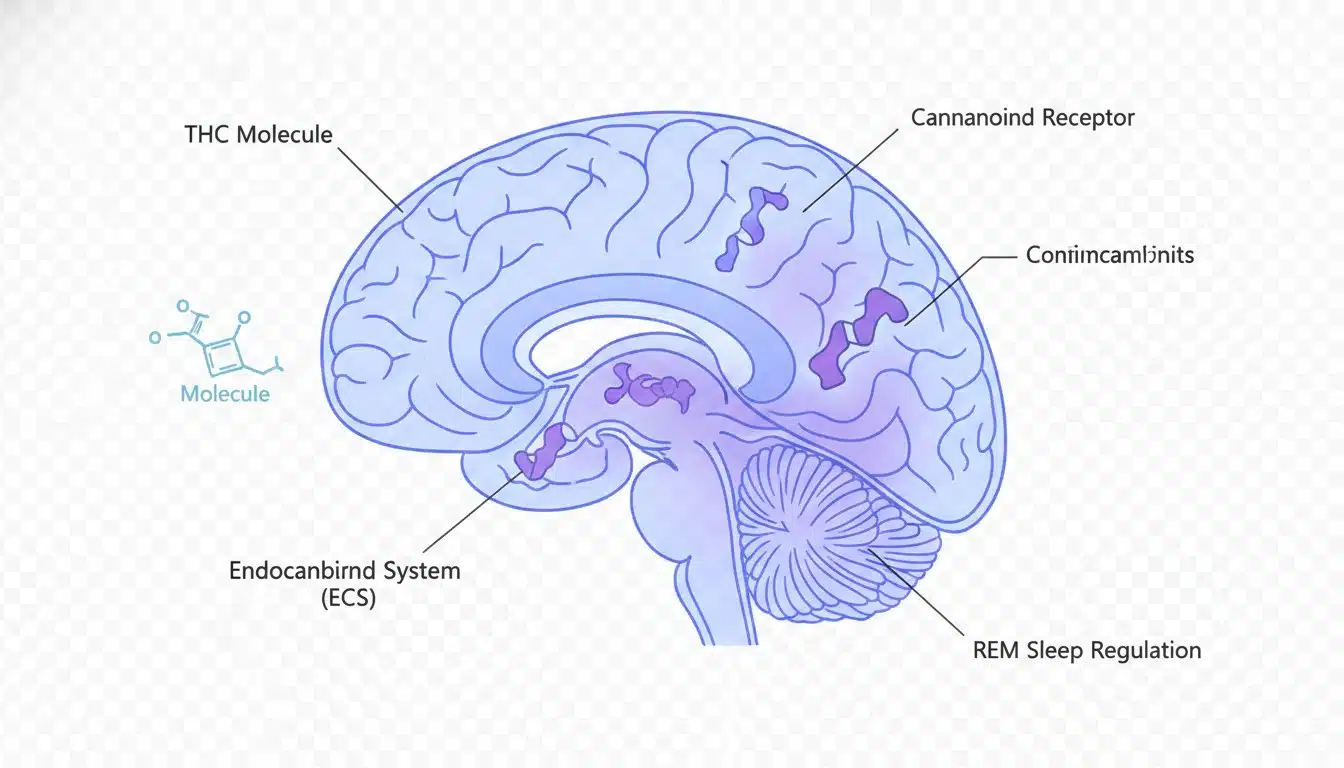
THC, or tetrahydrocannabinol, is the primary psychoactive compound in cannabis. It interacts with the body’s endocannabinoid system, a network of receptors and signaling molecules that helps regulate sleep, stress responses, appetite, and the processing of emotional memories.
Research suggests that THC has a particularly notable effect on REM (rapid eye movement) sleep — the stage during which the most vivid dreaming occurs. During REM sleep, the brain processes experiences and regulates emotions. THC appears to reduce the duration and intensity of REM sleep, which may explain why it can dampen traumatic dream activity.
“There is evidence suggesting that during REM sleep — the intense dream phases in which the brain processes experiences and regulates emotions — THC reduces dream activity and thereby alleviates nocturnal stress responses,” explained Röpke.
The endocannabinoid system also plays a role in fear extinction, the process by which the brain learns that previously threatening stimuli are no longer dangerous. Impairments in fear extinction are thought to contribute to PTSD, and THC’s interaction with cannabinoid receptors may help restore this natural recovery mechanism.
The Dronabinol Clinical Trial
The researchers tested Dronabinol (also known by its investigational code BX-1), a prescription medication containing THC extracted directly from the cannabis plant. It was administered as oral drops on a spoon in doses ranging from 2.5 to 15 milligrams, taken one hour before bedtime. Dosing began low and was gradually increased over the first four weeks to find each patient’s optimal level, followed by six weeks at a stable maintenance dose. The trial is registered at ClinicalTrials.gov under identifier NCT04448808.
The study enrolled 171 adults aged 18 to 65, with a mean age of approximately 38 years. Notably, 79% of the participants were women — consistent with the higher prevalence of PTSD among women. All participants had PTSD with recurrent nightmares occurring more than twice per week, and they were recruited across four medical centers in Germany between 2020 and 2025.
For ten weeks, participants took either Dronabinol or a cannabis-flavored placebo that looked identical. Neither the participants nor the healthcare professionals knew who received which treatment, making this a double-blind, placebo-controlled trial — the gold standard in medical research.

What the Results Showed
At the end of the ten-week period, nightmare severity had dropped significantly more in the Dronabinol group than in the placebo group. The primary endpoint — the CAPS-IV B2 score, which measures nightmare frequency and intensity — showed a between-group difference of -1.50 points, with a 95% confidence interval of -2.28 to -0.71 and a Cohen’s d of 0.65 (P < 0.001), confirming a statistically significant and clinically meaningful effect.
The key results are summarized below:
| Outcome | Dronabinol Group | Placebo Group |
|---|---|---|
| Average reduction in nightmare burden (0-8 scale) | 3.7 points | 2.2 points |
| Patients whose nightmares stopped completely | 37% | 15% |
| Patients whose nightmare burden was at least halved | 21% | — |
| Patients reporting markedly improved overall health | 83% | 24% |
| Patients who responded to treatment (at least 50% improvement) | 58% | — |
Beyond the nightmare burden scores, the trial tracked several secondary measures that reinforced the findings. On the Patient Global Impression of Change scale, the Dronabinol group showed substantially greater overall improvement, with an odds ratio of 4.66 (P < 0.001). Sleep quality, measured by the Pittsburgh Sleep Quality Index Addendum, also improved significantly in the treatment group (P < 0.001), as did patient-reported PTSD symptom scores (P = 0.006). A per-protocol analysis of 145 patients at week 10 confirmed response rates of 57.9% for Dronabinol versus 29% for placebo (P < 0.001), with remission rates of 36.8% versus 14.5%.
The real-world impact was striking. “More than a third of the patients treated with Dronabinol reported that they no longer experienced any nightmares after ten weeks. Another 21 percent reported that their nightmare burden had been at least halved,” said Röpke. “And about five out of six patients in the dronabinol group felt their health had markedly improved.”
The medication appeared to target nightmares and sleep specifically, rather than every aspect of PTSD. The researchers could not conclusively show that it reduced the overall severity of post-traumatic stress disorder or any accompanying depression. Still, by interrupting the nightly cycle of reliving trauma, the treatment allowed many participants to sleep more peacefully.
Safety Profile and Side Effects
No severe side effects were reported during the trial. Mild to moderate effects occurred more frequently in the Dronabinol group, including dizziness, headaches, increased appetite, and dry mouth (reported in 9.2% of the Dronabinol group compared to 1.2% of the placebo group). Overall, adverse events were reported in 90% of the Dronabinol group compared to 77% of the placebo group, with serious adverse events occurring in 8% of the Dronabinol group and none in the placebo group.
Importantly, the researchers found no withdrawal symptoms after participants stopped taking the evening doses at the end of the study. Treatment discontinuation due to adverse events was similar between the two groups — 5.7% in the Dronabinol group and 7.2% in the placebo group.
Cannabis-based medicines are already used in pain treatment in Germany, where access expanded after the “Cannabis for medical purposes” law took effect in 2017. The legislation broadened the medical and scientific use of plant-derived and synthetic cannabinoids. Dronabinol is one such medication, and this study adds PTSD-related nightmares to the list of conditions it may help address.
What This Means for PTSD Patients
The study is believed to be the first randomized controlled trial specifically designed to test THC for PTSD-related nightmares. While previous research has explored cannabis and cannabinoids for PTSD more broadly, this trial focused narrowly on nightmare frequency and intensity as its primary endpoint.
For the millions of people living with PTSD — including military veterans, survivors of violence and abuse, and those who have endured accidents or natural disasters — the results offer a new avenue for relief. The U.S. Department of Veterans Affairs estimates that between 11% and 20% of veterans who served in Iraq and Afghanistan experience PTSD in a given year, and nightmares are frequently reported as one of the most disruptive symptoms.

However, the researchers caution that Dronabinol is not a cure for PTSD. It addresses one specific and debilitating symptom. Patients would still need comprehensive care, including trauma-focused therapy and support for other PTSD symptoms such as hypervigilance, avoidance, and mood disturbances.
Study Limitations and What the Trial Does Not Show
While the results are encouraging, it is important to understand what this trial does and does not establish. The study was funded by Bionorica SE, a pharmaceutical company that manufactures cannabinoid medicines. Industry funding does not invalidate a well-designed, double-blind, placebo-controlled trial, but it is a disclosure worth weighing when interpreting the findings.
The ten-week duration means questions about long-term safety and whether patients may develop tolerance with continued nightly dosing remain open. The researchers themselves flagged this as a priority for future investigation. The trial also did not compare Dronabinol against existing nightmare treatments such as prazosin, so it is not yet known how it stacks up against the current off-label options.
Additionally, the participants were 79% women, with most reporting trauma related to physical or sexual assault. While this reflects the higher prevalence of PTSD among women, it means the findings may not generalize equally to all populations — including combat veterans, who made up only 19% of the study group. The trial also used a specific pharmaceutical formulation of oral THC drops, not inhaled or whole-plant cannabis products that patients encounter in real-world medical cannabis programs. Results from this carefully controlled setting may not translate directly to other forms of cannabis use.
In summary, the key limitations to keep in mind are:
- Short duration: Ten weeks does not establish whether benefits persist or tolerance develops with longer use.
- Industry funding: The study was supported by Bionorica SE, a cannabinoid medicine manufacturer.
- Narrow population: With 79% women and most trauma related to assault, the findings may not fully generalize to combat veterans or other PTSD populations.
- Specific formulation: The trial used standardized oral THC drops, not inhaled or whole-plant cannabis products.
- No comparator: Dronabinol has not yet been tested head-to-head against prazosin or other existing nightmare treatments.
- Symptom-specific: The treatment reduced nightmares but did not conclusively improve overall PTSD severity or depression.
Perhaps most importantly, this trial provides evidence for a targeted effect on nightmares and sleep — not for treating PTSD as a whole. Dronabinol should be understood as a potential tool for one of PTSD’s most stubborn symptoms, not as a standalone treatment for the disorder itself.
Frequently Asked Questions
Is Dronabinol the same as medical marijuana?
No. Dronabinol is a prescription medication containing pure THC extracted from the cannabis plant and standardized to precise doses. Medical marijuana, by contrast, varies in potency and contains a mix of cannabinoids and other plant compounds that differ from batch to batch. A prescription drug like Dronabinol offers the consistency and quality control needed for reliable clinical use.
Does THC cure PTSD?
No. The study found that Dronabinol significantly reduced nightmares, but it did not conclusively reduce overall PTSD severity or depression. It is best understood as a targeted treatment for one of PTSD’s most distressing symptoms, not a cure for the disorder itself. Comprehensive PTSD care typically involves a combination of therapy, medication, and support.
Can I take Dronabinol for PTSD nightmares now?
Dronabinol is currently approved in several countries, including Germany and the United States, for conditions such as chemotherapy-induced nausea and AIDS-related appetite loss. However, it is not yet approved specifically for PTSD-related nightmares. Patients interested in this treatment should consult their healthcare provider about off-label options and whether they might qualify for future clinical trials.
Were there any serious risks in the study?
No severe side effects were reported, and there were no signs of dependence or withdrawal after participants stopped taking the medication. Serious adverse events occurred in 8% of the Dronabinol group and none in the placebo group. Common mild side effects included dizziness, headaches, and increased appetite. Future studies will examine long-term safety and whether patients may develop tolerance over time.
What Comes Next
While the results are promising, the researchers say more work is needed. Future studies will examine whether the treatment remains safe and effective over longer periods and whether patients may gradually develop tolerance to the drug. Researchers also want to explore whether combining Dronabinol with trauma-focused therapy could produce even better outcomes.
The study was conducted by scientists from Charité, the University Medical Center Hamburg-Eppendorf, and the Central Institute for Mental Health in Mannheim, with support from the pharmaceutical company Bionorica SE. It was published in Nature Medicine on August 5, 2026.
For the millions of people worldwide living with PTSD, the prospect of a targeted treatment for one of its most stubborn symptoms represents a meaningful step forward. Being able to sleep without fear is something most people take for granted — but for those whose nights are haunted by trauma, this research offers a reason to hope.


