
If you have shopped for bedding, baby clothes, or towels recently, you have probably seen a small tag that says “OEKO-TEX Standard 100” or “Confidence in Textiles.” It is one of the most widely recognized textile safety labels in the world, yet many shoppers are not sure what it actually certifies. This guide explains what OEKO-TEX means, what Standard 100 tests for, how the different OEKO-TEX labels compare, and how to verify a product is genuinely certified.
What Does OEKO-TEX Mean?
OEKO-TEX is an independent, international testing and certification system for textiles and leather. The name comes from “Oeko,” the German word for ecology, and “Tex” for textiles. It is owned by the International Association for Research and Testing in the Field of Textile and Leather Ecology, a network of 17 independent research and test institutes in Europe and Japan.
The association was founded in 1992 by the German Hohenstein Institute and the Austrian Textile Research Institute (OETI). That same year it launched its best-known label, Standard 100, as a way to give consumers and brands a single, scientific benchmark for textile safety. Today, OEKO-TEX certifications are issued in more than 100 countries and cover every component of a product, from fabric and thread to buttons, zippers, linings, and coatings.
In practical terms, an OEKO-TEX label answers one question: has this textile been tested for harmful substances and found to be harmless to human health under normal use? Depending on the specific label, it can also confirm that the factory and supply chain meet standards for sustainable production and worker safety.
OEKO-TEX Standard 100 Explained: What It Tests
OEKO-TEX Standard 100 is a label for textiles tested for harmful substances. It is the most common OEKO-TEX label you will see on consumer products, and it sets the benchmark for textile safety from yarn to finished product.
To earn the label, every component of the finished article must be tested against a list of more than 1,000 harmful substances. That includes the outer fabric as well as sewing threads, buttons, zippers, coatings, prints, and any accessories. A T-shirt cannot be certified if its fabric passes but its dye or zipper does not.
The substances tested include:
- Pesticide residues that can remain in natural fibers such as cotton
- Heavy metals such as lead, cadmium, mercury, arsenic, and chromium VI that can be present in dyes and pigments
- Formaldehyde, which is sometimes used in wrinkle-resistant or shrink-resistant finishes
- Phthalates found in prints, coatings, and plasticized accessories
- Carcinogenic and allergenic dyes, including banned azo dyes that can release harmful amines and disperse dyes that can trigger skin reactions
- Chlorinated phenols, flame retardants, PFAS, and volatile organic compounds that can off-gas from treated textiles
- pH levels that indicate whether a fabric is skin-compatible
Limit values are reviewed and updated at least once a year to reflect new scientific findings and changes to regulations such as EU REACH, the U.S. CPSIA, and the ECHA Candidate List of Substances of Very High Concern. For example, the 2026 OEKO-TEX annual updates tightened limits for bisphenols B, F, and S from 1,000 mg/kg to 200 mg/kg, added new substances including DBDPE and Dechlorane Plus to the Restricted Substance List, and set new limits for PFOS and PFOS-related substances.
The standard also requires that at least one risk parameter be included in every product control, and any non-compliance triggers immediate corrective action by the certifying institute. Certificates are valid for one year and must be renewed through re-testing.
The Four Product Classes: Why Baby Products Have the Strictest Limits
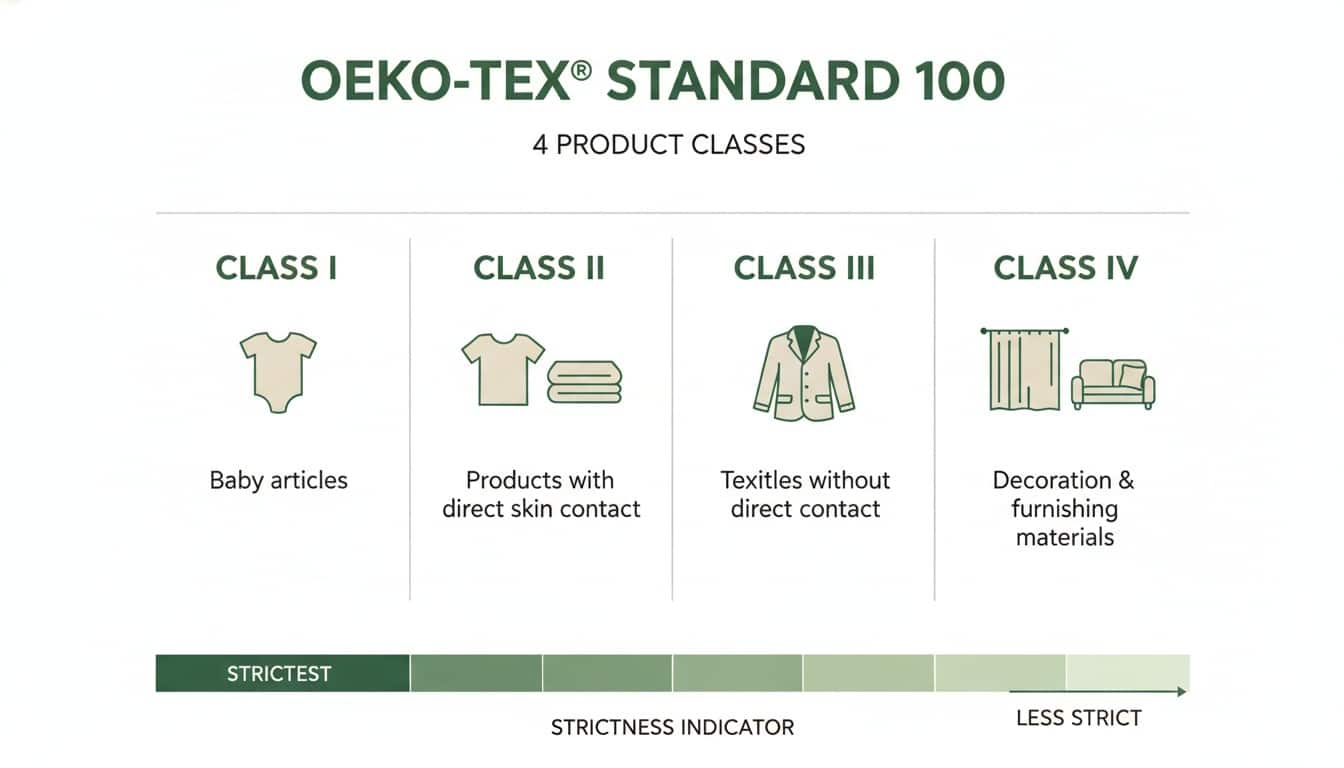
OEKO-TEX Standard 100 divides products into four classes based on how intensively they contact skin. The more intimate the contact, the stricter the limit values and laboratory tests.
| Product Class | Who or What It Covers | Examples | Strictness |
|---|---|---|---|
| Product Class I | Baby articles for children up to 3 years | Diapers, baby clothing, bedding, towels for infants | Strictest limits |
| Product Class II | Textiles with direct and prolonged skin contact | Bed sheets, T-shirts, underwear, socks | Strict |
| Product Class III | Textiles without direct skin contact | Jackets, coats, linings, vests | Moderate |
| Product Class IV | Furnishing and decoration materials | Curtains, tablecloths, upholstery, mattresses and rugs | Lowest, still tested |
This class system is the most important detail for shoppers to understand. A curtain and a baby onesie can both be Standard 100 certified, but they are tested to different thresholds. When you see a label, check which product class is listed and whether it matches the intended use. For instance, baby and toddler items should always be Product Class I, while your bedsheets should be at least Product Class II.
To illustrate what “stricter” means in practice, the 2024 edition of the standard sets the formaldehyde limit at less than or equal to 16 mg/kg for Product Class I, 75 mg/kg for Product Class II, and 300 mg/kg for Product Classes III and IV. Similar tiered limits apply to heavy metals, pesticides, and extractable nickel.
The Full Family of OEKO-TEX Labels: From Product Safety to Supply Chain
Standard 100 is only one member of a modular system. OEKO-TEX now offers several labels and certifications that cover different stages of the textile value chain, from chemical inputs to factory audits to finished products.
| Label or Certificate | What It Certifies | Scope | Validity |
|---|---|---|---|
| Standard 100 | Finished textile product tested for harmful substances | Product level, every component | 1 year |
| Leather Standard | Leather articles tested for harmful substances | Product level, including wet-blue and wet-white stages | 1 year |
| Made in Green | Product tested for harmful substances AND made in STeP-certified facilities with traceability via QR code | Product + factory | 1 year |
| STeP (Sustainable Textile & Leather Production) | Production facility for environmental and social performance | Factory level | 3 years |
| Eco Passport | Chemicals, colorants, and auxiliaries used in textile and leather manufacturing | Chemical inputs | 1 year |
| Organic Cotton | Certifies organic cotton content and tests for harmful substances and GMO traces | Fiber and product level | 1 year |
| Responsible Business | Company-level due diligence for human rights and environmental responsibility | Company level | Ongoing audit cycle |
For consumers, the most relevant distinction is this: Standard 100 tells you the finished item you hold is safe to use, while Made in Green tells you the same thing plus that it was made in audited, responsible facilities and you can trace its supply chain by scanning the QR code on the label. STeP and Eco Passport are primarily business-to-business certifications that sit upstream, assuring brands that their factories and chemical suppliers meet OEKO-TEX criteria before a Standard 100 product is even assembled.
How OEKO-TEX Certification Works: From Application to Label
Getting certified is a laboratory and audit process managed by one of the 17 OEKO-TEX institutes. Understanding the steps helps explain why the label is considered credible and why it must be renewed annually.
- Application: The manufacturer registers online, submits an application form, bill of materials, and a representative product sample including all accessories.
- Verification: The institute reviews the application and sample for completeness and assigns testing parameters based on the product class.
- Individual measurement plan: Analysts define risk parameters and develop a testing plan for the material. Every component is tested against the relevant harmful substance list.
- On-site visit: For many certifications, especially STeP and Made in Green supply chains, auditors inspect the production site to verify quality management and chemical handling.
- Laboratory testing: Samples are tested in accredited labs using harmonized methods. Results are compared to the limit values for the declared product class.
- Report and certificate: The institute issues a detailed test report. If all results comply, a certificate valid for one year is issued. The costs are shared across the supply chain, and if every component is already certified, finished-product testing can be waived to avoid duplication.
After certification, products are entered into the OEKO-TEX Buying Guide directory, and the label can be applied to packaging. Because limit values evolve each year, a product certified in 2024 must be re-tested against the updated 2025 or 2026 criteria to keep its status.
Is OEKO-TEX Good Quality? What the Label Does and Does Not Mean
A common misconception is that OEKO-TEX is a quality or durability mark. It is not. The Standard 100 label does not rate softness, thread count, colorfastness over time, or how long a garment will last. It is a human-ecology safety certification.
What it does guarantee:
- The product has been independently tested for more than 1,000 harmful substances and meets science-based limits for its product class
- Testing is harmonized worldwide, so a certificate issued in Germany uses the same methods and limits as one issued in Japan or the United States
- Compliance aligns with major chemical regulations, including EU REACH and U.S. CPSIA, providing an extra layer of consumer protection beyond minimum legal requirements
What it does not guarantee:
- That fibers are organic, recycled, or sustainably farmed. A conventional cotton sheet and an organic cotton sheet can both be Standard 100 certified
- That the entire supply chain is environmentally sustainable or that workers are fairly paid, unless the product also carries Made in Green or comes from a STeP-certified facility
- That the product is free of every trace chemical, only that it is below thresholds considered harmless to health under normal and intended use
For shoppers who care about both chemical safety and sustainability, the strongest signal is a combination of labels rather than one alone. Pairing OEKO-TEX Standard 100 with a fiber or process certification gives broader coverage than either label on its own.
OEKO-TEX vs Organic Cotton vs GOTS vs Bluesign: Which Should You Choose?
You will often see OEKO-TEX mentioned alongside GOTS and Bluesign. These certifications are not interchangeable. Each covers a different part of textile responsibility, and the best choice depends on what you value most.
| Certification | Core Question It Answers | Fiber Requirement | Scope | Best For |
|---|---|---|---|---|
| OEKO-TEX Standard 100 | Is the finished product free from harmful substances? | None, any fiber can be certified | Finished product safety | Health-conscious shoppers, parents, sensitive skin |
| GOTS (Global Organic Textile Standard) | Is the fiber organic and was the whole supply chain handled responsibly? | At least 70% organic fiber, at least 95% for “organic” grade | From harvesting through manufacturing to labeling | Shoppers prioritizing organic farming and supply chain traceability |
| OEKO-TEX Organic Cotton | Is this organic cotton genuine and free from harmful substances? | Certified organic cotton, tested for GMO markers | Fiber identity + product safety | Buyers who want verified organic content without full GOTS scope |
| Bluesign | Were chemicals and processes managed responsibly during manufacturing? | None | Chemical inputs and manufacturing processes | Technical apparel, outdoor gear, chemical management focus |
OEKO-TEX vs GOTS: Think of OEKO-TEX Standard 100 as a health test at the finish line. It checks what is actually in the textile you bring home. GOTS is an end-to-end supply chain certification that starts at the farm. It requires organic fiber, restricts certain chemical inputs during processing, and audits environmental and social criteria along the entire chain. A GOTS-certified organic cotton towel is, in most cases, also safe from harmful substances, but GOTS does not publish the same granular substance-by-substance limit table that Standard 100 does. Many brands pursue both to cover safety and organic provenance at once.
OEKO-TEX vs Bluesign: Bluesign focuses upstream, approving safe chemical formulations before they enter the factory and optimizing resource use during manufacturing. It is widely used in performance and outdoor apparel where chemistry is complex. OEKO-TEX Standard 100 focuses downstream, testing the finished article you wear or sleep on. Bluesign and Standard 100 can complement each other, and OEKO-TEX Eco Passport is the closest OEKO-TEX equivalent to Bluesign’s chemical input focus.
Does OEKO-TEX mean organic? No. Standard 100 does not verify how the fiber was grown. If you want certified organic content, look for GOTS or OEKO-TEX Organic Cotton alongside Standard 100. If you want verified chemical safety for any fiber type, Standard 100 is the more direct proof.
Is OEKO-TEX Safe? What It Means for Babies, Allergies, and Sensitive Skin
For most consumers, the practical safety question is straightforward: should I prioritize OEKO-TEX when shopping for items that touch skin for long hours?
The answer is especially relevant for three groups:
- Babies and young children: Product Class I sets the lowest allowable limits for formaldehyde, heavy metals, pesticides, and pH. The 2026 updates also banned biocides in all Product Class I articles and in any article with direct contact to mucous membranes, such as baby and adult diapers and menstrual underwear. If you buy OEKO-TEX certified baby clothes, look for Product Class I on the label and a valid certificate number.
- People with sensitive skin or chemical sensitivities: Allergenic disperse dyes are not permitted in Product Classes I and II, and carcinogenic arylamines from azo dyes must not be detectable. Chromium VI, nickel, and formaldehyde are all capped to levels designed to minimize irritation and sensitization during normal use.
- Anyone concerned about long-term exposure: Bedding, mattresses, and pillows fall into classes that require stringent testing because contact lasts for hours every night. Choosing Standard 100 certified sheets, comforters, and mattress textiles reduces exposure to residual processing chemicals that legal minimums alone might not catch.
It is important to keep expectations realistic. OEKO-TEX tests for a comprehensive but defined list of substances at the time of certification. It does not test for every chemical in existence, and it evaluates risk under normal, intended use rather than misuse. The strength of the system is that the list is actively expanded each year as new substances of concern, such as specific PFAS compounds, bisphenols, and siloxanes, are added to global regulation.
For broader context on how everyday materials can affect indoor health and why certifications that test for volatile compounds matter, see our guide to the room you are forgetting in your sustainable home makeover.
How to Check If a Product Is Really OEKO-TEX Certified (And Spot Fakes)
A genuine OEKO-TEX label should include the test institute, the product class, and a certificate number. Without those details, a claim of “OEKO-TEX certified” is not verifiable. Use these steps before you buy:
- Read the label closely: Look for the words “OEKO-TEX Standard 100” or “Confidence in Textiles,” the name of the testing institute such as Hohenstein or Testex, the product class (I, II, III, or IV), and a certificate number in the format like SHHO 123456. Made in Green labels will also include a QR code and a product ID.
- Use the official Label Check: Go to the OEKO-TEX Label Check tool and enter the certificate number or scan the QR code. The tool will confirm whether the certificate is valid, what product types it covers, and when it expires. If a listing cannot provide a number, treat the claim as unverified.
- Cross-check the Buying Guide: Brands and suppliers with valid certificates are listed in the OEKO-TEX Buying Guide. Searching the brand name there can confirm that the company holds a current certificate for the relevant product group.
- Be cautious with marketplace listings: On large retail platforms, some sellers add “OEKO-TEX” to titles as a keyword even when only a component, not the finished item, was certified. A valid finished-product certificate should reference the item you are actually buying.
- Check the date: Certificates are valid for one year. An old certificate number that no longer validates may mean the product has not been retested against the latest limit values.
This verification habit takes less than a minute and is the most reliable way to distinguish certified goods from marketing language. It is also useful when shopping for larger home items such as mattresses and upholstered furniture, where certifications and fabric choices together determine what you bring into your bedroom environment. For related ideas on building a safer, lower-impact home, explore our coverage of how major textile brands are shifting to sustainable fabrics.
Frequently Asked Questions
What is the meaning of OEKO-TEX?
OEKO-TEX is an independent certification system that tests textiles and leather for harmful substances and, through related labels, audits production facilities for sustainable and socially responsible practices. The most recognized label, Standard 100, means every component of the product has been laboratory tested and found harmless to human health under normal use.
Does OEKO-TEX mean 100 percent cotton?
No. OEKO-TEX Standard 100 does not indicate fiber content. A product can be cotton, polyester, wool, linen, or a blend and still be certified. The label refers to chemical safety, not to whether the fabric is cotton or what percentage is natural fiber.
Is OEKO-TEX good quality?
OEKO-TEX is a safety certification, not a durability or luxury rating. It confirms the product meets strict limits for harmful chemicals, but it does not measure softness, thread count, or how long the item will last. Think of it as a health assurance rather than a quality grade.
Is OEKO-TEX or organic cotton better?
They answer different questions. OEKO-TEX Standard 100 verifies that the finished product is safe from harmful substances regardless of fiber type. Organic cotton certifications verify that the raw fiber was grown without synthetic pesticides and GMOs. Many shoppers choose products that carry both types of assurance, such as an organic cotton item that is also Standard 100 certified, to cover both farming and chemical safety.
Does OEKO-TEX certified also mean organic?
Not by itself. Only the OEKO-TEX Organic Cotton label or a separate GOTS certification verifies organic fiber content. Standard 100 alone does not confirm that fibers are organic or recycled.
What is the difference between OEKO-TEX Standard 100 and Made in Green?
Standard 100 certifies that the finished product is tested for harmful substances. Made in Green includes that same product safety test plus certification that the item was made in audited, STeP-certified facilities and offers traceability through a QR code that lets you see where the product was made.
How much does OEKO-TEX certification cost?
Costs vary by product complexity, number of components, testing scope, and product class. OEKO-TEX does not publish a single fixed price. Instead, institutes provide a quote based on the individual measurement plan, with costs shared across the supply chain so that already-certified components do not need to be retested at the finished-product stage.
Conclusion: Why the Label Is Worth Looking For
OEKO-TEX does not make a textile organic, luxurious, or indestructible. What it does do is provide an independent, annually updated, and globally harmonized test that the item you wear, sleep on, or wrap your child in has been checked for more than 1,000 substances that can be harmful to human health.
As chemical regulations evolve and new substances such as PFAS and bisphenols receive tighter limits, a certification that updates its Restricted Substance List every year and validates every component from thread to zipper offers a practical layer of protection that legal minimums alone do not provide. For everyday shoppers, the simplest routine is to look for the label, note the product class, and verify the certificate number in the official Label Check. It is a small habit that adds meaningful confidence to purchases across the home, wardrobe, and nursery.


