
For twenty years, DREADDs have been neuroscience’s most precise laboratory tool for switching brain circuits on and off. Now Chinese teams have taken them into people for the first time, and the announcement left American scientists in stunned silence. At an NIH BRAIN Initiative meeting in Bethesda this week, inventor Bryan Roth revealed at least seven registered human trials testing DREADDs for intractable epilepsy, Parkinson’s disease, and trigeminal neuropathic pain, a leap no US group had dared to attempt.
What Are DREADDs? Designer Receptors Explained
DREADDs stands for Designer Receptors Exclusively Activated by Designer Drugs. They are a family of chemogenetic tools, engineered versions of human G protein-coupled receptors (GPCRs) that no longer respond to their natural neurotransmitter but instead bind with extraordinary sensitivity to an otherwise inert synthetic drug.
The concept was pioneered in 2007 by pharmacologist Bryan Roth at the University of North Carolina School of Medicine. Roth and colleagues mutated human muscarinic acetylcholine receptors so they lost affinity for acetylcholine and gained picomolar affinity for synthetic ligands. That engineering creates a lock-and-key system that exists nowhere else in the body.
- Designer receptor: A mutated human muscarinic receptor (most commonly hM4Di for inhibition) introduced only where therapy is needed.
- Designer drug: Originally clozapine-N-oxide (CNO), now understood to work after converting to clozapine, an approved antipsychotic, at very low doses.
- Chemogenetics: The umbrella term. Are DREADDs chemogenetics? Yes, DREADDs are the most widely used chemogenetic platform, alongside related systems such as KORD and PSAM/PSEM.
- Key distinction: Unlike conventional drugs that hit receptors throughout the brain, DREADDs are expressed only in the virally targeted neurons, offering a more precise knife for circuit-level control.
As detailed in Roth’s foundational primer DREADDs for Neuroscientists published in Neuron, the system enables researchers to selectively silence or activate specific neuronal populations in freely moving animals, from flies to nonhuman primates.
How DREADDs Work: Viral Delivery and the Clozapine Switch
The therapy has two parts: a gene delivery step and a drug activation step. Both are essential for the chemogenetic brain therapy now in human testing.
1. AAV Delivery of the Inhibitory Receptor
Researchers package the gene encoding the inhibitory DREADD hM4Di into an adeno-associated virus (AAV) vector. Using stereotactic neurosurgery, the virus is injected directly into the disease-relevant brain region. Once infected, those neurons manufacture the designer receptor and insert it into their membranes. The receptor remains inert until the drug arrives.
Three of the seven Chinese trials explicitly list an AAV vector, the same viral platform used in approved gene therapies for spinal muscular atrophy and blindness. The vector does not spread widely, which limits the effect to the targeted circuit. Similar AAV approaches have already shown promise, as seen in a viral gene-therapy breakthrough that improved eyesight for the blind.
2. Picomolar Activation by Low-Dose Clozapine
The Chinese trials use the original pairing: hM4Di activated by clozapine. Clozapine is an atypical antipsychotic normally dosed at 300 to 600 mg per day for schizophrenia. For DREADDs, effective doses are orders of magnitude lower because hM4Di binds clozapine with approximately 10,000-fold greater selectivity than native receptors.
Animal studies show that doses as low as 0.01 to 0.1 mg/kg activate inhibitory DREADDs without off-target behavioral or metabolic effects, while 1 mg/kg produces unwanted sedation and metabolic depression in thalamus and striatum. This low-dose window is central to translational safety, as demonstrated in research optimizing clozapine for chemogenetic neuromodulation, which concluded that subthreshold clozapine avoids the broad receptor activity that makes standard antipsychotic doses problematic.
When clozapine binds hM4Di, the Gi signaling cascade hyperpolarizes the neuron via GIRK channels and suppresses presynaptic neurotransmitter release. Firing in that circuit drops for several hours after a single oral dose, then returns as the drug clears. No implant or battery is needed beyond the initial gene delivery.
How Long Do DREADDs Last?
In mice, a single CNO injection produces DREADD-mediated effects for at least 60 minutes, with longer action at higher doses due to prolonged receptor signaling and clozapine metabolism. In people, duration will depend on AAV expression persistence and drug pharmacokinetics. AAV-delivered genes can express for years, potentially a decade, so the receptor itself is long-lasting. Activity, however, is reversible and dose-controlled: stop the drug, and neuronal signaling normalizes. That reversibility is a key advantage over irreversible surgical lesions.

First Human Trials in China: Seven Studies That Stunned the US
About two months ago, a rumor that designer proteins were being used to treat brain disease prompted Roth and a postdoctoral scholar to search clinical trial registries in the United States and China. They found seven studies.
Roth disclosed the findings this week at the NIH Brain Research through Advancing Innovative Neurotechnologies (BRAIN) Initiative meeting in Bethesda, Maryland. Attendees described the reaction as stunned silence. For two decades, DREADDs had been a lab-only tool precisely because commercial and regulatory barriers seemed insurmountable.
Chemical & Engineering News first reported the disclosure on August 14, 2026, noting that Roth had been approached over the years about commercialization but felt nobody wanted to take the risk.
| Indication | Registry | Delivery | Target Circuit | Significance |
|---|---|---|---|---|
| Intractable epilepsy | Chinese Clinical Trial Registry (ChiCTR) | AAV (in some studies) | Epileptogenic focus | Alternative to surgical resection of brain tissue; first trial to begin |
| Parkinson’s disease | ClinicalTrials.gov (NCT07533591 and related) | AAV via stereotactic surgery to subthalamic nucleus (STN) | Subthalamic nucleus | Aims to suppress pathological STN hyperactivity without deep brain stimulation hardware |
| Trigeminal neuropathic pain | ClinicalTrials.gov (NCT06596681) | AAV | Trigeminal pain circuit | Roth calls this highest potential; condition carries suicide risk and lacks effective therapy |
Investigators listed in the registries have not yet responded to requests for comment from C&EN, and no results have been published. Yet the timeline is telling: six of the trials appear to have started months after the first epilepsy study, suggesting investigators saw early safety signals before expanding to additional indications.

For several of these diseases, the current therapy of last resort is to surgically remove or ablate brain tissue. If chemogenetic inhibition proves safe and durable, it could offer a reversible, drug-titratable alternative. If it fails, Roth notes patients could still pursue surgery, underscoring the experimental nature of the approach.
Neuroscientist Jacques Carolan of University College London, who attended the BRAIN meeting, summarized the sentiment: “If we needed more evidence that China is ahead in neuro, this is it.”
DREADDs vs. Optogenetics: Two Paths to Brain Circuit Control
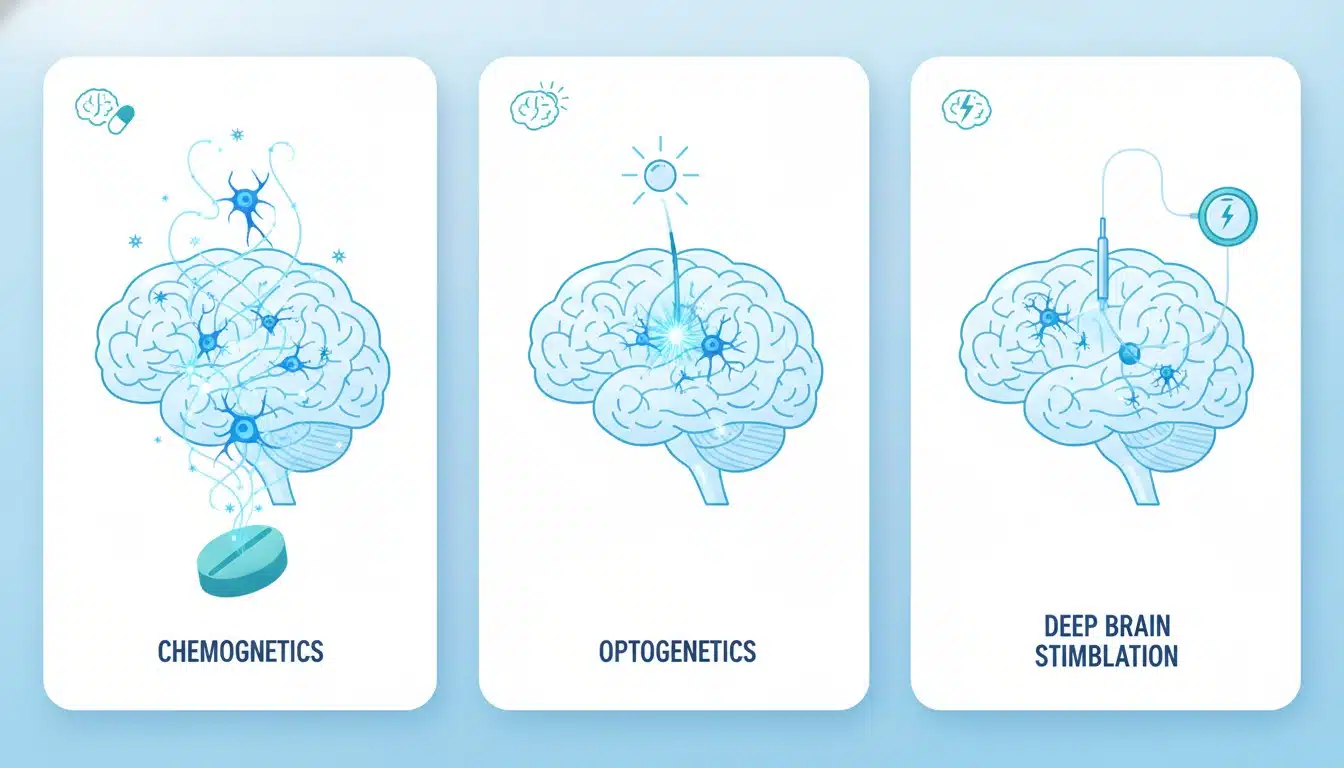
DREADDs belong to chemogenetics, a sibling technology to optogenetics. Both deliver an engineered protein via viral vector to make specific neurons controllable. How they are switched on divides them.
- Optogenetics uses light-sensitive ion channels (opsins) such as channelrhodopsin. Pulses of light delivered through an implanted fiber optic activate or silence neurons with millisecond precision but require a permanent intracranial implant, laser, and tether.
- Chemogenetics (DREADDs) uses an engineered GPCR activated by an oral drug. No light hardware is needed, effects last hours after one pill, and patient compliance is simpler. Temporal precision is lower, in minutes rather than milliseconds.
- Shared strength: Both provide cell-type and projection specificity via promoters and Cre-dependent strategies, enabling circuit-based therapeutics for epilepsy, Parkinson’s, and psychiatric disease as reviewed in Optogenetics and Chemogenetics overviews from NIH.
- Why DREADDs for the clinic: As biochemist Dirk Trauner of the University of Pennsylvania told C&EN, DREADDs offer a more precise knife than systemic drugs because the receptor appears only where injected, reducing off-target effects from endogenous receptors expressed elsewhere.
- Trade-off: Optogenetics offers unmatched temporal control for research; chemogenetics offers scalability and noninvasive actuation for therapy, which is why Chinese teams chose DREADDs for first-in-human trials.
- Hardware is improving too: One limitation of optogenetics is the implant itself. Researchers have built a needle-thin brain implant that delivers light, records electrical activity and injects drugs at several depths through one flexible fiber, which could reduce the hardware burden per experiment.
Risks and Safety: Why Human Use Took 20 Years
The enthusiasm is tempered by serious risks that kept DREADDs in animals for two decades.
Viral Vector Immune Reactions
AAV gene therapies can trigger potent immune responses. In early 2026, several participants died in gene therapy trials in China using viral vectors, a sobering reminder noted by C&EN. Although AAV is generally considered safer than lentivirus or adenovirus, pre-existing immunity, dose, and intracranial inflammation remain concerns. Long-term monitoring for neuroinflammation and off-target expression will be essential.
Clozapine’s Own Pharmacology
Clozapine at antipsychotic doses blocks dopamine D4, serotonin 5-HT2A, histamine H1 and muscarinic receptors, causing sedation, hypotension, and, rarely, agranulocytosis. The chemogenetic strategy depends on using 100- to 1,000-fold lower doses to stay below these thresholds. Yet even low doses must be proven safe with chronic, repeated administration, and metabolites such as N-desmethyl-clozapine could accumulate.
Early translational work highlighted that standard chemogenetic ligand CNO converts to clozapine in vivo, prompting the field to shift toward direct low-dose clozapine or alternative ligands such as perlapine and compound 21. A related finding that olanzapine potently activates hM4Di offers another FDA-approved alternative with a different side-effect profile.
Irreversibility of Gene Expression
Unlike a pill that washes out, AAV-delivered DREADDs persist. If unwanted silencing causes adverse circuit effects, clinicians cannot simply remove the receptor. They can stop the drug, but the protein remains. Future safeguards may require inducible promoters or kill switches.
The staged start of the Chinese trials suggests investigators are watching short-term safety closely before wider enrollment, but peer-reviewed safety data have not yet been released.
The Next Generation: GRANPA and Safer Designer Drugs
An originality gap in existing coverage is the very recent advance that could solve the clozapine problem.
In July 2026, researchers reported in Nature a next-generation chemogenetic receptor called GRANPA, a mutated muscarinic receptor that responds not to clozapine but to diphenhydramine, the over-the-counter antihistamine sold as Benadryl. Because diphenhydramine is widely used with a well-understood safety profile at standard doses, DPH-GRANPA potentially allows chemogenetic inhibition to be achieved relatively safely for epilepsy and other neurological disorders, the authors wrote.
GRANPA is not what the Chinese trials use; they rely on the original hM4Di-clozapine pairing. But its publication one month before Roth’s disclosure highlights how quickly the field is moving toward human-compatible ligands. If validated, GRANPA could offer lower regulatory friction and broader patient acceptance than repurposing an antipsychotic with a black-box warning for agranulocytosis.
Other avenues include the KORD receptor activated by salvinorin B, engineered neuroplasticity approaches like the non-hallucinogenic LSD analog JRT, and humanized Gs-coupled DREADDs now in preclinical testing, each aiming to expand the pharmacological toolbox beyond clozapine. Beyond engineered receptors, scientists are now engineering the cell’s own protein-building machinery, the transfer RNA molecules that translate mRNA into every protein in the body, as therapies in their own right, with an inhalable tRNA for cystic fibrosis reaching clinical milestones in 2025.

Frequently Asked Questions
Have DREADDs been used in humans before?
No. Until 2026, DREADDs were strictly a research tool in cell cultures, rodents, and nonhuman primates. The seven trials identified by Roth in Chinese registries are the first registered human uses. No efficacy or safety results have been published as of August 2026.
Are DREADDs the same as chemogenetics?
DREADDs are the dominant chemogenetic system, but not the only one. Chemogenetics is the broader field of engineering receptors or channels to be controlled by synthetic drugs. DREADDs specifically refer to engineered GPCRs, most often hM3Dq (excitatory, Gq-coupled) and hM4Di (inhibitory, Gi-coupled).
What does DREADD stand for?
Designer Receptors Exclusively Activated by Designer Drugs. The name reflects that the receptor is synthetic and its ligand is chosen to avoid activating natural receptors at therapeutic doses.
How long do DREADDs last?
The viral transgene can express for years, but the silencing effect lasts hours per dose and is reversible. In animals, activation persists for at least an hour and can be prolonged with higher or repeated dosing. Duration in humans will be established by the ongoing trials.
What is hM4Di-DREADD?
hM4Di is the inhibitory DREADD most relevant to the current trials. It is a Gi-coupled mutant of the human M4 muscarinic receptor that hyperpolarizes neurons when bound by clozapine or CNO, suppressing firing in the targeted circuit. Excitatory DREADDs such as hM3Dq do the opposite.
What conditions are the Chinese trials targeting?
According to registry entries found by Roth, intractable epilepsy, Parkinson’s disease (via subthalamic nucleus injection), and trigeminal neuropathic pain. Epilepsy and Parkinson’s trials use AAV delivery and stereotactic neurosurgery.
Why This Moment Matters
The leap from lab to clinic has long been hypothesized in review articles on China’s accelerating cell and gene therapy breakthroughs and drug-controlled gene therapies for neural circuit disorders, but no group had taken the regulatory and ethical risk. China appears to have done so at least seven times, and without fanfare until a rumor forced a database search.
Whether the approach proves safe remains unknown. Yet the scientific implication is clear: if an inhibitory DREADD can durably and reversibly dampen a pathological circuit with a low-dose pill, the same blueprint could be adapted to many neuropsychiatric diseases where specific circuits drive symptoms. As Roth told C&EN, if the trigeminal pain trial succeeds, it opens the way basically to circuit-based therapeutics for virtually all neuropsychiatric diseases.
For patients with no options beyond brain resection or implanted hardware, that possibility, and the cautious silence it provoked in Bethesda, marks a turning point for precision neuroscience.


