
Transfer RNA, known as tRNA, is one of the most important molecules in biology, yet most people have never heard of it. Without tRNA, the genetic code stored in DNA could never become the proteins that build your muscles, carry your oxygen, or fire your neurons. Every protein in every living thing on Earth depends on tRNA to be assembled correctly. In 2025, scientists made a leap that could turn this obscure molecule into the basis for an entirely new class of medicines, including the first inhalable therapy for a deadly form of lung disease.
This guide walks through what tRNA is, how it works, why it looks the way it does, and the breakthrough research that is putting tRNA at the center of modern medicine.
tRNA Explained: The Cell’s Molecular Translator
Transfer RNA is a small RNA molecule whose job is to translate the language of genes into the language of proteins. Francis Crick himself described it as an “adaptor,” because tRNA sits between two worlds that do not share a vocabulary: the nucleic acid world of DNA and RNA, and the amino acid world of proteins.
The National Human Genome Research Institute defines tRNA as a short RNA molecule, usually 76 to 90 nucleotides long, that links a specific three-letter codon in messenger RNA to the amino acid that codon specifies. Each tRNA carries one amino acid at one end and recognizes its matching codon with an anticodon loop at the other end.
To put it simply: if DNA is the cookbook and mRNA is the recipe card, tRNA is the chef who reads each three-letter instruction, fetches the right ingredient, and hands it to the ribosome, which is the kitchen where the dish (a protein) gets cooked.
The Three Types of RNA and How tRNA Differs from mRNA and rRNA
Cells make many kinds of RNA, but three do most of the heavy lifting in protein synthesis. Understanding how tRNA differs from the other two clears up a lot of confusion.
- mRNA (messenger RNA) is a copy of a gene. It carries the genetic instructions out of the nucleus and into the cytoplasm, where they can be read. Each mRNA is a long, temporary message that gets translated exactly once and then broken down.
- tRNA (transfer RNA) is the decoder. It does not carry instructions, it interprets them. Each tRNA is short, folds into a tight shape, and picks up a specific amino acid that matches the codon it recognizes.
- rRNA (ribosomal RNA) is the structural and catalytic core of the ribosome itself. rRNA makes up the bulk of the ribosome and even acts as the enzyme that forms the peptide bonds between amino acids. The ribosome is roughly two-thirds rRNA by mass.
So while mRNA is the instruction manual and rRNA is the workbench, tRNA is the worker who actually puts the pieces together.

The Shape of tRNA: Why It Looks Like a Cloverleaf
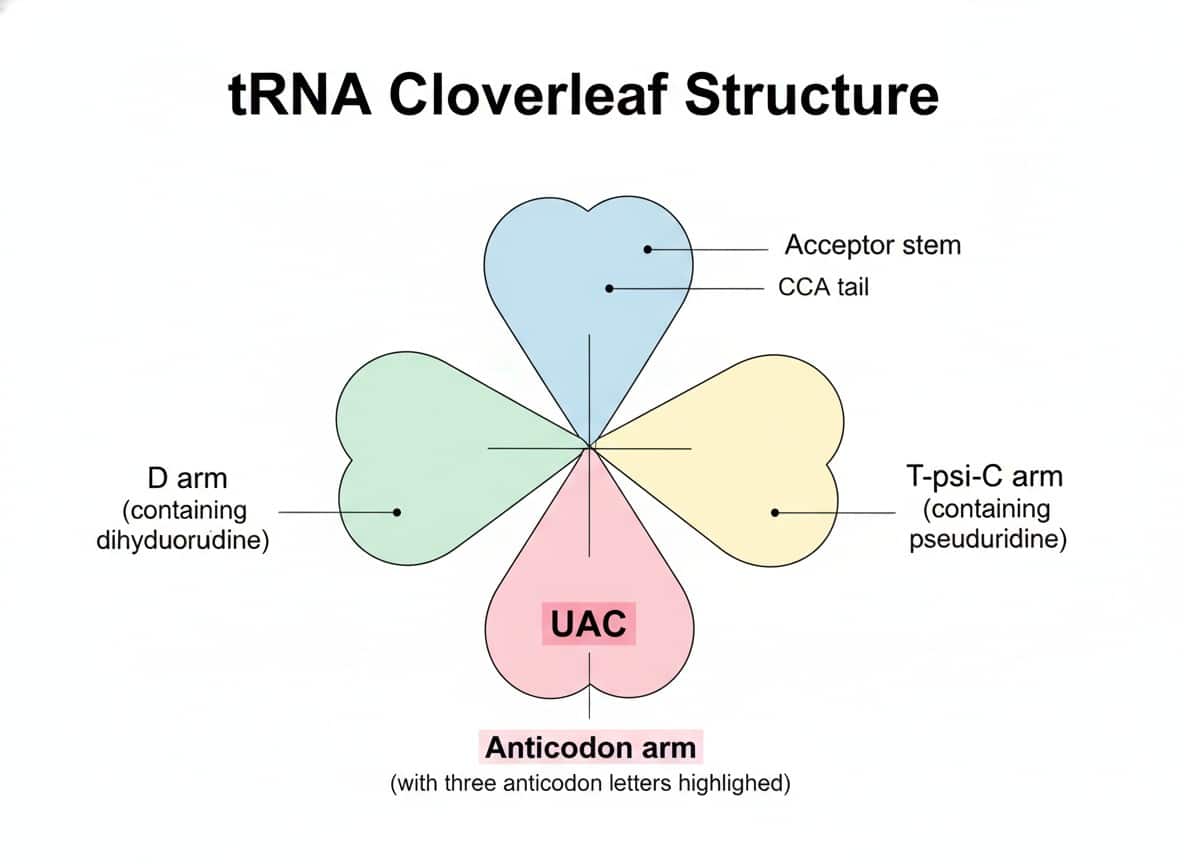
If you flatten a tRNA molecule onto a page and draw out all its base-pairing, it forms a four-leaf clover shape. In three dimensions, that clover folds into a compact L-shape that fits neatly into the ribosome.
The cloverleaf has four arms, each with a job:
- Acceptor stem with a 3′ CCA tail: this is where the amino acid attaches. The sequence CCA at the very tip is added enzymatically and is identical in nearly every tRNA in nature.
- D arm: contains the modified base dihydrouridine, which helps the molecule fold correctly.
- Anticodon arm: carries the three-nucleotide anticodon that base-pairs with the mRNA codon. This is the “reading head” of the tRNA.
- TΨC arm: contains the unusual base pseudouridine (Ψ) and helps the tRNA dock into the ribosome.
That compact L-shape is one of the most conserved structures in all of biology. Whether you look at tRNA from E. coli, a redwood tree, or a human cell, the overall architecture is nearly identical, a sign that the molecule was already perfected billions of years ago.
How tRNA Reads the Genetic Code: Codons, Anticodons, and the Wobble Hypothesis
The genetic code uses 64 three-letter codons. Three of those codons (TAA, TAG, TGA in DNA terms) are stop signals. The other 61 code for 20 amino acids. But cells do not need 61 different tRNAs to read 61 codons. Most organisms get by with around 31 to 45 tRNAs, depending on the species.
This works because of the wobble hypothesis, proposed by Francis Crick in 1966. The first two letters of a codon must match the tRNA’s anticodon perfectly, but the third letter has flexibility. A single tRNA can often pair with multiple codons that share the same first two letters but differ in the third. For example, a tRNA with anticodon 3′-AAG-5′ can read both 5′-UUC-3′ and 5′-UUU-3′ codons, both of which specify phenylalanine.
Wobble is why mitochondria, which have to pack all their genes into a tiny circle of DNA, manage with just 22 tRNAs to decode every codon. It is also why some diseases can be caused by a single tRNA mutation that misreads an entire codon family.
Aminoacylation: How tRNA Gets “Charged” with the Right Amino Acid
A bare tRNA is useless until it has been loaded with its amino acid. The loading step is called aminoacylation, and the molecule that does the work is an enzyme called an aminoacyl-tRNA synthetase. There are 20 of these enzymes in most organisms, one per amino acid.
Each synthetase performs a two-step reaction:
- It activates the amino acid by attaching it to ATP, forming an aminoacyl-AMP.
- It transfers the activated amino acid onto the 3′ end of the correct tRNA.
The synthetase is so picky that it gets the right tRNA right essentially every time, typically with an error rate below 1 in 10,000. If the wrong amino acid gets attached, the cell makes a defective protein, so the synthetases also carry built-in “proofreading” domains that hydrolyze mistakes before they reach the ribosome.
Once the amino acid is attached, the tRNA is described as “charged.” Charged tRNAs shuttle to the ribosome, deliver their cargo, and return empty to be recharged.
tRNA in Action at the Ribosome: Building Proteins One Amino Acid at a Time
Translation happens in three stages, and tRNA is a central player in all of them.
1. Initiation. The ribosome assembles around an mRNA with the start codon AUG, and the initiator tRNA carrying methionine binds at a site called the P site (peptidyl site).
2. Elongation. A new charged tRNA, whose anticodon matches the next codon on the mRNA, enters the A site (aminoacyl site). The ribosome then catalyzes peptide bond formation: the amino acid on the A-site tRNA is joined to the growing chain on the P-site tRNA. The ribosome shifts by one codon, the empty tRNA exits through the E site (exit site), and the cycle repeats.
3. Termination. When the ribosome reaches a stop codon, no tRNA can match it. Instead, release factors bind, and the finished protein is released.
Through this elegant dance, tRNAs add amino acids at a rate of roughly 15 to 20 per second in bacteria and 5 to 10 per second in human cells. A single ribosome can polymerize hundreds of amino acids per minute, and many ribosomes can read the same mRNA at once, forming structures called polysomes.

The Hidden World of tRNA Modifications (the Epitranscriptome)
Every tRNA in your cells is decorated with chemical tags that change how it behaves. On average, about 12% of the nucleotides in a mature tRNA carry post-transcriptional modifications. Across all known tRNAs, scientists have catalogued more than 93 distinct chemical modifications, with new ones still being discovered.
These modifications do several important jobs:
- They stabilize the L-shaped structure of the tRNA.
- They fine-tune codon-anticodon pairing at the wobble position.
- They affect how the tRNA is recognized by its dedicated synthetase.
- They help the cell detect stress, because some modifications appear or disappear when nutrients run low or oxidative damage occurs.
This system of modifications is called the tRNA epitranscriptome, and it has exploded into one of the hottest areas of biology. Researchers now know that mutations in the enzymes that install tRNA modifications are linked to many human diseases:
- Mutations in NSUN2 cause intellectual disability and Dubowitz syndrome.
- Mutations in ELP3 are linked to familial dysautonomia, a deadly neurological disorder.
- Mutations in mitochondrial tRNA-modifying enzymes cause MELAS and MERRF syndromes, two devastating mitochondrial diseases.
In cancer, the tRNA epitranscriptome is rewired. Tumors often ramp up modifications that allow them to translate their favorite oncogenes faster than normal cells can. Drugs that target tRNA modification enzymes are now being developed in academic labs and biotech companies.
tRNA Therapeutics: The 2025 Breakthrough for Cystic Fibrosis and Beyond
For decades, tRNA was treated as a finished story in biology textbooks. In 2024 and 2025, that changed. Researchers began turning tRNA itself into a medicine.
The most exciting advance came in August 2025, when a team led by Bowen Li at the University of Toronto published a landmark paper in the journal Science showing that an engineered suppressor tRNA could treat cystic fibrosis. Cystic fibrosis is caused by mutations in the CFTR gene, and about 10% of those mutations are “nonsense mutations,” which turn a normal codon into a premature stop codon and chop the protein short.
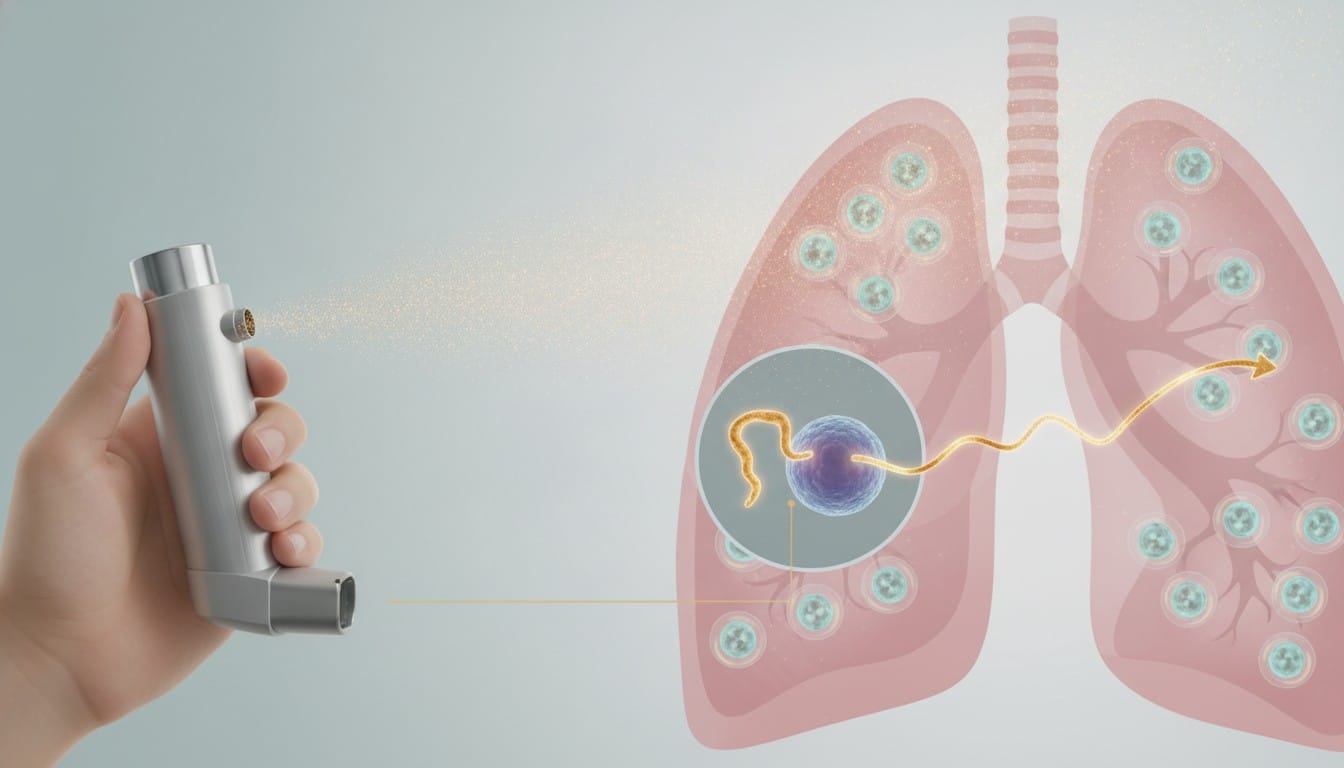
The Toronto team designed a chemically modified tRNA that reads through those premature stop codons and inserts the correct amino acid, restoring full-length CFTR protein. They packaged the tRNA into inhalable lipid nanoparticles, the same delivery technology used in mRNA COVID vaccines, and tested it in mice. The result: the modified tRNA reached the lungs, stayed there for more than 40 days, and restored CFTR function. When they compared it head-to-head with Vertex’s approved CF drug Trikafta in patient-derived organoids, Trikafta alone was not enough, but Trikafta plus the engineered tRNA fully rescued protein function.
The same strategy is being pursued for other diseases caused by nonsense mutations:
- Duchenne muscular dystrophy: Tevard Biosciences is developing AAV-delivered suppressor tRNAs that have restored dystrophin protein and motor function in mouse models at 12 weeks post-dosing.
- Rett syndrome: Researchers are extending the same modified-tRNA platform to neurological diseases with no current treatment options.
- Hurler syndrome and many others: AAV-NoSTOP, a UAG suppressor tRNA delivered by adeno-associated virus, has rescued Hurler syndrome in mice with a single dose.
Together, these advances have created a new field that Nature Reviews Drug Discovery has called “tRNA therapeutics,” and they have triggered a wave of biotech investment.
When tRNA Goes Wrong: Nonsense Mutations, Mitochondrial Disease, and Cancer
Because tRNAs sit at the heart of protein synthesis, mutations in tRNA genes or in the enzymes that modify them can cause a wide spectrum of human disease.
- Nonsense mutations account for about 11% of all known inherited disease mutations. Any one of the 61 sense codons can mutate into a stop codon, and the result is a truncated, non-functional protein. Cystic fibrosis, Duchenne muscular dystrophy, and many cases of familial hemophilia fall into this category.
- Mitochondrial tRNA diseases are particularly devastating. Mitochondria carry their own tiny genome with 22 tRNA genes. Mutations in MT-TL1 cause MELAS syndrome, a stroke-like disorder that begins in childhood. Mutations in MT-TK cause MERRF syndrome, which features seizures and uncontrolled muscle jerks. Because every cell needs mitochondria, these diseases affect the brain, heart, muscles, and eyes simultaneously.
- tRNA-derived fragments (tRFs) are short pieces of tRNA that get cleaved off and act as signaling molecules. Some tRFs suppress tumors, while others promote metastasis in breast and prostate cancer. They are now being studied as diagnostic biomarkers in blood.
Recent work has also linked tRNA biology to other small RNA systems, including the circular “obelisks” recently discovered inside microbes that colonize the human body.
The Strange and Wonderful World of tRNA: Mitochondrial, Selenocysteine, and the RNA World Hypothesis
Beyond its textbook role, tRNA has a few extraordinary features that surprise even working biologists.
- Mitochondria have their own tRNAs. Your nuclear DNA encodes 497 tRNA genes, plus 22 inside the mitochondria themselves. Mitochondrial tRNAs are shorter and more variable than their cytoplasmic cousins, and they have wobble rules all their own.
- Selenocysteine is the 21st amino acid. It is built into proteins using a special tRNA (tRNASec) that reads the stop codon UGA and inserts selenium instead of ending the protein. Selenocysteine is essential for antioxidant enzymes such as glutathione peroxidase.
- Pyrrolysine is the 22nd amino acid. Some archaea and bacteria use tRNAPyl to insert pyrrolysine, and it is the only known example of a “natural” 22nd amino acid in the standard genetic code.
- tRNA may be older than DNA itself. According to the RNA World hypothesis, early life used RNA both to store information and to catalyze reactions. tRNA, with its combination of structural and informational features, is one of the oldest molecular fossils we have. Some researchers think tRNA evolved from even shorter “minihelices” that simply attached amino acids to RNA strands.
Frequently Asked Questions About tRNA
Where is tRNA found in the cell?
Most tRNA is in the cytoplasm, where translation happens. Before translation, tRNAs are transcribed in the nucleus by RNA polymerase III and then exported to the cytoplasm. A separate set of 22 tRNAs is made inside mitochondria and used only there.
How many tRNAs do humans have?
The human genome contains 497 nuclear genes encoding cytoplasmic tRNAs, plus 324 tRNA pseudogenes and 22 mitochondrial tRNA genes. However, because of wobble, only about 48 distinct tRNA anticodons are actually used to decode all 61 sense codons.
What is the difference between mRNA and tRNA?
mRNA carries the genetic instructions as a long message that is read once and degraded. tRNA is a short, folded molecule that decodes those instructions, one codon at a time, by carrying a specific amino acid to the ribosome.
What does tRNA stand for?
Transfer RNA. The “transfer” refers to its role in transferring amino acids from the free amino acid pool into a growing protein chain.
Is tRNA an enzyme?
No. tRNA is an RNA molecule, not an enzyme. However, it works together with enzymes, especially aminoacyl-tRNA synthetases and the ribosome, to catalyze protein synthesis. The ribosome itself is a ribozyme, which means its catalytic core is made of RNA.
What does tRNA “charging” mean?
A tRNA is called “charged” when an aminoacyl-tRNA synthetase has attached its amino acid to the 3′ end. An “uncharged” tRNA is one that has delivered its amino acid to the ribosome and is empty.
How is tRNA made?
tRNA is transcribed as a precursor by RNA polymerase III, then trimmed at both ends, chemically modified at multiple nucleotides, and in some cases spliced to remove an intron. For nuclear-encoded tRNAs, the mature molecule is exported to the cytoplasm. Mitochondrial tRNAs are made by the mitochondrial transcription machinery inside the organelle.
The Future of tRNA Science
tRNA has gone from textbook obscurity to therapeutic frontier in just a few years. With the August 2025 cystic fibrosis breakthrough, Tevard’s Duchenne muscular dystrophy program advancing toward the clinic, and a new generation of tRNA modification enzyme drugs entering preclinical pipelines, the field is moving fast. Researchers are also exploring tRNA-derived fragments as cancer biomarkers, mitochondrial tRNA therapies for metabolic disease, and engineered tRNAs that incorporate non-standard amino acids into designer proteins.
If the early results hold, the same molecule that quietly translates every protein in your body may soon become a medicine that treats thousands of genetic diseases once thought untreatable.


