
In November 2025, a Turkish-Italian architecture studio called MASK Architects unveiled a striking two-wheeler: the Solaris, a motorcycle whose retractable circular solar “wings” unfurl like a mechanical flower whenever the bike is parked. Within days, headlines declared it the world’s first self-charging solar motorcycle, a machine that, in the founders’ words, would free riders “from fuel, grids, plugs, and the economics of energy itself.”
It was a beautiful pitch. It was also a concept.
If you searched for a “solar motorcycle” today, you’d land on a strange mix: a flashy concept bike that won’t reach production for years, a handful of real production motorcycles and scooters that actually do carry solar panels but rarely top 40 mph, and a 70 mph electric motorcycle called the Solar E-Clipse whose name contains the word “solar” but whose battery is plugged into a wall outlet, not the sun. Confusion reigns, and the math behind why truly self-charging solar motorcycles remain rare tells you more about the limits of photovoltaic surface area than any concept render ever could.
This guide breaks down what a solar motorcycle actually is, what you can realistically buy in 2026, and why the dream of unlimited solar range on two wheels still runs into stubborn physics.
The MASK Architects Solaris: What the Hype Is About

The Solaris first surfaced in late November 2025 via a coordinated reveal across design media. The bike is the work of MASK Architects (sometimes styled MARS Architects), an international design studio led by Öznur Pınar Cer and Danilo Petta, whose “Invent and Integrate” approach treats speculative design as a way to seed real engineering projects.
Three features define the Solaris:
- Retractable circular photovoltaic wings. When parked, two curved solar arrays unfold above the bike like an umbrella canopy, claiming up to 150% more solar capture than a flat panel of the same footprint because the curved geometry harvests light from a wider range of angles.
- Aluminum-carbon composite chassis. The frame pairs aluminum with carbon fiber, and the swingarm is aluminum, all targeted at keeping curb weight low enough that the modest solar input can move the bike at usable speeds.
- Intelligent solar energy management. An onboard system tracks collection, storage, and distribution in real time, while a digital cockpit and optional app give the rider live readouts of solar charging metrics alongside standard performance data. Regenerative braking adds a second recovery path during deceleration.
The visual language is equally deliberate: a stretched front end, a muscular forward-leaning stance, and flowing bodywork inspired by the anatomy of a leaping leopard. MASK Architects describes the Solaris as a “self-sustaining organism” rather than a vehicle.
What MASK has not disclosed is just as telling. There are no published figures for top speed, 0-60 mph time, battery capacity in kWh, motor output in kW, range per charge, range per day of solar charging, weight in kilograms, or projected price. The company describes performance only as “high-torque electric motor.” As of this writing, the Solaris remains a one-off concept, with no announced production partner, manufacturing timeline, or pre-order pathway. Whether the design ever reaches a dealership floor depends on whether MASK finds an OEM willing to industrialize a fundamentally unusual vehicle architecture.
The Math Problem: Why a Solar Motorcycle Can’t Yet Replace Charging
The Solaris concept leans on a powerful narrative: a vehicle that harvests enough energy from the sun to extend its range indefinitely. The math is more sobering than the marketing suggests.
A typical motorcycle silhouette offers, generously, two square meters of usable surface area once you account for bodywork, fairings, and a top surface that sees direct sun. A modern production photovoltaic panel converts around 22% of incident sunlight into electricity under ideal lab conditions, closer to 18-20% in real-world riding. Average peak solar irradiance in sun-belt regions is roughly 1,000 watts per square meter at noon, dropping to an effective daily average closer to 200-250 W/m2 when you integrate morning, midday, afternoon, and weather variation.

That gives you a realistic solar harvest of roughly 0.36 to 0.5 kWh per square meter per day in good conditions, or about 0.7 to 1 kWh per day for a two-square-meter motorcycle, before efficiency losses. A typical electric motorcycle consumes between 0.1 and 0.2 kWh per mile depending on speed and weight. The numbers line up to perhaps 5-10 miles of solar range per day in genuinely sunny climates, before you even factor in shade from the rider, parked angle, dust on the panels, or the energy the bike uses to power its own management systems.
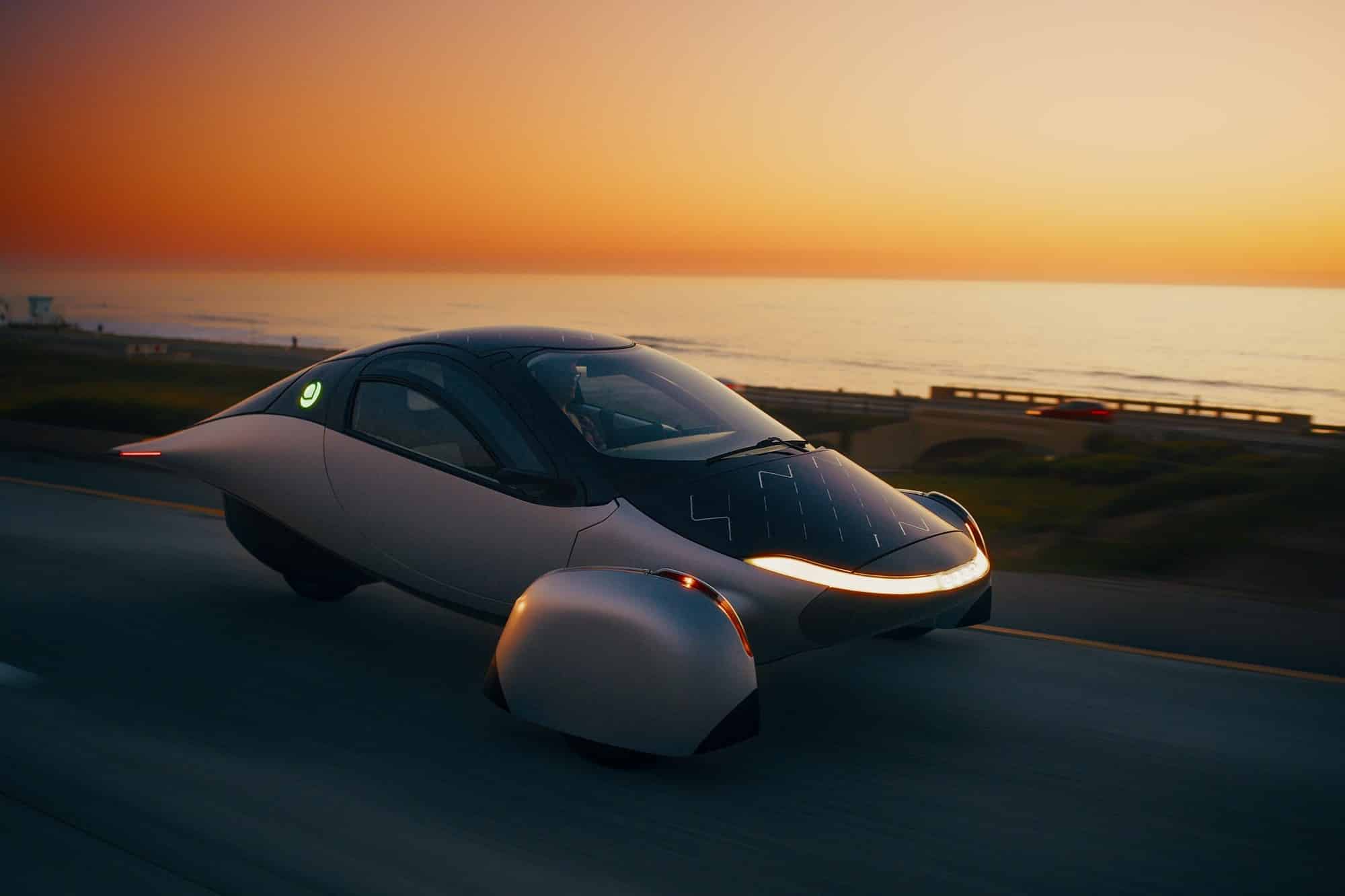
The Aptera three-wheeled solar EV, a vehicle purpose-built around maximizing solar surface area, confirms this ceiling in real engineering. Aptera’s published specifications, available on the official Aptera site, claim 700 watts of integrated solar capacity delivering up to 40 miles of free solar range per day in sunny California summers.

Independent analysis published by Green Car Reports pegs the more conservative real-world figure at 20-30 miles per day in summer, falling to around 10 miles per day in average conditions. That is from a vehicle whose every aerodynamic curve is a solar panel.
For a conventional motorcycle silhouette, even an aggressive one like the Solaris with its deployed circular wings, you are looking at the low end of that range. Solar is genuinely useful as a range extender, especially for commuters who park outdoors or riders in remote regions where charging infrastructure is sparse. It is not, in present physics, a replacement for plugging in.
Solar E-Clipse and the Brand-Name Confusion
One of the strangest side effects of the solar motorcycle conversation is how often it leads searchers to the wrong product. If you typed “solar motorcycle” into Google, the top result is the Solar E-Clipse, a real, street-legal electric motorcycle built by a UK company called Solar Scooters. The E-Clipse is electric. It is not solar.
The bike’s 72V 45Ah lithium-ion battery charges only from a wall outlet or a separately purchased portable solar generator. There are no photovoltaic cells anywhere on the bodywork, despite the sun-themed styling cues on its fairings. Multiple reviewers, including the German e-mobility publication Steckerbiker, have noted that “Solar” in this context is purely the manufacturer’s brand name, not a technology claim.
The confusion matters because the Solar E-Clipse’s popularity, both as a search result and as a real street-legal product, has crowded out awareness of genuine solar-powered two-wheelers that do exist today. The rest of this article focuses on those.
Real Production Solar Motorcycles That Actually Charge From the Sun
Outside the concept-render world, a handful of small manufacturers are already selling or pre-selling two-wheelers that harvest sunlight through onboard panels. They are not as sleek as the Solaris and most do not break 40 mph, but they exist, they ship, and they prove the underlying physics works at a small scale.
YongLE Risheng CG: The Wind-and-Solar Commuter From China

Chinese manufacturer Jiangsu YongLE New Energy Electric Vehicle Co. has put the CG into production, a utility-style electric motorcycle built on a Honda CG125-style chassis with a 250W solar panel and a small wind turbine mounted on a roof cage above the rider. The CG uses a 1,500W electric motor and a 30Ah lithium-iron-phosphate battery, reaching a top speed of around 37 mph (59 km/h). On a full charge it covers 50-75 miles (80-120 km), and on solar and wind input alone it manages roughly 31 miles (50 km), according to a detailed New Atlas breakdown.
The roof-and-turbine arrangement looks ungainly, more like a small delivery tuk-tuk than a sport bike, but the design is deliberate: it captures energy both while parked in the sun and while moving through the wind. The CG also supports plug-in charging from a standard 110-220V outlet, with a 6-8 hour full-charge time. Disc brakes front and rear, a 3-speed transmission, and a claimed curb weight of 293 lb (133 kg) round out the package. Pricing has not been publicly disclosed by the company, and the bike is currently sold only in China.
Otherlab Lightfoot: The Solar Cargo Scooter With Built-In Panels

San Francisco-based Otherlab has taken a different approach with the Lightfoot, a two-seat electric cargo scooter that integrates two 120W solar panels directly into its clamshell bodywork. There are no folding panels to remember, no external accessories, and no setup routine. You park it in the sun, and it charges.
Otherlab claims the Lightfoot’s panels can add up to 18 miles of range per day in good sunlight, roughly three miles per hour of strong exposure. The base 1.1 kWh battery delivers up to 37 miles of plug-in range, with an 80% recharge achievable in 90 minutes from a standard wall outlet. A 750W brushless hub motor drives each rear wheel, the top speed is just under 20 mph, and the 45.2-liter lockable cargo bay can haul up to 33 lbs. The Lightfoot weighs about 136 lb (62 kg) and retails for $4,995.
Caveats matter here. The Lightfoot was announced in November 2024 with first deliveries promised for January 2025. As of mid-2026 the company is still operating in reservation and pre-order mode, with no verifiable independent owner reviews. Italian e-mobility outlet Futuro Prossimo published a lengthy investigation in August 2026 documenting how the same specs have been recycled in press coverage for nearly two years without a single owner delivery confirmed. The product is real and the technology works in demonstrations, but buyers should treat the timeline as soft until production deliveries begin.
Phosgo Go5 Ultra: Solar Cells Built Into the Wheels

The most recent entrant, and arguably the most ambitious of the production-bound designs, is the Phosgo Go5 Ultra, a US-spec electric bike with four solar panels integrated into the wheel discs themselves. According to the product launch coverage and a detailed review on Notebookcheck, the Go5 Ultra pairs a Bafang M430 750W mid-drive motor with a 720 Wh LG battery and 200W of integrated wheel solar capacity, with back-contact cells rated above 26% efficiency.
Phosgo claims the solar system can add up to 17 miles of range per day, extend total range to roughly 120 miles, and let a typical commuter go up to a month between plug-in charges. The US version tops out at 28 mph; the EU version is software-limited to 25 km/h to comply with EPAC regulations. Pre-orders opened at $2,199 via Indiegogo in July 2026, well below the $5,999 MSRP.
The novelty of putting solar cells in the wheels is that they charge both when parked and while riding, a meaningful upgrade over bodywork panels that only work in direct sunlight at standstill. Whether the wheel-integrated design holds up to potholes, curb strikes, and rain in real-world use is the open question, and one only production deliveries and time will answer.
Spy Motorcycle: A Cautionary Tale
San Diego-based Spy Motorcycles grabbed headlines in 2022 with claims of a 125-mile-range, 75 mph electric motorcycle with integrated solar panels, billed as “the world’s first.” The brand’s website went dark within two years, no social media updates followed, and the company appears to have dissolved without delivering production units. WebBikeWorld profiled the project in late 2024 as a cautionary case for would-be solar motorcycle buyers: bold claims, prototype photos, and pre-order pages are not the same as delivered vehicles.
How Much Does a Real Solar Motorcycle Cost?
The price range for solar-equipped two-wheelers in 2026 spans an order of magnitude, depending on whether the bike has actual solar hardware or just solar in the name.
| Vehicle | Type | Price (USD) | Top Speed | Onboard Solar? | Status |
|---|---|---|---|---|---|
| Phosgo Go5 Ultra | Solar e-bike (wheels) | $2,199 pre-order / $5,999 MSRP | 28 mph | Yes (200W wheels) | Pre-order (July 2026) |
| YongLE Risheng CG | Solar + wind motorcycle | Not disclosed | 37 mph | Yes (250W panel + turbine) | On sale in China |
| Otherlab Lightfoot | Solar cargo scooter | $4,995 | ~20 mph | Yes (2x120W body panels) | Reservation / pre-order |
| Aptera Solar EV | 3-wheel solar EV | $33,200 (reservation) | ~100 mph | Yes (700W onboard) | 2026 production target |
| MASK Architects Solaris | Concept motorcycle | Not announced | Not disclosed | Yes (retractable wings) | Concept only |
| Solar E-Clipse 2.0 | Electric motorcycle | $5,995 | 60-70 mph | No (brand name only) | On sale |
The honest takeaway: a genuine solar-powered two-wheeler with verifiable delivery in 2026 is real but rare. The YongLE Risheng CG ships in China and is the closest thing to a production solar motorcycle today. The Otherlab Lightfoot and Phosgo Go5 Ultra both have functional prototypes and pre-order pipelines, but neither has documented owner deliveries at scale yet. Aptera sits in a class of its own, with three wheels, autocycle licensing, and a 2026 production target. For riders who want to plug in real solar input today without waiting for deliveries, the established route remains portable: any plug-in electric motorcycle can pair with a folding solar panel and a portable power station from brands like Jackery, Bluetti, or EcoFlow for off-grid charging.
Solar Motorcycles vs. Plug-in Electric Motorcycles: Side-by-Side Comparison
For most riders considering a “solar motorcycle” in 2026, the practical decision sits between a true solar machine with modest performance, a three-wheeled solar EV, and a plug-in electric bike they can buy today.
| Feature | YongLE Risheng CG | Otherlab Lightfoot | Aptera Solar EV | Solar E-Clipse 2.0 |
|---|---|---|---|---|
| Price (USD) | Not disclosed | $4,995 | $33,200 (reservation) | $5,995 |
| Top Speed | 37 mph | ~20 mph | ~100 mph | 60-70 mph |
| Range per Charge | 50-75 mi (80-120 km) | 37 mi | 400 mi (1,000 mi max) | 50-70 mi |
| Solar Powered | Yes (250W + wind) | Yes (240W body) | Yes (700W body) | No |
| Free Solar Range/Day | ~31 mi (solar + wind) | ~18 mi | 20-40 mi | 0 mi |
| Weight | 293 lbs | 136 lbs | ~1,800 lbs | 138 lbs |
| Wheels | 2 | 2 | 3 | 2 |
| Available Now | Yes (China) | Pre-order | Pre-order (2026) | Yes |
The trade-offs are stark. The YongLE CG gives real solar input and full motorcycle-class performance, but its 37 mph top speed and 31-mile solar range make it a commuter, not a highway bike. The Otherlab Lightfoot is the most practical urban runabout but tops out under 20 mph and is technically a scooter, not a motorcycle. Aptera offers real solar autonomy with car-class performance, but it is heavy, three-wheeled, and only available as a 2026 reservation. The Solar E-Clipse delivers genuine motorcycle speed and price-to-performance, but it is not solar-powered at all. There is no single winner because the four vehicles serve fundamentally different use cases; the right choice depends on whether the rider needs solar range, highway speed, or both.
Are Solar Motorcycles Street Legal?
It depends on what you are riding and where. The YongLE Risheng CG is classified as an electric moped or low-speed electric motorcycle in China and is legal on roads and bike lanes under local moped regulations. In most US states, a sub-40 mph electric motorcycle typically requires a motorcycle license or endorsement, registration, and standard equipment (lights, mirrors, horn, and turn signals).
The Otherlab Lightfoot is designed to comply with US Class 2 e-bike regulations in most states, has a top speed under 20 mph, and can typically be ridden in bike lanes without a motorcycle license. Riders should still check their state’s specific e-bike classification rules, which vary for throttle-equipped versus pedal-assist models.
The Phosgo Go5 Ultra US version, at 28 mph and 750W, sits at the upper edge of federal Class 2 e-bike limits. Several US states impose stricter rules, and Phosgo has not published state-by-state compliance documentation. Buyers should verify legality in their jurisdiction before placing a pre-order.
Aptera occupies a different legal niche. Most US states classify three-wheeled vehicles with specific weight and speed thresholds as autocycles rather than motorcycles, which means riders do not need a motorcycle endorsement to drive one. Intelligent Living previously covered Aptera’s never-needs-charging solar EV in detail when production plans first emerged. A few states still require a motorcycle license for any three-wheeler. If you are considering an Aptera reservation, check your state’s autocycle laws before placing the deposit.
Frequently Asked Questions
Is there a solar-powered motorcycle?
Yes, but with caveats. The YongLE Risheng CG is the only production two-wheeled motorcycle currently shipping with onboard solar hardware (250W roof panel plus a wind turbine), and it is sold only in China. The Otherlab Lightfoot and Phosgo Go5 Ultra both integrate solar panels into their bodywork and wheels, but neither has documented owner deliveries at scale. The MASK Architects Solaris is the most ambitious solar motorcycle concept, with retractable circular photovoltaic wings, but it remains a design study with no production partner.
How much does a solar bike cost?
Genuine solar-powered two-wheelers range from $2,199 for a pre-order Phosgo Go5 Ultra e-bike to $4,995 for an Otherlab Lightfoot cargo scooter to “unannounced” for the YongLE Risheng CG. The Aptera three-wheeled solar EV starts at $33,200 for a Launch Edition reservation, with production targeted for late 2026. The Solar E-Clipse 2.0, often the top search result for “solar motorcycle,” is the cheapest at $5,995, but it is not actually solar-powered; “Solar” is the manufacturer’s brand name.
Is the Solar Eclipse bike street legal?
The Solar E-Clipse is fully street-legal in most US states and EU countries when registered as an electric motorcycle, but it is not solar-powered. The brand is called Solar Scooters UK, and “Solar” is a name, not a technology. The astronomical event (a solar eclipse) and the motorcycle brand are unrelated. If you actually want a motorcycle that charges from the sun, the YongLE Risheng CG is the closest production option, sold in China with a 250W onboard solar panel.
What bike goes 70 mph?
Among motorcycles that come up when searching “solar,” the Solar E-Clipse 2.0 Race Edition is one of the most affordable at 70 mph ($6,799, 16 kW peak motor), though it is not actually solar-powered. Among genuine production electric motorcycles, the Zero SR/F (~120 mph, ~20,000), Energica Experia (~112 mph, ~29,000), and Can-Am Pulse (87 mph, ~8,999) all clear 70 mph. For genuine solar-equipped bikes, no current production model exceeds 40 mph.
Can a motorcycle run fully on solar power?
Technically yes, practically limited. The YongLE Risheng CG can run on solar and wind input alone for roughly 31 miles per day in good conditions, but only at low speed and only with the roof-mounted turbine and panel both contributing. The MASK Architects Solaris concept is designed around full solar autonomy but has no disclosed daily range and is not yet a production vehicle. The physics of photovoltaic surface area on a two-wheeler’s silhouette caps real-world solar input at roughly 5-10 miles of range per day in good conditions for a typical motorcycle, with smaller vehicles like the Phosgo Go5 Ultra e-bike claiming up to 17 miles per day from wheel-integrated panels.
How long do solar motorcycles last?
Solar panels themselves degrade slowly, typically 0.5-1% efficiency loss per year, meaning a quality panel still produces 80-90% of its original output after 20-25 years. The electric motorcycle components (battery, motor, and controller) follow standard EV longevity: batteries last 8-15 years depending on chemistry and care, while motors and controllers can run for decades with minimal maintenance. The YongLE Risheng CG’s lithium-iron-phosphate battery chemistry is particularly long-lived, often rated for 2,000+ charge cycles. The Phosgo Go5 Ultra uses LG 21700 cells with similar durability expectations.
The solar motorcycle market in 2026 is a story of three very different futures coexisting at once. MASK Architects’ Solaris shows what a fully self-charging two-wheeler could look like once battery and panel technology catch up with the designers’ ambitions. The YongLE Risheng CG, Otherlab Lightfoot, and Phosgo Go5 Ultra show what is actually shipping, or about to ship, today: real solar input, modest performance, and pricing that ranges from accessible to aspirational. Aptera shows what an extra wheel and a much larger surface area can do when the entire vehicle shape is rebuilt around solar capture. All three point in the same direction: a near future where sunlight is a meaningful contributor to how we move on two wheels, even if it is not yet the only contributor.

