
Scientists continue to make encouraging advancements regarding more durable concrete, and engineers at Australia’s RMIT University have been working at the forefront of this research for some time. Their most recent example is a type of concrete that integrates shredded personal protection equipment (PPE) for better performance while also addressing the growing waste produced by the current COVID-19 pandemic. This is the tale of a wondrous experiment exemplifying that one person’s disposable mask is another person’s valuable resource and reduced environmental footprint.
Why Should We Make Better Concrete?
There is much to be desired when it comes to making better concrete. A simple answer to the question would be pointing to its mechanical properties; concrete that is very strong, or self-healing, or perhaps both flexible and quite rigid simultaneously. As it turns out, however, the concrete industry has an even heftier price than the raw materials and manufacturing process expenses alone. Much attention has been given to the dangers of fossil fuel pollution, but not enough towards the impact on the cement industry.
Concrete is one of the most widely used construction materials in the world. However, few studies have addressed its environmental impacts, particularly in terms of water consumption. According to a study from 2018, concrete production was responsible for 9% of global industrial water withdrawals in 2012, accounting for about 1.7% of total global water withdrawal. The demand for this use of water is only expected to grow over time; by 2050, it is projected that 75% of concrete production’s water demand will likely be situated in regions facing high levels of water stress.

The cement industry is one that has flown under the radar when it comes to reducing its carbon footprint, despite being one of the biggest contributors to global warming. Over the past two decades, cement manufacturers have increased their carbon dioxide emissions by double what they were before. This means that cement production now accounts for at least 8% of global CO2 emissions, while aviation only counts for 2.8%. Scientists are urging a reduction of at least 16% in emissions from the cement industry by 2030, in line with the Paris Agreement, but action is yet to be taken on this front.
Given these alarming figures, concern about concrete’s environmental impact is growing, and more people are talking about it. When developing novel methods for making sustainable concrete, scientists haven’t been hesitant to get inventive with alternative materials, drawing inspiration from everything from tires, wood waste, and lobster shells to steel slag for inspiration. Meanwhile, earlier this year, scientists used shrimp shell waste to make stronger concrete. From carbon emissions to the strength of concrete, the construction industry is overdue for an overhaul.
Making Green Concrete from Recycled PPE
During the year 2021, the RMIT team also showed how discarded face masks could be used to strengthen recycled concrete for road layering materials. This time, the team has expanded the scope of their work to incorporate more coronavirus pandemic waste products. The researchers estimate that, on average, 54,000 tonnes of PPE per day are created globally, and 129 billion disposable face masks are thrown away each month. Their research could lead to a novel approach that gives these materials a new life rather than sitting in a landfill.
First author, Ph.D. researcher Shannon Kilmartin-Lynch, spoke about how the research can be utilized in the approach of a circular, providing a resource our society needs while dealing with an abundance of healthcare waste. Professor Jie Li, the corresponding author and research team leader at RMIT University, noted that PPE waste from both health care and the general public has a considerable effect on the environment.
Professor Jie Li explained:
“We have all seen disposable masks littering our streets, but even when this waste is disposed of properly, it all ends up in a landfill. With a circular economy approach, we could keep that waste out of the landfill while squeezing the full value out of these materials to create better products – it’s a win on all fronts.”
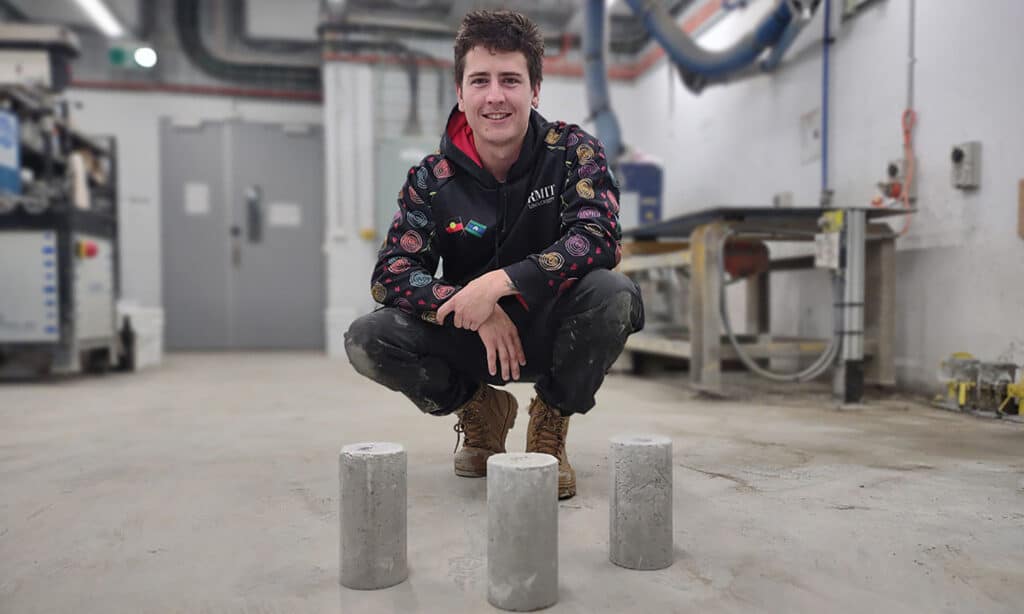
And the mission for these scientists doesn’t stop there, Kilmartin-Lynch, a Vice-Chancellor’s Indigenous Pre-Doctoral Fellow at RMIT said,
“We urgently need smart solutions for the ever-growing pile of COVID-19 generated waste — this challenge will remain even after the pandemic is over. Our research found that incorporating the right amount of shredded PPE could improve the strength and durability of concrete.”
The team added rubber gloves, face masks, and shredded gowns to concrete in three trials at quantities ranging from 0.1 to 0.25%. The concrete’s compressive strength was found to increase by up to 22% with rubber gloves and up to 17% with face masks. On the other hand, the shredded gowns had 15% greater compressive strength, 12% greater elasticity, and up to 21% greater resistance to bending stress. The team will then explore the performance advantages of combining the various PPE concrete products, and they will work with the health and construction sectors to conduct field experiments.
These are exciting early figures simply begging for a field trial as structural concrete. RMIT’s industry partner Casafico Pty Ltd is planning on making that a reality.
Looking toward the future of green concrete, Dr. Rajeev Roychand, the study’s co-lead author, believes in the real potential for construction industries to contribute, “While our research is in the early stages, these promising initial findings are an important step towards the development of effective recycling systems to keep disposable PPE waste out of the landfill.”
The three studies were published in Science of the Total Environment, the Journal of Cleaner Production, and Case Studies in Construction Materials.


