
Since the COVID-19 pandemic started, there has been an enormous demand for face masks with countries worldwide facing shortage problems. In Korea, the government even enacted a weekly ration of two masks per person to ensure that health care and medical professionals don’t fall short.
Unfortunately, the masks most commonly used are disposable ones referred to as N94 or N95 masks as they filter out up to 94% or 95% of fine airborne particles. Another issue, and the reason they’re one-time-use only, is that their electrostatic function disappears when exposed to liquid, thus reducing the filtering efficiency.
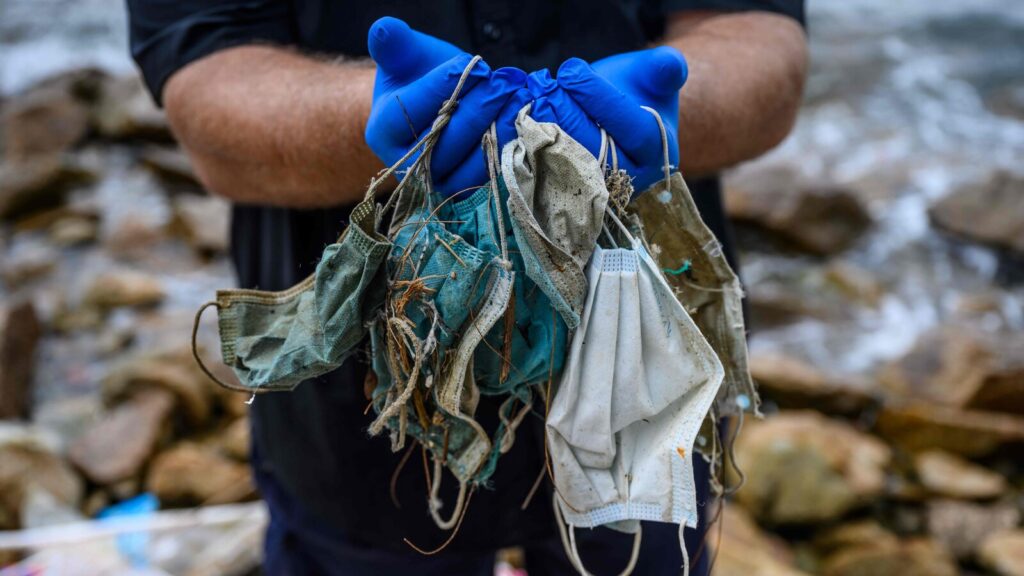
Performance issues aside, the fact that millions of masks are being used daily and thrown away is ridiculously unsustainable and destructive for the environment. The waste is polluting the planet. Pictures are being shared online of coastlines covered in N95 masks. Somehow, they’re making it into the oceans and washing up on beaches – that’s how dire the situation has become.
So, in search of an eco-friendlier solution, many researchers and companies have been designing masks that can be reused. Earlier this year, the New York-based company LIGC Applications created an electrically-charged graphene mask that repels bacteria and viruses. Now, on the other side of the world, a research team from the Korea Advanced Institute of Science and Technology (KAIST) has developed a reusable nano-filtered face mask that can be washed several times without affecting its filtering efficiency.

The nano-filter technology consists of nanofibers with a diameter of 100~500 nm aligned in orthogonal or unidirectional directions. An insulation block electrospinning process was used to manufacture orthogonal nanofibers by controlling their alignment.

The filter can fit inside standard surgical masks (such as mid-level KF80 masks or high-level N95 respirators) and is water-resistant.
It held an over 94% filtering efficiency after 20 bacterial tests and repeated hand washings with ethanol. They even left the filters soaking in an ethanol solution for over three hours, and the materials composition remained unchanged.
Professor Il-Doo Kim, the inventor, said:
We believe that this mask can be reusable for about a month even after washing in ethanol. The inner filter can also be replaced. We found that the mask filters out up to 80 percent of 600-nanometer particles even after undergoing a bending test more than 4,000 times.

Professor Kim is now awaiting final approval from the Ministry of Food and Drug Safety to start manufacturing and selling his product to the public. His startup company (the Kim Il-Doo Research Institute) can produce 1,500 nanofiber filters per day.


