
The European Parliament recently endorsed a one-year delay to the EU Deforestation Regulation (EUDR). Reuters reporting confirms that the regulation retains its core rules while shifting the main company deadline to December 30, 2026. The EUDR regulation text mandates that companies trading in cattle, cocoa, coffee, oil palm, rubber, soy, and wood must prove products are deforestation‑free using plot‑level geolocation and a formal due‑diligence statement.
Digital product passports serve as the operational link between policy and store shelves, accessible to shoppers or auditors via standards‑based QR codes. The Digital Product Passport framework establishes a portable model for product‑specific sustainability and compliance data. GS1’s Digital Link standard turns a QR code into a gateway for that data across packaging, pallets, or point‑of‑sale systems.
Circular battery economy supply chains demonstrate traceability and compliance data moving through complex value chains. Retailers are testing QR‑first experiences that reduce packaging waste while adding transparency for shoppers. The EUDR elevates compliance standards by mandating plot-level traceability.
EUDR Critical Intelligence: Deadlines, Data, and the 2026 Compliance Reality
- What EUDR Covers: The law applies to cattle, cocoa, coffee, oil palm, rubber, soy, wood, and many derived goods placed on or exported from the EU market.
- Core Proofs: Companies submit a Due Diligence Statement (DDS) in the EUDR Information System and retain auditable records. Downstream operators can reference upstream DDS IDs in their filings.
- Geolocation Standard: Traceability must resolve to the production plot using coordinates and, where applicable, plot polygons. Operators should avoid exposing sensitive coordinates in public views; regulators access them through official systems.
- Deadlines: Parliament backed moving the large‑company date to Dec 30, 2026 and SMEs to Jun 30, 2027, opening a strategic build window in 2026.
- Digital Product Passports (DPP): ESPR enables product passports that can include sustainability, circularity, and compliance fields retrievable via a QR code.
- QR Standard: GS1 Digital Link lets one QR carry IDs like GTIN along with batch and compliance references, so a single scan can open a live, product‑specific record.
- System Status: Recent EUDR‑IS launch news confirms the system is fully operational for the generation and management of DDS submissions.

Adapting Material Passports for Agricultural Transparency
Big idea: Built‑environment “material passports” already show that granular, lifecycle data can travel with assets. Agriculture can adapt this framework, ensuring biodiversity data accompanies each lot of beans, beef, or timber.
What Construction Taught Us About Portable Transparency
Material‑passport systems attach verified attributes to components and buildings and make them available through a persistent, scannable identity. This approach empowers designers, owners, and recyclers to recover value and minimise waste.
Madaster’s material passport organises design data, provenance, and end‑of‑life options in a way that non‑experts can navigate. Modern construction material passports make components traceable within housing-as-a-service models.
What Travels in a “Farm Passport”
A farm-adapted passport references official records rather than duplicating the regulator’s system. Instead, it presents a concise, non‑sensitive snapshot for buyers and, selectively, for shoppers:
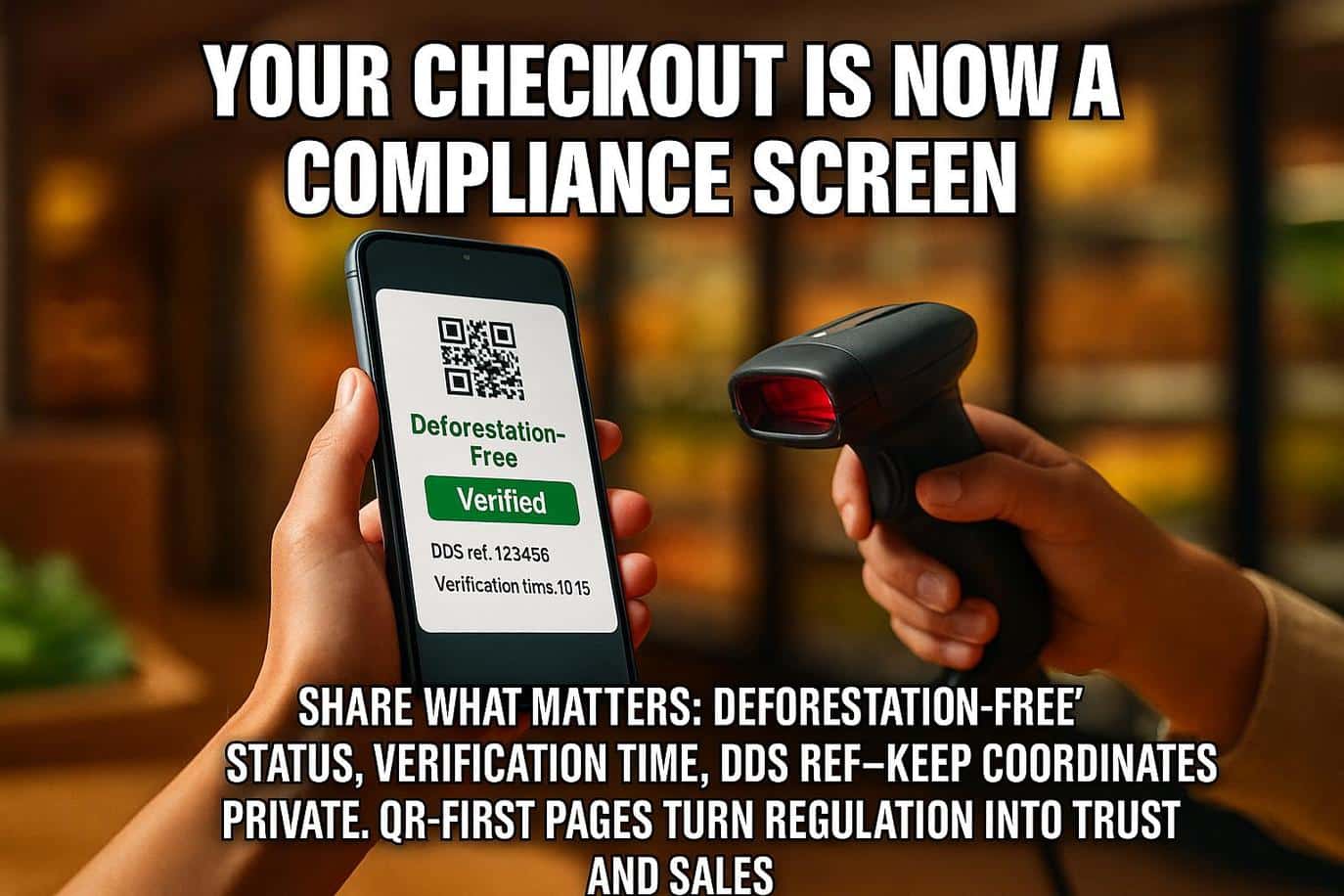
- A DDS reference number and verification status that resolves to the operator’s filing in the EUDR Information System.
- A plain‑language statement of deforestation‑free status with the relevant cut‑off date and the time of the last check.
- A summary of the chain‑of‑custody stage and data holder (for example, farm, cooperative, first processor) with a timestamped batch or lot identifier.
- Optional fields for third‑party monitoring, such as satellite or risk‑screening notes, when available.
What Stays Private
Coordinates, polygons, and supplier IDs should remain restricted to regulator and auditor channels. The public passport view presents verification status and essential claims, while the official channels retain sensitive geodata and documentation. This separation respects operational security and privacy without weakening traceability under the ESPR digital product passport model.
How the Pieces Connect in Agriculture
A practical build looks like this:
- Farm and first buyer capture plot‑level data and assemble the DDS for the shipment in the official system. The filing creates a DDS reference.
- Processors and traders inherit that reference as they combine, split, or transform lots; the reference persists in internal records and audit trails.
- A GS1 Digital Link QR on the unit, case, or pallet points to the product’s Digital Product Passport, which stores the public view and internally stores or securely references the DDS ID.
- Retailers and consumers scan the same code but see different levels of information based on role. Shoppers receive a clear deforestation‑free assertion and verification date. Auditors see the provenance and geodata through official channels.
This benefit is not theoretical. Similar data‑carrying patterns already help brands tell product stories and reduce waste at the shelf in QR‑first retail pilots.

Optimising Retail User Experience via GS1 Digital Link
Retailers bridge the gap between complex upstream systems and consumer decisions. Good UX translates compliance into trust without over‑sharing.
Why GS1 Digital Link QR is the Pragmatic Carrier
The same standards that underpin today’s barcodes can now deliver web links encoded with product identifiers, batches, and context. GS1 Digital Link makes a QR code scannable by phones, apps, and point‑of‑sale systems, which simplifies deployment across packaging and logistics layers. Because the link resolves to a live web resource, brands can update facts, add new certifications, or surface retailer‑specific information without changing the printed code.
What Shoppers Should See vs. What Auditors See
The shopper view should focus on clarity and relevance:
- Deforestation‑free status with a recent verification timestamp and a reference to the official filing.
- A short explanation of what was verified and the cut‑off date used by regulators.
- A pointer to the brand’s broader sustainability programme or sourcing standard.
The auditor or regulator view includes the DDS reference, documentation history, and the underlying geolocation data held in the official system. Official EUDR traceability and documentation outline how geolocation underpins risk‑based checks by competent authorities without exposing sensitive data to the public.
Turning Compliance into Value for Agri‑Commodities, Retailers, and Consumers
When a scan produces a clear, verifiable story, the benefits extend beyond simple compliance. A transparent digital interface allows stakeholders to unlock tangible value:
- Trust Premiums: Compliant supply can earn trust premiums and maintain shelf space in strict markets.
- Operational Efficiency: Retailers can reduce manual label clutter while offering richer product pages.
- Proven Utility: This builds on the same QR experiences that already aid low‑waste retail design and reusable cup traceability.
Brands exploring advanced verification can further pair these QR codes with AI‑assisted checks. Advanced AI and blockchain proofing for consumer goods pairs QR codes with skin diagnostics for enhanced trust. A guide on battery supply chains explains how following rules, data standards, and funding work together in different industries to ensure traceability and sustainable results.
Clear UX also helps reduce harmful side effects in producer countries. When compliant lots are easier to prove and easier to sell, traders have fewer incentives to reroute ambiguous material away from strict jurisdictions.
Buyers can commit to onboarding and inclusion programmes rather than exclusion by default, using the extra time afforded by the delay to build shared tools and training. A Financial Times analysis notes how uncertainty affects both environmental aims and market planning, which is precisely why practical, standards‑based builds matter now.

Achieving Plot-Level Transparency: A Two-Step Framework
Goal: Create a transparent, portable trail from farm plot to retail scan that satisfies regulators while giving buyers and shoppers information they can use.
Step 1: Capture Plot Evidence and File the DDS
EUDR requires traceability down to production plots, which can mean using coordinates and polygon boundaries for each plot contributing to a batch.
- Upstream operators collect this evidence, assess risk, and submit a Due Diligence Statement inside the official registry.
- Downstream companies can then reference the upstream filing rather than re‑creating it from scratch, which keeps audits consistent and reduces duplication.
- Coordinating with third‑party logistics partners helps align labelling, segregation, and returns to keep batch identity intact.
Step 2: Bind That Evidence to a QR‑Accessible Passport
Once the evidence exists, it needs to travel with the product in a privacy‑aware way. The Digital Product Passport framework under ESPR provides a home for selected sustainability and compliance fields that can be retrieved on demand.
A GS1 Digital Link QR on the unit, case, or pallet resolves to the product’s passport, which can include a DDS reference, a verification timestamp, and a plain‑language deforestation‑free assertion that a non‑expert can understand. Because the QR resolves to a live resource, brands can update claims if an audit changes status, and retailers can display a focused view that avoids exposing coordinates or supplier identifiers.
Implementation Timeline: A 2026 Playbook for Compliance
Reality check: The Parliament‑backed delay extends the runway, but it does not change the core requirements. Treat 2026 as the year to finish the plumbing and prove it works at scale.
Build 1: Supplier Onboarding and Contract Language
Start with a clean data model. Contracts and supplier manuals should specify who collects plot polygons, how batches are identified, how mixing is controlled, and how DDS references move downstream. Offer shared templates and training for smallholders so they can participate rather than be excluded.
Build 2: Plot Polygons and Evidence Capture
Adopt clear rules for when points suffice and when polygons are required, and document how you handle multi‑plot lots. Validate coordinates against satellite or official cadastral references when feasible, and retain proofs with time stamps in an auditable archive Commission geolocation rules.
Build 3: DDS Workflows and Registry Integration
Map the roles that prepare, review, and submit the Due Diligence Statement into the EUDR Information System. Create internal checks for high‑risk routes, and rehearse enquiries from authorities so the team can respond quickly with consistent evidence.
Build 4: Digital Product Passports and QR Standards
Decide which fields appear in the public view and which remain restricted to auditors. Use GS1 Digital Link so one code works for consumer phones, brand apps, and point‑of‑sale scanners without custom integrations.
Build 5: Retail UX and Change Management
Design pages that answer the shopper’s core questions in a few seconds. An effective landing page should clearly display:
- What was verified: The specific claims validated by the system.
- When it was verified: The timestamp of the last check.
- How to learn more: Links to deeper sustainability data.
Additionally, train store teams and customer support to interpret the page for curious customers. Emerging QR‑driven retail sustainability strategies explore how QR can simplify packaging while increasing transparency.

Mitigating Diversion Risks in Global Supply Chains
The risk: High compliance costs may encourage traders to divert unverified material to less strict markets, reducing the global biodiversity benefit. The solution is to make compliance easier to prove and more valuable to sell.
Inclusion, Not Exclusion
To prevent diversion, buyers must actively lower the barrier to entry for smaller producers. Effective support strategies include:
- Shared Geodata Tools: Providing access to mapping technologies that smallholders cannot afford alone.
- Pooled Satellite Checks: Aggregating monitoring costs across cooperatives.
- Buyer‑Funded Onboarding: Investing directly in the training required for compliance.
Price signals also matter. When compliant lots reliably fetch a modest premium and move faster, diversion to less strict markets becomes significantly less attractive. Regional context on forest loss, including Amazon deforestation trends, underscores why verified sourcing must scale across markets. Innovative supply chain transparency tools reduce friction and improve participation without resorting to blanket bans.
Data that Travels, Privacy that Holds
Keep sensitive fields like precise coordinates and farm identifiers within regulator and auditor channels. At the same time, allow the shopper to see a clear deforestation‑free claim, a verification date, and a reference to the official filing. This combination provides markets with the necessary verification signals while preserving safety and competitive integrity.
Strategic Compliance: Building Trust Through Transparency
The EUDR delay offers a strategic opportunity to implement systems that connect farm plots to price tags. The implementation path remains straightforward: capture plot evidence, file the Due Diligence Statement, and then bind a privacy‑aware snapshot to a Digital Product Passport reachable from a GS1‑standard QR. When a scan provides immediate, verifiable proof, compliant supply gains value, shoppers gain confidence, and biodiversity gains protection.
The next twelve months should be used to run pilots that prove the flow across high‑risk categories, refine retail pages, and measure success by the absence of diversion and the presence of verified, inclusive sourcing. By embedding these standards now, companies can turn a regulatory hurdle into a competitive advantage. Circular‑economy strategies for biodiversity can amplify those gains.

Frequently Asked Questions About EUDR Compliance
Do companies need to show exact farm coordinates to customers?
No. Sensitive geodata belongs in official channels. Shoppers should see verification status and a reference to the filing, not raw coordinates.
What is a Due Diligence Statement and where is it filed?
It is the formal record that an operator submits to the EUDR Information System to demonstrate risk assessment and mitigation for a shipment. Downstream operators can reference the upstream DDS in their own records.
Does the delay change the geolocation requirement?
No. The Parliament’s vote extends timelines for large companies and SMEs, but the core proofs, including plot‑level geolocation, remain in place.
How does a QR code relate to today’s barcodes?
GS1 Digital Link turns a QR code into a standards‑based gateway that encodes product identifiers and context so that phones, apps, and scanners can retrieve the same live record.
What should retailers actually show on a product page?
A short deforestation‑free statement, a recent verification timestamp, and a reference to the official filing. Avoid exposing exact coordinates or supplier IDs to the public.


