
Socket-ready solar technology has officially moved beyond niche engineering circles and into the mainstream consumer market. As governments and standards bodies fast-track small, socket-connected photovoltaic kits for retail shelves, clean electricity is finally becoming an option for apartment living and renter households. This shift means you no longer need a mortgage or a sprawling roof to participate in the renewable energy transition; a simple balcony and a standard plug are now enough to start generating your own power.
Exploring the electrical behaviour of plug-in kits clarifies what the real hazards are and how to adopt the technology safely. It avoids hype, ties every claim to verifiable sources, and ends with a decision-ready checklist.

Plug-In Solar at a Glance and Why it is Trending
Essential Facts: Navigating Safety, Local Laws, and Real-World Savings
Plug-in solar sits in an unusual category: it looks like consumer tech, but it behaves like a small generator connected to building wiring. That mix is why “worth it?” and “is it safe?” land in the same conversation. Reviewing this summary provides an essential baseline for safety requirements and technical benchmarks before diving into the full checklist.
- A recent UK announcement confirms that consumer-ready solar kits are coming to retail markets within months, signalling a major policy shift.
- Parliamentary updates now emphasise expanding renewable energy access for apartment residents as part of a national clean-energy strategy.
- Industry experts at the IET have issued an electrical safety alert for socket-connected generators, reminding households that older wiring may require inspection.
- Data tracking the rapid adoption of small-scale solar in Europe highlights how manufacturers are shifting toward standardised consumer kits.
- Benchmark data for annual solar energy production in the UK usually ranges from 700 to 900 kWh per kWp.
- Official guidance on receiving payments for excess solar export clarifies that self-consumption remains the most efficient savings strategy.
Taken together, the signal is clear: access is expanding, and the engineering constraints are being pulled into the open at the same time. The safest mindset is to treat a plug-in kit like equipment that must match your home’s electrical reality, not a gadget you try and hope for the best.

The Global Momentum Behind DIY Apartment Solar Technology
How Shifting Policies are Empowering Modern Renters
Renewable energy adoption is accelerating for three distinct reasons:
- Policy momentum pushing for wider consumer availability.
- Faster certification pathways for grid-interactive hardware.
- Increased demand from urban residents who cannot access rooftop installations.
These factors combine to make DIY balcony solar a practical reality for modern renters. UK plans to accelerate consumer availability provide a clear policy foundation, while regulatory standards ensure installations no longer rely on guesswork. Consumer interest centres on one practical promise: a way to cut daytime electricity use without owning the roof or committing to a full installation. The deeper reason it resonates is that local renewable generation helps conserve national resources while significantly lowering your home’s carbon footprint.
For buildings where roof access is complicated, a balcony kit can feel like a rare middle ground between “no solar” and a full install, especially when the goal is simply to shave daytime grid use.
Why Tiny Solar Arrays are Changing Household Energy Habits
Nations with established adoption patterns demonstrate significant scalability for balcony-mounted systems, proving the technology’s viability. This helps explain why retailers and manufacturers are preparing products that match defined device limits and safer connection expectations. In a mid-rise where neighbours compared notes, the biggest surprise was how predictable their daytime baseline became once they watched it for a week. That feedback loop is why small systems can change habits even when they are not huge generators.

The Technical Foundation of Socket-Ready Photovoltaic Systems
Defining the Core Tech Behind Your Balcony Kit
A Quick Breakdown for the Non-Engineer
Modern plug-in solar systems consist of a small photovoltaic array paired with a grid-interactive inverter. Common names include balcony solar, socket-connected solar, and plug-and-play PV. Most kits pair one or two panels with a microinverter that limits output to a defined level so it can synchronise safely with the grid.
Offsetting Daily Grid Use vs Total Energy Freedom
It is not the same as a rooftop system that is professionally wired into the consumer unit with dedicated protection and export metering. Standard professional rooftop solar installations utilise a different architecture with dedicated protection devices.
Plug-in systems prioritise ease of installation, so the microinverter converts panel DC to household AC and synchronises frequency and phase with the grid. Successful synchronisation allows generated power to flow into the local circuit where active appliances consume it first. If production exceeds demand, the inverter allows reverse flow toward the grid, where standard export rules and network protections take effect. When your fridge, router, or laptop is pulling power, that demand can be partially met by the inverter output, lowering grid import in real time.
A helpful contrast is the difference between grid-tied offset and true independence. A true off-grid solar setup is designed around batteries and self-management, while a plug-in kit is designed to behave safely inside an active grid environment.

The Practical Science of Socket-Ready Generation
The electricity path is simple, but each link matters. Photons hit the panels and generate direct current immediately upon contact. A microinverter mounted on the panel or in a small enclosure converts this DC into usable AC, precisely timing the waveform to match your household voltage.
Successful synchronisation allows generated power to flow into the local circuit where active appliances consume it first. If production exceeds demand, the inverter allows reverse flow toward the grid, where standard export rules and network protections take effect. When your fridge, router, or laptop is pulling power, that demand can be partially met by the inverter output, lowering grid import in real time.
The component roles become easier to picture when you start from understanding how each component in a solar kit functions: panels generate DC, the inverter shapes grid-matched AC, and the home uses that electricity first when loads are running. If you have a smart meter or a basic plug-in energy monitor, a bright day often shows up as a small but visible dip in imported power.
Decoding the Tech Specs You Actually Need to Know
Navigating the technical landscape requires a clear grasp of three specific safety and performance terms:
- Anti-islanding: Technical standards for automatic solar inverter shutdown ensure that power stops flowing when the grid fails, protecting utility workers. That is why a plug-in kit is a daytime offset tool, not an automatic blackout solution.
- Residual Current Device (RCD): A protective device that trips when the current balance between live and neutral deviates, commonly used to reduce electric shock risk. Some older wiring and older RCD types may behave unpredictably when power can flow in more than one direction, which is why inspection matters.
- Wattage vs. VA limits: Product rules sometimes cap output in watts or in volt-amps, which sound similar but are not identical in how engineers describe power. These technical distinctions are vital when selecting the correct inverter capacity to match your panel output and household loads.
A remote worker who logged lunchtime power draw found the real win was lining up a few routine tasks with sunny hours, not shopping for the biggest panel.
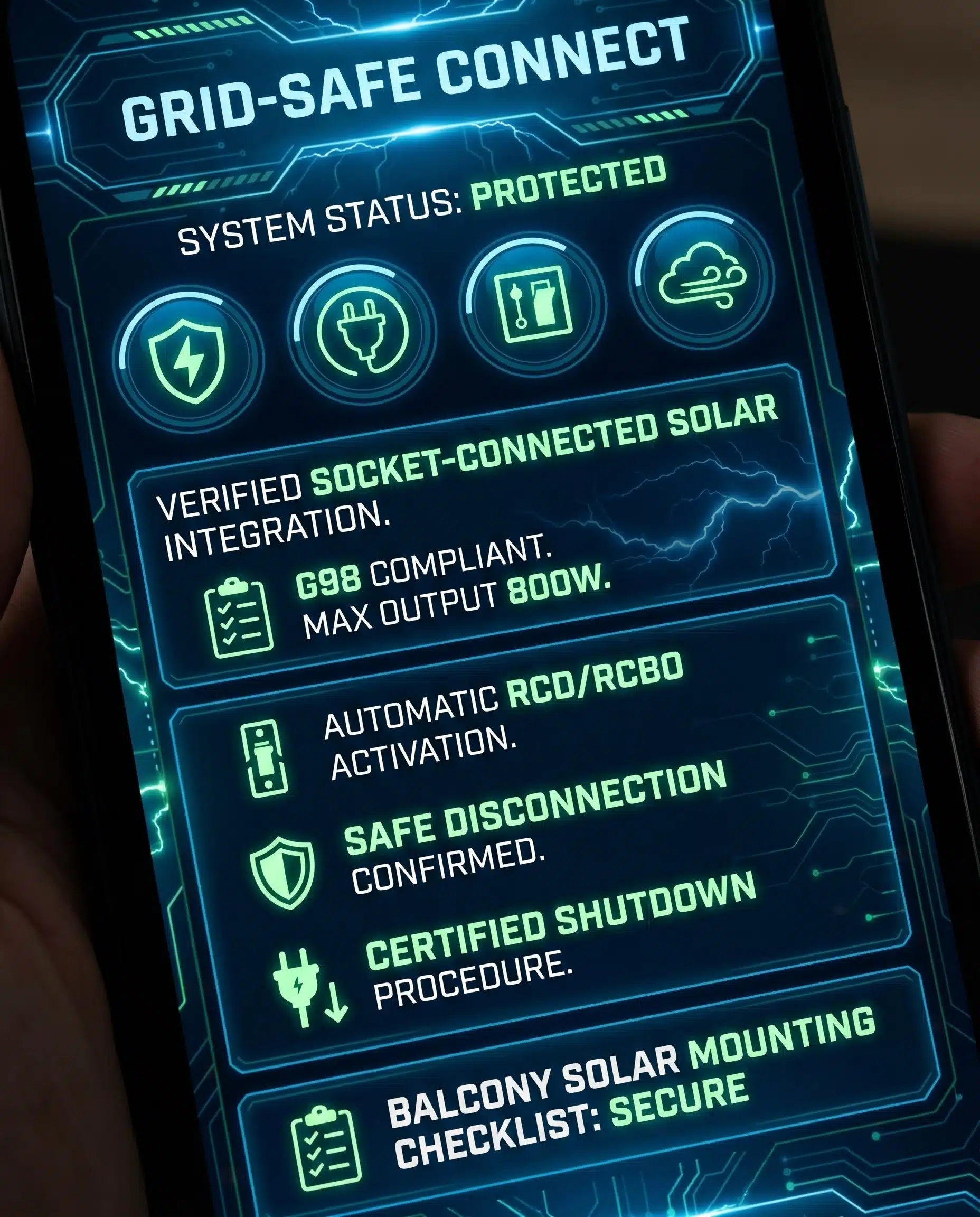
The 5-Step Safety Audit for Your Socket-Connected Installation
Gate 1: Assessing Your Home’s Current Wiring Health
Start with a professional inspection if your home has original wiring older than two decades. Renovated properties often hide mismatched circuits behind fresh finishes, meaning the actual condition matters more than the build date. This initial assessment aims to pinpoint vulnerabilities like degraded insulation or ageing components without causing unnecessary concern.
An inspection helps identify several critical vulnerabilities:
- Degraded insulation on ageing wires.
- Outdated or malfunctioning protective devices.
- Circuits already running near their maximum capacity.
Pinpointing these issues ensures your home remains safe during bidirectional power flow. A thorough check should look for evidence of deteriorating household circuits, such as heat, flicker, or visible scorch marks. A competent electrician can also confirm whether the circuit you plan to use is suitable for accepting reverse flow.
Gate 2: Verifying Your Safety Breakers and Protective Hardware
Verify RCD type and age, then confirm the protective device layout matches modern expectations. Modern consumer units often combine multiple protective functions. Learning how modern protective breakers function helps you understand why bidirectional flow requires compatible hardware. General safety standards for solar equipment remain applicable even for smaller, socket-connected systems.
In shared housing environments, frequent nuisance trips often serve as an early warning for failing protective hardware. Updating the protective hardware resolved the system errors and successfully mitigated the underlying electrical risks.
Gate 3: Understanding Circuit Limits and Local Connection Rules
Evaluating the current load distribution on your chosen circuit prevents overloading during peak production hours. A quick mental model is that the circuit has a maximum safe “traffic capacity”, and plug-in solar changes traffic direction as well as volume.
If that circuit already runs near its rated current during peak times, reverse flow can complicate how overloads are detected. Standard UK procedures for connecting small generators define the technical requirements for grid compatibility.
Confirm local notification requirements before connecting any hardware. Network operators often have specific expectations for small generators that you must satisfy to remain compliant.
Gate 4: Ensuring Safe Shutdown and Connector Integrity
Consumer kits must demonstrate safe shutdown when unplugged. Safe disconnection is not just convenience; it is about preventing exposed connectors from staying energised and limiting unexpected fault behaviour at the socket. Reviewing certified testing requirements for plug-in solar reveals the mechanical and electrical stress tests a safe device must pass.
Gate 5: Mastering Secure Mounting and Weather Resilience
Small panels are not immune to wind and water. Maintaining secure rail clamps and cable strain relief ensures your installation remains resilient during severe weather events. Secure mounting functions as critical safety gear; a detached panel poses a severe risk to anyone walking below the balcony. Secure mounting prevents loose connections, which are among the most frequent triggers for electrical fires in residential properties. A balcony installer who relied on adhesive mounts learned the hard lesson that the cheapest attachment method can become the most expensive mistake, especially when people are below.

Hardware Standards: Verifying Compliance and Managing Outage Expectations
Identifying Genuine Safety Labels and Certified Hardware
Real-World Hazards Professional Testing Helps You Avoid
Certification is a shorthand for the tests a device passed. Established safety benchmarks for consumer solar products specify device limits that protect your wiring from overheating. Limits like these reduce edge cases where heat, fault currents, and protection behaviour can drift into unsafe territory.
Spotting Valid Documentation and Performance Data
Verifying product quality involves checking for specific documentation:
- Comprehensive module safety test reports.
- Certified inverter safety and performance data.
- Documented grid compatibility and synchronisation stability.
- Clear instructions that eliminate guesswork regarding system behaviour.
Authentic certificates should always include a specific standard and a verifiable test report reference. Innovations in recovering materials from retired solar modules show that the entire lifecycle of your equipment can be sustainable. If a vendor claims “compliant” but provides no documentation, the practical move is to choose a different product rather than treating your home wiring as a test bench.
Why Basic Kits Aren’t Backup Systems Without Extra Tech
Understanding Automatic Shutdown During Power Outages
Plug-in solar is primarily a daytime offset technology. Household devices draw solar power directly while the grid functions normally, effectively lowering your real-time import. Inverters are designed to stop generating power during a blackout to prevent accidental grid energisation, a critical safety feature for repair teams. That shutdown can feel counterintuitive when the sun is out, but it is a safety behaviour designed to keep faults predictable.
Scaling Up with Storage for Enhanced Community Resilience
For resilience, the missing layer is storage and the control logic that allows safe islanded operation. Utilising solar storage to power essential appliances ensures that your home remains functional even when the main grid goes dark. The engineering logic behind home solar battery storage basics focuses on how that energy is buffered and protected across various failure scenarios.
Systems capable of off-grid operation typically require dedicated switching and clearly defined critical-load circuits. Community-wide efforts to build resilient local energy networks demonstrate how shared generation can protect entire apartment buildings. Even without shared hardware, shared planning around critical loads can make outages less chaotic.

Why Small-Scale Solar is Your Best Daily Energy Habit
Adopting socket-connected solar provides a low-friction entry point for residents to actively manage their daily energy consumption and reduce monthly bills. It serves as the practical start of a broader habit: learning your home’s baseload, shifting heavy appliance use to sunny hours, and eventually adding battery storage for true resilience. Transforming electricity from a mysterious monthly expense into a measurable daily routine is one of the biggest wins for any sustainable household.
To make the behaviour change stick, pair the kit with small, repeatable habits such as mapping peak hours and testing a simple schedule shift. Adjusting your schedule to match electricity rates with sun hours helps you maximise the financial benefits of your balcony installation. Combining generation with effective methods for lowering energy costs allows you to identify and eliminate hidden power drains. These results improve when affordable efficiency improvements reduce the total power your home needs to function.
Answers to Your Top Questions on Balcony Solar Rules
Are plug-in solar panels legal for UK renters?
Legality is currently evolving with the government moving toward consumer availability; always check your specific tenancy agreement and local building codes first. Recent changes to national electrical wiring regulations show how installation standards are adapting to bidirectional power flow.
Can a socket-connected kit damage my home’s wiring?
Potential risks exist if your circuits are already at capacity; a professional inspection ensures your wiring can handle the bidirectional power flow safely.
Do balcony solar panels provide backup power during a blackout?
Standard grid-tied inverters automatically shut down during power cuts for safety; you need a specific battery storage system for true off-grid resilience.
What is the typical yearly savings for an 800W kit?
Savings vary based on orientation and shading, but most users see a significant dip in daytime grid import by matching production to active loads. You can use a location-specific solar yield calculator to model potential production based on your balcony’s orientation.
Do I need my landlord’s permission for a non-permanent installation?
Communication is essential; even non-structural kits can impact building aesthetics or shared spaces, so getting written consent is a vital safety step.


