Enterprises are moving away from impulse integrations and flashy pilot projects that fail to scale. Current industry shifts show that artificial intelligence, when it actually delivers measurable returns, behaves less like a novelty and more like essential plumbing: it must be designed, versioned, and owned as part of a core enterprise AI architecture. This shift ensures that agentic workflows and automated decisions remain grounded in actual company standards rather than generic guesses.
Choosing to implement AI model customization is now a key engineering decision for any business looking for enterprise AI beyond pilot projects. Modern customization stacks make this shift feasible, allowing teams to own their data and logic while monitoring the architectural movements that will define market competition.

Fast Facts: How Custom AI Models and RAG Drive Enterprise Value
Industry experts agree that enterprise AI model customization is being treated less like a feature and more like a repeatable system that must survive audits, budget pressure, and real users.
- Customization is an Architecture Choice: The push for better ROI shows how businesses now treat models as production-ready enterprise systems with measurable outcomes.
- RAG Grounds Outputs in Company Knowledge: Engineering squads often start by grounding models in internal knowledge before moving to heavier tuning. This retrieval layer feeds a model permitted internal documents so answers stay current and traceable.
- Adapter Tuning Lowers the Cost of Iteration: A low-rank adaptation technique can reshape behavior by training small adapters while the base model stays frozen.
- Quantized Tuning Makes Big Updates Practical: Large model customization is now reaching smaller teams that still need domain-specific control through the QLoRA 4-bit adapter method.
- Evaluation Becomes the Release Gate: Teams increasingly rely on structured evaluation metrics to score quality, safety, and regression risk before updates touch users.
- Governance Lives Inside the Stack: Recent risk management guidance frames generative systems as an ongoing practice rather than a one-time policy memo.
Generic AI sounds impressive in a demo, but customization is what makes AI reliable inside the messy constraints of real work.
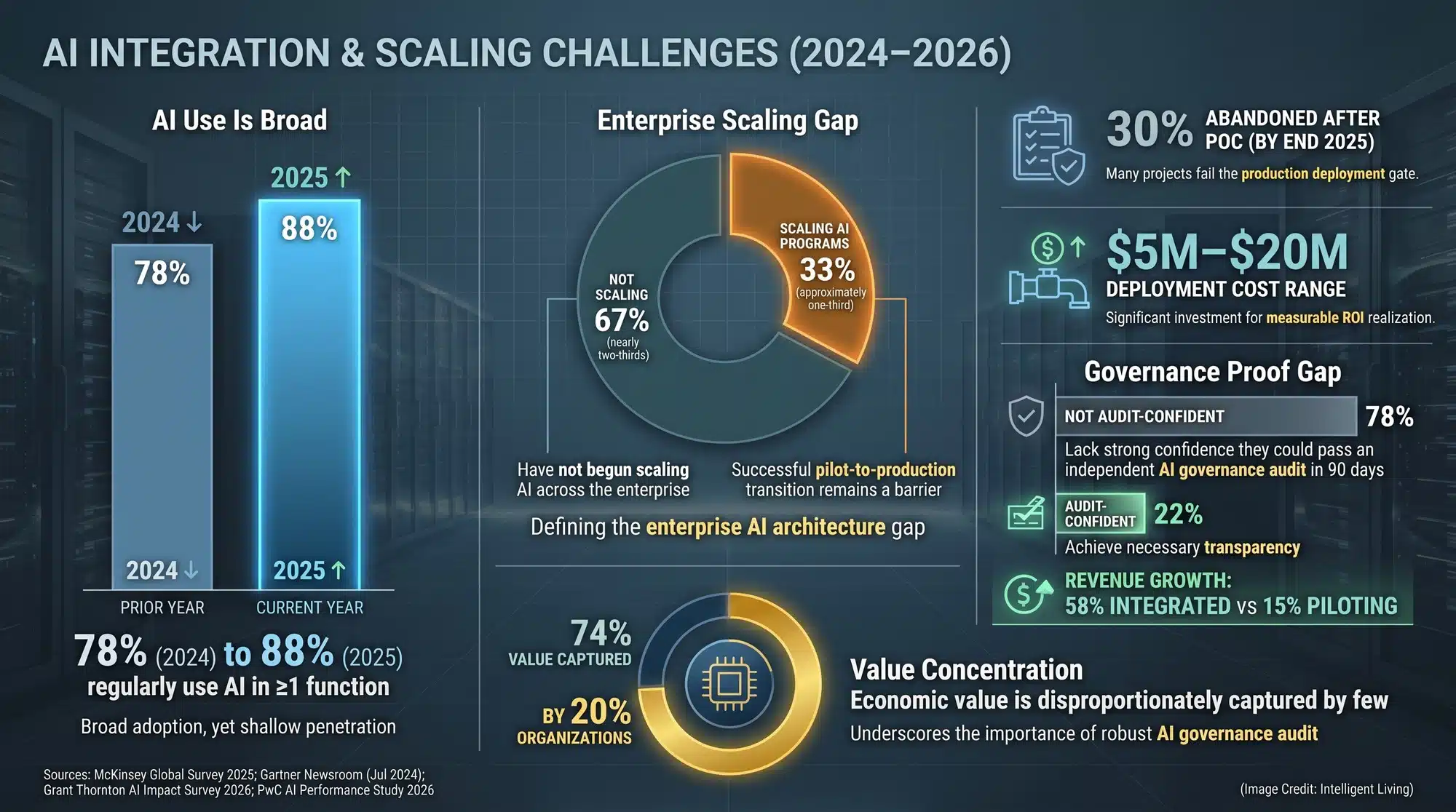
Transitioning from Experimental AI Pilots to Production Architecture
The Drive Toward Customization: Making AI Work for Your Business
Integrating Public AI Gains into Private Business Workflows
Enterprises are prioritizing model customization as a default strategy at the same time that base model improvements feel less dramatic to everyday teams. Meaningful progress happens when the model masters your company’s internal language:
- Naming specific parts and inventory.
- Routing internal approvals.
- Defining risk and source-of-truth documents.
Why Customization is the Best Way to Measure AI Success
Business demand surged as platforms started packaging customization as a workflow rather than a single training run. This shift landed as a broader indicator that businesses want deeper control over their own logic.
Moving Beyond AI Experiments into Permanent Enterprise Budgets
Defined goals are replacing experimental play in enterprise implementation. Modern adoption strategies show how vendors are now packaging production readiness as the real milestone rather than a successful demo.
Treating Custom AI as Infrastructure Instead of an Experiment
Scaling from AI Pilot Projects to Managed Versioned Pipelines
Customization shifts the conversation from a single tuning run to a life cycle of versions, tests, and rollbacks. Teams need pipelines that record every change and the data used. This allows leaders to answer critical audit and compliance questions easily. Efficient programs treat evaluation and monitoring as part of the same release process.
Winning through System Integration Instead of Model Shopping
High-value work happens at the boundary between a model and a company’s systems of record. Instead of treating models like interchangeable parts, smart businesses focus on building a persistent layer of organizational context that feeds the right information into the system at the right time. Clear access rules and maintained sources build trust by keeping the system aligned with organizational standards.
The shift looks familiar anywhere AI touches real infrastructure. For example, managing the hardware demands of large models shows that power and latency constraints show up fast once models leave the lab.
Even the best model will fail if the system lacks enough memory or relies on inconsistent data. Strong models can stumble when throttled by network constraints or fed inconsistent documentation.
In a regional manufacturer, a lead technician summed it up: the best tool is the one that speaks your team’s language.

The Customization Stack (RAG + Adapters + Evals + Monitoring)
The practical stack for making AI reliable relies on four key parts:
- Retrieval layer for grounding outputs in real data.
- Adapters for behavioral tuning without high costs.
- Automated evaluations for consistent quality checks.
- Active monitoring to catch performance drops early.
Most failures happen when teams treat one of these as optional. A model that sounds right in isolation can still underperform when retrieval is stale, evaluation is vague, or monitoring is missing.
Retrieval Augmented Generation: Anchoring AI in Your Data
Retrieval-augmented generation adds a search layer over company documents and data stores. Grounding the AI keeps outputs accurate without constant retraining. Retrieval layering anchors responses in up-to-date material and reduces the need to bake every fact into model weights.
Teams must first decide whether they need up-to-date information or a change in how the model acts. Comparing how to decide between retrieval-based accuracy and specific behavioral tuning shows why retrieval often wins when the goal is correct, source-anchored answers.
How LoRA and QLoRA Make Tuning Practical
Retraining a full model is too expensive for most, making adapter methods the smarter choice. LoRA updates behavior by training small add-on matrices while leaving the base model frozen. This makes repeated, targeted updates realistic in production.
QLoRA pushes accessibility further by pairing adapters with quantization. Memory savings are the reason many teams can test domain-specific variants without building a full training cluster. Groups are also exploring ways of optimizing GPU memory for smaller clusters so larger experiments can run on modest setups.
Evaluation Rubrics: Creating Unit Tests for Your Language Models
Launching a tuned model requires reliable evaluation pipelines—automated rubrics that check for factuality, alignment, and unwanted behavior. Evaluation turns gut feelings into a scored checklist. Standard evaluation workflows spell out how teams formalize those checks before shipping an update.
In a busy support operation, even a small change in tone or policy wording can generate confusion. This is why teams treat evaluation as a release gate, not a best-effort afterthought.
Active Monitoring: Preventing Model Drift in Production
Once live, models can shift as user behavior changes, internal documentation evolves, and edge cases become common. Accurate monitoring clears up confusion by making performance visible:
- Drift alerts and retraining triggers prevent quality erosion.
- Model monitoring tools allow production teams to watch for skew and change over time.

Industry Outlook: Verifying AI Customization Claims and Market Trends
Fact-Checking Current AI Vendor Promises
What Enterprise AI Architects and Analysts are Saying
Independent experts often urge caution regarding platforms that present customization as a packaged workflow. Organizations want control over their models and data rather than outsourcing everything to remote APIs. The move toward keeping data control within the enterprise shows a wider desire for controlled infrastructure.
Cutting through the Noise of Current Industry AI Promises
Vendors often highlight end-to-end capability. Mistral positions Forge as a full lifecycle system that can take teams from data preparation to deployment. Data quality, evaluation design, and the governance workflow around changes tend to be the hard parts.
The Truth about Customization in Independent Tech Coverage
Independent coverage tends to be more cautious: full model ownership has trade-offs, and running updates requires staff and compute. A practical read is that customization is real, but operational discipline decides outcomes.
Procurement choices are also shifting as open-weight ecosystems provide more leverage when budgets or policies change.
Practical Impacts: 9 Ways Custom AI Reshapes Real Work
The clearest impact of customization shows up in places where consistency matters more than novelty. When teams rely on AI for decisions, approvals, or customer-facing language, a model that stays aligned with internal rules is worth more than a model that is occasionally brilliant.
- Contextual Engineering Copilots: Systems tuned on internal specs can slash onboarding time and keep technical language consistent.
- Compliance First Assistants: Audit-oriented workflows benefit when answers can be traced back to policy text and evaluated against fixed rubrics.
- Manufacturing and Digital Twin Enhancements: Plant operations improve when merging sensor data with language logic helps models understand equipment terminology and sensor data.
- Private Offline Deployments: Schools, clinics, and field teams often need ways of running AI without an active internet connection that remain vital even when connectivity is weak.
- Faster R and D Loops: Parameter-efficient adapters let research teams test and iterate without turning every experiment into a massive project.
- Reduced Vendor Roadmap Risk: Organizations prefer local ownership because it allows for faster adaptation when requirements change.
- Job Redesign, Not Replacement: As models move into production, human-centered verification habits are becoming a core workplace skill.
- Cost Predictability Becomes an Engineering Constraint: Stability depends on hardware planning for memory, VRAM, and cache behavior.
- Tokens Become an Energy Bill: As AI agents do more work, their throughput and speed impact the bottom line directly.
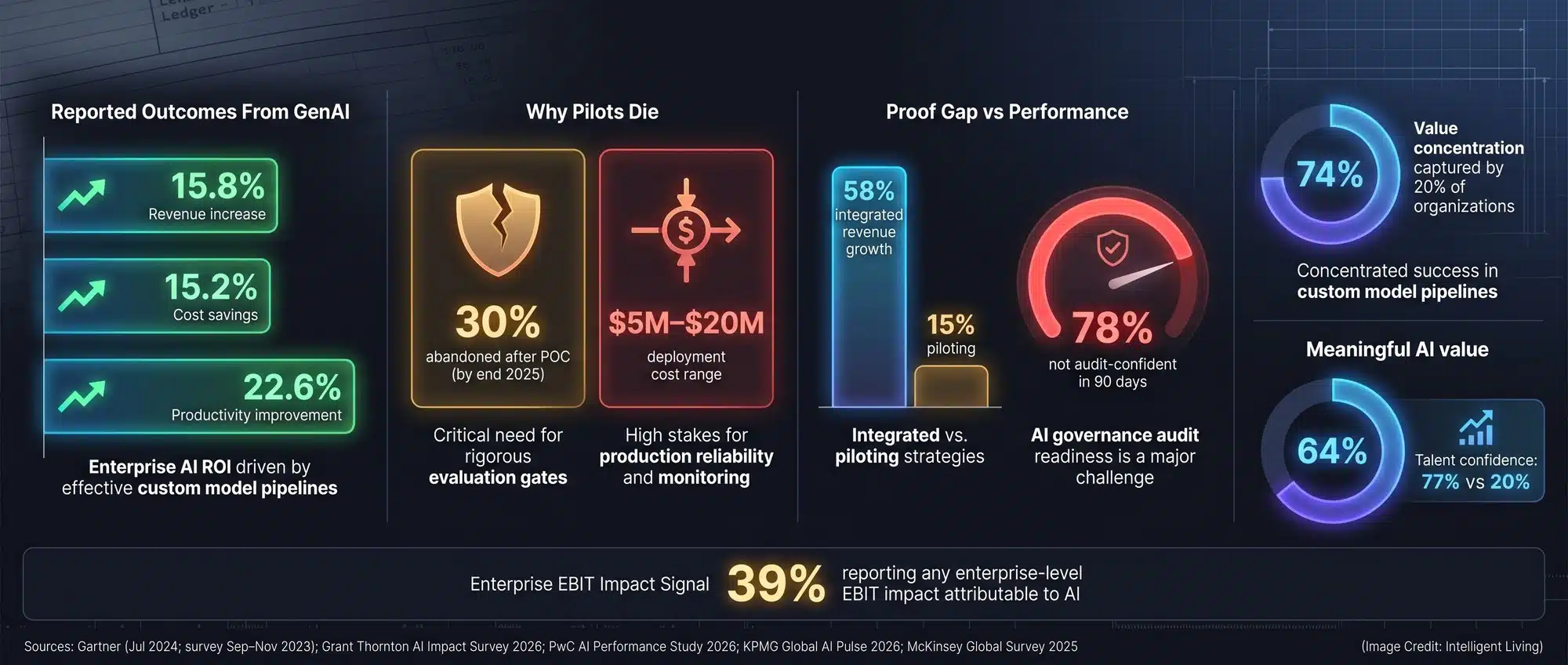
Final Considerations: The Business Case for Custom Model Pipelines
Integrating AI into production requires systems thinking: reproducible pipelines, evaluation thresholds, and monitoring loops. Operational success depends on combining technical controls with human verification. A reliable roadmap for many teams is a hybrid stack, keeping retrieval and governance close to the data while models are adapted through controlled updates.
Adhering to a risk management framework provides a useful baseline for mapping and measuring success across the model lifecycle. Weak documentation and unclear ownership can degrade any model, custom or not.
Looking Ahead: Key Trends for the Next 90 Days of Enterprise AI
- Memory Becomes the Hidden Bottleneck: Long context systems can hit a memory wall before they hit a compute wall. Compressing the memory required for long-form context is one way to make large-scale deployment less brittle.
- Governed Tool Use Moves Into the Enterprise: Agentic workflow platforms now bake governance directly into the user experience, rather than treating it as a separate checklist.
- Evaluation Becomes Procurement Language: Buyers will likely ask for failure mode testing and regression dashboards before approving a rollout.
- Hybrid Deployment Patterns Harden: Future patterns favor keeping governance near the data while mixing local and cloud models based on latency and cost.
Why Custom Architecture is Your Best Path to Reliability
Moving from short-term experiments to long-term reliability requires treating model maintenance as a regular part of your business operations. This transition isn’t about chasing higher benchmarks or technical jargon; it’s about building custom AI models for business ROI that stay accurate even as your company evolves. When these systems remain trustworthy, people actually depend on them for daily work.
Establishing public trust is an integral component of operational success. When engineering teams pair technical controls with building trust through clear operational habits, the friction to adopt new tools drops significantly. This approach makes trust by design an operational advantage that helps your business stay ahead while others struggle with generic, unreliable outputs.

Quick Answers: Navigating Enterprise AI Model Customization
How do I customize an AI model for my business?
You can connect a base model to your own files using RAG or add small, custom modules known as adapters to change how it behaves.
What is the best way to anchor AI in company data?
Use Retrieval Augmented Generation (RAG) to feed the model up-to-date, permissioned documents for traceable answers.
How does model monitoring prevent quality erosion?
Tools track “model drift” to alert teams when user behavior or internal documents change, triggering necessary updates.
Why is AI model customization better than generic AI?
Custom models understand your specific industry language, vocabulary, and internal rules, leading to higher reliability.
Is fine-tuning or RAG better for enterprise AI?
Use RAG for data freshness and source tracking; use fine-tuning or adapters for specific changes in writing style or logic.