
Professional landscapes for early-career hires shift permanently when accreditation frameworks mandate AI competence as a core requirement. Employers, regulators, and high-level professional programs now view AI literacy as a measurable baseline competency rather than a fringe technical elective. Navigating this transition requires building a human-centered control stack of agency, trust-by-design guardrails, and verification habits to ground every decision in evidence, bypassing the allure of superficial, confident phrasing.
Rapid acceleration of technological utility has pushed oversight into the center of professional life, making AI literacy essential in the 2026 skill shift. No longer a niche topic for software teams, these skills now dictate employability across law, healthcare, and finance. Mastering these tools means moving beyond simple prompt generation toward a sophisticated understanding of model limits and data governance.
Aspiring professionals who adopt these habits early gain a distinct advantage in a market that increasingly filters for technical accountability. Prioritizing verification workflows and privacy-first data handling transforms passive users into high-trust operators. This guide breaks down the specific competence layers and proof-of-work strategies required to remain employable as the professional rungs of the ladder continue to evolve.
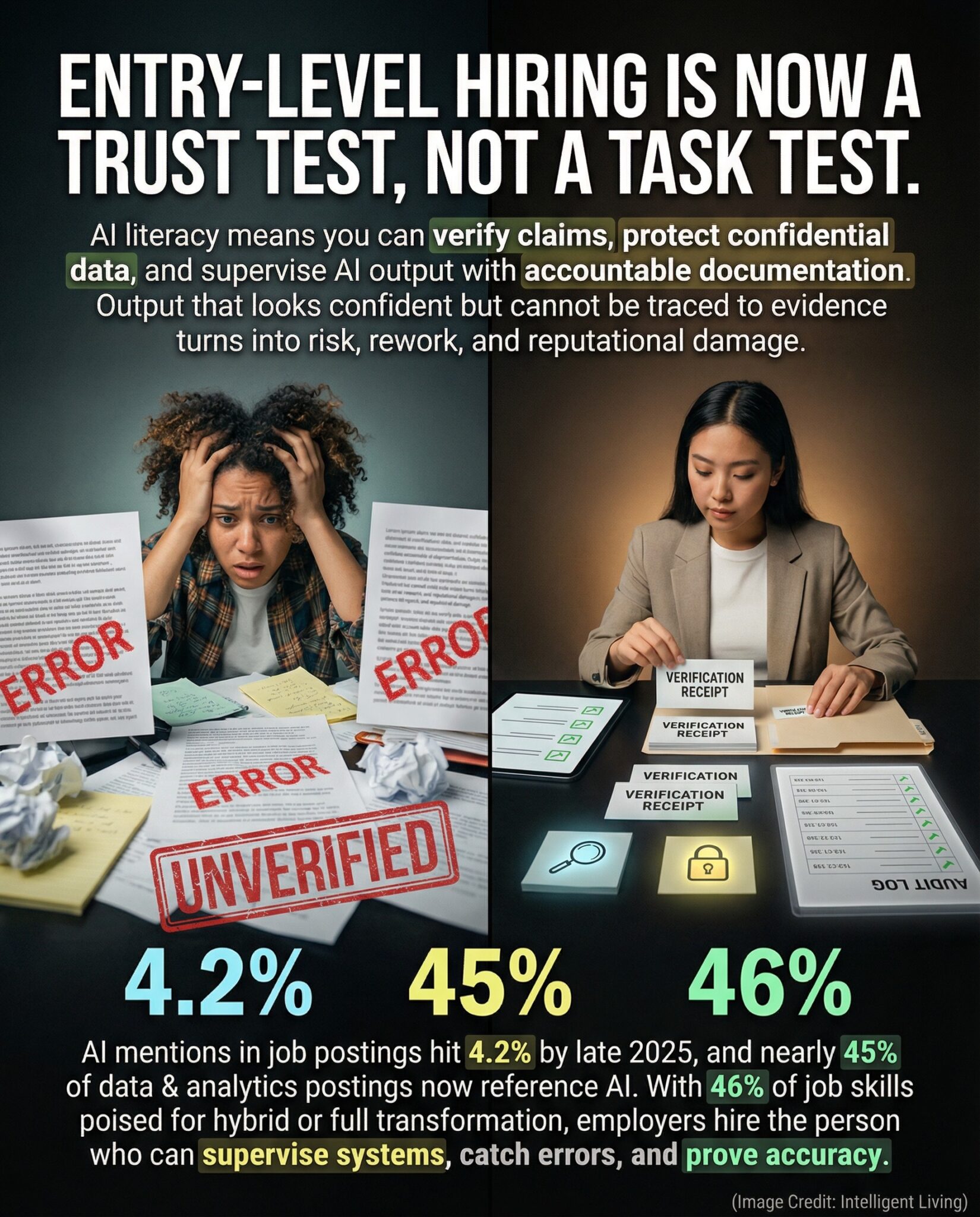
Analyzing the Professional AI Literacy Baseline and Market Signals
Key Indicators of the Accelerating AI Skill Shift
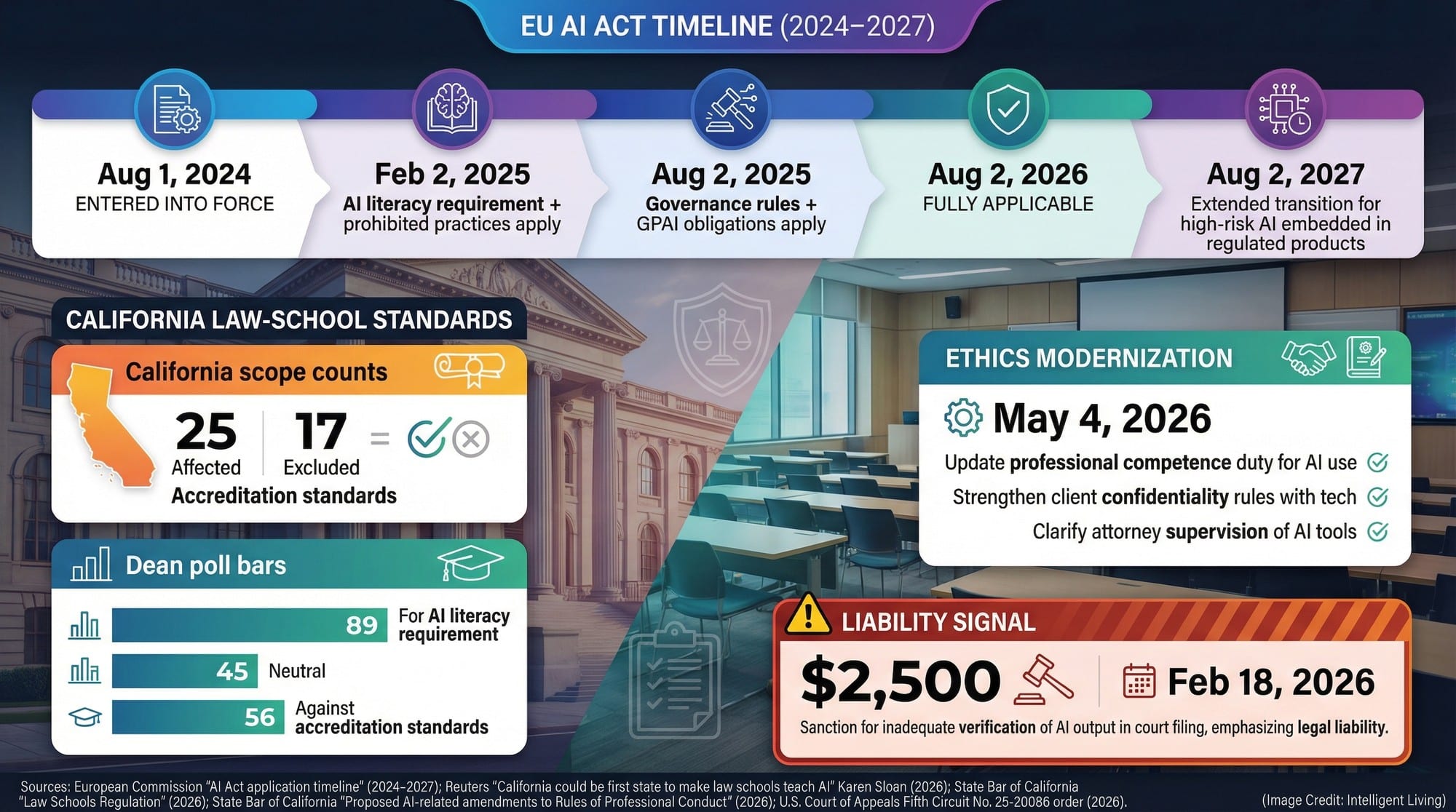
- California may become the first U.S. state to require AI training in certain law schools by offering practice-based credits. This policy effectively shifts academic curriculum toward mandatory AI training for future legal professionals, turning standards into a baseline requirement rather than a choice.
- Employer-facing demand signals are accelerating, and LinkedIn lists AI literacy as a fast-rising workplace skill rather than a niche specialty.
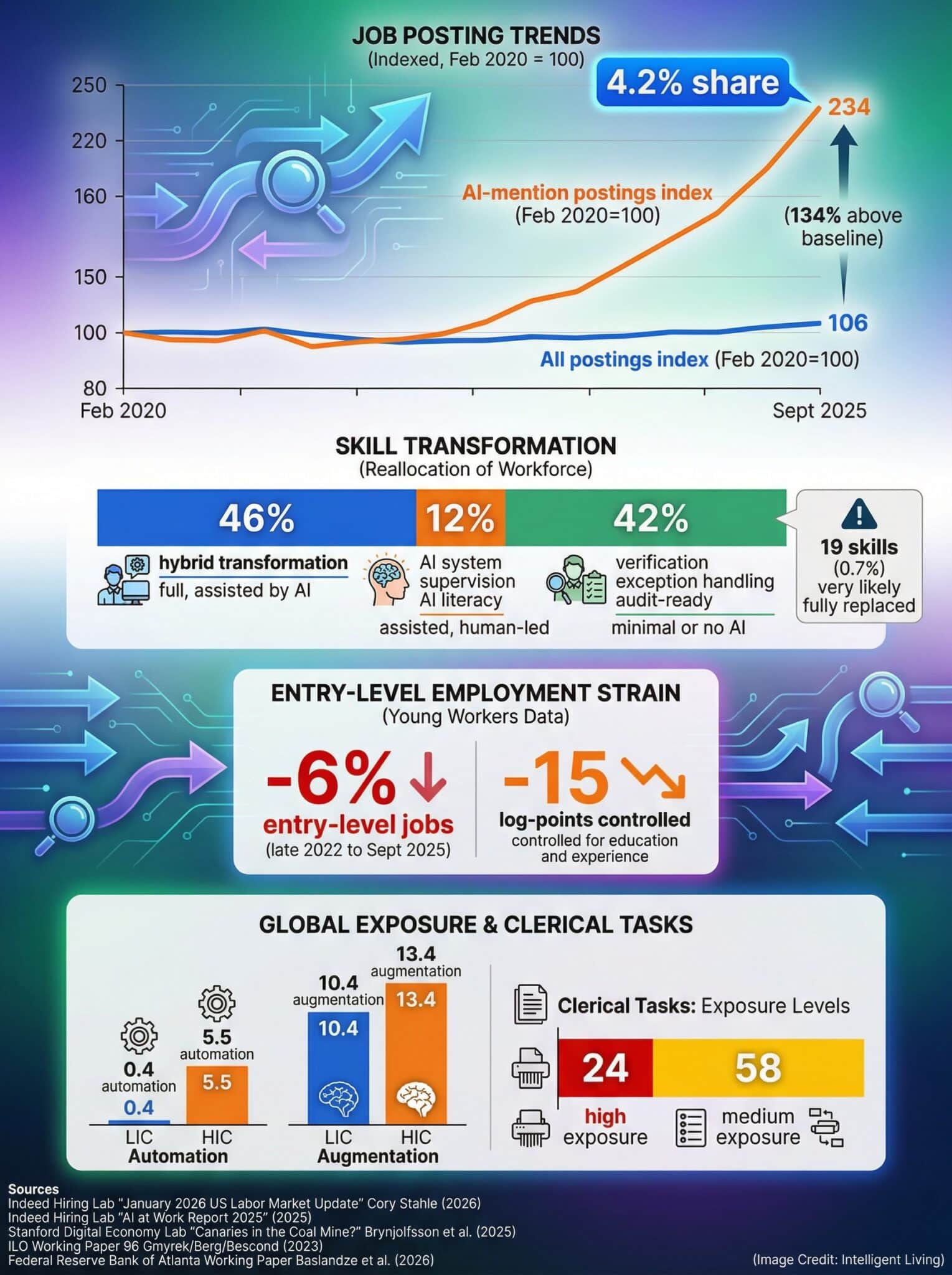
- Hiring language is shifting in plain sight, with job postings showing rapid growth in generative AI terms that increasingly act as a screening filter.
- Generative AI task exposure analysis suggests these tools are more likely to reshape work through augmentation than full replacement, with heavy exposure concentrated in clerical sectors.
- The European Union is treating literacy as part of governance, with an EU requirement for workplace AI literacy tied to how people operate AI systems.
Defining Socio-Technical AI Competence and Common Misconceptions
The Professional Definition
AI literacy is a socio-technical competency that blends technical understanding, critical assessment, and decision-making habits. The Organization for Economic Co-operation and Development frames it as the ability to master and critically assess AI systems in context. This involves understanding specific limits, evaluating model outputs, and maintaining human accountability for final decisions.
Common Misconceptions to Dispel
- AI literacy is not the same as prompt mastery. Prompting can speed work, but literacy demands verification, provenance checks, and an ability to judge when AI output is appropriate.
- The claim that entry-level jobs have simply disappeared is often too broad for practical career planning. Pathways are thinning in AI-exposed sectors, but the more accurate narrative involves a changing first rung.
Junior roles increasingly demand mastery over several high-value supervisory tasks:
- Providing meticulous human review of model outputs.
- Ensuring the accuracy of AI-assisted documentation.
- Managing risk through exception handling and verification.
One junior paralegal described a memo that appeared flawless until a routine citation check proved the legal authorities were entirely fabricated. That single moment instilled a permanent reflex to verify sources before trusting a model’s tone—the true essence of AI literacy in a professional setting.
Regulatory Standards and Compliance in the New Entry-Level Reality
Critical Drivers of Mandatory Workplace AI Literacy
Mandating minimum competencies at the regulatory level forces an immediate shift in academic curriculum. Professional programs move quickly to integrate these standards, mitigating institutional risk and safeguarding their student pipelines.
In California, the State Bar’s Committee of Bar Examiners regulates state-accredited and unaccredited law schools, which is why standards updates translate into curriculum requirements.
Professional conduct rules are undergoing a rigorous review to clarify how AI use aligns with existing mandates. This evaluation focuses on essential duties such as technical competence, confidentiality, and active supervision, including public comment on proposed AI-related amendments to professional conduct rules that directly reference hallucinations and clearer expectations.
Impact of Academic Accreditation on AI Skill Requirements
Compliance: Organizational Duty to Ensure Literacy
Under the context-based AI literacy duty for people operating AI systems, literacy is treated as a governance obligation that depends on role, setting, and potential impact. In reporting-heavy sectors, governance habits are critical as data lineage and audit trails establish organizational trust. Consequently, some firms treat AI output as regulated evidence when AI copilots support ESG compliance workflows.
Judicial Sanctions and Professional Liability for Verification Failures
Courts and regulators are signaling that unverified AI output is no longer considered a harmless mistake in official work products.
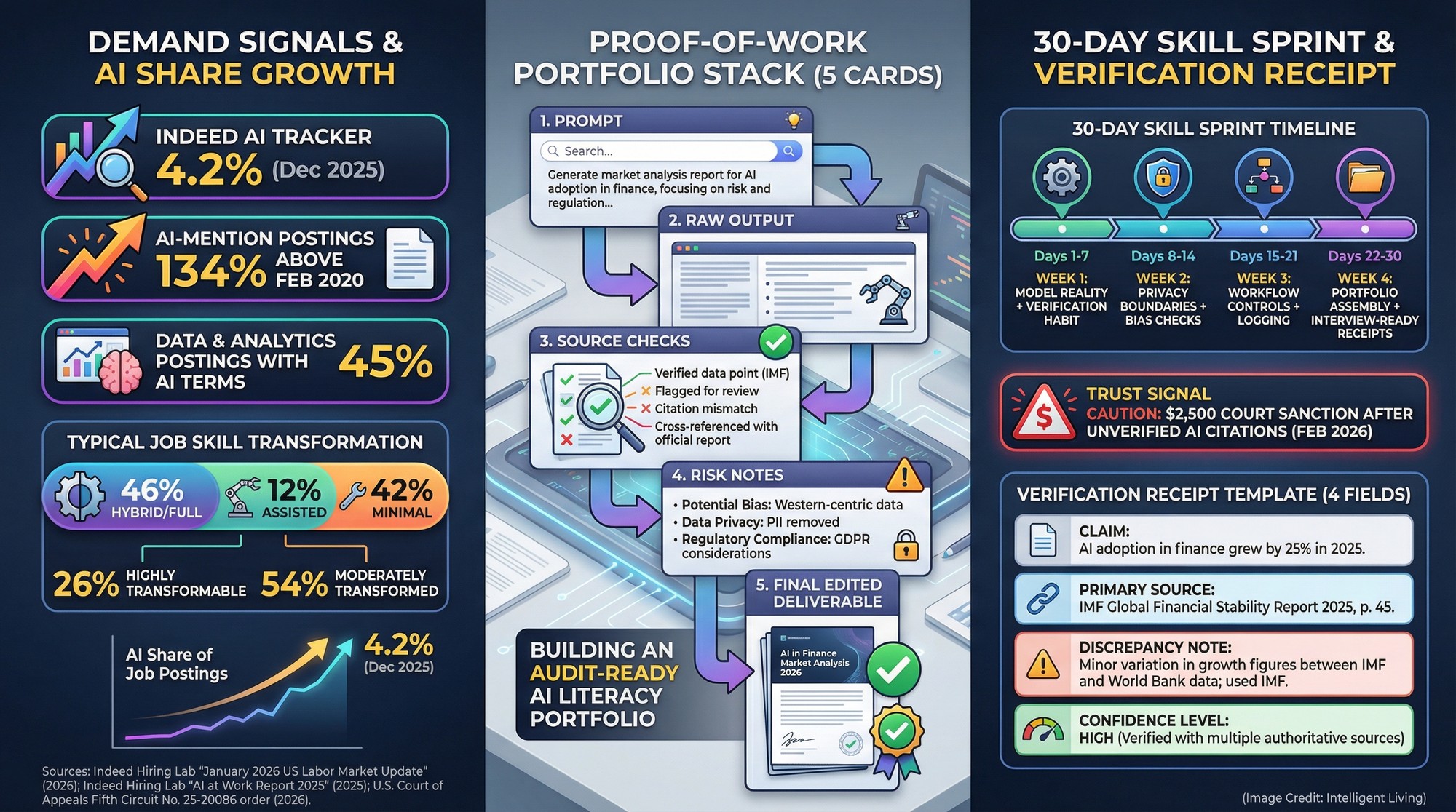
In early 2026, the Fifth Circuit issued a sanctions order responding to fabricated or unsupported citations in an AI-linked brief. This ruling reinforces the mandate that ultimate responsibility remains with the human professional.
A mid-career nurse described a policy change after a tool suggested a schedule that ignored allergy context, forcing the team to adopt a mandatory verification checklist. The point was not to ban AI, but to make humans responsible for the final decision.
Transitioning From Task Execution to AI System Supervision
Early-career work is undergoing a fundamental reshape in AI-exposed sectors. Routine drafting and clerical duties are no longer reliable training grounds as the professional focus shifts toward review, exception handling, and expert judgment.
Survey-based research effort points to limited near-term job loss alongside compositional shifts in roles as adoption widens, consistent with evidence from corporate executives on AI, productivity, and the workforce.
Research regarding the shifting entry-level employment ladder indicates that labor-market timing can distort attribution. Consequently, professional adaptation should prioritize supervision and verification over reactionary panic regarding technological shifts.
What Employers are Saying through their Job Ads
Hiring language increasingly treats AI literacy as a practical skill, not a conversation topic. Structured research into how generative AI rewires job skills highlights several areas where human oversight remains a critical differentiator for new hires.
The New Junior Advantage: Review, Judgment, Communication, Accountability
The most resilient early-career profile emphasizes reviewing outputs, explaining reasoning to supervisors, and keeping audit-ready records of decisions. A hiring manager recently highlighted a successful candidate who demonstrated a concise verification workflow. This operator provided high-trust evidence by documenting:
- The original prompt used for generation.
- The raw AI-generated output.
- A log of cross-checked primary sources.
- A brief note clarifying areas of uncertainty.
Showing these verification receipts turns abstract literacy into tangible employability proof.
Acquiring a manager mindset in junior roles allows for a transition toward exception handling rather than repetitive, low-value output generation.
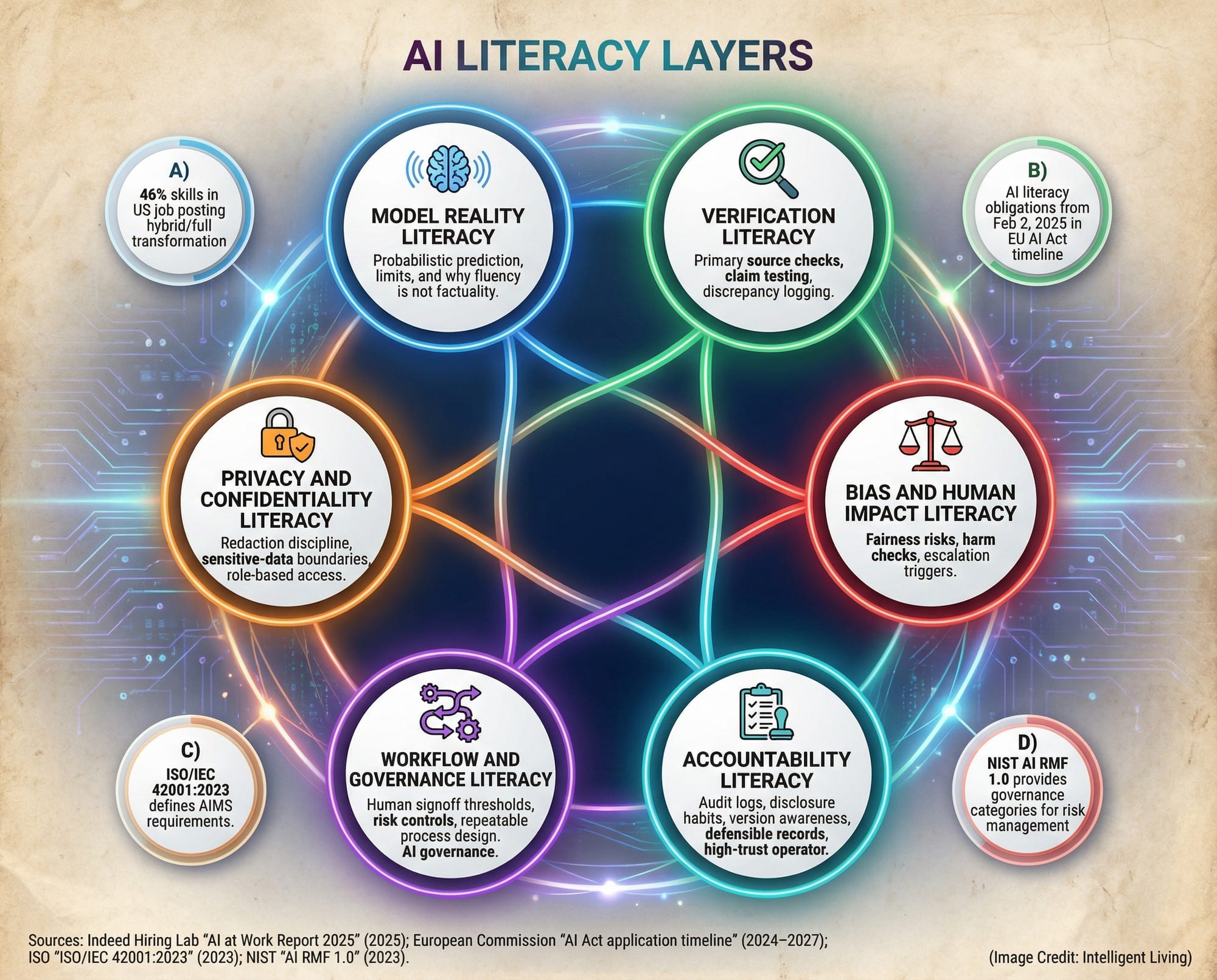
The Professional AI Literacy Competence Stack for High-Trust Operators
Here is a professional-grade stack to teach, test, and demonstrate AI literacy across degrees and workplaces.
Layer 1: Understanding Probabilistic Model Prediction and Factuality
Grasping model mechanics is the first step: these systems predict plausible text by identifying patterns within vast datasets. Never mistake fluency for factuality. Form the habit of treating every model assertion as a hypothesis requiring rigorous testing rather than a fact for immediate use.
Modern chatbots often create a convincing illusion of thought and reasoning, illustrating why literacy requires distinguishing probabilistic prediction from actual understanding.
Layer 2: Implementing Systematic Verification and Source Authentication
Mastering fast, repeatable checks involves pinpointing core claims, locating primary sources, comparing claims to source text, and documenting discrepancies. Verification becomes an explicit step in workflows for professionals who cannot afford errors.
Verification failures often occur when general-purpose assistants misclassify synthetic media as authentic. These instances reinforce the reality that layered verification beats confident tone.
Layer 3: Managing Data Privacy and Institutional Confidentiality
Mastering data governance means knowing exactly what information to exclude from third-party systems. This expertise is critical across high-stakes fields:
- Legal services requiring client confidentiality.
- Healthcare operations managing sensitive patient data.
- Financial advising, protecting proprietary information.
Maintaining these boundaries aligns with professional ethics guidance for generative AI, emphasizing that competent use includes supervision and confidentiality protections.
Layer 4: Bias, Fairness, and Human Impact Literacy
Assess how outputs might reflect bias or lead to unfair outcomes, especially in admissions, hiring, finance, and healthcare contexts. Literacy includes the ability to spot harmful patterns, escalate when necessary, and document reasoning.
Responsible practice treats transparency and accountability as fundamental requirements for ethical AI systems rather than optional features.
Layer 5: Designing Human-in-the-Loop Workflows and Governance Controls
Design workflows so humans remain in control at decision points. Use simple flow diagrams that require human signoff for high-risk outputs and automated logs for lower-risk tasks.
Organizations frequently treat the NIST risk management framework for AI governance as a baseline structure for defining oversight, testing, and documentation requirements. For teams deploying chatbots and copilots, a NIST profile of generative AI risks and controls maps common failure modes into safeguards, while an ISO standard for an AI management system formalizes organization-wide governance expectations.
Tangible applications of these frameworks appear in edge AI infrastructure projects in smart cities, where reliability and logging directly impact public services.
Operationalizing these controls is why many corporations are investing in AI governance to formalize habits like logging and review thresholds.
Layer 6: Professional Accountability Habits and Audit-Ready Records
Prioritize documentation, disclosure, and constant audit-readiness. Accountability habits serve as the professional equivalent of clinical notes or engineering version control. Operators should maintain meticulous records of prompts, model versions, and verification checks.
A first-year analyst adopted the habit of attaching a two-line verification receipt to every AI-assisted chart. This simple step eliminated review friction and ensured their work product remained unassailable under executive scrutiny.

AI Literacy For Professional Degrees (Practical Mini-Guides)
Legal Practice: Ethical Duties and Competence Standards
Coursework should include verification methods, confidentiality safeguards, and duty-of-competence expectations for AI-assisted drafting and research. The American Bar Association’s ethics guidance on lawyers’ duties when using generative AI frames AI use inside existing responsibilities, including competence, confidentiality, communication, supervision, and fee reasonableness.
Corporate Finance: Risk Management and Disclosure Norms
Learning governance practices, model risk assessment, and disclosure norms provides a necessary foundation. A useful baseline involves treating AI output like financial data, requiring ownership, rigorous checks, and traceable evidence.
The everyday discipline of governance and risk management often determines whether AI tools reduce risk or quietly multiply it.
Clinical Operations: Patient Privacy and Decision Support
Curricula should focus on verification, patient-data safeguards, and human oversight in decision support. In practice, literacy means knowing where AI can assist with drafting and summarizing while maintaining clinician responsibility for diagnosis and care.
Many teams start with narrow use cases like scheduling and intake, where conversational AI workflows in healthcare operations still require privacy boundaries and human review for edge cases.
Academic Instruction: Coaching Independent Source Verification
Modern teacher training focuses on coaching learners to evaluate model outputs rather than treating tools as simple answer machines. Instructional shifts emphasize several key habits, aligning with adults acting as AI coaches for learners:
- Challenging specific model claims.
- Verifying primary sources independently.
- Demonstrating original work instead of copying fluent text.
At the policy level, these practices support UNESCO guidance on guardrails for generative AI in education and research.
Technical Infrastructure: Testing Reproducibility and Threat Modeling
Prioritize rigorous testing, reproducibility, and comprehensive threat modeling. Validating model outputs against ground truth and documenting clear test cases allows for the seamless reproduction of results across technical teams.
Quality assurance workflows illustrate this shift perfectly, where AI tools for mobile app testing accelerate production while increasing the demand for reproducible test evidence.
Demonstrating Practical AI Literacy to Potential Employers
How To Prove AI Literacy To Employers (Without Sounding Like a Buzzword)
Create small artifacts that show process, not just outcomes: the prompt, the raw output, the verification notes, and a short explanation of what remained uncertain. Hiring managers respond to candidates who demonstrate reliability and judgment.
In high-stakes hiring, portfolios that demonstrate verification workflows carry more weight than buzzwords because they prove an operator can document and improve decisions under pressure.
Showcasing High-Trust Evidence Through Proof-of-Work Artifacts
Use concise, standardized verification receipts: claim, source checked, discrepancy note, and final confidence level. Showing a few receipts in a portfolio or interview turns AI literacy into evidence.
The 30-Day Skill Sprint
Executing a targeted four-week sprint builds demonstrable literacy: week one focuses on reality literacy and tools, followed by confidentiality audits, workflow integration, and the final assembly of proof-of-work artifacts.
A first-year professional once described using a 30-day sprint to build a small set of verification receipts and workflow examples, then using those artifacts as the difference-maker in a competitive internship process.
Long-Term Implications of the AI Baseline Expectation
AI literacy is increasingly becoming comparable to spreadsheet literacy in its baseline expectation, but with higher stakes because AI output can shape legal outcomes, clinical decisions, and financial advice. The safest career path is to become a high-trust operator who can translate AI output into reliable decisions while maintaining transparent evidence trails.
Global institutions are already quantifying exposure, including the IMF estimate that AI could affect nearly 40% of jobs worldwide, while skills forecasts like the World Economic Forum’s Future of Jobs Report 2025 point to rapid disruption in core workplace competencies.

Strengthening Career Resilience Through Proactive AI Verification
Recalibrating professional habits allows students and early-career workers to align with the new reality of AI literacy as an observable baseline competency. Responding to this shift requires more than just familiarity with tools; it demands the consistent application of verification workflows and the creation of tangible proof-of-work artifacts. When you treat documentation and audit-readiness as core parts of your daily routine, you move from making vague claims about AI to demonstrating technical reliability that hiring managers and regulators now demand.
Acquired literacy habits serve as a primary defense against operational anxiety, replacing the risks of unverified shortcuts with the confidence of repeatable evidence. Maintaining this trajectory requires a dedicated commitment to literacy-based habits for balanced AI use to ensure human agency remains the final arbiter.
Professional AI Literacy: Core Competencies FAQ
How is AI literacy defined in a professional context?
AI literacy combines technical understanding with critical assessment skills, focusing on the ability to verify outputs against primary sources and maintain human oversight in decision-making workflows.
Why do nontechnical workers need these skills?
Modern roles in law, finance, and healthcare increasingly involve AI-assisted research and drafting, making verification, judgment, and documentation essential for maintaining professional duty of competence.
What information should be excluded from AI tools?
Confidential data, including personal health records, unredacted financial statements, and private client files, must never be entered into third-party AI systems to ensure data and privacy compliance.
Is prompt engineering the same as AI literacy?
Prompting is a tactical skill for generating output, whereas literacy is a broader governance habit that includes provenance checks, risk assessment, and judging the appropriateness of AI-generated content.
How do verification habits improve employability?
Demonstrating a repeatable verification sequence—pinpointing sources, logging discrepancies, and recording confidence—shows employers you are a reliable operator who prioritizes accuracy over speed.


