
Computational analysis comparing TikTok and Spotify hits indicates that algorithmic music curation and platform visibility normalize what becomes a hit, regardless of personal taste. Finding a secret track today doesn’t guarantee its obscurity, especially since the same song might reach global saturation by next week. Such shifts reflect more than just organic popularity.
It’s a familiar loop. You open an app for background music, and an hour later, you realize the music recommendation systems have kept you in a narrow lane of identical tempos and artists. Digital listening agency begins by recognizing how often “choice” is just a pre-loaded path inside a playlist ecosystem.

Key Insights: Comparing TikTok Virality and Spotify Streaming Data
- Researchers analyzed two years of daily hit song charts (2020–2022) across TikTok and Spotify to map platform influence.
- UC Davis summary of the dataset counts reports 321 songs on TikTok’s Top 100 and 1,707 on Spotify’s Top 100 during that period, with only 68 songs overlapping.
- Evidence from the platformization of music research frames charts as a practical embodiment of platform influence, not just a popularity scoreboard.
- Streaming hit charts do more than reflect feedback. Through visibility algorithms, platforms are effectively deciding which songs reach the mainstream, a process that embodies true platform influence.
- The analysis uses computational methods to compare attributes such as genre, themes, and artist context across platforms, outlined in the arXiv PDF version of the study.
- Fundamental design differences drive platform divergence:
- Spotify focuses on full-track distribution.
- TikTok relies on short-form video reuse.
- These distinct approaches explain why TikTok music virality rarely overlaps with Spotify streaming hits.
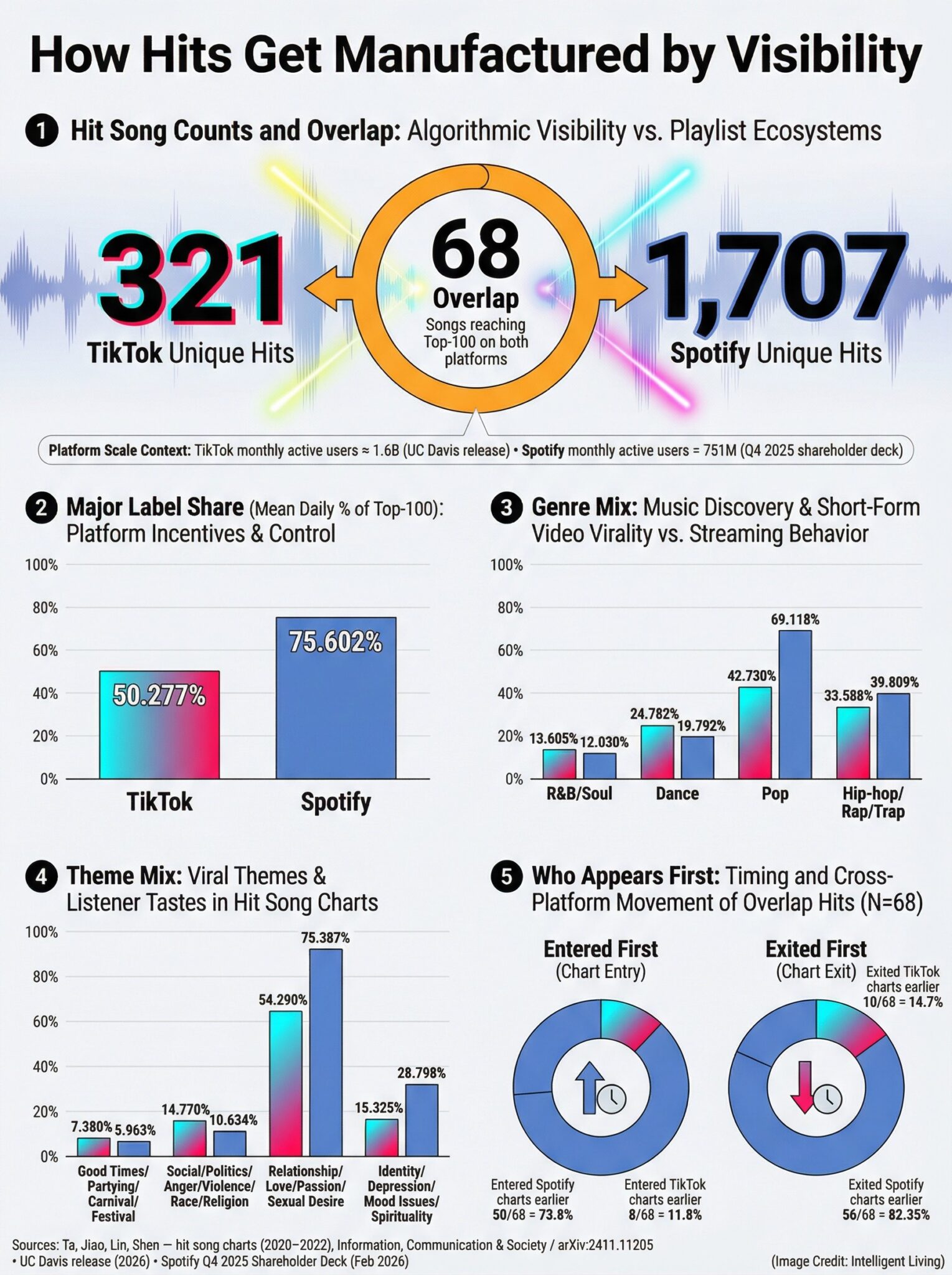
How Algorithms Turn Songs into Hits on TikTok and Spotify
Algorithmic Outcomes: Why Visibility Scales Faster than Taste
Why Visibility Scales Faster than Taste
Here’s the plain truth: popularity is real, but visibility is engineered. Platforms raise the odds that specific tracks get heard first and replayed often, recommending them precisely when you’re most likely to accept.
With Spotify reporting 751 million monthly active users, minor ranking shifts scale into massive exposure changes, even when individual intent remains unchanged.
AI functions like infrastructure by quietly routing your attention until discovery options feel narrow. It acts as a cultural mirror for how systems manage digital focus.
Success often depends on AI-curated discovery systems that prioritize a “visibility first” logic, a pattern music platforms now mirror, prioritizing reach over raw popularity. Music platforms run on that same logic, just with songs instead of search results.
A small, relatable example makes the point without drama. A student might fall for a track buried in a micro-genre playlist, then watch it stall there because the playlist never gets surfaced widely. Their taste was genuine, but the distribution channel never scaled.
Platform Optimization: Short-Form Reuse vs. Full-Track Retention
Short-Form Reuse Versus Full-Track Sessions
TikTok and Spotify reward different forms of “fit” based on their core design. Each platform optimizes for a specific type of listener engagement:
- Spotify prioritizes full-length listening sessions and long-tail playback.
- TikTok focuses on short clips inside video, turning hooks into tools for creator reuse.
Structural gaps between apps explain why a viral hook rarely translates into a consistent streaming hit across platforms. Data from the two-year longitudinal dataset of daily hit charts treats these charts as artifacts of platform influence.
Platform design dictates what rises: TikTok elevates 20-second loops and punchy hooks, while Spotify favors three-minute tracks that sustain playlist retention.
Monolith-driven infrastructure allows songs to spike through short-form video reuse before they reach streaming staple status. TikTok’s feed depends on industrial recommendation engine architecture to route content at scale.
Industry experts compare “TikTok-friendly” bridges to reusable scene changes. While the track isn’t necessarily weak, the most shareable fragment simply secures the spotlight first.
Why the Overlap Can Stay Low
A small overlap in hits doesn’t mean listeners are inconsistent; it highlights how different the platforms really are. Each surface routes attention through its own logic:
- One app embeds songs inside a fast-paced scroll of visual stories.
- The other places are tracks inside long-form listening sessions designed to continue.
Surface context dictates which songs become “hits.” Lived experience reflects this through common queries like “Why do TikTok songs not show up on Spotify charts?”—a reality that holds true even when the artist and track are identical.
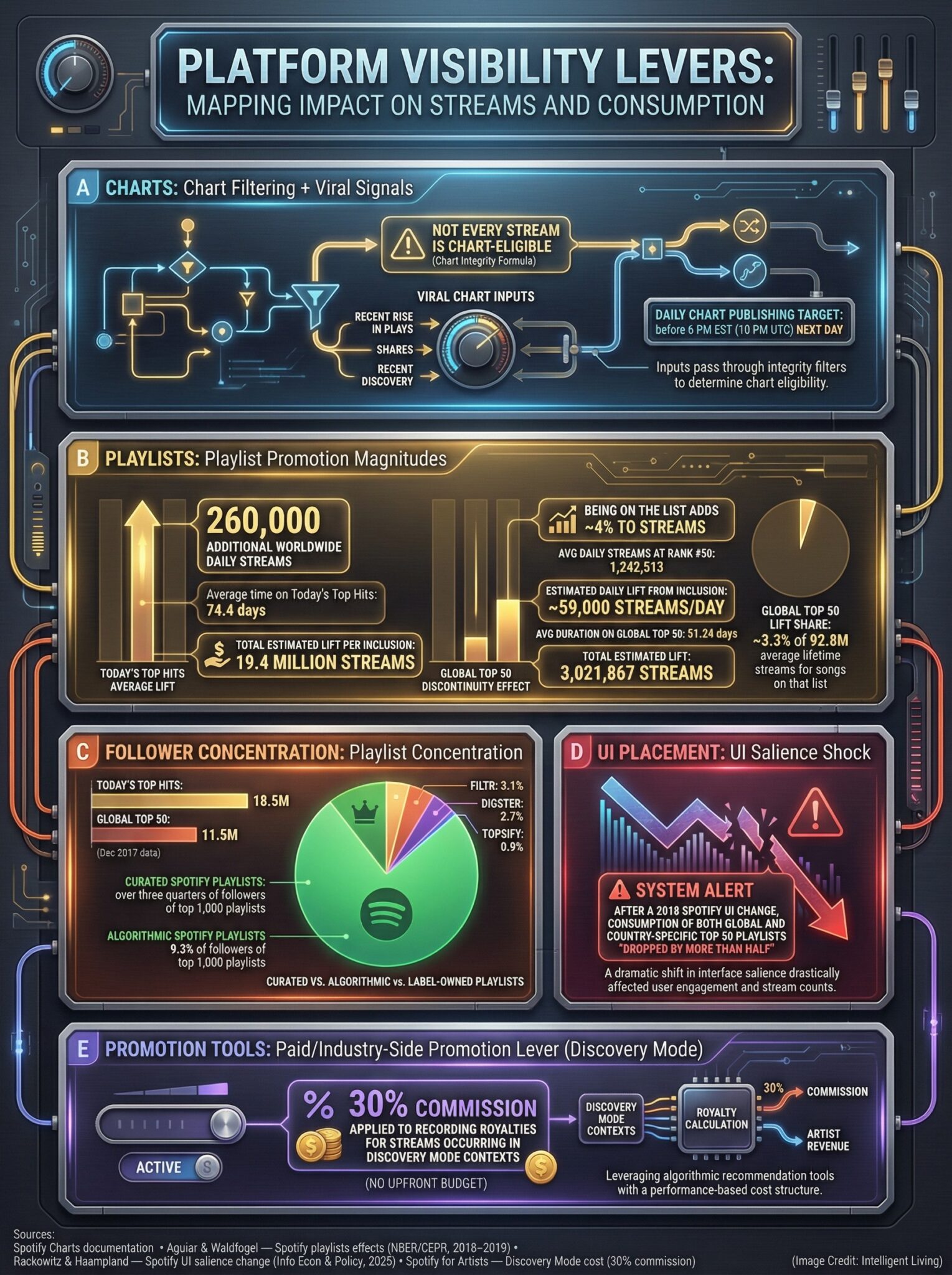
Platform Visibility Levers: How Ecosystems Influence Music Choice
Platform influence is driven by concrete levers like eligibility rules, recommendation inputs, interface placement, and playlist pathways. There’s no need for mind-control language to explain this.
Measurement Constraints: Understanding Chart Eligibility Rules
Charts function as measurement systems with constraints rather than raw votes. Spotify chart eligibility rules determine what qualifies as chartable, meaning not every stream is counted the same way.
Chart-eligible streams are the only ones that count for ranking. Two songs can feel equally popular in your circle yet appear differently on a Top 50 list.
Strategic Inputs: Recommendation Transparency and Commercial Signals
Recommendation systems aren’t only driven by past listening. Platforms incorporate various inputs, including business-facing signals. Spotify addresses commercial influence in its guide to recommendation transparency, acknowledging that business signals can shape your feed.
Algorithmic timing drives influence. Tracks appearing in autoplay or repeated discovery radios gain momentum quickly, ensuring new releases feel established within hours.
Artists use Discovery Mode to increase recommendations for selected tracks, illustrating how industry-side choices shape what listeners see.
Interface Placement: How Layout Steers Listener Attention
Layout steers attention at scale. A peer-reviewed Spotify UI change study proved that Top 50 engagement dropped sharply after a simple interface redesign. Default buttons matter. When a surface becomes one tap farther away, casual listening flows elsewhere, and the new default quietly becomes the new “taste.”
It’s a quiet shift: you don’t usually ‘decide’ to quit a playlist—you just stop seeing it.
Distribution Railways: Playlist Promotion and Amplification Effects
Playlists act as distribution railways. Platform playlist promotion effects are now a critical lever, as placement dictates artist success. Playlists also change interpretation. A track placed inside a workout mix can be heard as “high energy,” while the same track in a late-night mix can be heard as “melancholy,” and those contexts influence saves and replays.
The gap between a niche list and a high-traffic playlist is the difference between a street corner and a stadium. This isn’t marketing—it’s the raw math of exposure.

How to Reclaim Your Listening Agency
Listener agency isn’t a fantasy. It’s a practice. The goal isn’t to “beat” algorithms. The goal’s to stop letting default surfaces become your whole music life.
Build an Intent Playlist
Maintain a personal archive of full-track decisions to protect your taste.
- Add songs only after a complete listen.
- Save clips for curiosity, but keep them off your main playlist until you’ve heard the entire track.
- Testing songs this way ensures the music actually holds up beyond a catchy hook.
Setting healthy digital boundaries creates a mindset where music discovery habits are specific and easy to keep. Habit design works best when it is repeatable and intentional.
Rotate Your Discovery Inputs
AI-driven recommendation systems blend collaborative filtering with content cues, often reinforcing existing habits. Broadening their suggestions requires intentional rotation of your discovery inputs. Try this pattern:
- Dedicate one session to manual search only.
- Explore a specific micro-genre for an hour.
- Listen to a single album from start to finish.
To make it concrete, use voice search language that matches intent, not trends, such as “new indie dance songs without TikTok” or “underrated alternative playlists 2026.” Those queries often land outside the most repeated recommendation loops.
Use Cross-Platform Saves on Purpose
Users can add songs from TikTok to streaming apps to move from a short clip to full-track context as soon as a hook grabs you.
TikTok-to-Spotify song saving moves a clip into a library context that’s easier to revisit later, which helps turn short-form discovery into full-track listening.
Treat saves as a sorting tool. Tag songs for later curiosity, then decide what to keep after listening with full attention.
Schedule Serendipity
Treat discovery like a ritual instead of an endless scroll. Apply a weekly “one new album” rule to slow the reflex of saving the first catchy fragment you hear. This habit encourages deeper listening over algorithmic scrolling.
Rituals work best when they’re easy to track. Mindful analytics for digital well-being keep your music habits intentional by ensuring you choose the track instead of letting the feed decide.
Understanding distrust in AI and algorithmic literacy helps listeners identify the mechanics behind feed bias and take back control.
Broader Implications: Navigating the Future of Music Infrastructure
For Listeners
For listeners, the takeaway’s practical rather than cynical: platforms shape the menu, but people still choose what to keep. Small habits can widen the menu without turning music into homework. The goal isn’t to eliminate algorithms; it is to transform them. Manual discovery ensures your feed becomes a tool rather than a tunnel.
For Artists
For artists, the takeaway’s structural: success increasingly depends on platform-native pathways, from short-form hooks that travel well to streaming patterns that fit playlist ecosystems. Defining a ‘hit song’ now depends on the platform. Success is either optimized for short-form video reuse or long-tail playlist retention.
For Transparency and Design
For culture, the bigger question’s transparency. If charts and feeds operate as cultural infrastructure, what should platforms disclose about the signals they use to boost content? The broader pattern of smart technology shaping daily routines suggests this music discovery gap is actually a critical design issue.
Designing controls for trust mirrors how data flows and privacy UX can improve clarity by treating consent as a core feature.
Ongoing studies show how TikTok save features reshape music discovery as TikTok’s save mechanics turn short clips into long-form listening sessions.

Conclusion: Making Better Music Choices Inside TikTok and Spotify Algorithms
Address algorithmic bias in music streaming to build better discovery habits. Clarity is the real advantage. A hit isn’t just a beloved track; it’s one routed into enough moments to become familiar.
Build your own discovery pathways by acknowledging that visibility is engineered. Reclaiming choice requires responsible AI transparency and human recourse to override default loops.
In a world where TikTok and Spotify algorithms can turn a hook into a wave, listening agency starts with a simple decision about which playlists, searches, and habits get to decide what “you like.”
FAQ: Common Queries on Algorithmic Music Discovery
Do listeners or TikTok algorithms actually decide what becomes a hit?
Listener plays and saves matter, but platform visibility and industrial recommendation infrastructure decide which tracks reach the scale necessary to become a mainstream hit.
Why do TikTok hits differ from Spotify streaming hit charts?
TikTok relies on short-form video reuse and viral hooks. Spotify playlist ecosystems prioritize long-tail playback and session retention. These differing designs create distinct versions of success.
Are Spotify charts just “most streams wins”?
Not exactly. Charts reflect streams that meet eligibility rules, and measurement choices can affect which tracks qualify as chartable.
Can TikTok virality increase Spotify streams?
It can, but it is not guaranteed. Viral clips are a discovery vector, not a contract that streaming success will follow.
How can you find music outside recommendation loops and algorithmic curation?
Prioritize manual music discovery. Use specific searches, follow niche curators, and build an “intent playlist” to break out of automated recommendation loops.


