
Finding bugs in a massive pile of code often feels like searching for a needle in a haystack, especially when developers face tight deadlines. Meta researchers recently unveiled a structured prompting technique that disrupts this dynamic, requiring large language models to provide evidence for their conclusions. This evolution aligns with a growing trend where transparency in AI literacy demands higher standards of verification in our daily coding routines.
Complex academic theories start to feel real when they solve the ‘Tuesday morning’ dread—that moment a developer wonders if a seemingly harmless pull request will crash the entire system. Meta AI research on LLM patch verification focuses on creating a compact LLM verifier certificate. Standardized certificates outline definitions, premises, and traced logic to confirm behavioral equivalence verification. Generating these certificates improves LLM accuracy in code review by providing a readable map of why a model believes a code patch is safe to ship.

Execution-Free Code Review Breakthrough: Building an Evidence Layer for Meta AI
Meta’s Verification Breakthrough: Why Developers are Paying Attention
Recent research from Meta is attracting interest because it targets the verification bottleneck most teams face. Coverage of optimizing LLM prompts for code analysis positions the prompt format as a way to make LLM judgments more reliable during patch verification, all without executing a single line of code.
Experimental evaluations determine if agents successfully navigate repositories, trace dependencies, and analyze semantics across multiple tasks. These tasks include patch equivalence verification, fault localization, and code question answering. Code reviews typically struggle with multiple factors, such as tight deadlines, limited context, and systemic uncertainty.
Fast Insights: Semi-Formal Reasoning for LLM Verifier Certificates
Semi-formal reasoning acts as a concise receipt for a verdict. Verification models explicitly detail the premises used, the paths traced, and the conclusion reached rather than just labeling a patch as safe.
- What it Is: A verifier prompt that produces a structured reasoning certificate for patches with definitions, premises, traces, and a conclusion.
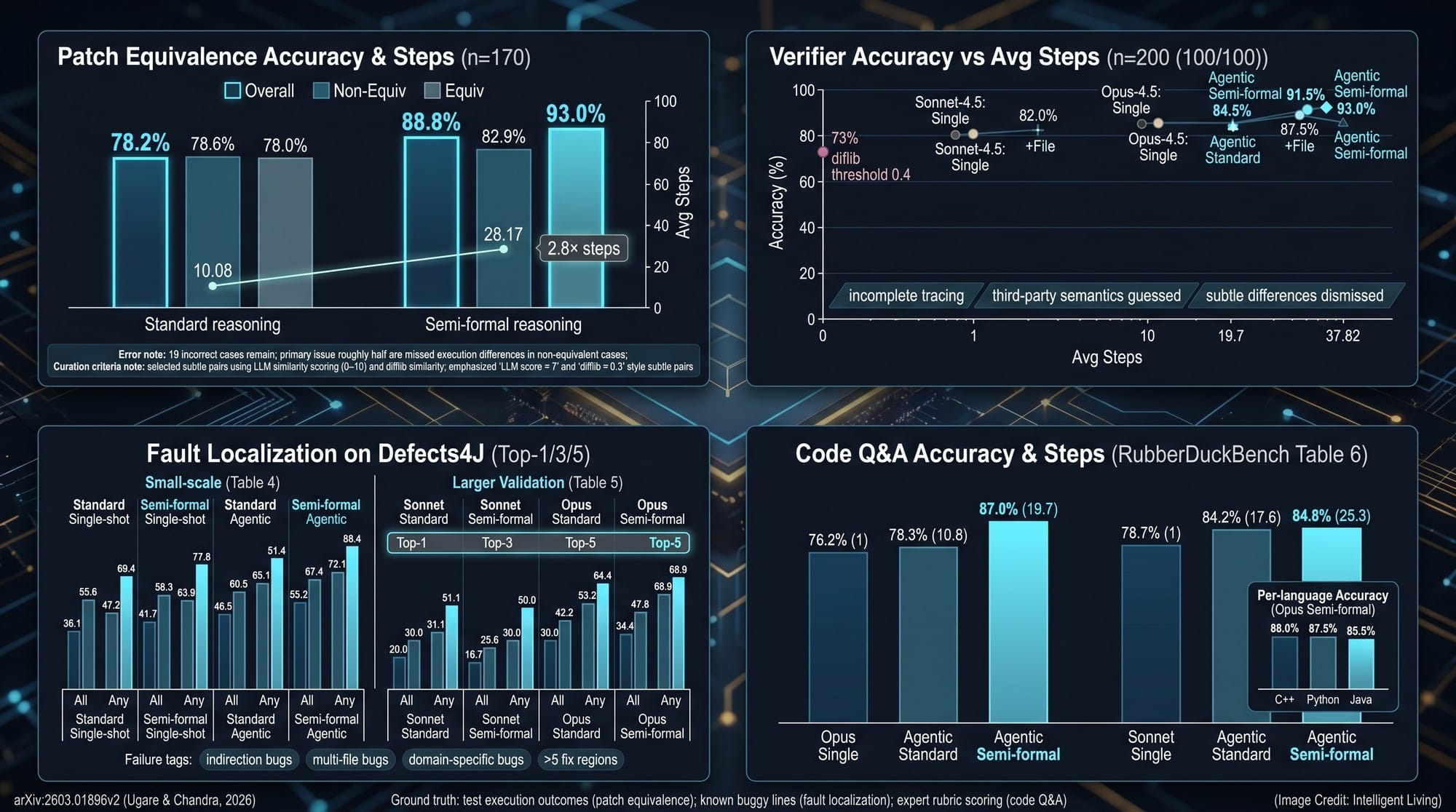
- Headline Result: Reported headline results show patch-equivalence verification accuracy reaching 93.0% in one verifier configuration.
- Typical Improvement: Transitioning from standard reasoning to a structured format boosts accuracy from 78% to 88% on difficult examples.
- Key Tradeoff: Higher certainty costs more runtime, with one comparison showing roughly 2.8× more reasoning steps.
- Why it Matters: Integrating an execution-free verification signal can filter risky changes before expensive test suites kick in.
Interpreting these metrics correctly requires distinguishing between the study’s primary data and its practical boundaries. Subsequent sections break down what the certificate contains, what the verifier realistically infers without execution, and where accuracy gains appear strongest.

The Method: Creating Semi-Formal Reasoning Certificates for LLM Verification
Defining Semi-Formal Reasoning in Meta LLM Code Review
Semi-formal reasoning sits between casual chain-of-thought and full formal verification. Robust prompt engineering relies on structured prompt engineering techniques to prevent models from generating freestyle guesswork. Adopting this philosophy, semi-formal reasoning applies structured constraints to code verification—a field where guesswork proves costly.
The Logic Behind Semi-Formal Logic Constraints
Constraint-based reasoning avoids attempting mathematical proofs of correctness common in formal methods. Structured templates force the verifier to commit to a short record of why it believes a change is safe, unsafe, or uncertain. Rigorous constraints prevent models from generating guesswork, anchoring their logic in verifiable evidence.
Evidence Trail: Anatomy of an LLM Verifier Certificate
Standard certificates include four key components:
- Definitions and Scope: Clarifying what the functions, inputs, and tests actually mean.
- Premises: Concrete assumptions the verifier is allowed to use.
- Traced Paths: Step-by-step traces showing how control flow and data flow change under the patch.
- Conclusion: A crisp verdict, with a counterexample when the verifier believes the patches are not equivalent.
Constraint-based logic turns a model from a confident narrator into a focused reviewer. Bluffing becomes difficult when the verifier cannot justify a claim with a trace.

Execution-Free Code Verification: Reasoning without Running Tests
Verification models analyze behavior through textual evidence, including function signatures, docstrings, tests, and repository context. Commit history often becomes part of the evidence trail in real repositories, and analyzing repository version control history can expose whether a change repeats a past failure pattern. The verifier treats the codebase like a static object, simulating behavior in prose, while the certificate format provides necessary guardrails.
Semantic vs. Runtime: Understanding Execution-Free Code Review
Practical verification ignores runtime outputs entirely, prioritizing textual evidence. Software agents read the specification that the repository already contains, especially tests and interfaces. Analysis focuses on whether the patch would change externally observable behavior under those specs. This distinction highlights how the method streamlines triage and review while maintaining the need for final code execution.
Verifying Behavioral Equivalence in AI-Powered Code Patches
Patch equivalence asks a simple question that hides significant complexity. Do two different code changes produce the same externally observable behavior against a given spec or test suite? One patch might refactor a function, another might reorganize the same logic, and both can look fine in isolation.
Semi-formal verification asks the model to map outcomes between versions. Identifying the input that flips behavior allows the verifier to trace branches and explain which test would fail during a refactor.
If no such input exists within the spec, the certificate makes that explicit. Human review processes typically follow a similar pattern, as reviewers rarely run every possible input. Logic flows toward the path that breaks first, especially in fragile code.
Evidence and Benchmarks: Evaluating Meta AI Patch Verification Accuracy
Benchmarking Meta AI: Patch Verification and Accuracy Results
Multi-task evaluations of semi-formal reasoning highlight improvements addressing a common pain point: confident yet incorrect model answers. Data is easiest to interpret when grouped by task.
High-Accuracy Patch Equivalence Outcomes
Accuracy improves from 78% under standard reasoning to 88% under semi-formal reasoning on curated challenging examples. Real-world agent-generated patches with test specifications reach 93% verification accuracy in certain verifier setups. Distinguishing between textual similarity and behavioral equivalence is essential for reliable verification results.
RubberDuckBench Performance: Reducing Hallucination in Code Q&A
The RubberDuckBench benchmark highlights a critical baseline problem: coding assistants can be inconsistent and fabricate explanations when repository context is incomplete. Results show semi-formal reasoning reaches 87% accuracy with Opus-4.5. Such outcomes represent an improvement of 10.8 percentage points over single-shot setups.
These performance gaps frequently emerge during routine development scenarios. Instant answers from models can sound plausible enough to ship even when return values are null. Semi-formal prompting slows down that moment and forces the model to name its premises.
Fault Localization Gains: Tracking Bugs on Defects4J Benchmarks
Top-5 accuracy gains reached the range of 5 to 12 percentage points during testing against reproducible bug datasets like Defects4J. Benchmarks show consistent improvements, though results depend on the quality of available specs, test clarity, and repository context completeness.
Practical Applications for Software Engineering Agents
- PR Patch Equivalence Triage: Verifier certificates flag high-risk changes before reviewers waste hours on adjacent files.
- CI Early Gate: Execution-free verification can filter changes so the most expensive test suites run on the commits most likely to pass. Focusing on automated software testing strategies prioritizes early, test-aware signals.
- Repo Q&A With Evidence Trails: Delivering specific logic traces instead of vague explanations helps developers understand complex function behaviors.
- Fault Localization Triage: Certificates narrow down likely buggy regions so humans stop chasing unrelated errors.
- Training and Reward Signals: Verification-style outputs provide cheaper feedback for agent training pipelines when sandbox execution is expensive.
- Security Triage as Future Work: Template logic could flag risky API usage patterns, though this direction remains exploratory.
Engineering teams will adopt verifiers as filters rather than replacements for human oversight. Verification helps manage patches that are hard to reason about quickly, like dependency updates and large refactors.

Adoption Playbook: Deploying LLM Verifiers and Managing Latency Costs
Scaling Constraints: Measuring the Cost of LLM Verification
Increased confidence requires balancing trade-offs in performance and cost. Reports indicate that semi-formal reasoning can increase the number of reasoning steps, which translates into latency and token cost. Long context carries a hidden tax, and IndexCache-style sparse attention serves as a reminder that faster models do not automatically make verification cheap.
High costs become real in the middle of a review. Quick lint passes return in seconds, while slow verifier responses can stall developer attention. Throughput and responsiveness matter as much as raw accuracy, especially when AI agent processing delays turn a fast review into a stop-and-start ritual.
Boundaries of Semi-Formal Logic in Repository Maintenance
Certificates are audit artifacts, not proofs. Semantic differences can still be missed when context is incomplete, when tests fail to encode intent, or when the repository relies on undocumented behavior.
Deployment Strategy: Adopting LLM Verification Without Friction
Documentation as Code: Reviewing LLM Verifier Certificates
Storing certificates alongside pull requests ensures they act as visible documentation rather than opaque verdicts. Teams can treat these as mini specs where reasoning remains diffable and reversible. A collaborative Markdown documentation system ensures that provenance remains intact while ideas and code evolve together.
Prompt Engineering Discipline: Managing Repository Context Layers
Pilot the verifier in low-risk environments where feedback loops remain clear. Avoid dumping an entire monolith into a prompt, as this inflates costs and invites confusion. Retrieval and memory discipline provide a cleaner approach to evidence slicing, with integrated memory architectures for AI acting as a practical pattern for keeping context tight.
Automated Security Gates and Governance Protocols
Structured prompts reduce hand-wavy answers but cannot replace operational safeguards. Merge decisions remain a form of delegated authority, and delegated authority needs boundaries. Teams using strict security gating protocols avoid letting automated verdicts become silent production changes.
Recent supply chain incidents, like the LiteLLM PyPI attack, highlight how automation can accidentally amplify the blast radius of a security flaw. Poisoned dependencies can move through installs and CI before a human notices.
Phased Implementation: Pilot Programs for AI Code Review
Launching pilot programs on low-risk projects facilitates clear feedback loops. Pilot the verifier on a narrow set of repositories, log certificates, and compare them against real test runs. Teams moving toward autonomous coding workflows often find that evaluation discipline differentiates performance more than raw model capability.
Boosting operational efficiency involves tiering processes according to the specific risk of each code change. Running lightweight verifiers on most pull requests allows teams to reserve full certificates for large diffs and dependency changes.

Strategic Conclusion: Verification Becomes the Core Differentiator
Reliable verification holds more value than the rapid generation of unverified code. This structured prompting for software engineering agents offers a pragmatic middle ground between guessing and full-blown mathematical proofs. While execution-free code verification doesn’t replace traditional testing, it serves as a powerful filter for the human review process. Teams can now prioritize their attention where it counts, using these certificates to triage risky updates before they reach expensive production cycles.
Moving toward automated verification changes how developers trust their tools. Systems like this bridge the gap between AI-powered fault localization benchmarks and actual day-to-day repository maintenance. Prioritizing semantic evidence over syntax enables teams to detect regressions earlier and with greater confidence. Scaling this semi-formal approach ensures that code reviews remain fast without sacrificing the safety of the software we depend on every day.
Meta AI Research: LLM Code Review and Execution-Free Patch Verification
How does the LLM verify code without running it?
Analysis of code, tests, and specs as text allows the model to produce a certificate that traces control flow and data flow to justify a verdict.
What makes semi-formal reasoning different from regular AI chatting?
Constraint-based templates require definitions, premises, and traced reasoning, making the logic inspectable rather than opaque.
How accurate is this Meta LLM code review method?
Research shows it reaches 93% accuracy in verifying if code patches are behaviorally identical to the originals in curated setups.
Can this replace my existing unit tests?
No, it acts as an early warning system to catch errors before tests run, helping triage changes more efficiently.
Why do coding assistants sometimes lie about bugs?
Hallucinations often happen when a model lacks full repository context or is allowed to guess instead of using structured evidence.


