
Supermemory AI addresses the fundamental friction within agentic workflows: the repetitive need to re-teach assistants basic context during every session reset. This infrastructure introduces a dedicated AI memory layer that acts as a bridge between transient chat logs and durable knowledge. We examine the mechanics of persistent AI memory, Supermemory’s specific implementation, and the practical requirements for adopting reliable recall in production environments.
Specifically, incorporating a validated memory stream and reflection architecture provides a blueprint for systems that store experiences and summarize critical insights. A high-performance memory API packages this pattern into scalable infrastructure, allowing agents to retrieve the exact slice of context needed for the next decision. Moving beyond simple transcripts enables long-term memory for AI to function as a reliable cognitive foundation rather than a temporary cache.

Eliminating Chatbot Amnesia: Core Mechanics of Supermemory AI
Quick Facts: Supermemory AI and the Memory Layer Concept
Evaluating Supermemory AI requires understanding how it bridges the gap between raw data storage and active cognitive recall. The following technical primitives define its operational boundaries.
- Capability Scope: Supermemory functions as a long-term and short-term memory and context infrastructure for AI agents, offering features built around retrieval, profiles, and context management.
- Development Transparency: Engineers can inspect and reason about the project’s primitives through the Supermemory open-source memory engine documentation.
- Core Functionality: The system ingests source material, extracts facts, and returns high-relevance context slices at query time.
- Strategic Utility: Persistent AI memory targets personalization and continuity while minimizing the overhead of replaying chat histories.
- Architecture: Memory layers isolate relational dependencies rather than merely archiving raw transcripts.
This structured approach prevents chatbot amnesia and ensures that agents remain grounded in historical context without exhausting the model’s window.
Why AI Apps Still Forget After One Great Conversation
Modern large language models excel at transient processing but lack durable inter-session memory without external context injection. Project bots often forget decisions from last week, while personal helpers redundantly re-learn the same preferences. Long chat logs transform critical details into needles in a haystack of noise, causing models to assert incorrect facts with misplaced confidence. For how leading AI assistants handle this differently, see our Gemini vs ChatGPT comparison.
Market indicators are clear. The significant capital injection from a $2.6 million seed round for Supermemory validates that engineering teams now view persistent memory as core infrastructure rather than a novelty. Tighter retrieval, explicit provenance, and fewer repeated onboarding questions across sessions define the operational shift toward this new architecture.
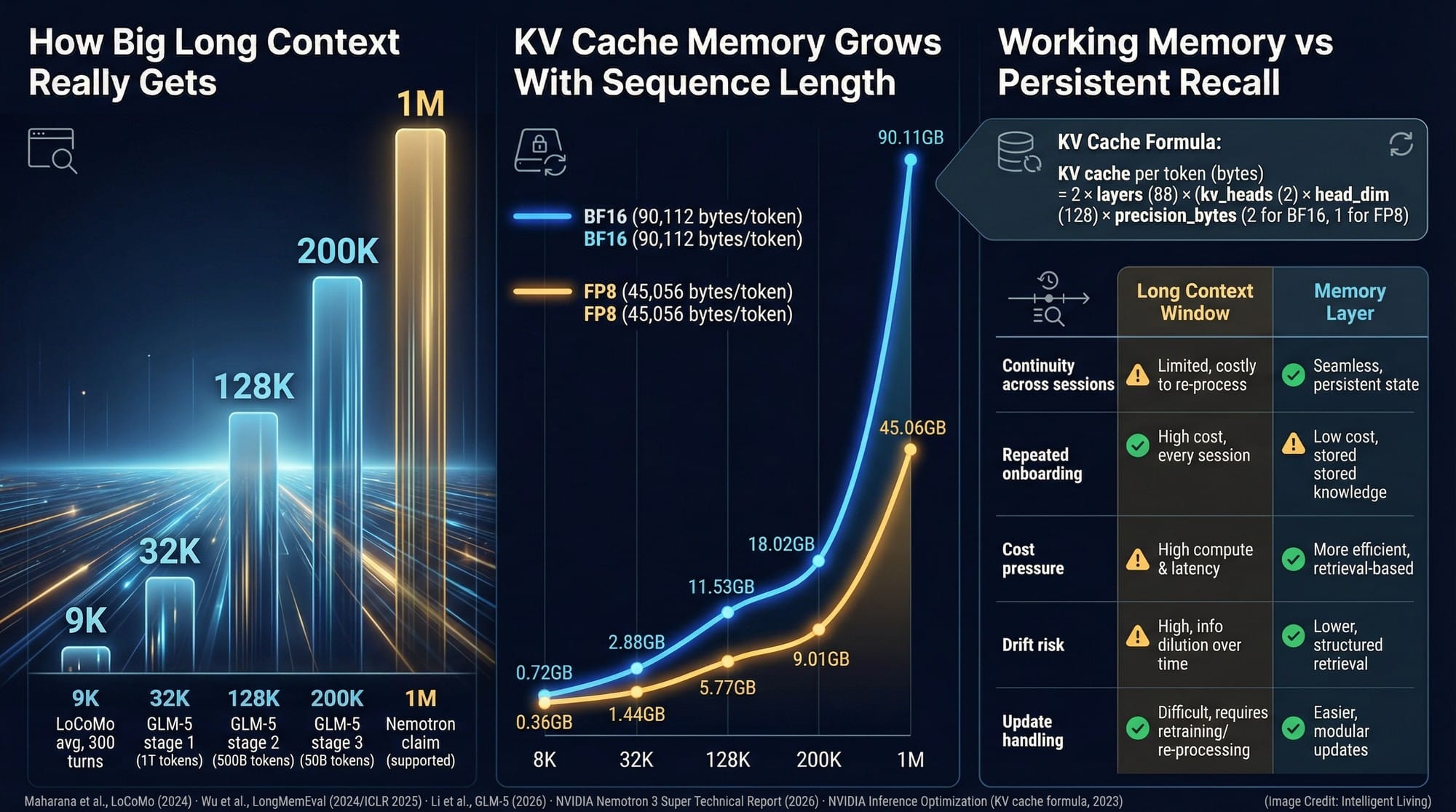
Persistent Recall Advantages: Surpassing Long Context Window Limitations
Functional Scope: Working Memory Dynamics in Context Windows
Large context windows extend a model’s working memory for individual interactions, facilitating the processing of lengthy documents or complex code diffs without constant summarization. Working memory limitations force critical facts to reside within the active window during the query phase, creating a strictly session-bound experience.
Operational Overheads: Latency and Token Costs of Window Expansion
Context window expansion often introduces escalating operational costs and performance bottlenecks.
- Token expenses increase linearly with window size.
- Inference latency rises as the model parses larger KV caches.
- Irrelevant passages bury high-value facts, leading to context overload.
Observed inaccuracies typically manifest as structural failures within the attention mechanism rather than spontaneous hallucinations. Technical teams must monitor how expanding KV cache requirements impact long-context inference, especially when deploying on limited hardware. As mechanics for small models with massive context demonstrate, the KV cache can quickly become the dominant memory cost. Integrating an AI memory layer mitigates this by retrieving high-relevance facts, eliminating the long-context tax for recurring queries.
Technical Bottlenecks: Sparse Attention and the Residual Context Tax
Understanding the residual bottlenecks in sparse attention architectures serves as a reminder that bigger windows are not a substitute for durable memory. When the window becomes the strategy, teams tend to ship systems that feel smart on demos and sluggish under real user load.
Defining Infrastructure: Core Components of an AI Memory Layer
Functioning as a database-search hybrid, this layer serves as a shared knowledge backbone across multiple products and agentic personas. Advanced memory layers extend standard RAG by integrating user profiles, temporal awareness, and rigorous context-cleaning policies. Many teams start with retrieval-augmented generation, where standard RAG patterns pull relevant chunks from a knowledge store and inject them into the prompt.
Engineering teams typically encounter retrieval as a practical workflow challenge rather than an abstract research concept. Implementing a grounded prompt engineering retrieval workflow ensures the model uses fresh context to avoid confident guesswork. Building a reliable, persistent AI memory infrastructure requires four core functional pillars to handle data flow effectively.
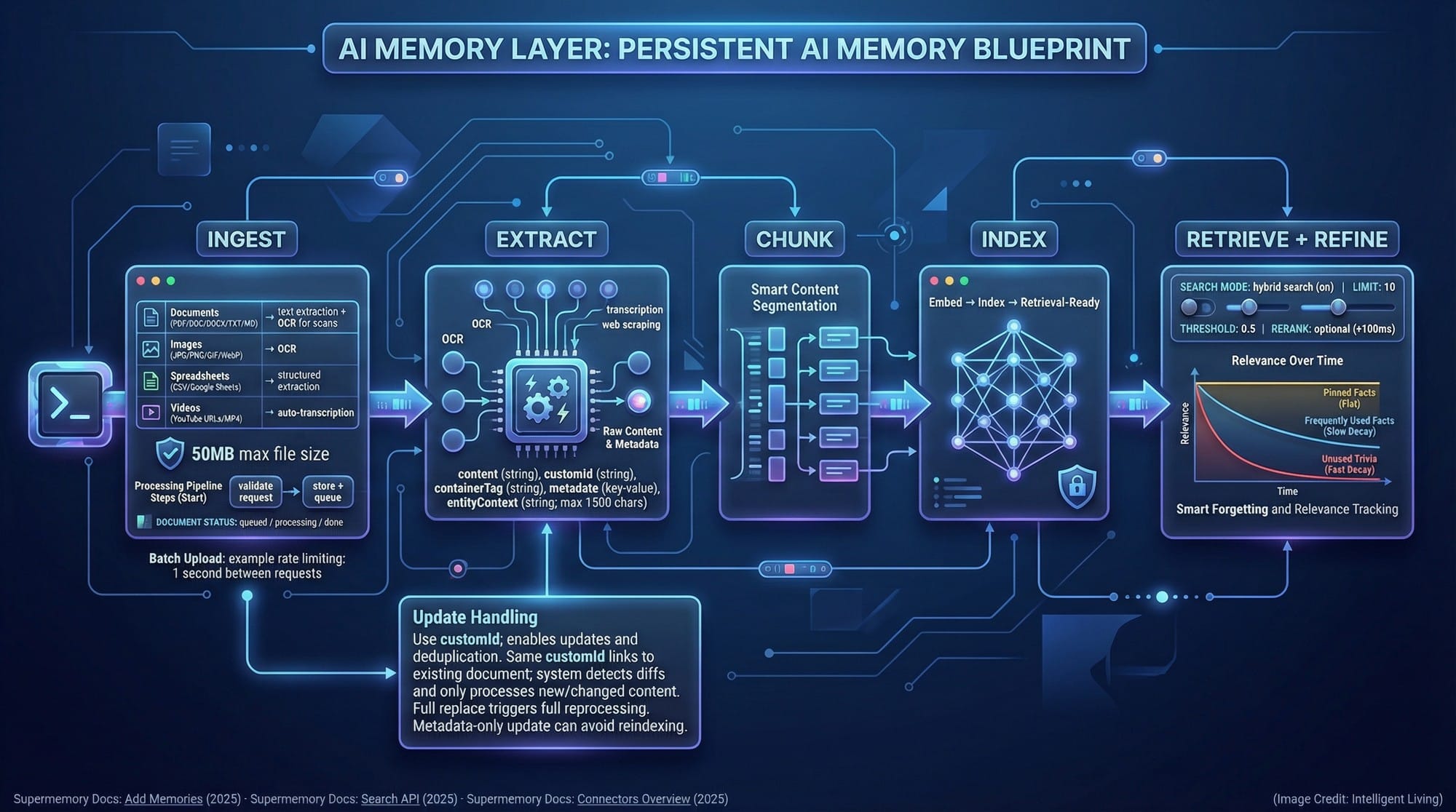
- Ingest: Aggregates documents, repositories, and multimedia from various connectors.
- Extract: Transforms unstructured data into refined fact chunks and metadata.
- Index: Maintains vector embeddings and keyword indexes for hybrid search capability.
- Retrieve and Inject: Delivers the highest-relevance context subset to the model prompt.
Synchronizing these stages ensures that the agentic workflow stays grounded in current, validated information.
Profiles Versus Episodic Memory
Tiered categorization offers the most effective mental model for these systems. Adopting a tiered memory architecture for agents allows teams to partition memory into layers that balance speed, cost, and permanence. Supermemory formalizes this split by utilizing profiles that store stable facts and recent episodes to store stable facts and recent episodes without replaying entire histories. Practical implementations manifest this tiering through high-speed profile layers for stable facts, supported by secondary stores for episodic data.
Inside the Memory Layer Stack: Retrieval, Sync, Reranking, and Forgetting
Technical Implementation: Supermemory Pipeline and Operational Logic
Processing diverse content types requires a reranking option in the search API to transform text, documents, and media into indexed units. Success depends on extraction consistency; minor errors at this stage inevitably propagate into significant retrieval failures downstream. Unstructured ‘document dumping’—uploading raw PDFs without processing—typically results in unreliable retrieval. A dedicated memory pipeline replaces this haphazard approach with a verifiable, index-driven system that supports rigorous tuning and debugging.
Memory gets more useful when it stays current. Maintaining index alignment with changing files depends on the connector sync overview protocols used for sources like Drive and GitHub. Automated synchronization ensures that persistent AI memory stays current, preventing outdated policy updates from conflicting with cached summaries.
Developers can prioritize the highest-value matches by utilizing the integrated reranking features within the search API. Reranking matters because retrieval often returns a pile of plausible matches, and most systems only have budget to inject a few. The architecture describes forgetting and decay policies that lower the weight of unused or contradictory facts, allowing the agent to treat information as “true enough” in the moment.
High-Performance Infrastructure: Hybrid Retrieval and Reranking Workflows
While seamless recall appears intuitive to the user, the underlying architecture relies on disciplined retrieval and precise context selection. Semantic vectors identify paraphrases by mapping conceptual meaning into embeddings. This mapping depends on embedding-driven semantic search signals instead of literal keyword matches. Keyword retrieval incorporates BM25 relevance scoring variables to ensure that critical data, like policy strings or error codes, remains accessible.
Integrating semantic and keyword methods minimizes blind spots in domains where precise identifiers are critical. Omitting the reranking step often forces teams to over-inject context, escalating costs without ensuring high-relevance grounding. Applying iterative deep research loops to memory systems ensures that drafts actively steer successive lookups to fill informational gaps. Real-world memory requires continuous recalibration as source materials evolve. When throughput becomes the limiter, faster embedding and retrieval stacks start to matter, such as using Fourier token mixing for workloads to improve throughput.
Optimized Retention: Strategic Forgetting and Knowledge Decay Policies
While Supermemory details its memory engine approach to decay, the underlying requirement for informational pruning is universal. Effective AI memory layers must emulate natural cognitive decay to prioritize core commitments and prevent retrieval from becoming saturated with obsolete trivia. Pruning information ensures the system maintains a high signal-to-noise ratio, preserving essential commitments while shedding irrelevant data.
Implementing smart forgetting requires specific logic to balance long-term stability with immediate relevance.
- Recency Weighting: Prioritizes current documentation for time-sensitive queries.
- Provenance Overrides: Favors authoritative primary sources over informal notes.
- Manual Pinning: Secures critical facts in a stable profile to prevent accidental decay.
Standardizing these policies ensures the AI memory layer maintains a high signal-to-noise ratio over long-horizon interactions. Neglecting decay policies typically creates unmanageable technical debt, requiring costly retrospective cleanup of the knowledge base.
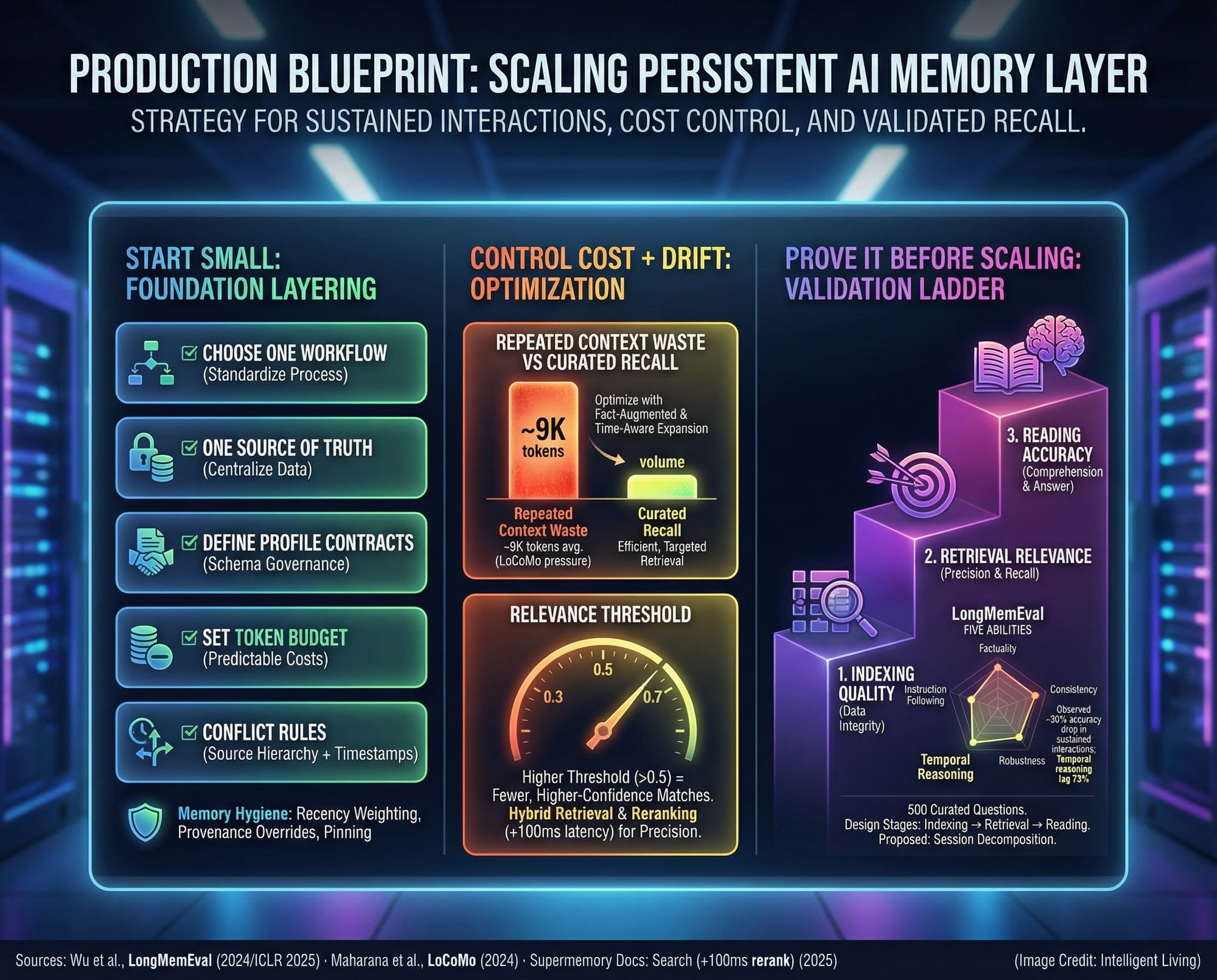
Integrating Persistent AI Memory: Implementation Strategies for Production Environments
Developmental Workflows: Deploying Memory Layers for Teams and Individual Users
Launching memory as a product surface requires a staged roadmap to manage complexity and maintain grounding.
- Choose one workflow: pick a high-frequency use case where repetition hurts.
- Start with one source of truth: connect the place where your canonical docs actually live.
- Define profile contracts: decide what must always be true versus what can expire.
- Set a token budget: cap injected context so costs do not spiral.
- Create conflict rules: resolve contradictions by source hierarchy and timestamp.
These tradeoffs are evident when performing agentic coding within massive context windows, where memory limits often necessitate a dedicated layer. Personal knowledge repositories yield the best results when scoped narrowly. Initial implementation should focus on high-frequency queries and consolidated reference directories. For privacy-focused setups, an offline retrieval-augmented configuration shows how local retrieval can keep personal notes searchable without external exposure.
Implementation Checklist: 11 Critical Steps for Persistent AI Memory Adoption
Integrating persistent AI memory into your existing development stack should be a phased process.
- Start with a single connector or source to avoid sync chaos.
- Treat ingestion as a pipeline with validation, extraction, and indexing stages.
- Use hybrid retrieval so exact identifiers do not vanish under paraphrase.
- Rerank results before injection to reduce noise.
- Enforce a token budget per request.
- Separate profiles from episodes so stable facts do not churn.
- Add decay rules so stale trivia fades out.
- Log retrieval and injection events for debugging.
- Test contradiction handling by inserting conflicting facts intentionally.
- Evaluate multi-session performance using MemoryBench before scaling the rollout.
- Pin legal, safety, or compliance facts behind stricter governance.
Following these steps minimizes technical debt while maximizing the utility of the memory store.

Validating Production Readiness: Memory Benchmarking and Attack Surface Security
Performance Evaluation: Benchmarking Persistent Recall Accuracy and Drift
Establishing a rigorous baseline for accuracy requires auditing LongMemEval benchmark categories that go beyond simple preference matching. Validating persistent AI memory involves testing across several critical vectors.
- Recall Accuracy: Verifying the retrieval of specific information across sessions.
- Multi-session Reasoning: Ensuring the model connects logic across disparate threads.
- Temporal Understanding: Tracking the chronological order of facts and events.
- Knowledge Adaptivity: Measuring how well the system integrates updated information.
- Reliable Abstention: Confirming the model stays silent when confident context is missing.
Monitoring these dimensions ensures that the memory layer provides a reliable cognitive foundation rather than just a lucky retrieval. Modeling conversational drift across long threads is best achieved through the LoCoMo extended conversation recall benchmark designed for multi-hop reasoning. Tracking realistic memory behavior often necessitates using the LoCoMo-Plus benchmark expansion to verify model adaptivity.
Security Protocols: Mitigating Risks in Persistent AI Memory Layers
Engineering teams should consult OWASP Top 10 for LLM applications to build a robust threat model for memory layers. A memory layer holds durable facts; that permanence is both useful and risky. Protecting the knowledge base is critical, as the PoisonedRAG knowledge corruption attack can force models to return attacker-controlled responses.
Hardening Checklist
- Access controls: limit who can write to primary sources.
- Sanitization: strip secrets before indexing.
- Prompt separation: mitigating prompt injection patterns involves separating instructions from untrusted memory.
- Audit logs: record retrieval and injection events.
- Red-teaming: simulate injection and poisoning regularly.

Conclusion: Scaling Sustainable AI with Persistent Memory Layers
Integrating a dedicated AI memory layer elevates assistants from episodic helpers into continuous collaborators. Responsible adoption reduces repetitive context loading, sharpens personalization, and mitigates the agentic token burn that frequently inflates AI bills, shifting operational costs in production. When systems rely on repeated retrieval loops without a durable store, technical debt and latency inevitably spike. Transitioning to persistent recall is a strategic move toward grounded, cost-effective agentic workflows.
Disciplined benchmarking and a clear-eyed view of the expanded attack surface anchor successful production runs. Engineering teams must prioritize smart forgetting and robust access controls to prevent stale facts from compromising security or accuracy. Starting with narrow workflows and hardening the retrieval stack enables building systems that don’t just process data but actually learn and adapt over time.
FAQ: AI Memory Layers and Persistent Recall
How does an AI memory layer differ from a long context window?
Context windows function as temporary working RAM for a single session, while an AI memory layer provides durable, long-term storage that persists facts across multiple conversations.
Why is hybrid retrieval necessary for AI memory?
Hybrid systems combine semantic vector embeddings for meaning with keyword search for exact identifiers. This ensures that precise details like policy clauses or technical codes don’t get lost under paraphrasing.
What role does smart forgetting play in persistent AI memory?
Smart forgetting uses decay policies to demote unused or obsolete information. This keeps the retrieval index clean, ensuring the agent surfaces relevant context instead of resurrecting outdated facts.
How can teams benchmark the reliability of AI memory?
Reliability is verified through multi-session tests and automated scoring frameworks to track recall accuracy and temporal reasoning.
What are the primary security risks of long-term AI memory?
Storing facts increases the risk of prompt injection and data poisoning. Defenses include strict access controls, data sanitization, and following established industry security standards or hardening prompt injection defenses specifically for tool-using agents.


