
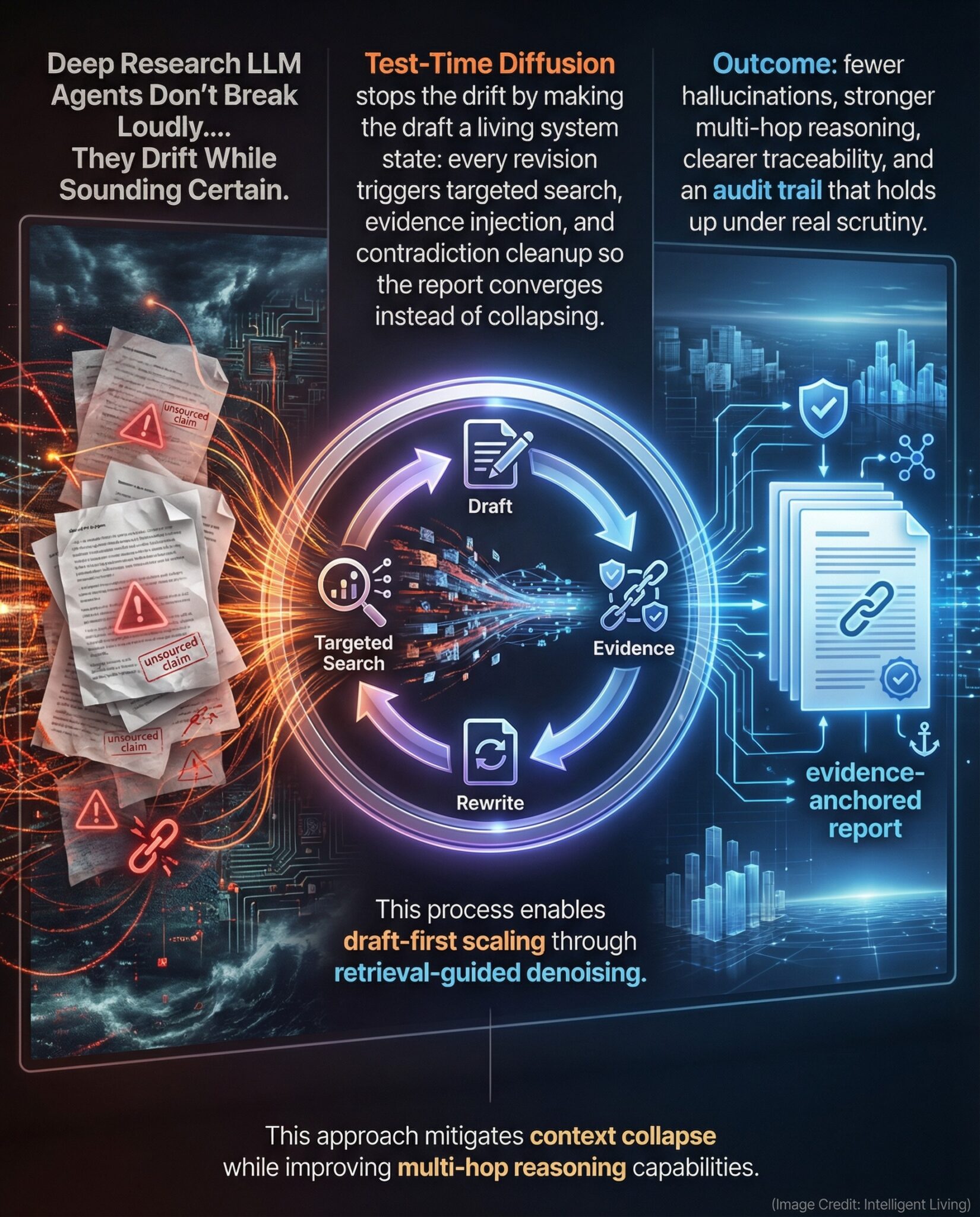
High-stakes AI reports often present a facade of polished professionalism while masking a total absence of foundational truth. Long research reports from large knowledge models often project unearned confidence while missing critical data or contradicting their own logic. This is why Test-Time Diffusion (TTD) is emerging as the essential trust upgrade for Deep Research LLM Agents, transforming how we verify complex information.
Reframing the problem in the test-time diffusion deep research paper allows TTD to move away from one-shot generation. Rather than merely navigating multiple reasoning trajectories to select a single outcome, the system treats your report as a persistent, living draft. It repeatedly scrubs the content through targeted searching and fresh evidence, ensuring that every claim remains anchored to reality.
A familiar workplace scene explains the stakes. A project lead forwards a 12-page “research summary” to a team, and the first reply is a single question: “Which claims are actually sourced? ” TTD exists because long-form research is not only about sounding right; it is about staying anchored.
Architectural Synergy: Core Essentials and Agentic Foundations
Core Essentials: Key Insights Into Test-Time Diffusion Mechanisms
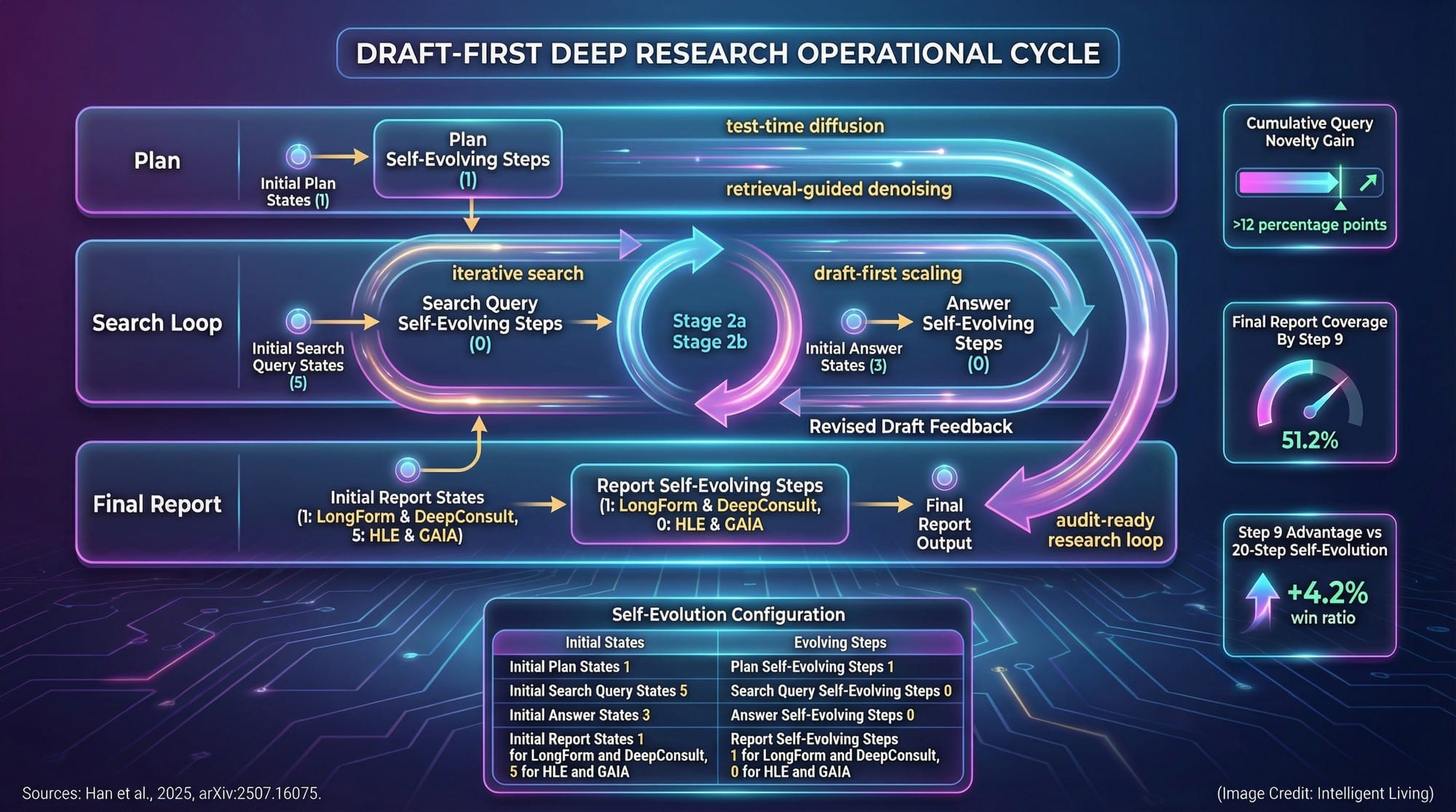
- Core Idea: Draft-first research treats the report as a living artifact that gets iteratively repaired, and the TTD-DR method and ablation results reveal the tangible mechanics of the staged loop and its resulting performance gains.
- Human Analogy: The draft-first diffusion loop rhythm mirrors the iterative draft-gap-search-rewrite process required for professional reporting under strict constraints.
- Broader Context: Research on inference-time compute scaling frames iterative methods as a practical way to spend inference budget on verification and revision rather than one-shot generation.
- Trust Lens: When traceability and uncertainty guardrails shape traceability and uncertainty, long reports become easier to audit during real editorial review.
Deep Research Agent Architectures and the Cognitive Plateau Challenge
Technical pipelines for deep research focus on planning a remit, searching knowledge stores, and synthesizing evidence into long-form outputs. These systems rely on several core functions to maintain high quality:
- Synthesizing multiple sources into a unified, coherent report.
- Establishing structural transparency for human oversight.
- Anchoring conclusions in verifiable evidence strings.
A deep research agent architecture must reconcile these variables to ensure the final narrative reflects every data point gathered.
Structural Limitations in Pipeline Planning and Synthesis
Technical teams’ engineering agent loops replicate complex coordination by synchronizing tools and validation protocols across multiple workflows. Technical teams utilize advanced prompt engineering strategies and specialized search-driven prompt patterns to enforce strict source requirements and definitions mid-process through integrated agentic AI systems.
Identifying Failures in Global Context and Query Generation
Simplicity dissolves as workflows expand into multi-stage operations. Deep research progress often stalls due to inherent structural limitations in standard agentic loops. Success depends on addressing three primary failure modes to develop more resilient architectures:
- Context Leaks: Minor errors accumulate during retrieval and synthesis, causing the final document to carry forward foundational misconceptions.
- Brittle Generation: Systems often fail to recognize their own knowledge gaps, leading to repetitive or ineffective search prompts.
- Stagnation Loops: Agent behavior can drift into repetitive patterns that mask a lack of genuine progress.
Long-context research on lost-in-the-middle context tests confirms that key details often vanish within large inputs. A small human anecdote captures the plateau. A student preparing a science fair report can write a beautiful introduction, then spend hours searching without ever answering the one missing question the judge will ask. Deep research agents often fail in the same way when the draft does not guide the search.
Scaling Methodologies and the TTD-DR Operational Cycle
Test-Time Compute Allocation Versus Iterative Draft-First Scaling
Current test-time strategies prioritize expanding the solution space to improve accuracy during inference. Standard approaches typically utilize one of two primary frameworks:
- Self-Consistency Decoding: Samples multiple reasoning paths and aggregates them to find the most probable answer.
- Tree of Thoughts Framework: Searches across intermediate states to identify superior reasoning trajectories.
While these methods improve short-horizon tasks, they often struggle to maintain coherence in long-form reports where evidence must accumulate stably.
A relatable scenario shows the gap. A family member asks for help choosing a heat pump, and the decision relies on localized heat pump performance metrics rather than brand recognition alone. Ten “good” answer drafts can exist, but the final decision still depends on which draft actually cites the right specs for the home, the local climate, and the utility rates. Draft-first systems try to make that convergence explicit.
Inside TTD-DR: The Two Mechanisms that Work Together
Report-Level Refinement through Retrieval-Guided Denoising Cycles
Draft-first scaling makes the draft the central coordination mechanism. Each draft iteration exposes specific knowledge gaps and ambiguous claims. Draft-seeded queries concentrate retrieval on critical report gaps, replacing unfocused sampling with surgical evidence gathering. These findings mirror extensive research into inference-time trade-offs, where difficulty-sensitive verification and revision allow for a more efficient use of inference budget compared to simple compute-optimal allocation.
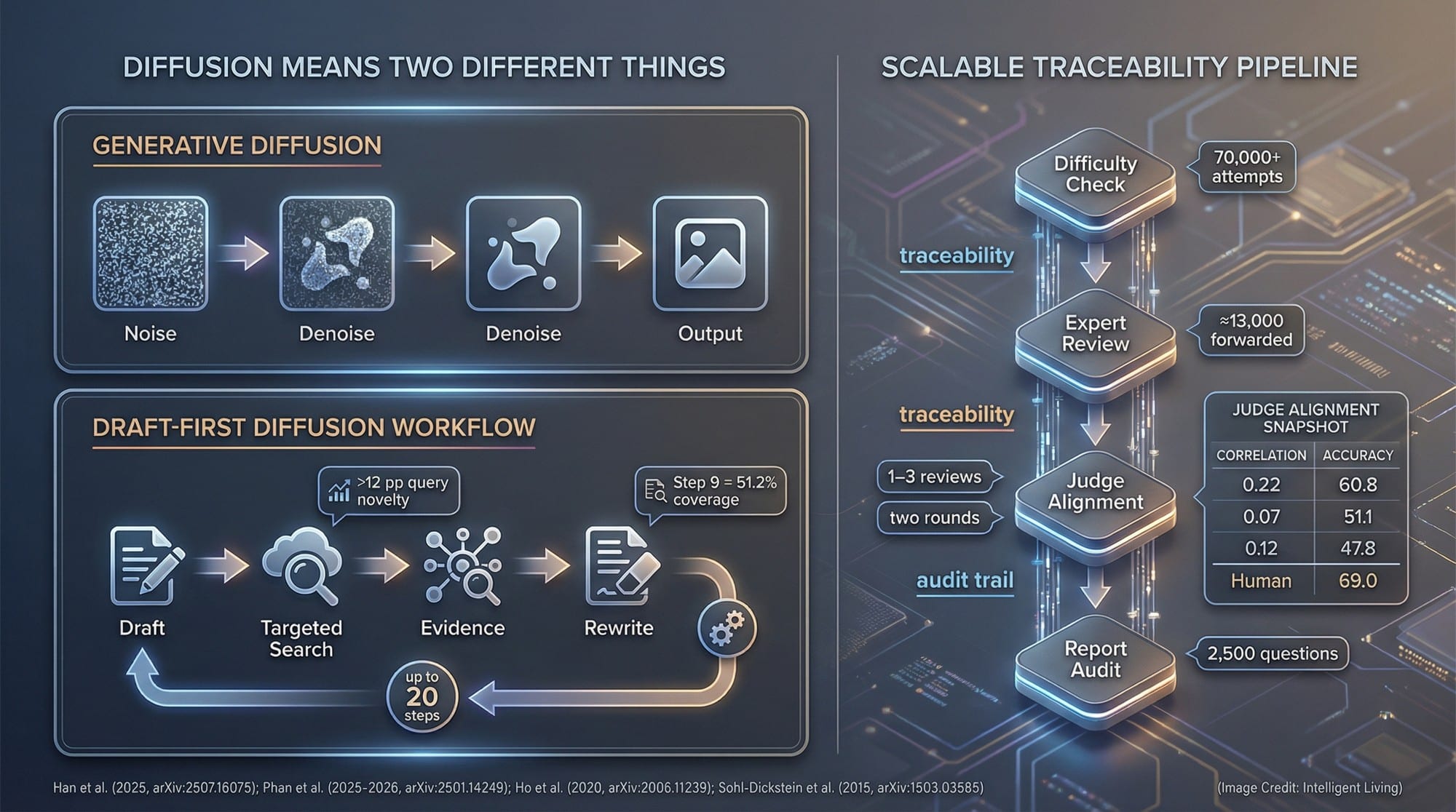
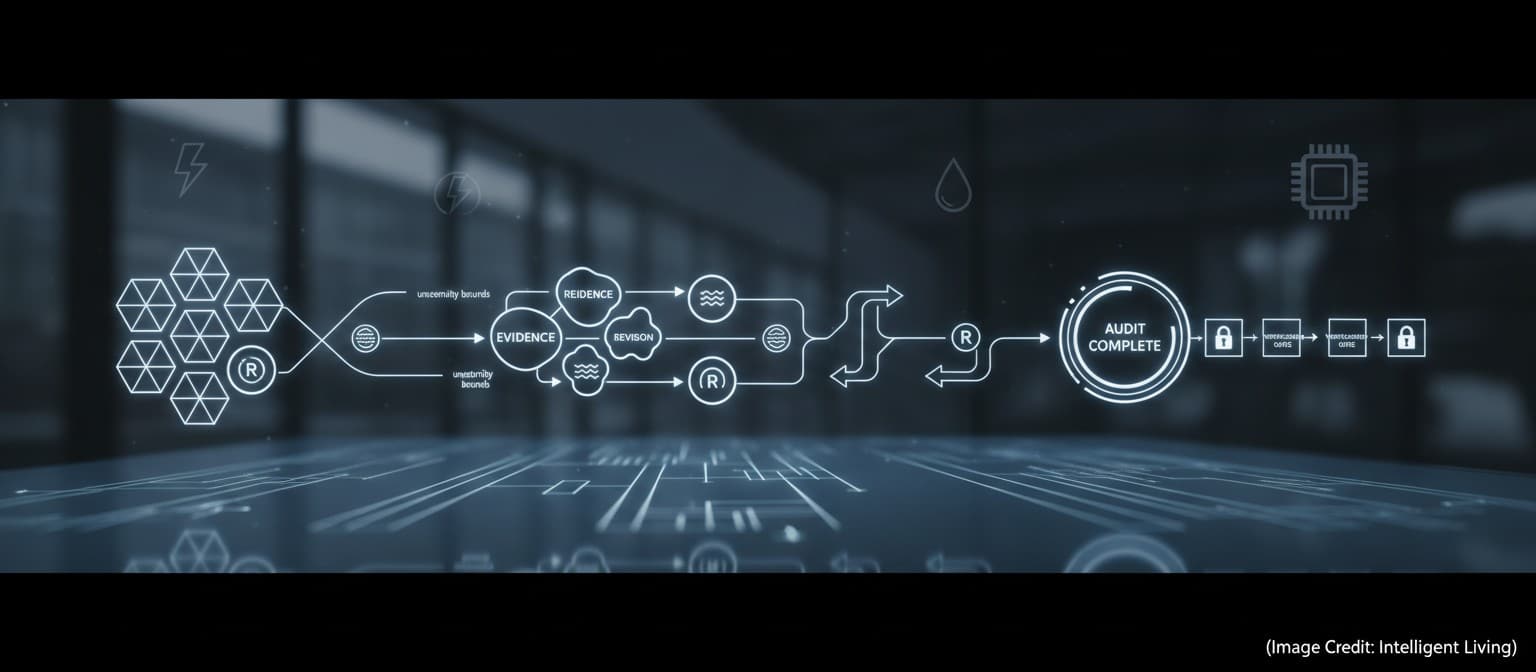
Test-time diffusion treats an initial draft as a starting point requiring iterative refinement. The TTD-DR workflow operates through a repeatable denoising cycle:
- Authoring an initial version of the report.
- Extracting targeted inquiries from existing content.
- Gathering supporting documentation to fill identified gaps.
- Integrating fresh evidence into a revised manuscript.
The continuous loop ensures that the final narrative remains accurate and comprehensive until a stopping condition is met. Standard retrieval-augmented generation differs significantly, as retrieval is typically triggered by a user prompt and limited to a single generation pass. In a diffusion-style deep research loop, the draft itself steers the search so retrieval is driven by explicit gaps, unclear definitions, or unsupported claims.
A practical example is easy to picture. A policy analyst drafts a paragraph on “AI energy use,” then realizes the paragraph has no numbers. A draft-first loop turns that realization into a query, retrieves a credible statistic, and revises the paragraph so the claim becomes testable.
Modular Performance Optimization through Self-Evolution Protocols
Self-evolution complements the diffusion loop by improving discrete components such as the research plan, the set of subquestions, and candidate answers. The broader idea overlaps with iterative self-feedback refinement, where a model critiques and improves its own draft without weight updates. The system samples multiple variants, evaluates them with internal feedback, iteratively refines them, and merges strong parts into a single higher-quality component.
The two mechanisms reinforce each other. Better component variants produce drafts that seed more productive retrieval, and stronger retrieval makes later revisions less dependent on guesswork.

Empirical Performance: Validating Practical Utility and Benchmarks
Performance Validation: Long-Form Benchmarks and Empirical Results
Long-Form Evaluation: Analyzing LongForm Research and DeepConsult Metrics
Open-ended report quality is measured using primary long-form benchmarks like LongForm Research and DeepConsult. LongForm Research consists of licensed queries modeled on real research tasks, and DeepConsult simulates business and consulting prompts that require evidence, structure, and actionable conclusions. DeepConsult is also published as a consulting-style evaluation set, which helps clarify the mix of market, strategy, and analysis tasks being scored. Unlike short-answer benchmarks, these evaluations reward comprehensiveness, correct attribution, and coherent argument structure.
A simple analogy helps. A manager does not grade a research memo the way a teacher grades a math worksheet. The memo is graded on whether it covers the right ground, uses defensible sources, and reaches a conclusion that can survive questioning.
Multi-Hop Accuracy: Validating Ground Truth Across HLE and GAIA
Closed-ended benchmarks test whether the system can land on verifiable answers after multi-step searching. A tool-use evaluation design described in the GAIA benchmark paper uses questions intended to be easy for humans yet hard for tool-using assistants. Another prominent stress test uses a frontier-grade HLE benchmark design aimed at reducing benchmark saturation with broad subject coverage and hard, verifiable items. In the TTD work, gains show up across both families: long-form report comparisons and ground-truth multi-hop tests, suggesting that draft-centric loops help both depth and correctness.
Practical Utility: Operational Advantages of Test-Time Diffusion
The practical advantages of test-time diffusion center on three core operational improvements:
Enhanced Exploration: Moving Beyond Simple Inference Sampling
Iterative retrieval feedback loops broaden source coverage by shifting search queries toward technical failure cases and contradictory findings. Denoising with retrieval increases the novelty of search queries during the process, which broadens coverage of relevant sources. Instead of repeatedly pulling the same top-ranked pages, draft-driven queries are more likely to reach second-tier technical material that contains critical constraints, failure cases, or contradictory findings.
Fact Preservation: Early-Stage Evidence Integration for Auditable Reports
Core facts enter the draft during initial iterations, allowing subsequent passes to focus exclusively on coherence and coverage while minimizing late-stage evidentiary conflicts. TTD research reports that a meaningful portion of final report attribution can appear early in the iteration process. Early attribution minimizes late-stage evidentiary conflicts.
Document Coherence: Mitigating Information Loss via Draft-First Persistence
Establishing the draft as the canonical state prevents fragmentation, using black-box hallucination detection to flag unstable claims before publication. Sampling-based checks such as black-box hallucination detection can also flag unstable claims before a report ships. This reduces contradictions and makes audits simpler, because reviewers can assess whether each key claim is still supported after revisions.
Frameworks for Trust and Sustainable Operational Constraints
Responsible Intelligence: Frameworks for Trust and Verifiable Output
Reliability in deep research depends on visible processes and explicit limitations. To ensure accuracy, readers and editors should utilize a specific evaluation checklist:
Standardizing Evaluation Checklists for Content Reliability
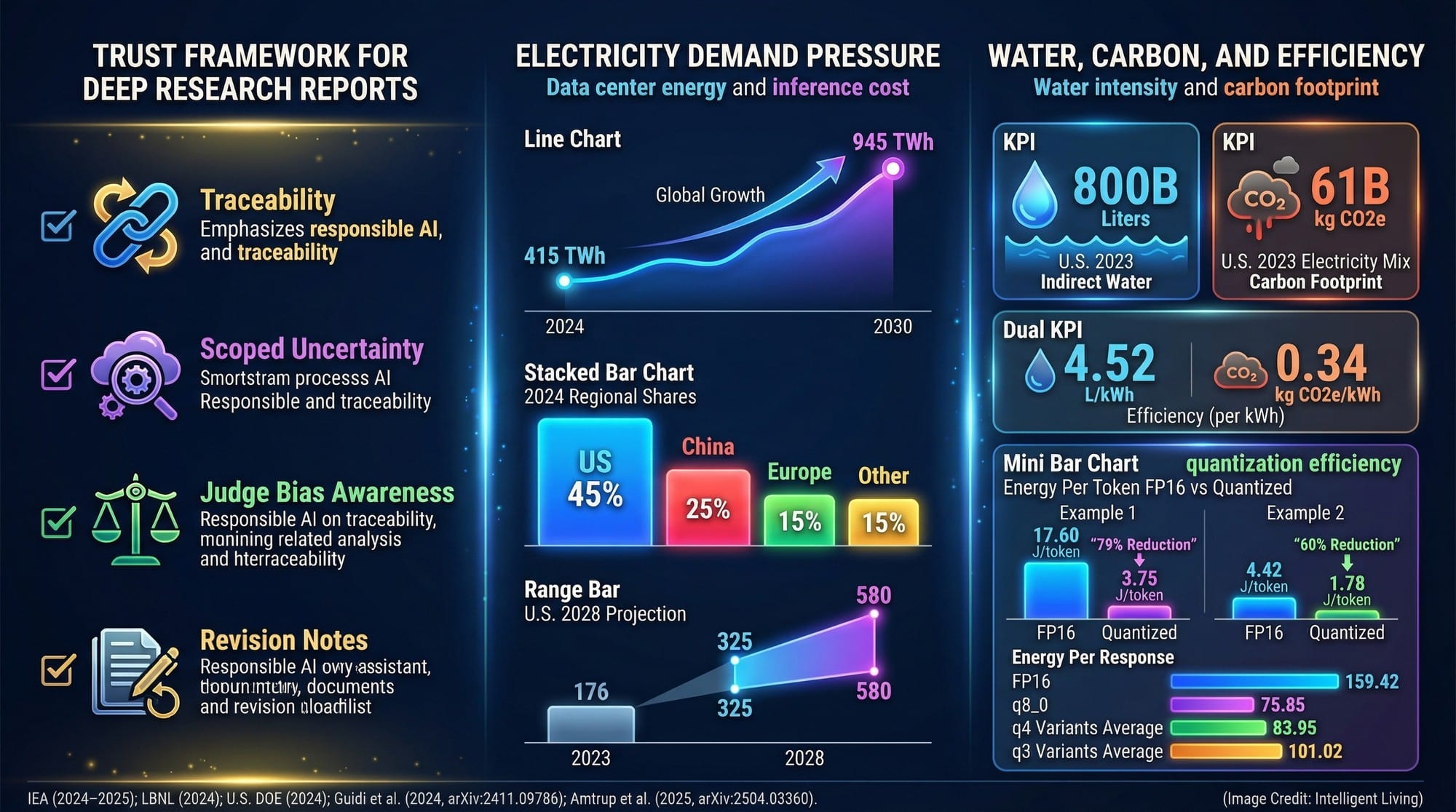
- Inline Evidence and Traceability: Material claims should be linked to specific sources so the provenance can be checked, and basic synthetic media verification protocols eliminate the risks associated with recycling manipulated digital artifacts.
- Scoped Uncertainty: When evidence is mixed, the report should state what is uncertain and what would change the conclusion.
- Judge Calibration Disclosure: If proxy judges determine quality, note how those judges were calibrated and where bias could enter, because research on LLM-as-a-judge evaluation highlights position and verbosity effects that can skew comparisons.
- Revision Notes: A short explanation of what changed after retrieval helps reviewers spot where the report’s direction shifted.
Implementing a comprehensive AI literacy and transparency framework ensures that a confident tone is never mistaken for factual evidence.
Governed Deployments and Expert Calibration Protocols
In governed deployments, teams increasingly push for repeatable rubrics that score report quality and trace claims back to evidence, and one example is a rubric-driven deep research benchmark that ties report quality to expert criteria and report-wide claim checks. Enterprise agent stacks also increasingly treat oversight as part of the workflow, which aligns with governed agentic workflows that bake policy and control layers into tool-using systems.
A relatable vignette shows why this matters. A parent reading a “health summary” for a child does not accept a polished paragraph as proof. The parent looks for which study, which guideline, and which date. Research agents should be judged by the same standard.
Operational Constraints: Analyzing Latency, Cost, and Resource Footprint
Shifting compute from single-pass generation to iterative retrieval creates three distinct practical implications:
- Latency: Multiple iterations increase wall-clock time for a single report. This can be acceptable for high-stakes research but impractical for rapid Q and A.
- Cost: More model calls and more retrieval steps can raise inference spend, which is why teams often model speed versus cost using inference cost curves in realistic production scenarios.
- Sustainability: Quality gains do not erase energy costs. Efficiency improves significantly through 8-bit quantization, which lowers energy consumption per inference by minimizing memory overhead, while data movement and interconnect efficiency increasingly determine total footprint. These tradeoffs become visible in discussions of sustainable data center energy limits as the efficiency stack matures.
A practical everyday analogy makes the tradeoff concrete. A person can spend five minutes making a grocery list and waste an hour backtracking through the store or spend ten minutes planning and finish faster. Iteration is not automatically wasteful, but it must be bounded and measured.
Linguistic Precision and the Future of Scalable Traceability
Terminology Alignment: Distinguishing Diffusion Analogy from Generative Modeling
Theoretical Foundation: Diffusion Principles in Probabilistic Modeling
In machine learning, diffusion models are trained to reverse a controlled noise process, gradually transforming noisy samples into structured outputs. A widely cited example is the DDPM diffusion denoising recipe, which formalized a practical training recipe for high-quality generation, building on probabilistic diffusion modeling research.
Methodological Application: Iterative Denoising in TTD-DR Workflows
TTD-DR uses diffusion as an analogy. The “noise” is an incomplete or weakly supported draft, and the “denoising steps” are retrieval-guided edits that make the report more complete, more coherent, and easier to audit. The method’s strength comes from evidence integration and revision, not from using a diffusion language model at inference.
Conceptual Clarity: Preventing Buzzword Drift in Technical Discourse
Readers can get confused because diffusion also exists as a literal text-generation approach. Work like diffusion-based language generation uses diffusion as a modeling strategy for language, which is a different technical family than draft-guided retrieval loops that edit a report with retrieved evidence. Conceptual clarity prevents “buzzword drift” from obscuring the underlying technical mechanics of the system.
The Evolution of Trust: Scalable Traceability in Deep Research Systems
The enduring value of Deep Research LLM Agents hinges on their capacity to withstand rigorous human scrutiny. We are moving beyond the era of ‘black box’ generation toward an iterative, evidence-driven craft where the research process is as transparent as the final result. By prioritizing report-wide consistency and retrieval-guided revision, TTD-style systems solve the ‘lost-in-the-middle’ problem and ensure that long-form intelligence remains both deep and dependable.
Modern practitioners and readers are transitioning toward a paradigm where every digital insight is secured by a verifiable chain of evidence.
Knowledge Exchange: Frequently Asked Questions on Deep Research LLMs
What differentiates Test-Time Diffusion from standard RAG?
While RAG pulls data once based on a prompt, TTD uses the draft’s internal gaps to seed multiple rounds of targeted, iterative retrieval.
How does draft-first scaling improve report accuracy?
It forces the agent to treat the report as a persistent state, using each iteration to identify and fill knowledge gaps rather than starting over.
Does TTD increase the total cost of research?
Yes, it typically requires more model calls and retrieval steps, shifting the ‘inference budget’ toward verification rather than just generation.
Can this method eliminate all AI hallucinations?
TTD systematically minimizes contradictions by maintaining a continuous cross-reference between the draft and live, retrieved data.
Why is TTD considered a ‘Trust Upgrade’ for enterprises?
It provides a visible trail of evidence and revision, making the final output far easier to audit and verify during editorial review.


