
Research actively explores how interactive digital environments influence cognitive development throughout a child’s formative years. Insights from a recent report highlight peer-reviewed findings currently reshaping discussions in child development circles. Evidence suggests that the specific nature of digital engagement determines whether a child experiences cognitive growth or potential distractions.
Findings from the Karolinska Institutet illustrate that children who engage in gaming more than their peers often demonstrate slightly higher gains in specific child intelligence factors over time. These observations prompt deeper investigations into how executive function skills, such as working memory and cognitive flexibility, adapt to the challenges found in complex game mechanics.
In-depth examination of abcd study results indicates that the connection between video games and child iq involves complex variables beyond simple hourly tracking. This analysis explores the study’s specific measurements, the reasons researchers debate causality in longitudinal analysis, and practical methods for families to protect child well-being while fostering healthy academic performance.
Quick Facts: Video Game Screen Time, Child IQ, and Cognitive Development At A Glance
- A large longitudinal analysis found a modest association between higher gaming time and slightly larger gains on a composite intelligence score over two years.
- The result is not a guarantee that gaming raises a child’s IQ, and it is not the same as retaking a traditional IQ test.
- Research suggests different screen activities behave differently, as brain development tracking analyzes gaming, social media, and TV separately.
- Meta-analyses disagree on how much cognitive training from games generalizes, although action video game research shows small average gains alongside significant variation between studies.
- For families, the most actionable move involves shaping quality and using pediatric digital wellness strategies as the baseline for household rules.
What the New Study Actually Found About Gaming and Kids’ IQ
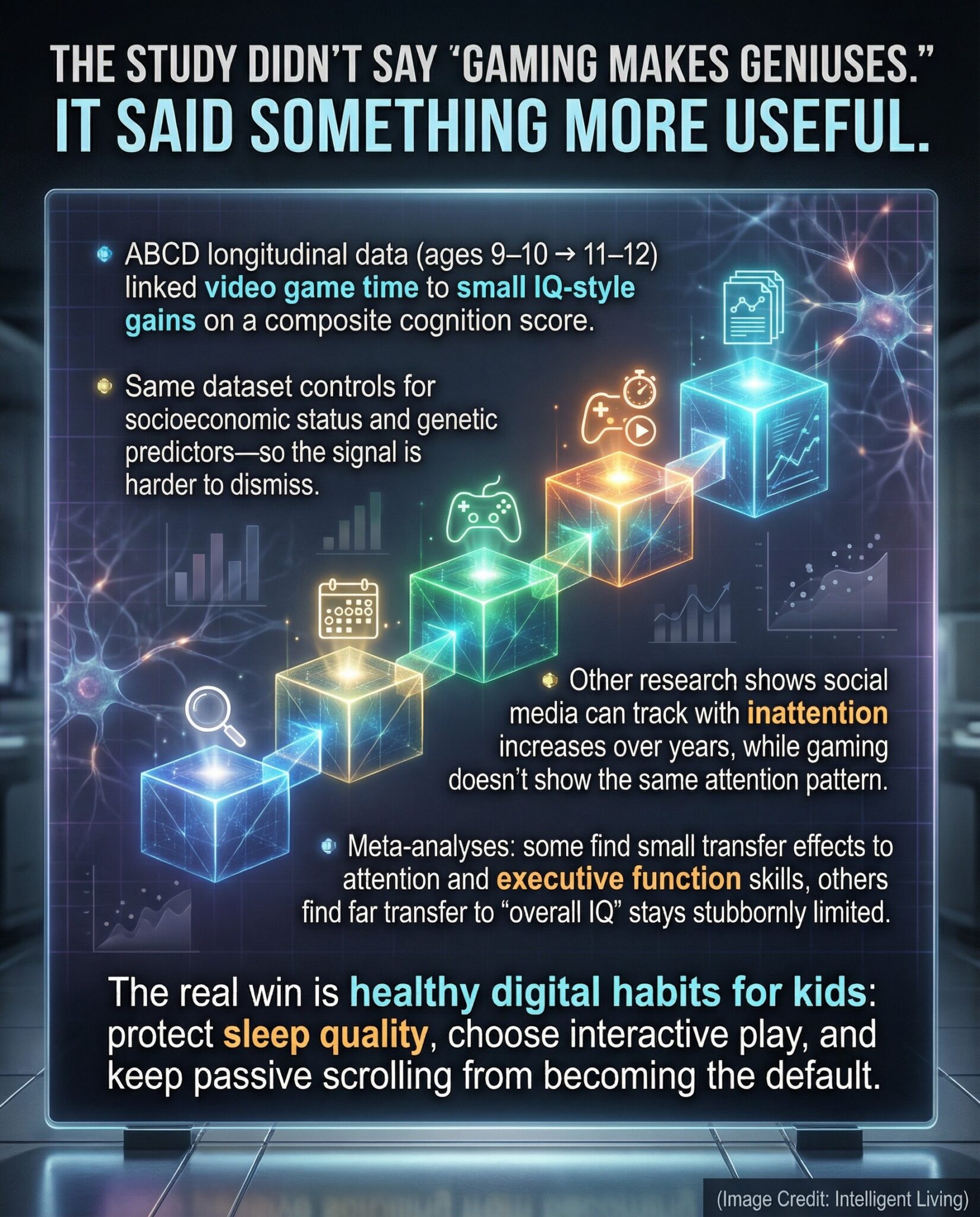
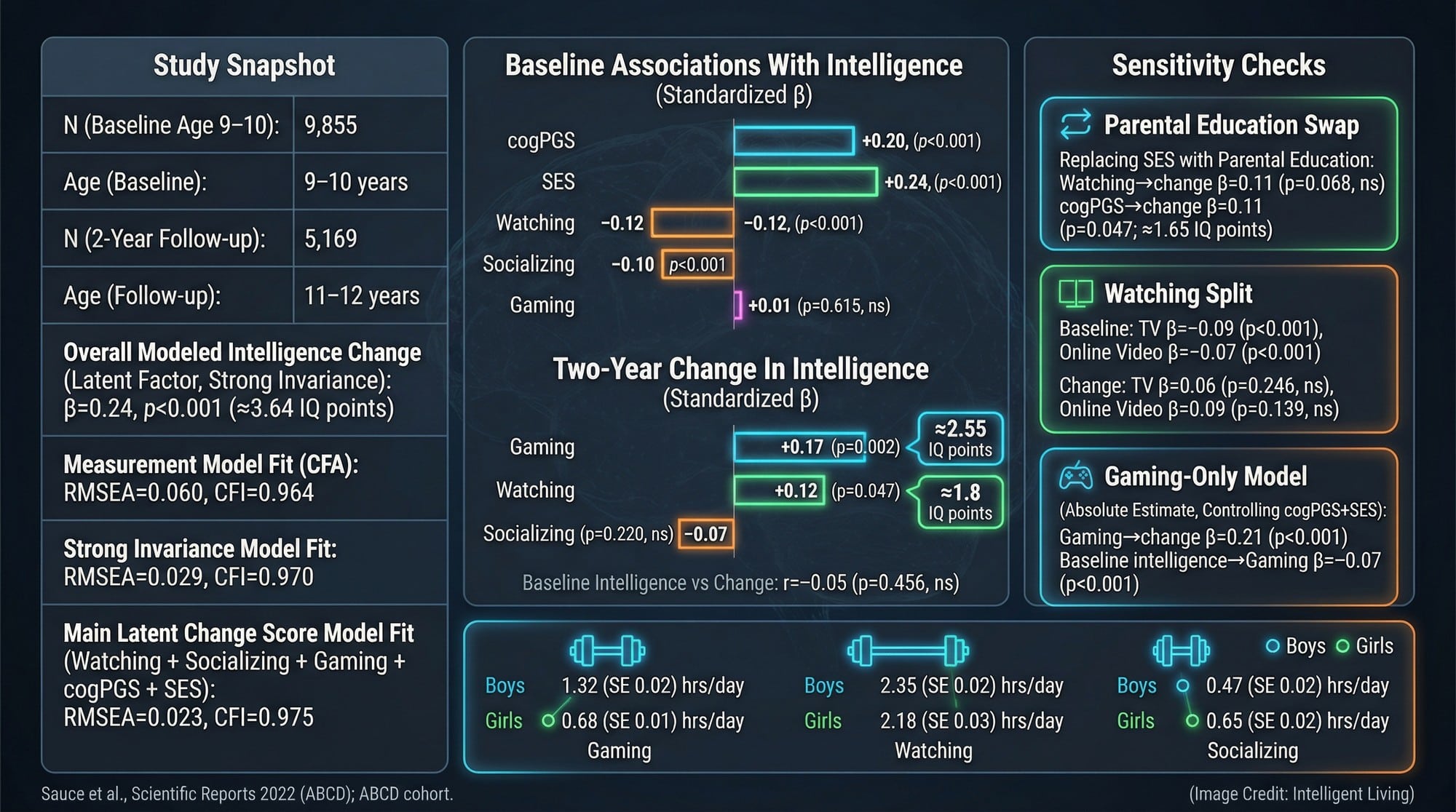
In plain terms, children reporting higher gaming frequency compared to their peers often demonstrate slightly larger improvements on a modeled intelligence factor over a two-year period. The core study behind the recent news cycle evaluated children’s screen habits alongside changes in cognitive performance over time.
These findings remain consistent even after researchers statistically adjust for socioeconomic variables and genetic predispositions linked to cognitive growth. One critical distinction involves the definition of iq within this framework. Rather than administering a classic iq test for later comparison, researchers measured changes through a specific set of cognitive tasks. Translating that modeled change into “IQ points” is a readability choice, not a clinical diagnosis.
Caregivers often observe a consistent behavioral shift when a child engages with strategy-based play. These shifts often manifest through several intersecting behavioral changes:
- Increased willingness to pause and evaluate options before making a move.
- Improved motivation to master complex, rule-based systems.
- Development of a better-structured daily routine through goal-oriented play.
Behavioral changes of this nature mirror improved intelligence but often reflect the combined impact of practice and sustained engagement.
ABCD Study Scope: Participant Demographics and Research Timeline
Researchers initially assessed participants between the ages of 9 and 10, with follow-up evaluations occurring two years later. The findings draw from the ABCD Study, a massive U.S. initiative tracking brain development and behavior over several years. Longitudinal designs provide deep insight by tracking internal changes within a specific group of children over several years. However, the validity of these findings depends heavily on the accuracy of family reports regarding media habits.
How Big was the Effect, Really?
While the reported difference remains modest, these population-level patterns interest researchers even if the results vary too widely to predict outcomes for an individual child. Child learning trajectories respond to sleep quality, academic environments, and the consistent practice of specific skills.
Defining Intelligence Factors: Composite Scores versus Traditional IQ
In this study, “IQ” refers to a composite intelligence factor built from multiple cognitive tasks. This metric acts as a broad snapshot of working memory and processing speed rather than a static clinical iq score.

Differentiating Screen Time Effects: Why Interactive Play Outperforms Passive Media
Distinguishing these categories is essential because neural responses vary significantly between different digital activities. Interactive and rule-bound video games contrast sharply with social media, which often involves interruption-heavy patterns, and passive watching has different attentional demands.
Specific routines, rather than simple minute-counting, help clarify how smartphones influence social development. When phones become the default background noise of the day, the constant checking rhythm can reshape attention and social development in ways that differ from focused play.
Evidence shows that digital media and attention symptoms can vary significantly across different activities. Social media use showed an association with increasing inattention, while video games and television did not show the same signal in that analysis.
A grounded, everyday example is familiar in many schools: some students can stay focused through a timed puzzle challenge but struggle to complete a worksheet when their phone notifications keep pulling their attention away. The activity type, not just the minutes, shapes how attention is trained or fragmented.
Comparative Cognitive Demands: Gaming, Social Media, and Passive Viewing
Strategy-based gaming requires sustained attention, rule memorization, and rapid feedback-driven adjustments. Social media triggers rapid checking behaviors and emotional responses. By contrast, passive video consumption often involves multitasking that disrupts deep focus. These activities represent distinct cognitive environments, making it logical that research yields varied results.
Prioritizing Content Quality: Why Activity Type Influences Screen Time Effects
Aggregate screen time metrics frequently obscure the nuances of digital engagement. An hour of cooperative gaming on a weekend afternoon is not the same as an hour of late-night scrolling that cuts into sleep. Establishing effective digital boundaries within the home helps families manage mealtimes and study time more effectively.

Scientific Evidence Ladder: Assessing Longitudinal Analysis and Cognitive Research
Evaluating research quality requires an understanding of how different study designs operate. The evidence ladder typically includes the following:
- Observational research: Reveals patterns across large populations while adjusting for major confounders, though it cannot prove causation.
- Randomized trials: Evaluate cause and effect via controlled interventions while typically facing limitations from small sample sizes and brief durations.
- Longitudinal designs: Tracks changes within the same subjects over time to observe developmental trajectories.
Each method offers distinct insights into how digital habits shape long-term cognitive growth. Complex research variables naturally lead to disagreement within scientific literature. A widely cited meta-analysis of video game training suggests that video game training does not reliably enhance broad cognitive ability. These results indicate that ‘far transfer’—the application of gaming skills to unrelated academic areas—remains difficult to achieve.
At the same time, a 2023 PLOS ONE meta-analysis reports small-to-moderate gains in certain cognitive outcomes across game-based training studies, while also emphasizing that effects vary by study quality and game design. Classroom pilots often demonstrate that while students master specific practiced tasks, broader academic gains remain limited. Skill-specific gains can be real, yet broad intelligence changes are a higher bar.
Correlation, Controls, and What Still Cannot Be Proven
The ABCD intelligence study improves on earlier work by accounting for factors like socioeconomic background and genetic predispositions linked to cognition. Observational research occasionally overlooks environmental variables like parenting styles and school support systems. Such external influences significantly shape both gaming habits and long-term cognitive outcomes. Large cohort studies depend on specific statistical choices, which determine what a result means in practice.
The Generalization Debate: Assessing the Scope of Brain Training Benefits
Debates persist over defining meaningful improvement, especially as some findings regarding executive function fail to generalize across broader settings. Researchers argue about what counts as meaningful improvement. Some studies show gains on executive function tasks, while others find those gains fade or do not generalize. Publication bias can also inflate the apparent benefit when only positive results reach the spotlight. That is why evidence summaries weigh both effect size and evidence quality.
Tracking Reliability: Addressing Self-Report Bias in Media Research
Research frequently utilizes self-reported screen time, a method prone to inaccuracies regarding game context and variety. The ABCD questionnaire protocols detail the development and harmonization of tracking tools. High measurement quality is essential for researchers to make responsible claims about digital effects.
Gaming as Cognitive Exercise: Strengthening Executive Function Skills
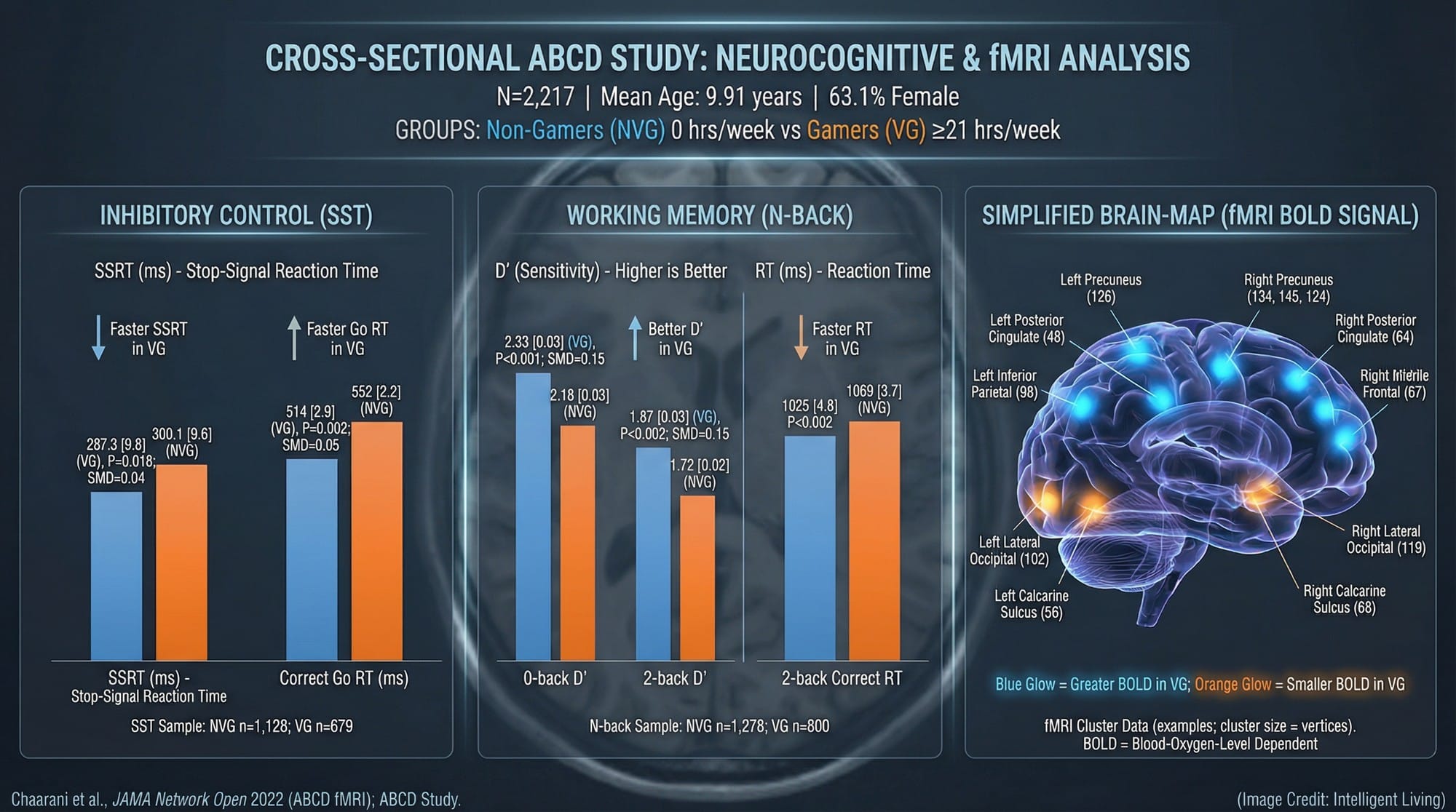
Research linking gaming to cognitive gains suggests that many titles repeatedly exercise executive functions. These mental challenges require constant engagement from neural pathways responsible for logic and problem-solving. These functions include working memory—holding and updating information—along with cognitive flexibility and response inhibition. Those are “mental control” skills that overlap with the kinds of tasks used in many developmental research batteries.
Significant reports on cognitive performance and gaming indicate that children who spent more time gaming performed slightly better on tasks involving working memory and impulse control. Other analyses, including a cross-sectional review of nine- and ten-year-olds, reported small cognitive differences, though subsequent record revisions highlight the need for careful interpretation. That combination points to why trade-offs matter and why “more is always better” is not a safe conclusion.
A short, realistic vignette often fits: a child who practices a puzzle platformer becomes more patient with multi-step math problems, yet the same child may also become irritable if gaming runs too close to bedtime. The habit is not just gaming; it is timing and structure.
Primary Cognitive Benefits: Impact on Attention and Working Memory
The most consistent evidence highlights improvements in executive functions, specifically attention control and working memory. Executive functions remain vital for planning and self-regulation, even when viewed as narrower targets than general intelligence. One longitudinal analysis reports that media effects on executive function can differ by activity and baseline ability, which is why broad conclusions from a single screen-time number often miss the real story.
Optimizing Cognitive Gains: How Strategic Game Mechanics Shape Learning
Mechanical depth outweighs marketing labels, as games featuring adaptive difficulty and strategic planning consistently encourage iterative problem-solving. Families seeking interactive learning alternatives often choose game-based options designed to blend logic and motor skills without relying on endless checking loops.
Clinical Insights: The Role of Structured Video Game Interventions
Controlled trials isolate how distinct game mechanics influence cognitive skills through supervised sessions and measured training doses. Analysis of game-based clinical protocols shows why outcomes vary by population and implementation. Translating those controlled conditions into everyday home play is trickier because home gaming varies by genre, social context, and whether gaming displaces sleep, reading, or physical activity.
Managing Screen Time Effects: A Guide to Healthy Digital Habits for Kids
Interpreting current evidence requires a balanced assessment of potential benefits versus developmental trade-offs. A gaming habit that supports problem-solving can still create net harm if it consistently cuts into sleep, movement, or language-rich time with adults and peers. Core physiological needs support brain development more effectively than any specific digital application.
Following established screen time protocols helps families safeguard sleep and prioritize offline relationships. Families can reference standard screen time protocols to protect sleep and prioritize offline relationships. The broader digital ecosystem framework treats design and commercial defaults as part of the challenge. Households frequently observe that reducing total screen time significantly enhances mental well-being.
Cognitive Displacement: Identifying Essential Activities Replaced by Screens
A simple way to assess a child’s screen routine is to check what gets pushed out.
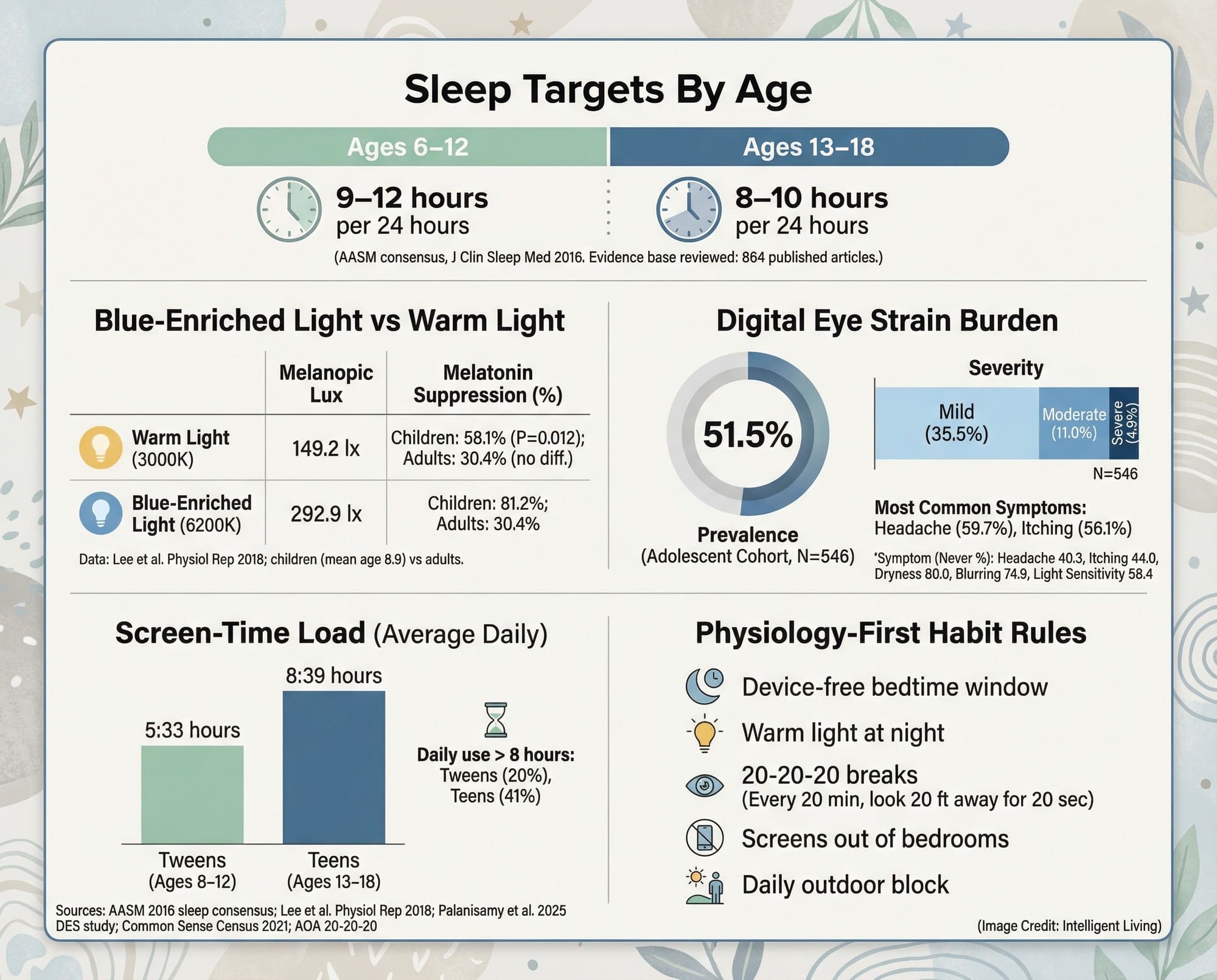
- Sleep: Late evening gaming can delay sleep through arousal and light exposure, so the most protective move is consistent wind-down timing and device-free bedrooms. Managing light exposure and melatonin timing supports biological clocks, which families often integrate into preventive care routines for school-age children.
- Vision and Eye Strain: Long stretches of close-up screen focus can contribute to dryness, headaches, and blurred vision in some kids. Families can mitigate digital eye strain by monitoring behavior during homework-heavy weeks.
- Reading and Language: Language growth often stalls when digital engagement displaces high-quality verbal interactions between children and caregivers. Such patterns hold particular relevance for households where dedicated reading time has been replaced by passive digital consumption.
- Movement and Outdoors: Physical activity supports mood and attention, and it also provides a natural counterbalance to sedentary play. Families often find momentum by protecting scheduled outdoor activities on the calendar.
Evidence-Based Implementation: Establishing Healthy Digital Habits for Kids
Consistent boundaries protect developmental milestones while reducing the need for daily household negotiations.
- Sleep-First Scheduling: Keep gaming earlier in the day when possible and make bedtime a consistent, low-stimulation routine. Research suggests midday rest improves cognitive performance for kids who still benefit from it.
- Quality Over Quota: Prefer games with planning, challenge, and clear feedback loops, and treat co-play as a way to turn entertainment into conversation.
- Swap, Don’t Only Subtract: If a habit is being reduced, replace it with something appealing that still fits the child’s identity, such as sports, music, or clubs. Achieving a positive mood through boundary setting helps reduce household conflict.
- Focus Windows: Silencing nonessential alerts and building predictable homework blocks helps attention recover from digital fragmentation. Utilizing concentration techniques to improve clarity pairs well with digital discipline strategies that make checking intentional rather than automatic.
- Safety and Autonomy: Older kids benefit from rules that are negotiated and explained, not only enforced. Implementing mental health-conscious screen rules helps when social platforms start to dominate daily attention.
Balancing gaming as a weekend activity with focused weekday study blocks minimizes conflict without requiring a complete digital ban.

Balanced Perspectives on Video Games and Child Intelligence Factors
Current data suggests that although video games do not guarantee cognitive improvement, the abcd study results indicate a modest association with enhanced child intelligence factors. Longitudinal analysis confirms that interactive play engages neural pathways differently than passive consumption. Success depends on maintaining a balance where digital challenges complement, rather than replace, essential offline activities.
Effective digital habits for kids prioritize restorative sleep and physical movement over excessive screen engagement. Research into screen time effects continues to show that the context of play matters as much as the duration. Protecting foundational health allows children to benefit from the cognitive stimulation of gaming without sacrificing the well-being necessary for long-term academic performance.
Frequently Asked Questions: Brain Development Research and Gaming
Can Gaming Improve Executive Function Skills?
Evidence suggests certain games challenge working memory and planning, potentially strengthening specific mental control skills during childhood.
What Do ABCD Study Results Say About IQ?
The study found that children who gamed more showed slightly larger gains on intelligence-related tasks over a two-year period.
How Do Video Games Affect Academic Performance?
Impact varies based on whether gaming displaces homework and sleep; structured, moderate play typically shows no negative effect on grades.
Is There a Link Between Gaming and Brain Development Research?
Ongoing research analyzes how the interactive nature of games might stimulate neural pathways associated with problem-solving and spatial reasoning.
What Are Healthy Digital Habits for Kids?
Effective habits include keeping consoles in shared spaces, enforcing device-free bedtimes, and choosing games that require strategy over mindless repetition.


