
Reframe your financial baseline as a safety system rather than a willpower test. The following guide provides a blueprint to stabilize week-to-week cash flow, firewall recurring obligations from daily spending, and protect essentials through a conservative survival budget built for income volatility.
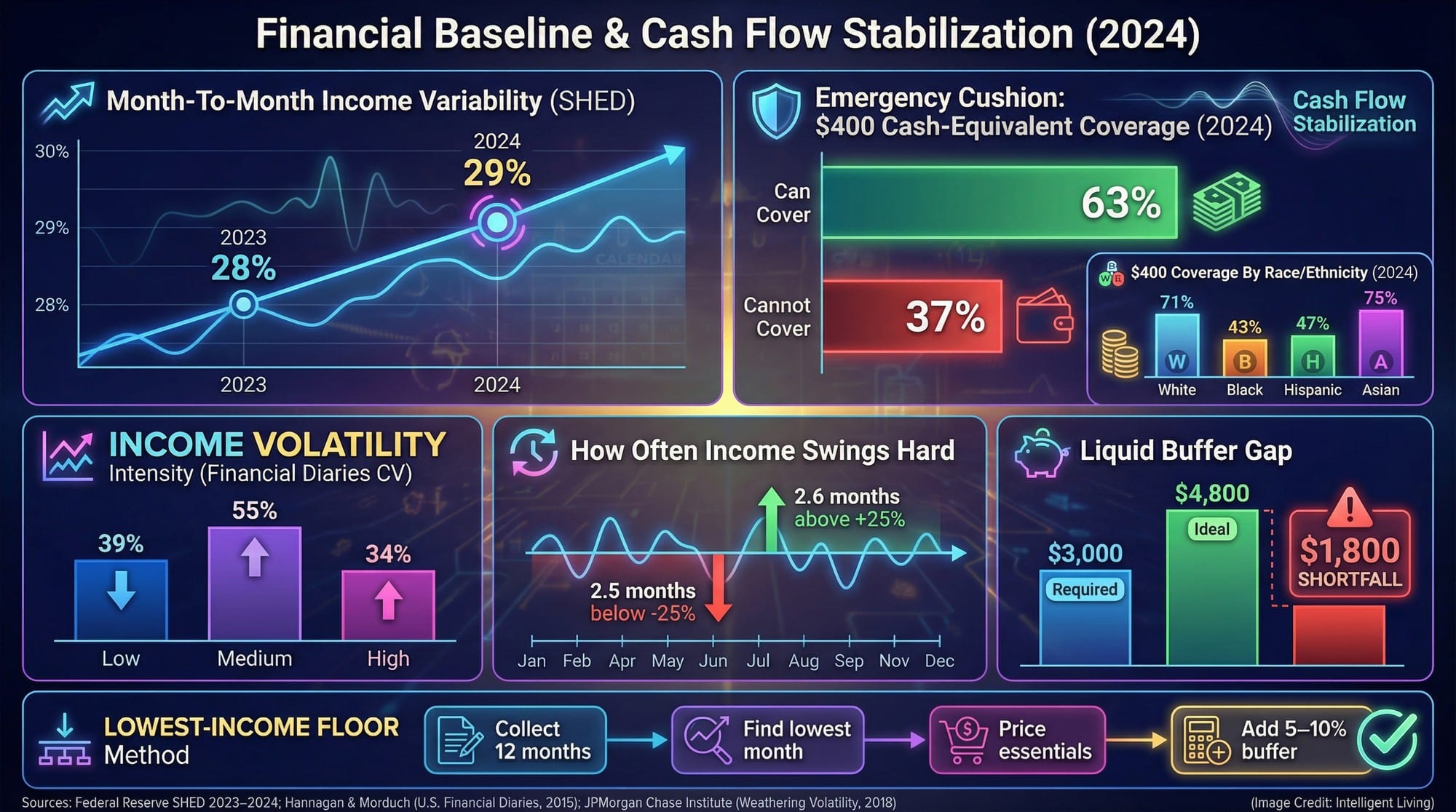
Actual paychecks rarely behave like a fixed salary. Research confirms that monthly income swings are common, particularly when shifts or hours fluctuate. Effective irregular income planning starts here, creating a fee-proof system that functions even during your leanest months.
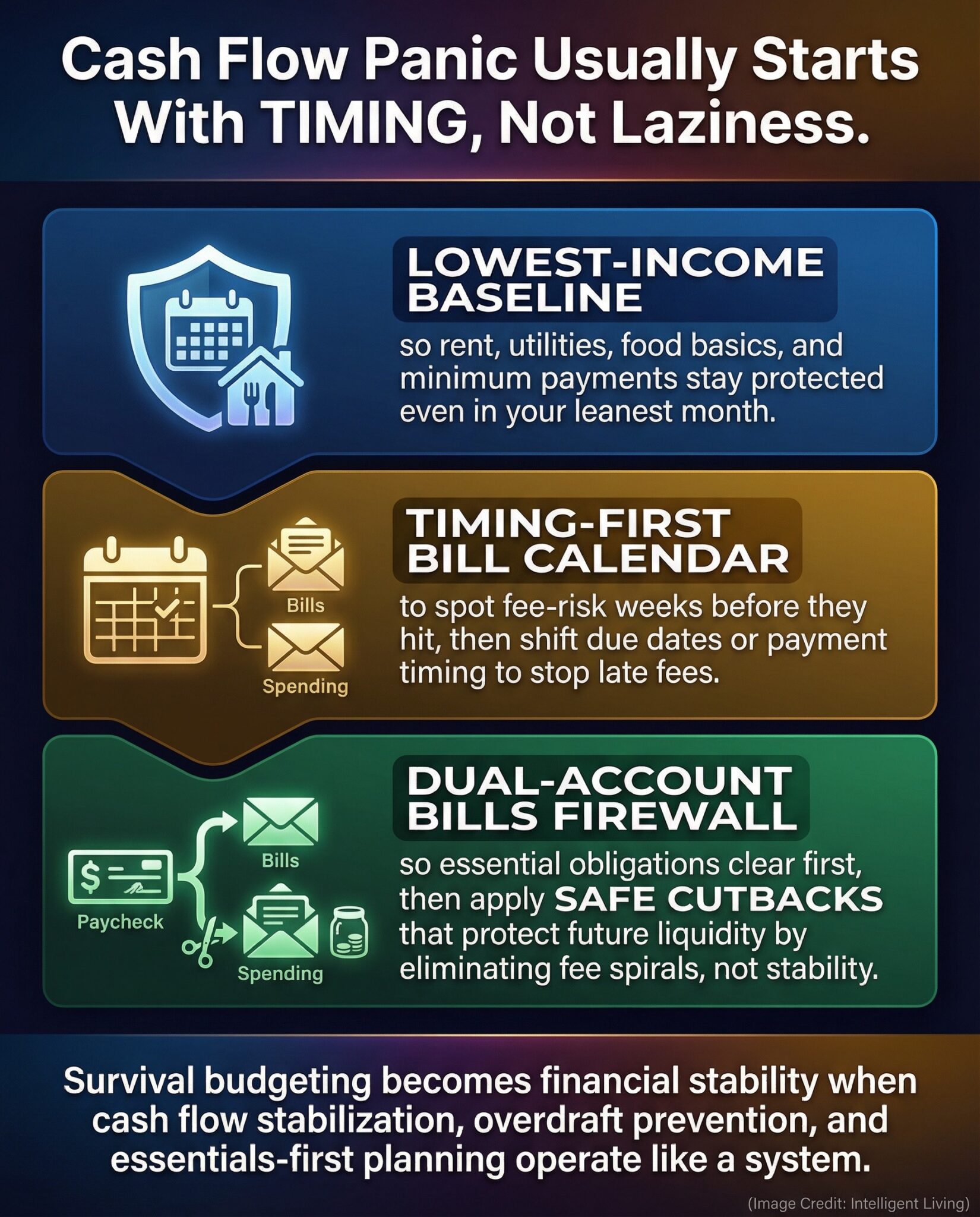
Essential Liquidity Management: Key Facts for Financial Resilience
- A cash-flow budget tracks timing as well as totals, so tight weeks show up early instead of surprising you.
- CFPB research suggests that changing bill due dates to match income flow can reduce the monthly juggling that triggers late fees.
- For irregular income, a conservative baseline uses the lowest recent month rather than an average.
- A spending tracker for a full month can reveal small recurring costs that quietly weaken your baseline.
- Separating bills from daily spending reduces accidental overspending on fixed obligations.
- Housing and utilities are essentials, and the budget works best when they are protected first.
- Overdraft and late fees can magnify stress, so safe cutbacks focus on avoiding fee spirals.
Step 1: Identifying Your Financial Baseline and Lowest Income Floor
Auditing Income Volatility: Locating Your Lowest Planning Month
Collect gross income for each month across the last year. Finding the realistic floor matters more than highlighting a peak month. Identify the lowest monthly income over the past six months to serve as your primary planning figure.
Construct your baseline from consistent monthly income to ensure essentials are clear in lean periods while creating breathing room for better months.
Mini Worksheet
- Total income for each month (Month 1, Month 2, etc.)
- Lowest monthly total = Baseline Income Floor
Anecdote: A seasonal caterer found stability after identifying a slow winter month and using that number as the planning floor so rent never competed with groceries.
Essentials Triage: Protecting Survival Needs Over Flexible Spending
Drafting an essentials list ensures your most critical needs remain funded even when cash is short. Focus on the high-consequence items that anchor your stability:
- Housing and essential utilities
- Basic grocery needs
- Necessary work-related transportation
- Life-safety prescriptions
- Minimum insurance and childcare
Review these monthly to verify your survival budget remains lean and effective.
Separate predictable seasonal bills to avoid treating routine costs like emergencies.
Prioritizing baseline protection creates a tangible difference between a calm month and one spent juggling due dates. Protect the baseline first, then treat flexible spending as a reward earned for maintaining your survival budget.
Survival Budget Formula: Calculating Your Monthly Floor
Calculate your floor using this simple equation:
Baseline Survival Budget = Sum(Essential Monthly Costs) + Small Buffer (5 to 10 percent)
Absorb timing gaps and unexpected fluctuations with a small buffer. Strategic buffering simplifies managing irregular paychecks by removing the pressure of monthly guesswork.
Example: If essentials total $1,600 and the buffer is 8 percent, the baseline is $1,728.
Step 2: Securing Cash Flow Stability Through Timing-First Calendars
The Utility of Cash-Flow Mapping: Visualizing Paycheck Timing
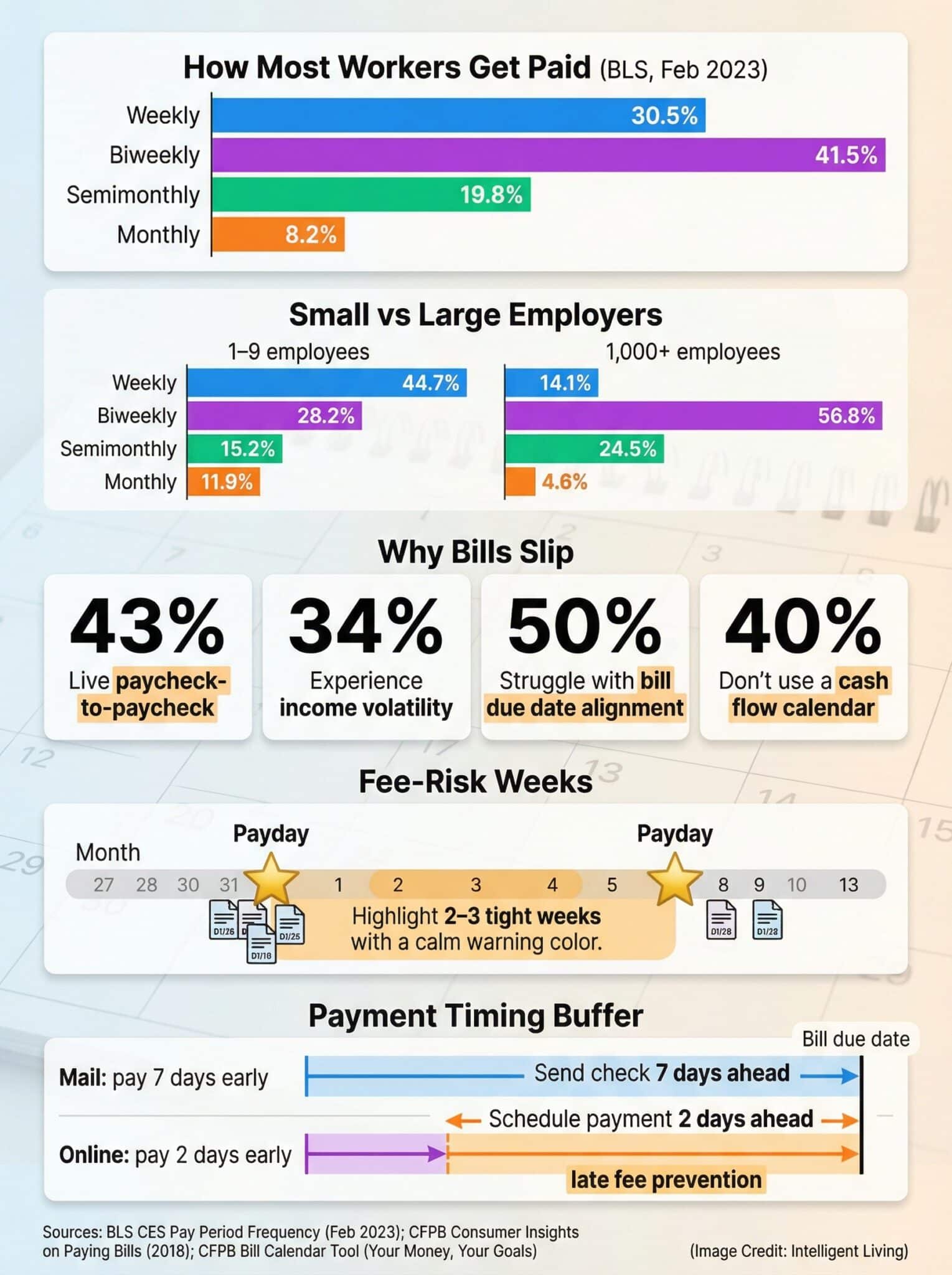
Use a cash flow budget to track income and expenses, ensuring you have enough from week to week.
Funds from direct deposits rarely clear the moment they are issued. ACH payments often settle on a bank’s processing schedule; therefore, build your calendar around actual clearance dates rather than expectations.
Constructing a Bill Calendar: Identifying Fee-Risk Weeks
Create a simple calendar that lists income deposits on the day they arrive and expenses on the day they are paid. A cash-flow calendar layout makes tight weeks obvious, which is exactly what you want.
Anecdote: A contract designer stopped surprise overdrafts after realizing a subscription cluster hit three days before the biggest client invoice usually cleared.
Cash Flow Smoothing: Shifting Due Dates and Splitting Payments
Smoothing reduces the impact of crunch weeks and avoids large periodic spikes. Try these adjustments to balance your cash flow:
- Shifting bill due dates to follow paydays
- Splitting quarterly payments into monthly installments
- Timing transfers to your Bills Account immediately after deposits
These moves prevent large payments from draining your daily spending account unexpectedly.
Automate transfers and alerts to maintain your baseline:
- Trigger low-balance warnings before payments clear
- Schedule automatic moves immediately after deposits
- Set due date reminders to prevent oversight
These proactive steps ensure your financial system holds even during expensive weeks.
Step 3: Eliminating Overdrafts With a Dual-Account Bills Firewall
Funds Allocation: Separating Bills From Daily Spending
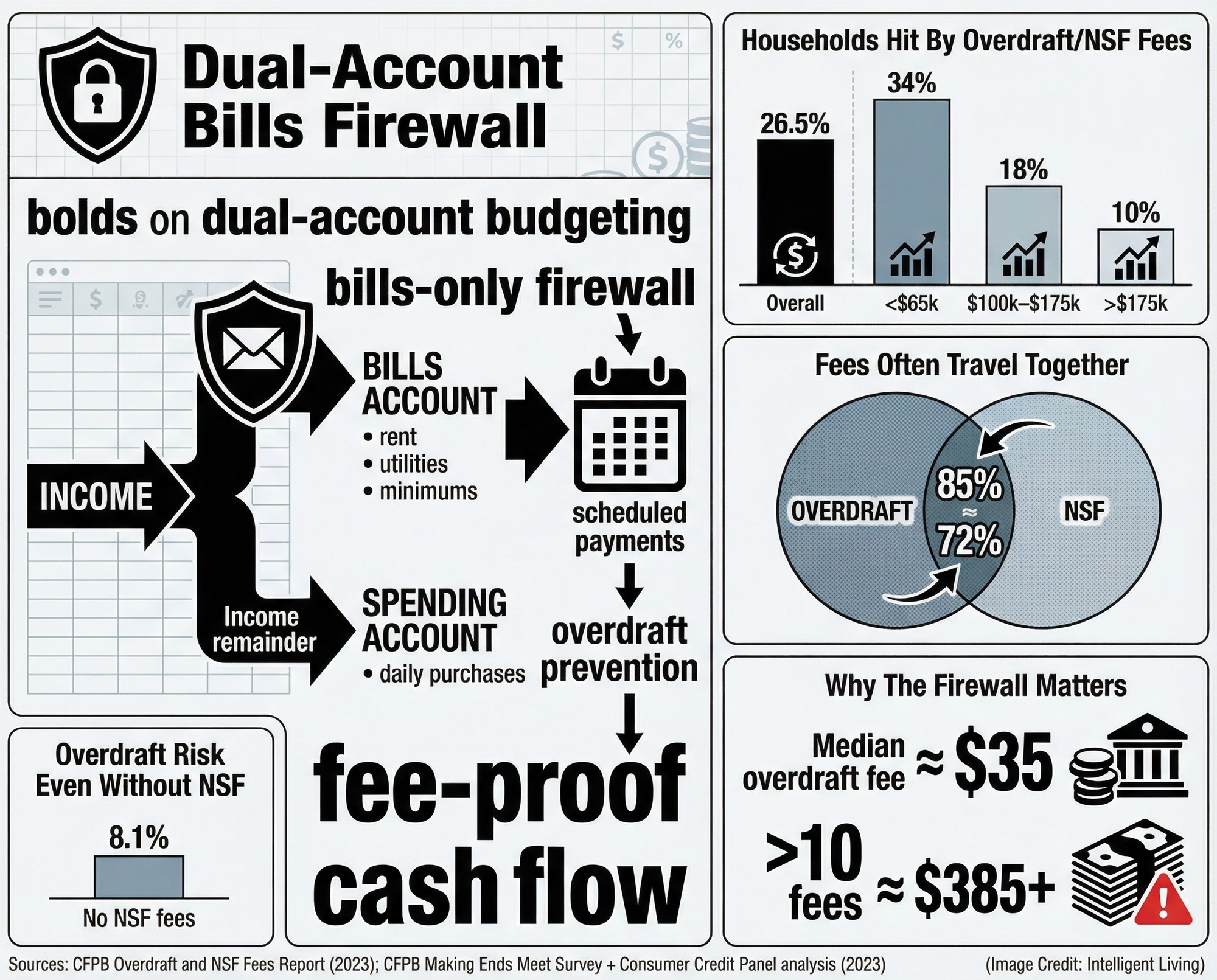
Anchor your stability with a two-account strategy to separate fixed expenses.
Use a Bills Account for fixed obligations and a Spending Account for daily purchases to ensure rent, utilities, and minimum debt payments never compete with daily needs.
Systemic Transfers: Protecting Your Survival Budget Baseline
After every pay event, move the portion of income that covers baseline obligations into the Bills Account. Separate funds necessary to pay incoming bills before day-to-day spending starts to protect rent and utilities.
Transfer first, then spend with the remainder. Strict adherence to baseline obligations keeps the financial system stable even during expensive weeks.
Anecdote: A rideshare driver secured their season by transferring a set amount into the Bills Account after each shift, ensuring rent remained funded before leisure spending began.
Safety Buffers: Proactive Overdraft Prevention Strategies
Keep a small buffer in the Bills Account equal to one week of essentials where possible. If you pay by check or debit, insufficient funds can trigger fees from both the bank and the biller, so the buffer should be sized around the tightest week. Building a tiny buffer is often less expensive than recurring fees.

Step 4: Consequence-First Allocation for Housing and Utilities
Housing Burden Analysis: Evaluating Affordability Thresholds
Housing researchers commonly use cost-burden thresholds based on monthly housing costs, including utilities, with 30 percent as a burden warning line and 50 percent as a severe burden indicator.
Calculate the residual income remaining for other essentials after covering housing costs. Fixed percentages often overlook the importance of measuring residual income, particularly for households with high medical or transport burdens.
The Essentials Hierarchy: Prioritizing High-Consequence Payments
When cash is tight, triage your needs based on the immediate consequence of non-payment. A consequence-first hierarchy prevents exhausting funds on low-priority bills while leaving high-consequence essentials vulnerable. Protect these categories in descending order:
- Housing and essential utilities
- Essential medication
- Basic food needs
- Work-related transportation
- Minimum insurance or childcare
Utility Crisis Support: Accessing Immediate Financial Aid
If disconnection is possible, federally funded programs like LIHEAP can assist with energy bills and crisis support. Use the directory for federal energy assistance to find state-level resources, or contact local navigators through 211 for current information on local openings.
Pursue home energy upgrades that lower utility costs to decrease recurring obligations and defend your financial baseline.
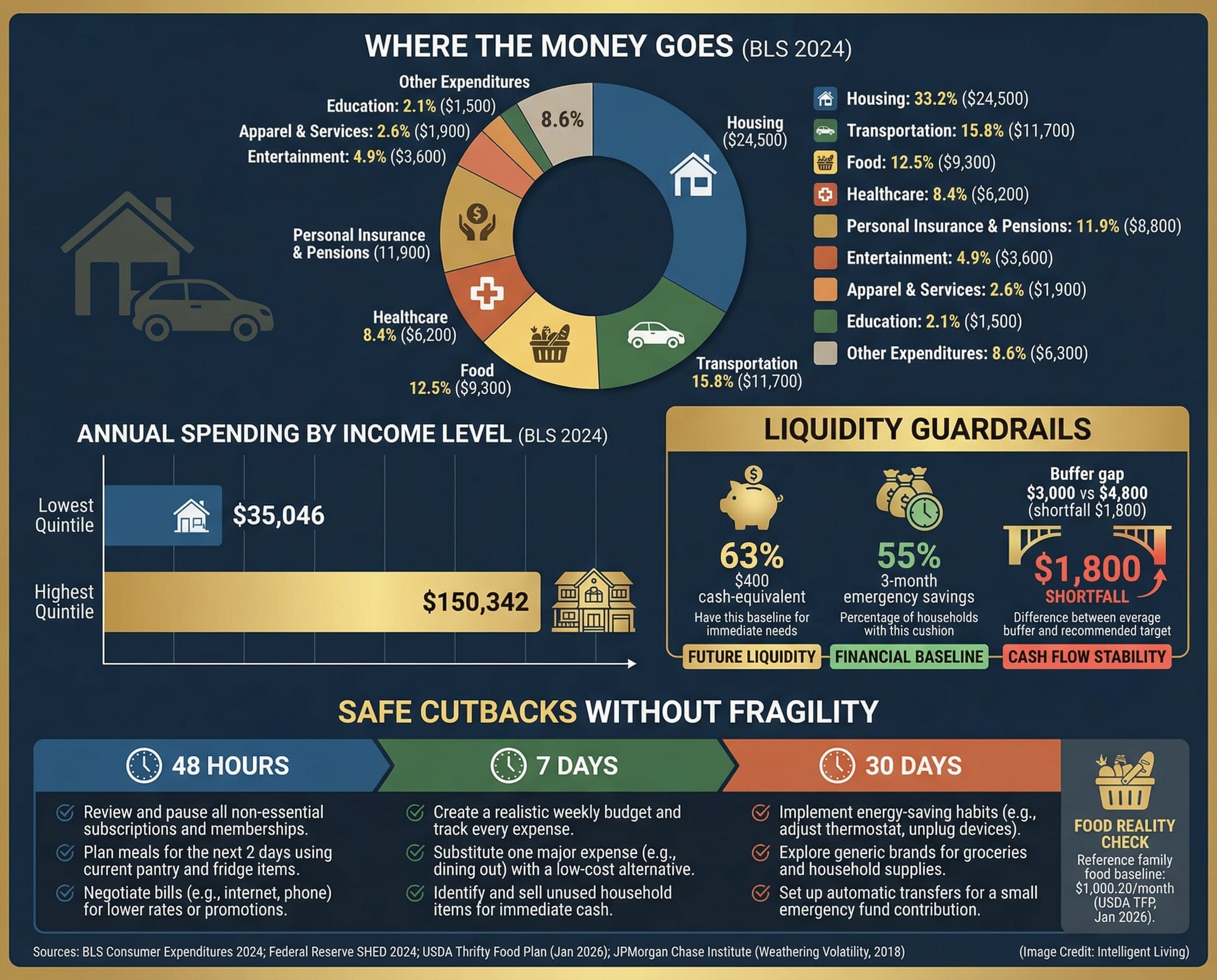
Step 5: Implementing Safe Cutbacks to Preserve Future Liquidity
Reduction Timelines: Rapid Response and Reversible Cuts
Execute reductions based on speed and impact to buy immediate breathing room:
- 48 Hours: Immediately pause nonessential subscriptions and delay discretionary purchases within the first 48 hours.
- 7 Days: Renegotiate recurring bills and reduce flexible spending categories.
- 30 Days: Evaluate recurring services for cancellation, ensuring removal won’t increase other costs.
Utilize specialized tools to reduce expenses, focusing on repeatable outcomes that protect long-term stability without creating new risks.
Mitigating Fee Spirals: Purging Overdrafts and Penalties
Fee spirals trigger a chain reaction that turns tight months into financial emergencies. Recent findings on the impact of overdraft and nonsufficient fund fees highlight how these penalties concentrate among households under pressure.
Overdraft fees often land around $35, and multiple charges can stack before you notice.
Anecdote: A retail worker avoided a chain reaction one month by setting a two-payment plan with the utility, then cutting one subscription instead of letting overdrafts stack.
Consequence-Based Planning: Negotiating Bills When Cash Is Limited
Develop a short-term plan to prioritize bills based on the immediate consequence of non-payment. Maintain practical, non-punishing cutbacks. These small saving moves provide the breathing room needed while your system stabilizes.
Avoid high-cost short-term credit, which often triggers a payday lending cycle that drains future paychecks. If a funding gap occurs, safer emergency cash options—including due-date resets and hardship plans—limit the long-term damage.

Securing Your Financial Baseline for Long-Term Stability
Stabilizing your cash flow begins with a single protective rule that functions when you are exhausted. Whether you initiate a scheduled Bills Account transfer or set a low-balance alert to prevent fees, these small moves buy the breathing room necessary for recovery. This methodology transforms a survival budget into a permanent firewall, ensuring that housing and utilities remain protected regardless of paycheck timing.
Navigating financial hardship requires reducing decision fatigue, especially when every payment feels urgent. By defending your income floor and avoiding high-cost debt cycles, you preserve future liquidity and reduce financial fragility. Commit to the baseline today to ensure your essentials stay paid and your fee-proof system stays intact.
Survival Budget and Cash Flow FAQ
How do I identify my baseline income floor?
Review your last twelve months of deposits. The smallest monthly total serves as your conservative financial baseline for all irregular income planning.
Why is a cash-flow budget better than a standard one?
Standard budgets only track monthly totals. A cash-flow budget maps the specific timing of paychecks against due dates to reveal hidden timing gaps.
Can I change my bill due dates to avoid fees?
Yes. Requesting a due-date reset that follows your payroll is a primary way to prevent bank overdraft fees and late penalties.
Which bills are high-consequence essentials?
Prioritize housing, utilities, essential prescriptions, and work-related transport. These categories carry immediate legal or life-safety consequences if unpaid.
How do I stop recurring overdraft fee spirals?
Separate your funds using a dual-account system. Transfer your baseline obligations into a dedicated Bills Account immediately after your pay clears.


