
Britain’s appetite for starting businesses shows no sign of fading. Whatever measure you use, the latest UK company numbers point the same way: more people are choosing to set up limited companies, and they are doing it despite higher costs. For anyone weighing UK limited company formation, the numbers are worth understanding.
The scale of the register
At the end of June 2026 there were 5,516,377 companies on the register, and the register grew by 0.7% between April and June, a net change of 37,339 companies. Those figures come from Companies House quarterly statistics. That is a net gain of tens of thousands of companies in a single quarter, after dissolutions are counted.
Over the full financial year, there were 815,277 company incorporations in FYE 2026, up 1.67% on the previous year. That works out to well over two thousand new companies on every working day.
The register is not the same as the number of businesses trading. It includes dormant companies and those heading for dissolution. Government business population estimates put the number of actively trading companies at around 2.1 million. Founders should keep that gap in mind: forming a company is easy, but building one that trades is a different job.
Formations are climbing despite higher fees
The most interesting finding is what happened to costs. Research based on Companies House data found that 461,765 companies were incorporated between January and July 2026, 6.9% more than the same period in 2025, even though the digital incorporation fee doubled from £50 to £100 on 1 February 2026 and the confirmation statement fee rose from £34 to £50.
A higher government fee has not deterred new founders. People who have decided to start a company are treating the fee as a small part of the overall cost of launching. It does mean that “cheap company formation” is now about the total cost, not just the registration fee. Optional extras can add up quickly, so it pays to know what you actually need.
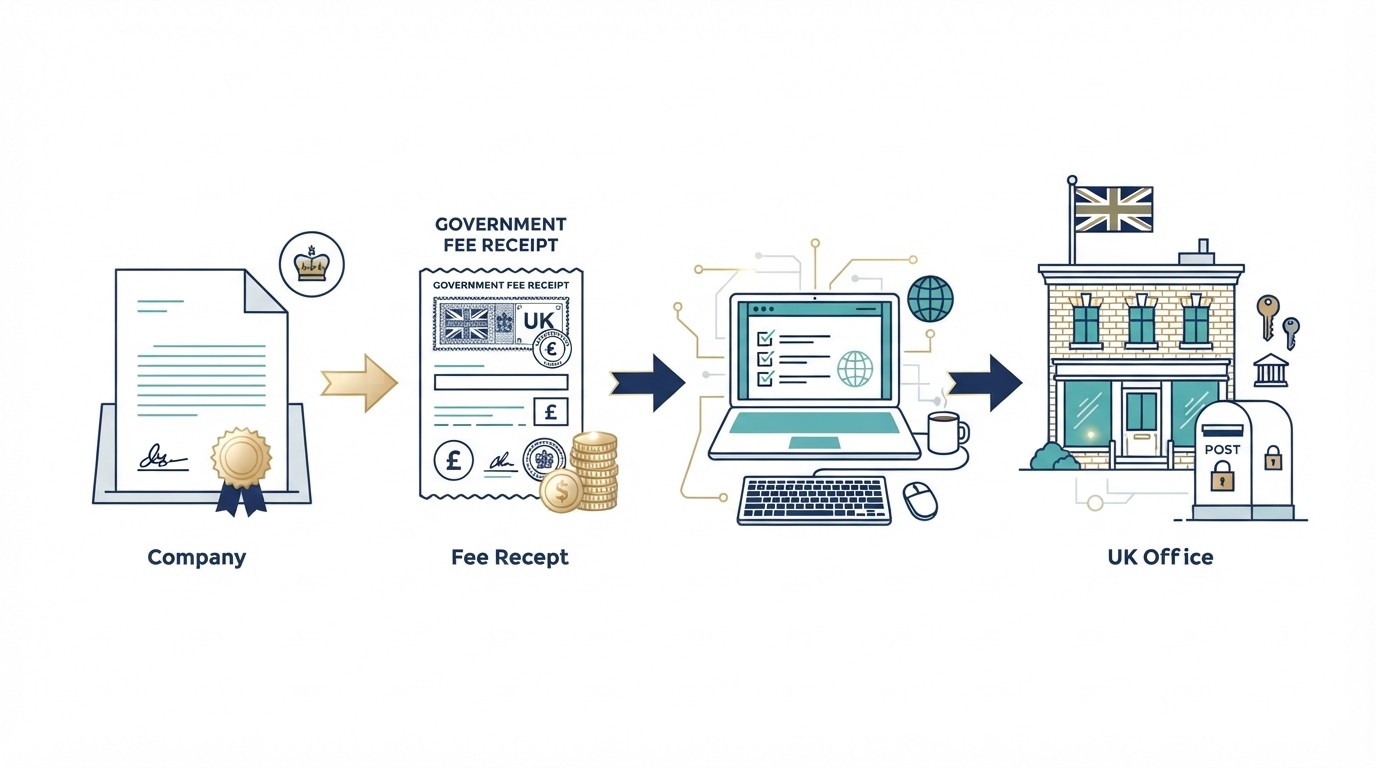
What this means if you plan to register a new company
Compare the full cost, not the headline price. When you register a new company, the statutory fee is the same for everyone. Formation agents differ in what they bundle in: confirmation statements, registered office services, mail handling and support. A low advertised price can hide recurring charges later, so look at the first-year total.
Plan your address early. Every UK company must have a registered office address in the UK, and it appears on the public register. Many founders work from home and don’t want a personal address published. A UK virtual address solves this. It gives you a professional business address for official correspondence and Companies House filings, and it keeps your home address private. It can also lend credibility if you trade with customers or suppliers who check the register.
Expect more scrutiny. Companies House has been expanding its checks, with its recent annual report highlighting identity verification, monitoring filings and removing non-compliant entities from the register. Accurate details, a genuine address and timely filings matter more than they used to.
Remember the competition. With so many new companies arriving each year, a limited company alone doesn’t set you apart. Customers notice a clear offer, a professional presence and reliable service.
Choosing a provider
If you want help with UK limited company formation, look for a provider that is transparent about pricing and can supply the address services you need alongside incorporation. For example, BusinAssist offers company formation together with business address solutions, which suits remote founders and those who want to keep a home address off the public record. Whoever you choose, read the terms on renewals and check that the registered office service is genuine and compliant.
Practical steps for new founders
- Decide your structure and confirm a limited company suits your plans and tax position.
- Check your chosen company name against the Companies House register.
- Choose your registered office and a UK virtual address if you need privacy or a business presence.
- Gather director and shareholder details, and prepare for identity verification.
- Budget for the first year, including accounting, filings and any address or mail services.

The bottom line
The 2026 figures show that entrepreneurship in the UK is resilient, and it follows a wider pattern seen after earlier shocks. Formations are growing, costs have risen, and founders are still choosing to incorporate, a trend explored in our coverage of business formation spikes after global crises.
The founders who do best treat formation as the first step: they keep costs honest, protect their privacy with the right address, and stay on top of their compliance duties from day one.


