
Evaluating the 2026 landscape requires more than just selecting a brand; it involves verifying adoption trends, comparing quotes with precision, and identifying the exact program IDs required for eligibility. Homeowners and businesses can utilize the Heat Pump Installation Guide 2026 to navigate the complexities of modern electrification with regional precision.
Estimating your Air Source Heat Pump Cost involves more than the sticker price on the unit. Real-world comfort and stable operating costs depend on how well the system integrates with your building’s specific thermal needs. Comprehensive analysis identifies what to verify before you commit, ensuring your upgrade delivers high efficiency without the common pitfalls of poor sizing or inadequate commissioning.
Targeting Ground Source Heat Pump Efficiency or selecting a simple ductless solution requires a deep understanding of the technical requirements and financial incentives available in 2026. Transitioning to a heat pump is a long-term investment in comfort, and getting the foundations right today prevents expensive surprises tomorrow.

Crucial 2026 Benchmarks for Informed Heat Pump Decision-Making
Navigating the 2026 market requires a clear-eyed look at the data behind the hardware. These core principles help homeowners and facilities managers prioritize high-value actions over expensive marketing distractions:
- Heat pump investments yield the fastest returns when paired with a thermally efficient building envelope. Optimizing your building with advanced air sealing and insulation allows for smaller equipment and steadier comfort.
- Grid transitions mean the long-term carbon math often favors heat pumps over traditional combustion furnaces for many households.
- Rental properties and smaller floor plans benefit from a single window heat pump that replaces a heater and AC, delivering room-by-room temperature control without structural changes.
- Facilities managers improve operational waste through high-efficiency commercial HVAC planning that prioritizes zoning and indoor air quality.
- Underperforming systems rarely stem from technical flaws; instead, they typically result from improper sizing against building heat loss or inadequate commissioning.
- Reducing winter thermal leakage through attic insulation retrofits ensures quiet, steady system operation in colder climates while aligning with thermal resistance or R-value targets. Homeowners should periodically inspect for warning signs of attic insulation moisture and compression to avoid sudden efficiency drops in older buildings.
- In 2026, incentives and eligibility rules are increasingly program-specific, so the best plan starts with documentation and model verification before a contractor is booked.
Establishing these benchmarks early in the process ensures that your contractor focuses on measurable performance rather than vague promises of efficiency.

The Heat Pump Basics You Actually Need (Not the Marketing Version)
Mechanics of Heat Exchange and Energy Transfer Efficiency
A heat pump moves heat rather than generating it. In winter it extracts heat from outdoor air or the ground and delivers it inside; in summer the flow reverses. Energy transfer—rather than direct heat generation—allows a well-sized system to deliver two to four times the thermal energy per unit of electricity consumed. Analyzing air-source performance metrics clarifies how outdoor variables and control logic dictate final efficiency without turning the explanation into marketing.
Comparative Analysis of 2026 Heat Pump Configurations
Standard ducted systems offer a familiar transition for homes with existing ventilation infrastructure. Conversely, ductless mini-splits provide a targeted solution for room-by-room comfort problems. Major renovations or new builds often favor hydronic and geothermal systems as the most efficient long-term choices:
- Air-to-air: common for homes; mounts to ducted systems or uses ductless indoor units.
- Air-to-water: supplies hydronic systems like radiators and underfloor heating.
- Ground-source (geothermal): higher upfront cost but steady year-round efficiency. See our full comparison of geothermal and air-source systems for cost and efficiency figures.
Selecting the appropriate HVAC system configuration allows buyers to determine whether ductless or hydronic setups align with their specific floor plan. Detailed geothermal site evaluation ensures that ground loop budgeting is accurate before drilling or trenching begins.
Essential Protocols for Quality Installation and Commissioning
- Load Calculation: A room-by-room heat loss analysis is essential. Contractors typically utilize the ACCA’s Manual J standard to ensure equipment capacity matches the building’s actual thermal load.
- Envelope Assessment: Insulation and air sealing can shrink required capacity and improve comfort; treat envelope fixes as a parallel investment.
- Electrical Readiness: Confirm panel capacity and breaker space before signing a contract.
- Emitter Compatibility: Low-flow, lower-temperature emitters may be needed; radiator or underfloor changes sometimes follow the heat pump selection.
- Commissioning: Handover protocols require a signed heat pump commissioning review to verify refrigerant charge and airflow before final payment is issued.
A practical anecdote: A family in a cold climate replaced a failing furnace without a load calculation and noticed that one bedroom stayed stubbornly chilly. After a proper heat-loss assessment and a small insulation fix, the replacement system ran longer at lower power, and the room finally stopped feeling like a drafty corner.
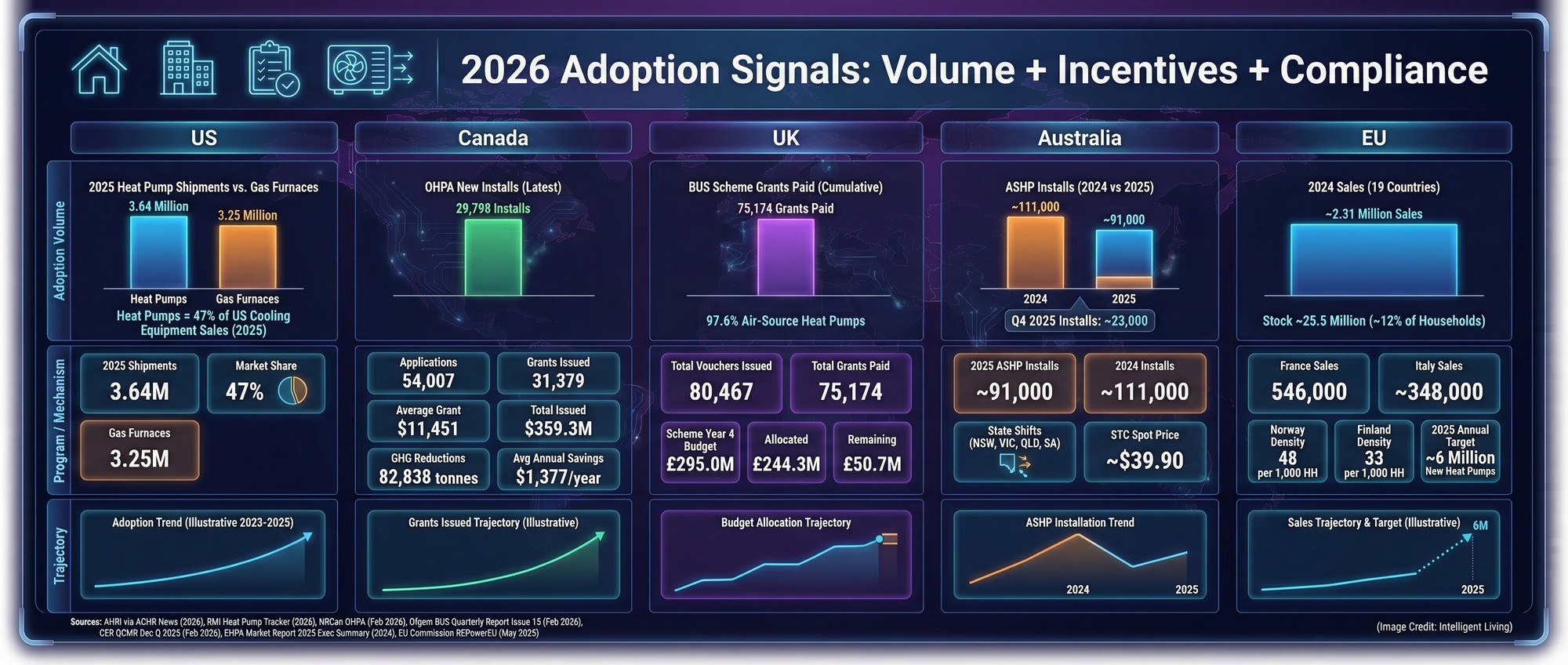
Global 2026 Adoption Trends and Policy Frameworks
Current market data highlights momentum and planning risks rather than marketing hype across primary global regions:
- United States: Market momentum is clearly visible in the latest HVAC shipment data, indicating a sustained shift away from legacy combustion systems. US heat pump market share trends provide a directional signal for identifying 2026 growth patterns.
- Canada: High adoption rates correlate with OHPA grant totals and average support levels in regions previously dependent on heating oil.
- United Kingdom: Retrofit scale in the UK remains tied to the regulatory framework of the Boiler Upgrade Scheme and its funding stability.
- Australia: Deployment dynamics are recorded in the quarterly renewable energy installation reports, which clarify regional pricing shifts.
- European Union: Aggressive European decarbonization targets suggest an installation run rate of six million units per year starting in 2025. Current European heat pump sales data confirms that installed-stock levels vary significantly across member states based on local incentive stability.

United States Regional Market Drivers and Policy Context
The primary driver for heat pump adoption in the U.S. is not a solitary federal credit but a broader market transition supported by a patchwork of state, utility, and local incentives. Securing federal incentives requires strict adherence to energy credit timing rules, as equipment must be officially placed in service during the tax year.
Parallel to these financial shifts, equipment availability in 2026 is significantly influenced by EPA technology transition limits shaping new refrigerant choices. These mandates dictate long-term servicing and maintenance strategies.
Primary Considerations for Residential Retrofits in the US
- A focus on HVAC-driven air quality improvements—such as advanced filtration and humidity management—ensures long-term resident satisfaction after the retrofit.
- Require a Manual J heat-loss calculation and a written commissioning plan before work starts.
- Treat electrical readiness as part of the project scope, including panel capacity, breaker space, and any wiring constraints.
A short anecdote: In a mixed-climate suburb, a homeowner accepted a bundled quote that hid a likely panel upgrade. The equipment arrived, the electrician flagged the limitation, and the project stalled for a week. A simple pre-check for panel capacity would have prevented both downtime and a surprise bill.
Strategic Planning for Commercial HVAC Electrification
Facilities managers should adopt a structured electrification roadmap to minimize operational disruptions:
- Asset Classification: Group buildings by retrofit complexity, focusing on envelope integrity and electrical panel capacity.
- Procurement Standardization: Mandate documented Manual J load calculations and commissioning reports for every site.
- Operational Continuity: Maintain productivity by scheduling equipment transitions during low-occupancy periods and critical operating windows.
- Sustainability Alignment: Pursue carbon-reduction HVAC strategies that balance emission goals with occupant thermal comfort.
Practical Cost and Comparison Tips
Regional variations dictate total installed costs, which shift based on building type and existing distribution infrastructure. Securing three competitive bids using identical assumptions remains the most reliable method for establishing a realistic budget.
Preemptive maintenance often provides immediate financial relief prior to a full system replacement. Addressing refrigerant leaks, airflow restrictions, and coil fouling through targeted HVAC repairs can significantly lower energy consumption while you finalize your long-term electrification plan.
Common Mistakes in the US
- Accepting rule-of-thumb sizing instead of a Manual J calculation.
- Allowing the project to proceed without a commissioning checklist and owner training.
- Ignoring electrical constraints until equipment is already ordered.

Canadian Affordability Initiatives and Cold-Climate Standards
Canadian policy prioritizes direct affordability and strict model verification, particularly for households transitioning away from oil heating. In 2026, the clearest low-risk move is to treat eligibility as a technical requirement, not a paperwork afterthought. Project success depends on verifying OHPA eligibility requirements to ensure the system qualifies for targeted affordability grants before procurement.
What Homeowners Should Study First
- Model Matching: Strictly verify equipment against the OHPA model eligibility lookup before ordering.
- Cold-Climate Planning: Align projects with the NRCan sizing method for cold-climate heat pumps to maintain efficiency during peak winter loads.
- Envelope Retrofits: Prioritize insulation and sealing to lower required capacity and operational costs in older, drafty homes.
A quick human note: In colder regions, owners sometimes choose a smaller system to reduce upfront cost, then observe winter bills rise because backup heat runs too often. The better-feeling outcome usually comes from a right-sized system paired with low-cost draft fixes like weatherstripping and sealing that reduce winter heat loss in cold-weather home heat loss basics without changing the character of the house.
What Businesses Should Do First
- Treat heat pumps as a facilities strategy, not a single equipment purchase. The best outcomes come from consistent specs, commissioning documentation, and clear ownership of controls that align with energy efficiency in modern buildings across the whole facility.
- For multi-site organizations, start with a pilot and instrument the space so operating schedules and setpoints are tuned after installation.
Common Mistakes in Canada
- Assuming program eligibility without verifying the exact model.
- Skipping envelope upgrades that allow the system to run efficiently in extreme weather.

UK Boiler Upgrade Scheme and Installer Quality Standards
Government-backed grant support and rigorous installer standards serve as the dual pillars of the UK heat pump market in 2026. For 2026 planning, many buyers start with the £7,500 support level provided by the Boiler Upgrade Scheme grant amount for heat pumps. In this region, thorough documentation serves as a critical proxy for installation quality.
What Homeowners Should Study First
- Cost Benchmarking: Use UK heat pump installation steps and typical costs as a baseline before signing contracts.
- Standards Verification: Mandate commissioning evidence that aligns with MIS 3005 requirements.
- Planning Compliance: Adhere to domestic permitted development criteria to avoid local positioning disputes.
A short anecdote: A homeowner in a Victorian house found that comfort improved most after a radiator right-sizing step, not after buying a larger outdoor unit. The system ran steadier, and the living room stopped swinging between too hot and too cool.
What Businesses Should Do First
- Standardize procurement so contractors deliver the design artifacts, commissioning evidence, and controls handover expected under MIS 3005.
- Protect operations by building a schedule that avoids peak occupancy and aligns commissioning with a period when staff can give feedback.
A useful business lens is that building controls often deliver savings faster than equipment changes. Smart sequencing matters, and occupancy-aware control strategies similar to building management systems for commercial efficiency can reduce waste while the heat pump project is still in planning.
Common Mistakes in the UK
- Hiring an installer without evidence of standards-based design and commissioning.
- Underestimating emitter upgrades needed for low-temperature comfort.
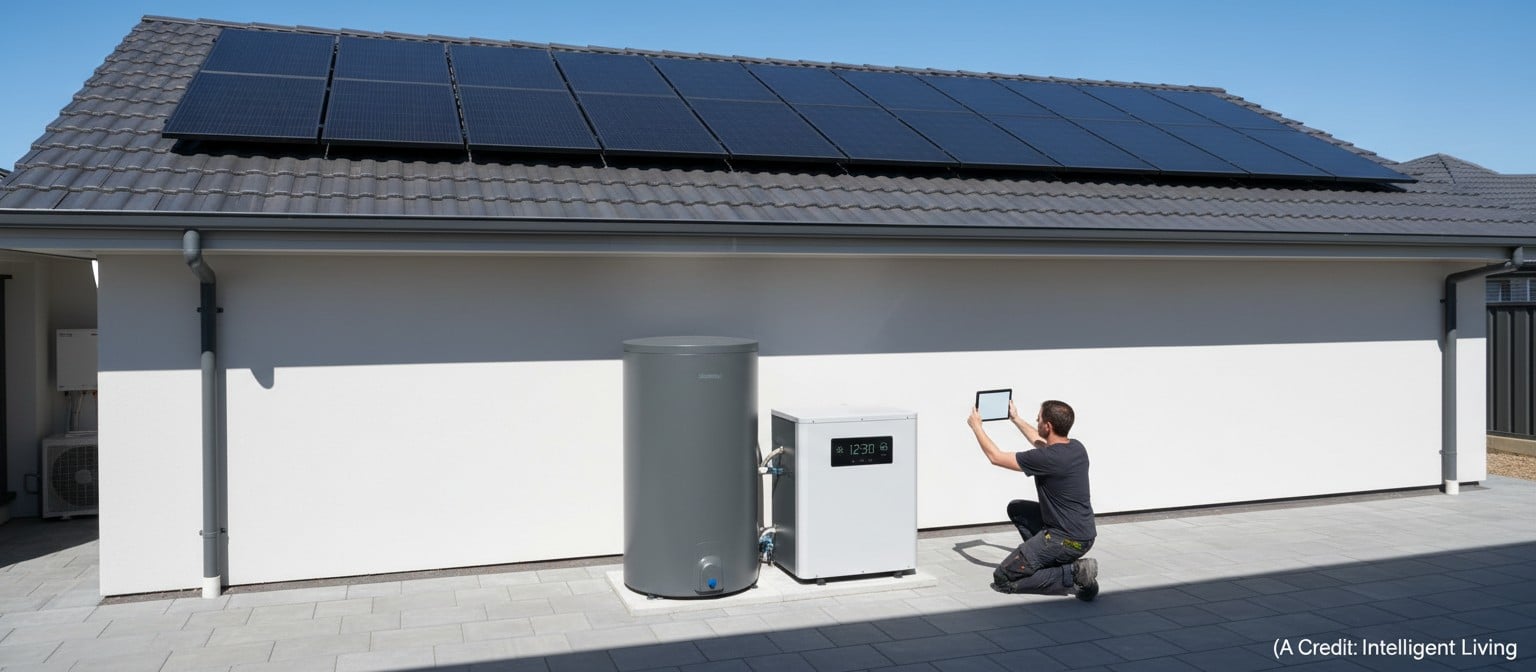
Australian Certificate Mechanics and Rebate Eligibility Criteria
Project viability depends on technical compliance with the national scheme and the accurate valuation of certificates within the initial contract. The practical definition of eligibility is whether the system qualifies under the national scheme and whether the certificate value is handled correctly in the contract.
What Homeowners Should Study First
- Technical Compliance: Verify system eligibility under STC rules for heat pump hot water systems.
- Solar Integration: Manage tradeoffs of solar-powered heating by aligning heating cycles with peak daytime generation.
- Discount Mechanics: Correctly assign certificate creation rights to secure immediate upfront cost reductions.
A practical observation: Households frequently accept a discount without realizing it comes from certificate assignment.
What Businesses Should Do First
- Hospitality, laundries, and multi-residential facilities should build a demand profile and size systems around real daily hot water loads.
- Operational savings often come from scheduling and monitoring. Load shifting can matter as much as equipment choice, and timing hot water heating to off-peak or solar production mirrors solar battery strategies that reduce peak demand.
Common Mistakes in Australia
- Assuming every air-source heat pump qualifies for STCs without checking the system class and installation circumstances.
- Ignoring peak-demand tariffs that change the economics of hot water heating.

EU F-Gas Regulations and Member State Deployment Targets
Heat pumps represent a core energy-efficiency pillar in Europe. An EU-level baseline for system performance is available in the European Commission heat pump efficiency overview.
Strict adherence to the EU F-gas phase-down schedule is essential for selecting equipment that remains compliant with long-term environmental regulations.
What Homeowners Should Study First
- Regional Incentives: Confirm national program details and local installer qualification requirements across the regulatory patchwork.
- Compliance Verification: Require service partners to document refrigerant handling and leak prevention as per updated EU F-gas regulation text.
- Commercial Connectivity: For larger industrial or multi-site projects, utilize industrial heating and cooling strategies that leverage waste-heat recovery.
A human note: Facility managers with multi-country responsibilities often find the regulatory patchwork is the biggest source of delays. A single compliance checklist per country, paired with a consistent commissioning requirement, reduces procurement friction.
Europe’s shift also includes large heat pumps for district heating, which changes the scale of what a heat pump looks like. A real example at city scale is river-powered district heating with large heat pumps that turns a waterway into a thermal resource for buildings.
Common Mistakes in the EU
- Treating EU rules as uniform rather than confirming national transposition and enforcement.
- Underestimating training and documentation requirements for servicing.
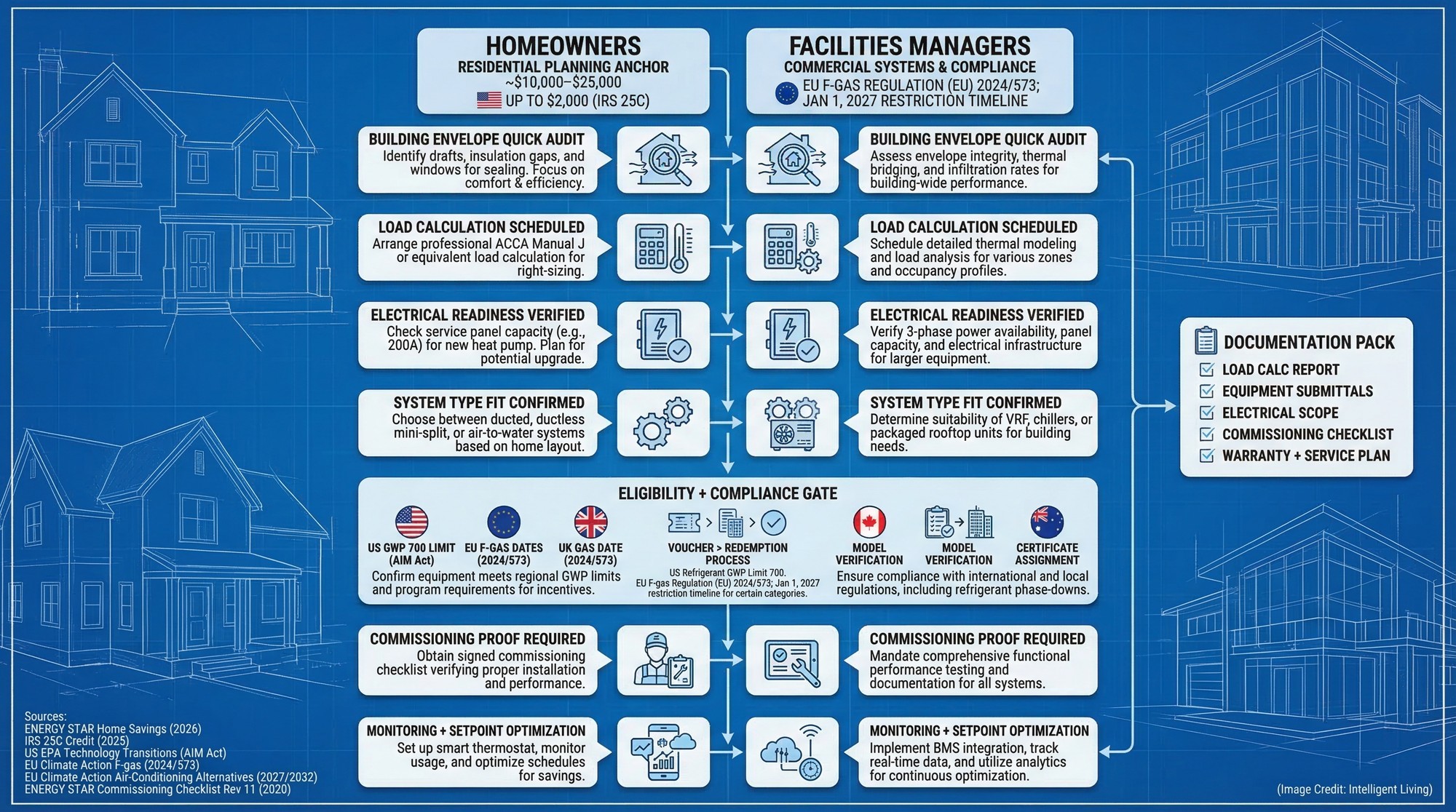
Strategic Implementation Checklist for Homeowners and Facilities Managers
Moving from planning to active procurement requires a structured, multi-step approach:
- Audit your existing HVAC infrastructure and age, then secure a professional Manual J load calculation before soliciting installation quotes. Proactive maintenance to maximize HVAC efficiency maintains system longevity while homeowners coordinate the final electrification transition.
- Following the audit, verify program eligibility and model details before ordering equipment.
- Request separate line items for equipment, labor, electrical upgrades, and commissioning in every quote.
- Upon installation, make commissioning and basic owner or staff training a condition of final payment.
- Finally, for multi-site portfolios, pilot one or two installs with monitoring, then standardize the procurement package.
Completing these steps creates a documented ‘paper trail’ of performance, giving you the leverage needed to ensure your contractor delivers a high-quality installation.
One short anecdote: A small landlord piloted a single retrofit and discovered that a basic thermostat schedule and zoning adjustment reduced operating costs more than an additional equipment upgrade would have that year. Inaccurate readings from poorly positioned thermostats often result in temperature swings and increased energy consumption.

Maximizing Your Heat Pump ROI in 2026
Achieving a high return on investment requires a shift in perspective from viewing the heat pump as a standalone appliance to treating it as a component of a whole-house system. Envelope improvements, a verified Manual J load calculation, and strict commissioning discipline are the three actions that most reliably turn a theoretical efficiency gain into real-world comfort. Prioritizing these technical foundations ensures that your equipment operates within its optimal range, extending its lifespan and keeping utility bills predictable.
Local incentives and tax credits serve as a welcome bonus, but they should never be the sole justification for an upgrade. A system designed around your building’s actual heat loss profile provides a level of comfort that generic installations simply cannot match. Focus on finding a contractor who prioritizes data and documentation, as this remains the most effective way to secure a safe, low-regret path to home electrification in 2026.
Essential Heat Pump FAQ for 2026
Why do some heat pump installations fail to meet efficiency goals?
Incorrect sizing and skipped commissioning steps are the primary culprits. If the system capacity does not align with a documented Manual J load calculation, it will likely short-cycle, increasing wear and energy consumption.
Are heat pumps effective in extremely cold climates?
Modern cold-climate models maintain efficiency well below freezing. Performance depends on selecting verified hardware, optimizing defrost settings, and minimizing building heat loss through envelope upgrades.
How should I compare multiple heat pump quotes?
Request line-item transparency for equipment, labor, and electrical work. Ensure every bidder uses the same heat-loss methodology and includes a written commissioning plan to keep comparisons ‘apples-to-apples.’
What is the impact of 2026 refrigerant regulations on new buyers?
New EPA and EU rules favor low-GWP refrigerants, which may influence product availability. Confirm with your installer that your chosen model complies with current environmental standards to ensure long-term serviceability.
Can I install a heat pump if my home has existing drafts?
Residential properties with air leaks still benefit, though prioritizing air sealing is essential for optimal performance. Eliminating leaks allows for smaller, more affordable equipment and prevents the system from overworking to compensate for thermal loss.


