
If you are weighing a heat pump for your home, the choice usually comes down to two very different machines: a geothermal (ground-source) heat pump that taps the steady temperature of the earth and an air-source heat pump that pulls heat from the outside air. Both can heat and cool a house efficiently, but they differ sharply in upfront cost, cold-weather performance, and long-term value. In 2026, changes to federal incentives have also tilted the math in ways that catch many homeowners by surprise.
This geothermal vs. air source heat pump comparison breaks down efficiency, cost, installation, and available incentives so you can decide which system actually fits your climate and budget.
Here is the short version of how the two compare:
- Geothermal costs far more upfront but holds steady efficiency in any weather.
- Air-source costs roughly a third as much and performs well in mild to moderate climates.
- Extreme cold is where geothermal’s advantage is greatest.
- Federal residential tax credits for both ended after 2025.
- Local rebates, your climate, and how long you stay decide the winner.
How the Two Systems Differ
Both technologies work on the same basic principle: instead of burning fuel to create heat, they move existing heat from one place to another using a refrigerant cycle. A COP of 3.0 means the system delivers three units of heat for every unit of electricity it consumes. Where they differ is where that heat comes from.
Ground-Source (Geothermal) Heat Pumps
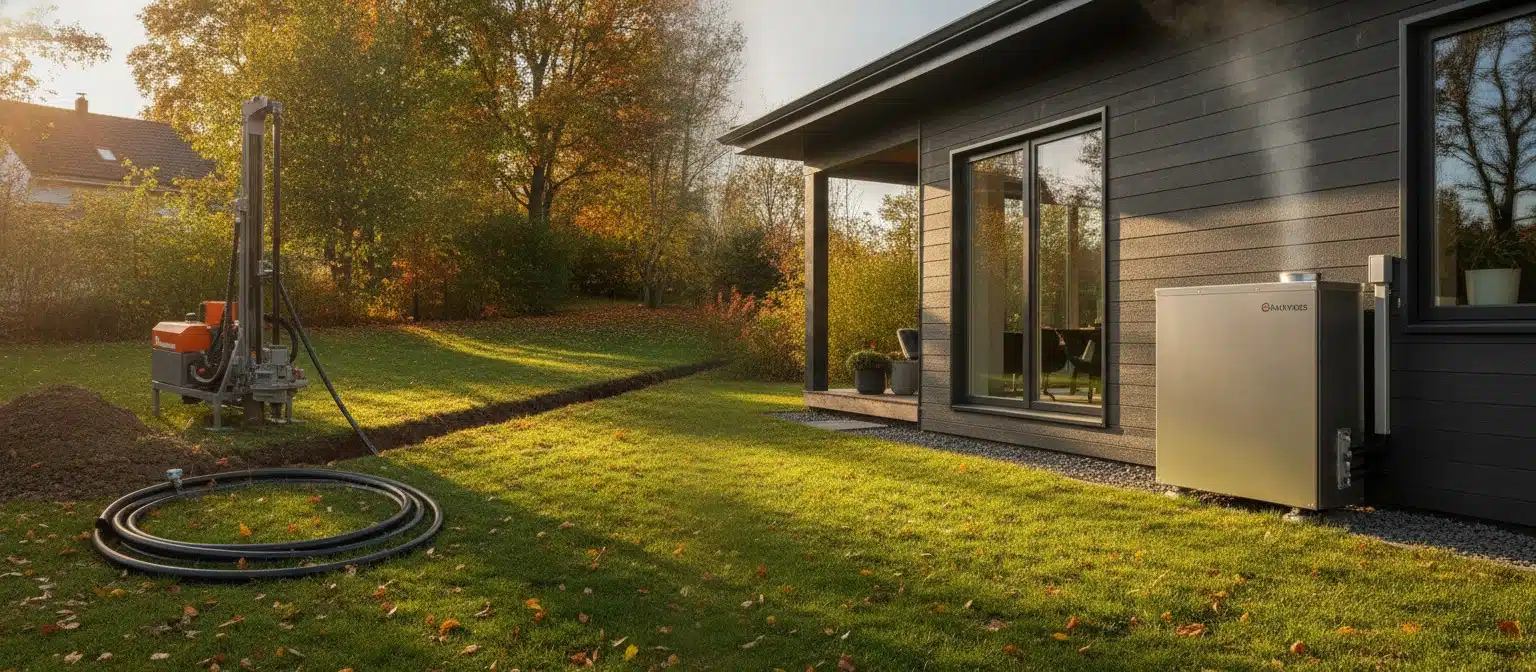
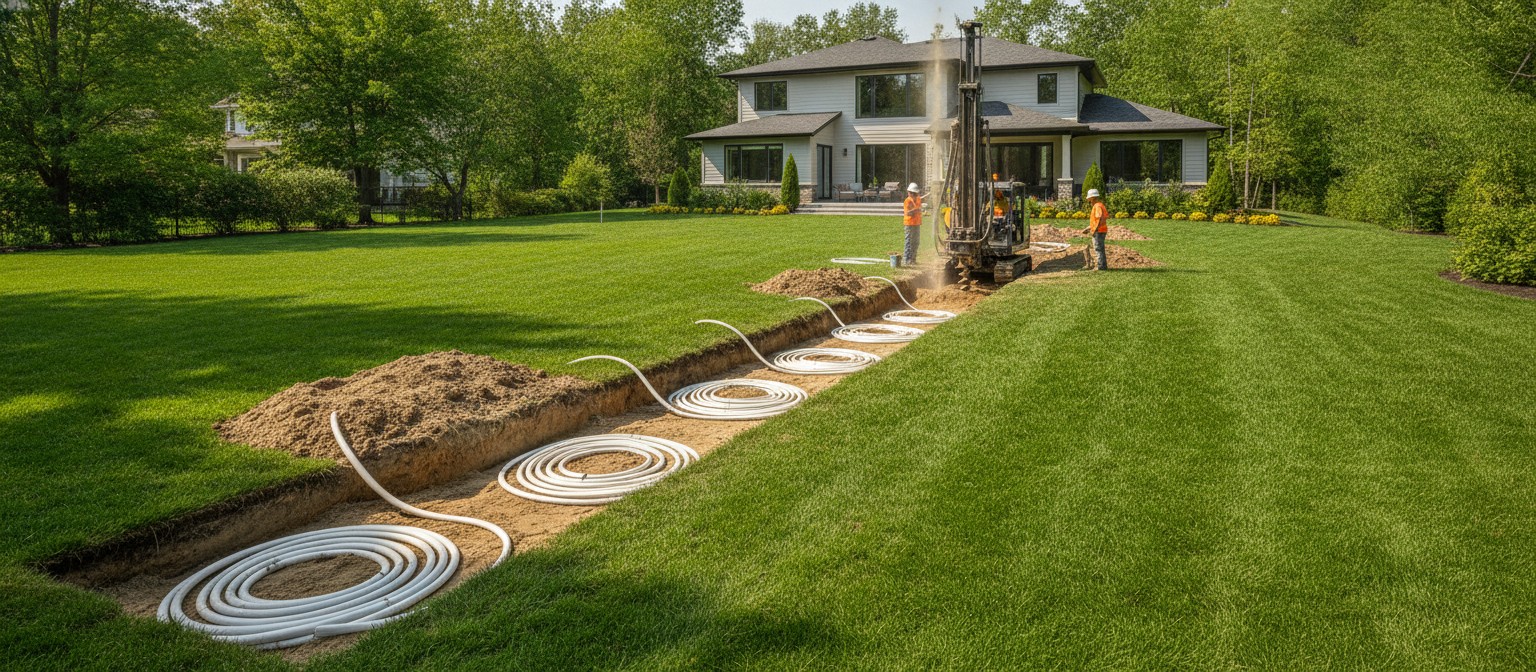
A geothermal heat pump circulates fluid through pipes buried in the ground, either in horizontal trenches or vertical boreholes. Because soil a few feet down stays at a stable 50°F to 60°F year-round in most of the United States, the system draws from an almost constant thermal reservoir, a principle the U.S. Department of Energy explains as the core advantage of ground-source systems. In winter it extracts heat from the ground; in summer it reverses the flow and dumps heat back into the cooler earth. The field is advancing quickly: engineers have tested zero-emission geothermal systems in Canadian backyards, and Iceland has even drilled into a volcano’s magma chamber to reach extreme temperatures.
Air-Source Heat Pumps
An air-source heat pump takes heat from the outdoor air and moves it indoors. Modern cold-climate models from manufacturers such as Mitsubishi, Daikin, Bosch, and Fujitsu are rated for heating well below freezing, and ENERGY STAR’s central heat pump listings rank them among the most efficient home heating options available. The trade-off is that their efficiency falls as the outdoor temperature drops, because there is simply less heat to harvest from cold air.

Efficiency Comparison: COP and Real-World Performance
The coefficient of performance (COP) is the single most useful efficiency metric for comparing the two. A geothermal unit typically holds a COP of roughly 4.0 to 5.0 regardless of the weather, while an air-source unit swings widely with outdoor temperature.
| Condition | Air-Source Heat Pump (COP) | Geothermal Heat Pump (COP) |
|---|---|---|
| Mild weather (47°F / 8°C) | 4.0 – 5.0 | 4.0 – 5.0 |
| Around freezing (32°F / 0°C) | 2.8 – 3.5 | 4.0 – 5.0 |
| Very cold (5°F / −15°C) | 1.5 – 2.2 | 4.0 – 5.0 |
| Any outdoor temperature | Varies with air temperature | Consistent year-round |
Why Geothermal Efficiency Stays Constant
Because the ground temperature barely changes between summer and winter, a geothermal heat pump operates near its rated efficiency all year. That stability is its defining advantage. Even when the air outside is far below freezing, the loop field is still absorbing heat from soil that sits around 50°F, so the compressor never has to work against a collapsing temperature gradient.
How Air-Source Efficiency Drops in Cold Weather
Air-source performance is highly climate-dependent. According to the International Energy Agency (IEA), a standard air-source heat pump can lose 40–55% of its rated heating capacity at −10°C (14°F) compared with operation at 7°C (45°F). Cold-climate-rated units lose only 15–25% over the same range thanks to two-stage or variable-speed compressors. Below about 5°F, many standard models approach a COP near 1.0, which is no better than electric resistance heat, while cold-climate units still deliver a useful COP around 2.2.
That gap matters most during the handful of extreme cold snaps each winter. For the majority of the heating season, a modern air-source heat pump performs close to a geothermal unit, which is why many homeowners find the cheaper option perfectly adequate in mild and moderate climates.
Upfront Cost and Installation
This is where the two systems diverge most dramatically.
Geothermal Installation Costs
A complete geothermal system, including the ground loop field, the indoor heat pump unit, and installation, typically runs $45,000 to $70,000 for a typical residential application, though simpler or smaller installations can land below that range. The expense is driven by excavation or drilling for the loop field, which depends on soil conditions and available land. Vertical boreholes cost more per foot but need far less space than horizontal trenches.
Air-Source Installation Costs
A comparable cold-climate air-source heat pump generally runs $15,000 to $22,000 installed. There is no excavation, the installation is faster, and the equipment can usually be placed against an exterior wall or on a small pad. The U.S. Department of Energy notes that air-source heat pumps can also provide efficient cooling, since the same refrigerant cycle runs in reverse during summer. For homeowners seeking a lower-cost, lower-disruption option, an air-source unit is the clear entry point. There are even single-window heat pump designs aimed at replacing a space heater and a window air conditioner at once.
Operating Costs and Long-Term Savings
Geothermal units are more efficient on paper, but the gap in operating cost is narrower than the COP figures suggest because the two systems perform similarly across most ordinary heating hours. The geothermal advantage concentrates in extreme weather and in homes with very high heating loads.
Several factors decide whether the higher efficiency of a geothermal system translates into real savings:
- Climate: the colder and longer the winter, the more geothermal pulls ahead.
- Efficiency gap: in mild climates the two systems perform similarly for most of the year.
- Energy prices: local electricity and fuel rates vary widely and shift the break-even point.
- Incentives: state and utility rebates can narrow the upfront cost gap.
- Home efficiency: a well-sealed, well-insulated house needs less heat, whatever the source.
For a well-insulated house in a cold climate, the lower running cost of a geothermal system can eventually offset its higher upfront price, though the payback period often stretches across many years and depends heavily on local electricity and fuel prices. In milder climates, the savings are smaller, and the case for spending tens of thousands more on a loop field becomes harder to justify. A homeowner who wants to plan the numbers carefully can start with a complete guide to home geothermal heat pump installation, which walks through loop sizing and site requirements. Pairing a heat pump with eco-friendly home insulation reduces the heating load and shortens any payback period, since a better-sealed house needs less energy to stay comfortable.
Incentives and Tax Credits in 2026
Federal incentives changed significantly at the end of 2025, and this is the detail most homeowners have not yet caught up with.
The Residential Clean Energy Credit (Section 25D), a 30% credit that covered qualifying geothermal heat pumps, is no longer available. As the IRS confirms, the credit applies to property placed in service through December 31, 2025, and is “not available for any property placed in service after December 31, 2025.” The Energy Efficient Home Improvement Credit (Section 25C) ended on the same date. It had offered up to $2,000 per year for qualifying heat pumps and heat pump water heaters.
In practical terms, a residential heat pump installation completed in 2026 receives no federal tax credit under either of these programs. State and utility incentives are now the main source of support, and they vary enormously by location.
For 2026 installations, the remaining support generally comes from:
- State-level rebates, grants, and property tax exemptions.
- Utility efficiency and electrification programs.
- Manufacturer and installer promotions.
Meanwhile, ENERGY STAR still publishes efficiency guidance and the legacy credit amounts for qualifying equipment placed in service by the end of 2025.
Efficiency standards have also been tightening independently of tax policy. ENERGY STAR’s Version 6.2 heat pump standards raised the bar for what counts as a high-efficiency air-source unit, which has pushed manufacturers to improve cold-weather performance across their lineups.
Which Is Better for Your Home?
There is no universal winner. The right choice depends on your climate, your property, and your budget horizon. The table below summarizes how the two systems stack up at a glance.
| Factor | Geothermal | Air Source |
|---|---|---|
| Typical installed cost | $45,000 – $70,000 | $15,000 – $22,000 |
| Efficiency (COP) | 4.0 – 5.0, constant | 1.5 – 5.0, weather-dependent |
| Cold-weather performance | Unaffected | Falls as temperature drops |
| Service life | Loop 50+ years, unit 20+ | Roughly 12 – 15 years |
| Outdoor noise | Minimal | Some |
| Land required | Loop field or boreholes | Small wall or pad space |
Choose Geothermal If…
- You live in a climate with long, severe winters where air-source efficiency collapses.
- You have enough land for a loop field or the budget for vertical boreholes.
- You plan to stay in the home long enough to capture long-term operating savings.
- You value the quietest, most stable, and longest-lasting system available.
- You want to cut fossil-fuel use for both heating and cooling in one system.
Choose Air Source If…
- Your winters are mild to moderate, where the efficiency gap is small.
- You want a lower upfront cost and a faster, less disruptive installation.
- Your lot is small or has limited space for a ground loop.
- You would rather pair a modest system with other upgrades, such as insulation or solar.
- You need a system installed quickly with minimal yard disruption.
Larger-scale geothermal projects continue to advance as well, from utility-scale zero-emission geothermal energy systems to district heating networks in Europe, which suggests the technology will keep improving on both the residential and grid scales.
Heat pumps also work best as part of a wider home energy plan. Smart controls, the kind behind context-aware homes, can shift heating to cheaper off-peak hours, while pairing a heat pump with battery storage such as solid-state or lithium-ion systems lets homeowners store cheaper electricity for peak winter demand. Those comparing storage technologies often weigh hydrogen fuel cells against lithium-ion batteries, while large renewable projects, from solar installations to wind, keep lowering the carbon intensity of the electricity a heat pump runs on.
Frequently Asked Questions
Is a geothermal heat pump worth the extra cost over an air-source heat pump?
It depends on your climate and how long you plan to stay. In cold climates with high heating demand, geothermal running costs can eventually offset its higher price. In milder climates, the gap in performance is small enough that the added cost is often hard to recover.
Do air-source heat pumps work in freezing temperatures?
Yes. Cold-climate models are rated for heating well below freezing and continue operating at reduced capacity down to roughly −15°F or colder. Standard models lose efficiency faster and may rely on backup resistance heat during extreme cold.
Are there still federal tax credits for heat pumps in 2026?
For residential installations completed after December 31, 2025, the federal 25C and 25D credits are no longer available. State, local, and utility rebate programs remain the primary incentives, and they vary widely by region.
How long do geothermal and air-source heat pumps last?
Geothermal systems are known for long service life, with the underground loop field often lasting 50 years or more and the indoor unit typically lasting 20 years or longer. Air-source heat pumps generally last around 12 to 15 years, with the outdoor unit exposed to weather.
Which system is quieter?
Geothermal heat pumps are usually the quieter option because there is no outdoor compressor or fan operating next to the house. Air-source units produce some outdoor noise while running.
The Bottom Line
Air-source heat pumps have closed much of the performance gap in recent years, and at roughly a third of the installed cost of a geothermal system, they deliver strong value in mild and moderate climates. Geothermal remains the more efficient and longer-lasting choice where winters are brutal, efficiency matters most, and the homeowner can absorb the higher upfront investment. With federal residential credits now expired, the deciding factors in 2026 are your local incentives, your climate, and how long you intend to stay in the home.


