
Heating and cooling account for roughly half of a typical household’s energy consumption. The insulation inside your walls, attic, and floors is the single biggest factor determining how much of that energy stays inside or escapes. Yet most homeowners never think about what their insulation is actually made of.
Conventional insulation materials like fiberglass and rigid foam come with environmental baggage: high embodied energy from manufacturing, petroleum-based binders, and formaldehyde off-gassing that affects indoor air quality. Eco-friendly insulation alternatives have matured beyond niche status. They now match or exceed the thermal performance of conventional products while sequestering carbon, regulating humidity, and eliminating toxic chemicals from your living space.
This guide covers every major eco-friendly insulation material available today, compares their real-world performance and costs, and explores next-generation materials emerging from research laboratories that could reshape how we insulate homes in the coming decade. Making your home’s insulation eco friendly doesn’t mean compromising on thermal performance. Whether you are building new or retrofitting an older home, this guide provides the data-driven comparisons you need to make an informed decision.
What Makes Insulation Eco-Friendly?
Not all “green” insulation claims are equal. A genuinely eco-friendly insulation material should satisfy several criteria simultaneously, not just one or two.
Embodied carbon is the total CO2 emitted during manufacturing, transport, and installation. Many natural insulation materials are carbon-negative; they store more carbon in the material than was emitted to produce it. Cellulose insulation, for instance, is roughly 85% recycled newspaper; the carbon in that paper remains locked in your walls for decades. Hemp absorbs CO2 as it grows in just 3–4 months, compared to the 25 years softwood trees need to mature.
Renewable or recycled content. Materials like sheep’s wool, cotton denim, and cork come from rapidly renewable sources or post-consumer waste streams. This reduces pressure on virgin resources and diverts material from landfills.
Manufacturing footprint matters just as much as the raw material. Mineral wool, for example, requires melting rock at temperatures exceeding 1,400°C, an energy-intensive process often powered by coal-fired furnaces. In contrast, hemp batts are mechanically processed at low temperatures with minimal energy input.
Indoor air quality and toxicity. Conventional fiberglass insulation often contains formaldehyde-based binders that off-gas volatile organic compounds (VOCs) for years after installation. Eco-friendly alternatives use borate-based fire retardants, natural oils, or require no chemical treatment at all. Look for GREENGUARD Gold certification, which verifies low VOC emissions for sensitive indoor environments.
End-of-life: can the material be composted, recycled, or safely returned to the earth? Cork, hemp, and wool are fully biodegradable. Mineral wool can be recycled into new batts. Rigid foam boards, by contrast, typically end up in landfill and persist for centuries.
Eco-Friendly Insulation Materials Available Today
Each material below is commercially available, has a proven track record in residential construction, and offers distinct advantages depending on your climate, budget, and building type.
Cellulose Insulation
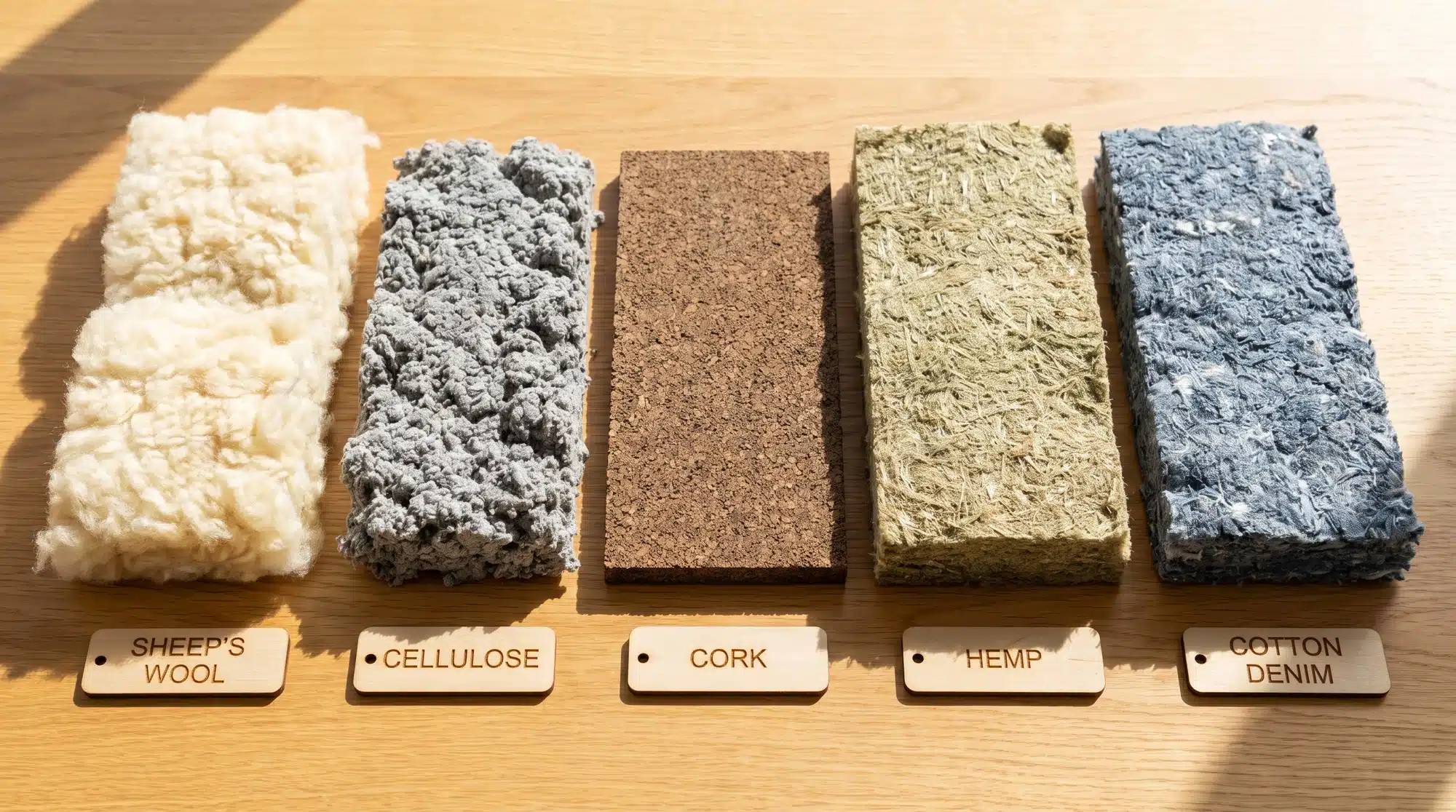
Cellulose is the workhorse of eco-friendly insulation, affordable, widely available, and made from up to 85% recycled paper (primarily newspapers and cardboard). The remaining 15% consists of borate compounds that provide fire resistance and deter pests and mold. It is applied as loose-fill, dense-pack, or wet-spray and works well in attics, wall cavities, and between floor joists. With an R-value of 3.2–3.8 per inch, cellulose performs comparably to fiberglass but with a negative carbon footprint and better sound-dampening properties. It costs approximately $1.40–$1.90 per square foot installed, making it one of the most budget-friendly eco-friendly options.
Sheep’s Wool Insulation
Sheep’s wool batts offer a unique combination of thermal performance and moisture management. Wool fibers naturally absorb and release humidity without losing their insulating ability, a property called hygroscopic buffering that helps regulate indoor humidity and reduces condensation risk within wall cavities. Wool batts achieve R-3.5–3.8 per inch and are naturally fire-resistant due to their high nitrogen content. The material is typically reinforced with up to 20% polyester binder, though some manufacturers now offer 100% wool options. At $3.80–$5.20 per square foot installed, sheep’s wool is among the more expensive options, but its 50+ year lifespan and passive humidity regulation justify the premium in high-performance builds.

Cotton and Denim Insulation
Made from post-industrial denim scraps and cotton textile waste (approximately 80% recycled content), cotton batts are soft, itch-free, and easy to handle, a welcome contrast to fiberglass. The material is treated with boric acid for fire and pest resistance and achieves R-3.2–3.7 per inch. Cotton insulation costs $2.10–$2.75 per square foot installed, roughly twice the price of fiberglass. Its main drawback is that cotton, as a plant fiber, can absorb moisture if exposed to leaks, so proper vapor barrier installation is essential.
Cork Insulation
Expanded cork board is one of the most versatile eco-friendly insulation materials. Harvested from the bark of cork oak trees, which regenerates every 9 years without harming the tree, cork is naturally hydrophobic, fire-resistant, antimicrobial, and dimensionally stable. It contains suberin, a waxy substance that repels water and resists rot. Cork boards achieve R-3.6–4.0 per inch and can be used on exterior walls (as part of an EIFS system), interior walls, floors, and even as exposed finish surfaces. At $3.50–$4.50 per square foot for an R-13 assembly, cork is a premium material, but its durability (50+ years) and multi-functional properties make it a worthwhile investment, especially in humid climates where other natural materials might struggle.
Hemp Insulation: Batts and Hempcrete
Hemp is one of the fastest-growing plants on Earth, reaching harvest maturity in 3–4 months while absorbing significant CO2. Two distinct hemp insulation products are available:
Hemp fiber batts (R-3.5–3.8 per inch) resemble fiberglass batts in form and installation method. They are flexible, easy to cut, and contain no synthetic binders; the fibers are mechanically bonded. Hemp batts cost $2.80–$3.60 per square foot installed and are available from manufacturers like Hempitecture in the US.
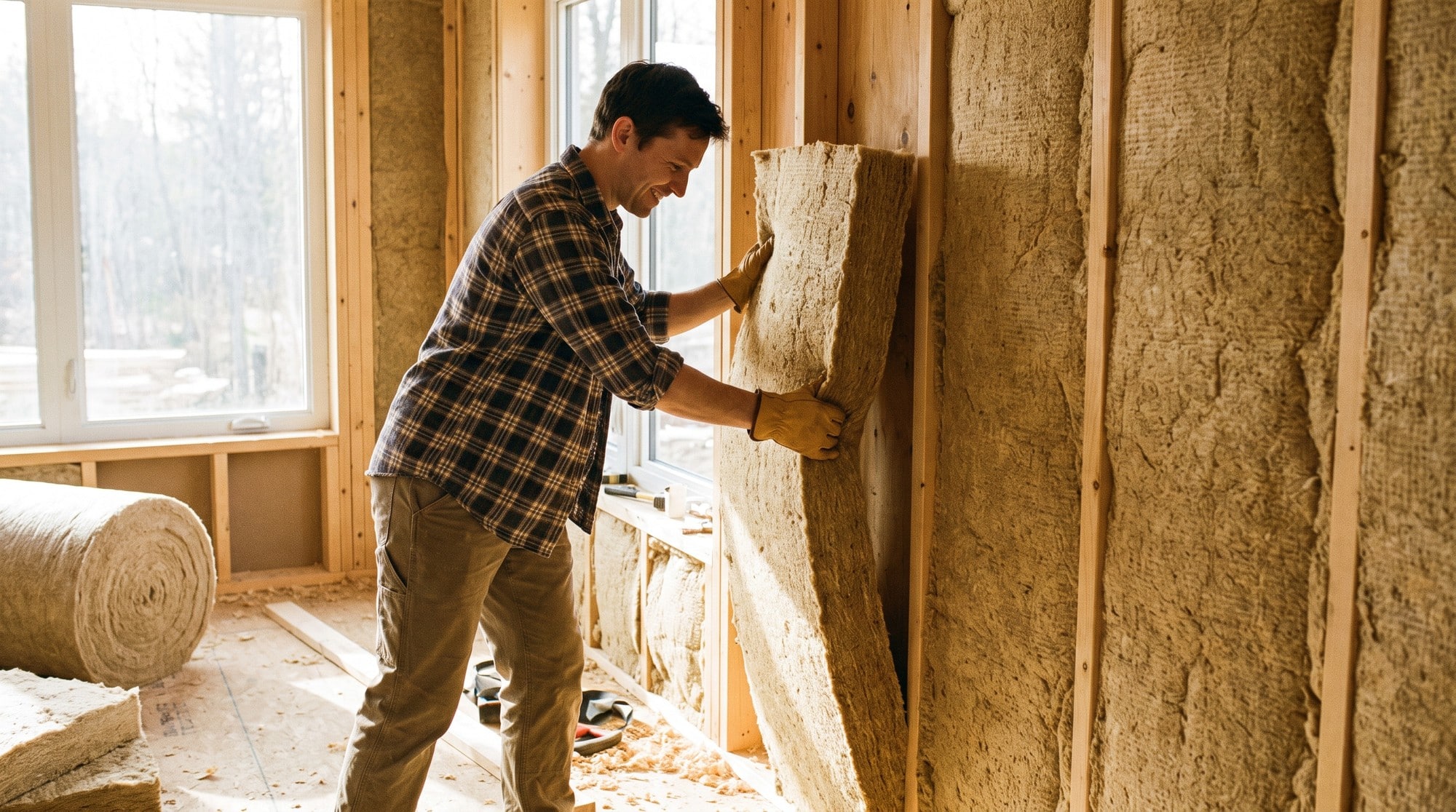
Hempcrete is fundamentally different: a mixture of hemp hurds (the woody core of the hemp stalk), lime binder, and water, poured or sprayed into formwork to create monolithic walls. With an R-value of approximately 1.5–2.0 per inch, hempcrete is a lower-R material, but its high thermal mass and breathability produce excellent real-world energy performance that often exceeds what R-value alone would predict. Hempcrete was accepted into the 2024 International Residential Code (IRC) as an allowable building material, a significant milestone for mainstream adoption. A 10-inch hempcrete wall achieves roughly R-17 in field testing.
Wood Fiber Insulation
Wood fiber boards and batts, manufactured primarily in Europe, are made from softwood chips processed into fibers and bound with either natural lignins or small amounts of polyurethane binder. The material achieves R-3.6–4.2 per inch and offers excellent sound insulation alongside thermal performance. Wood fiber is vapor-permeable, allowing walls to “breathe” and reducing condensation risk in cold climates. It costs approximately $1.80–$2.50 per square foot and is particularly well-suited to timber-frame construction, where it can serve as both sheathing and insulation in a single layer.
Mineral Wool (Rock Wool)
Mineral wool occupies a middle ground between conventional and eco-friendly. Made from spun basalt rock or steel slag (a recycled industrial byproduct), it achieves the highest R-value of any commercially available eco-friendly batt at R-4.0–4.2 per inch. It is completely fireproof: it can withstand temperatures above 1,000°C without melting and offers excellent soundproofing. However, mineral wool’s manufacturing process is energy-intensive and often relies on fossil fuels, and some products emit low levels of VOCs. It is also a skin and respiratory irritant during installation. Whether mineral wool qualifies as truly “eco-friendly” depends on the specific product and manufacturer, but its durability (50+ years) and recyclability strengthen its sustainability case.
Icynene and Bio-Based Spray Foams
Unlike petroleum-based spray foams, Icynene is derived partially from castor oil, a renewable plant resource. It expands to approximately 100 times its liquid volume when sprayed, creating an effective air barrier that seals gaps and cracks. Icynene achieves roughly R-3.6 per inch and is applied by certified professionals; this is not a DIY product. While the castor oil component reduces reliance on petroleum, the manufacturing process still involves chemical polymerization, and the cured foam is not biodegradable. Icynene also requires adequate ventilation during and after installation due to off-gassing. Cost ranges from $2.50–$5.00 per square foot installed, making it one of the pricier options.
R-Value and Performance: Full Comparison Table
R-value measures thermal resistance: the higher the number, the better the material resists heat flow. But R-value alone does not tell the full story. Thermal conductivity (lambda, measured in W/m·K), moisture performance, thermal mass, and real-world air-sealing all influence how a material actually performs in a building assembly.
The table below provides a direct comparison of every major eco-friendly insulation material across the metrics that matter most:
| Material | R-Value per Inch | Thermal Conductivity (W/m·K) | Flammability | Durability (Years) | Toxicity & Safety | Cost per Sq Ft (Installed) | Availability |
|---|---|---|---|---|---|---|---|
| Cellulose | 3.2–3.8 | 0.038–0.040 | Class 1 (borate treated) | 30–50 | Low toxicity; borate is a mild irritant | $1.40–$1.90 | Widely available |
| Sheep’s Wool | 3.5–3.8 | 0.037–0.040 | Self-extinguishing | 50+ | Non-toxic; no respiratory irritants | $3.80–$5.20 | Specialty suppliers |
| Cotton/Denim | 3.2–3.7 | 0.038–0.042 | Class 1 (boric acid treated) | 30–50 | Low toxicity; no skin irritation | $2.10–$2.75 | Moderately available |
| Cork Board | 3.6–4.0 | 0.038–0.043 | Class B2 (self-extinguishing) | 50+ | Non-toxic; naturally antimicrobial | $3.50–$4.50 | Specialty suppliers |
| Hemp Batts | 3.5–3.8 | 0.038–0.040 | Class B2 (treated) | 50+ | Non-toxic; no binders needed | $2.80–$3.60 | Growing availability |
| Hempcrete | 1.5–2.0 | 0.047–0.138 | Class A1 (non-combustible) | 100+ | Non-toxic; lime can be caustic when wet | $8.00–$12.00* | Specialist installers |
| Wood Fiber | 3.6–4.2 | 0.038–0.043 | Class B2 | 50+ | Low toxicity; natural lignin binder | $1.80–$2.50 | Limited (mostly EU imports) |
| Mineral Wool | 4.0–4.2 | 0.033–0.036 | Class A1 (non-combustible) | 50+ | Skin/respiratory irritant; low VOC options exist | $1.60–$2.20 | Widely available |
| Icynene (Bio Spray Foam) | 3.6 | 0.036–0.038 | Class B2 | 30–50 | Off-gassing during cure; not biodegradable | $2.50–$5.00 | Certified installers only |
| Mycelium (Fungi) | 3.5–4.5 | 0.015–0.060 | Fire-tolerant | Under research | Non-toxic; fully compostable | Not yet priced | Lab/early commercial |
| Bio-Aerogel | 10.0+ | 0.012–0.020 | Fire-resistant (LOI >60% for bio types) | Under research | Non-toxic (bio-based types) | $2.00+/sq ft (silica) | Limited/emerging |
*Hempcrete cost is per square foot of wall assembly, not direct material comparison. Prices are 2025–2026 US national averages.
Cost Breakdown: What You’ll Actually Pay
The cost gap between eco-friendly and conventional insulation has narrowed significantly. As recently as 2020, eco-friendly options carried a 40–60% premium over standard fiberglass batts. By 2026, scaled manufacturing, stabilized agricultural supply chains, and federal incentives have brought that premium down to approximately 15–25%.
Several factors influence your total cost:
- Material cost: the insulation itself, which ranges from roughly $0.95–$1.30 per square foot for basic fiberglass to $3.80–$5.20 for sheep’s wool, installed.
- Labor: blown-in cellulose and spray foam require specialized equipment and trained installers. Batt insulation (hemp, wool, cotton, or mineral wool) can be a DIY project for homeowners comfortable with basic construction, saving $0.50–$1.50 per square foot on labor.
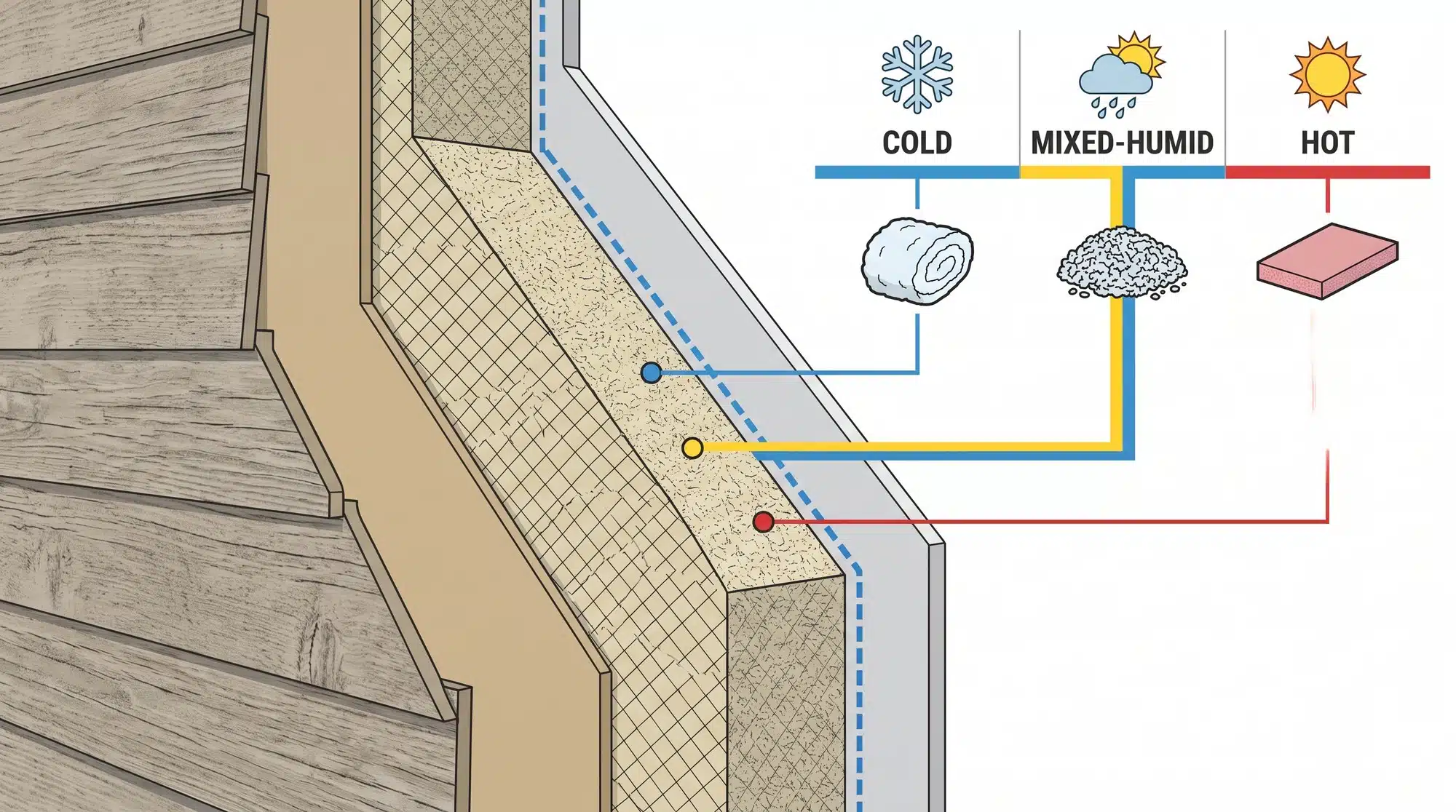
- Vapor barrier requirements: some materials like sheep’s wool serve as their own moisture buffer, eliminating the need for a separate Class I vapor retarder in mixed-humid climates (IECC Zones 4 and 5), saving approximately $0.40 per square foot.
- Thickness and framing: materials with lower R-values per inch (like hempcrete) require thicker wall assemblies, increasing overall construction costs even if the material itself is affordable.
Federal tax credits through the Inflation Reduction Act’s 25C Energy-Efficient Home Improvement Credit can offset up to 30% of insulation costs, capped at $1,200 annually. When combined with state and utility incentives, the effective cost of eco-friendly insulation often drops below conventional alternatives over a 5–10 year period once energy savings are factored in.
Health and Safety: The Least Toxic Insulation Options
For households with children, allergy sufferers, or anyone concerned about indoor air quality, the chemical composition of insulation matters enormously. Conventional fiberglass and spray foams can off-gas formaldehyde, benzene, and isocyanates for years after installation. Eco-friendly alternatives dramatically reduce or eliminate this risk.
The safest options by toxicity category:
- Completely non-toxic, no treatments needed: Sheep’s wool (naturally fire- and mold-resistant), cork (naturally antimicrobial and hydrophobic), and hemp batts (mechanically bonded, no chemical binders). These materials can be installed without gloves or respirators.
- Minimally treated with low-toxicity additives: Cellulose and cotton/denim use borate compounds for fire and pest resistance. Borates are low in acute toxicity for humans, comparable to table salt, but are mild irritants. They do not off-gas VOCs.
- Moderate concern: Mineral wool can cause skin and respiratory irritation during installation, though this is a physical effect (fine fibers) rather than chemical toxicity. Some mineral wool products contain formaldehyde-based binders; look for formaldehyde-free certifications.
- Requires ventilation and professional handling: Icynene and other spray foams off-gas during the curing process and require the home to be vacated for 24–72 hours post-application. Once fully cured, these products are considered inert.
Fire safety: Mineral wool and hempcrete are non-combustible (Class A1). Sheep’s wool is naturally self-extinguishing due to its high nitrogen and moisture content, it will not sustain a flame once the ignition source is removed. Cellulose and cotton are treated with borate fire retardants to achieve Class 1 ratings. Cork contains suberin, making it self-extinguishing. Aerogel and mycelium composites have demonstrated impressive fire tolerance in laboratory testing, with bio-based aerogels achieving UL-94 V-0 ratings, the highest classification for flame retardancy.
Cutting-Edge Innovations: Mycelium, Bio-Aerogels, and Lab-Stage Materials
While the materials above are available for your next renovation, a new generation of insulation materials is emerging from university laboratories and biotech startups, some poised for commercial release within the next 2–5 years.
Mycelium (Fungi-Based) Insulation
Mycelium, the root-like network of fungi, can be grown into rigid, lightweight insulation panels by feeding agricultural waste (hemp shiv, straw, sawdust, and coir) to fungal cultures inside molds. After the mycelium colonizes the substrate, the material is heat-dried to halt growth, producing a stable, inert composite.
The numbers are striking. A 2025 study published in the Journal of Materials Chemistry A demonstrated thermal conductivity as low as 0.015 ± 0.003 W/m·K using Ganoderma lucidum mycelium on coir fiber, a value lower than the thermal conductivity of still air (0.025 W/m·K), meaning the mycelial film itself acts as an exceptional insulator. More typical values range from 0.035–0.050 W/m·K, placing mycelium composites on par with or better than polystyrene foam.
Mycelium insulation is fire-tolerant, naturally hydrophobic, and fully compostable at end of life; it can be broken up and used as garden mulch. A 2026 systematic review in the International Journal of Sustainable Engineering concluded that mycelium-based composites demonstrate “promising thermal performance” and up to 70% lower embodied carbon than conventional insulation, though moisture sensitivity and lack of standardized manufacturing remain barriers to widespread adoption.

The market is moving fast. The global mycelium insulation panel market was valued at approximately $0.3 billion in 2025 and is projected to reach $1.4 billion by 2034 (CAGR 18.5%). Ecovative Design, Biohm, and Mycelium Materials Europe are leading commercial development. In April 2026, New York City approved its first residential building using mycelium insulation panels, a 12-unit development in Greenpoint, Brooklyn, with occupancy expected by late 2026. IKEA announced its first mycelium-based panel system for residential interiors the same month.
Bio-Based Aerogels
Aerogels have been called the “superman of insulation,” with thermal conductivity as low as 0.012 W/m·K, they outperform every conventional insulation material by a factor of two to three. Traditional silica aerogels are expensive and energy-intensive to produce, but bio-based aerogels made from cellulose, sodium alginate (from seaweed), and other renewable polymers are changing the equation.
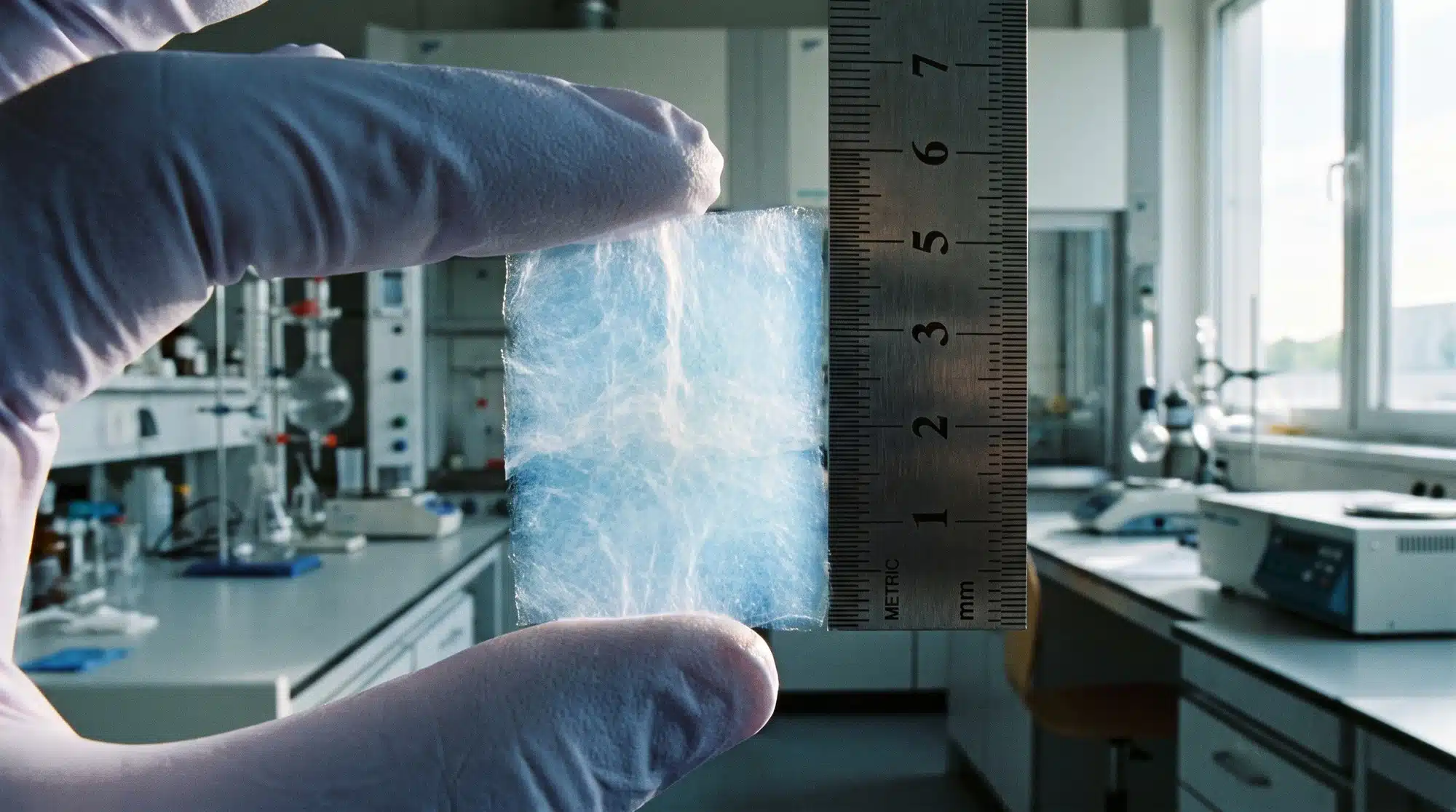
A 2025 study in the International Journal of Biological Macromolecules developed a fully bio-based sodium alginate aerogel with a limiting oxygen index exceeding 60% (effectively non-flammable), a UL-94 V-0 rating, and thermal conductivity of 0.039 W/m·K, competitive with conventional foam insulation while being entirely renewable and biodegradable. A 2026 Frontiers in Sustainability paper reported hemp-lime composites incorporating aerogel achieving thermal conductivity as low as 0.020 W/m·K, approximately four times better than standard hempcrete.
ETH Zurich spin-off Aeroskin Tech is commercializing aerogel-based spray plaster and insulating boards that deliver 2–2.5 times the insulation performance of conventional materials at one-third the thickness: roughly 10 centimeters of Aeroskin material achieves the same insulation level as 30 centimeters of rigid foam board. The company is targeting both new construction and retrofit applications, with products expected to enter the European market within 2–3 years.
Other Emerging Materials
Several additional materials are progressing through research pipelines:
- Straw bale insulation. One of the oldest building materials is being re-engineered. Modern compressed straw panels achieve R-1.5–2.0 per inch and cost just €7–€10 per square meter ($0.80–$1.10 per square foot), making them among the cheapest biobased options. Research is focused on improving fire resistance and moisture durability through mineral additives.
- Recycled PET and textile waste insulation. Plastic bottles are melted and spun into polyester fiber batts. These divert waste from landfills (a single 4×8-foot batt uses approximately 50 recycled bottles), are fully recyclable, and cost $1.50–$2.50 per square foot. The downside is that they are still petroleum-derived at the molecular level.
- Novel mixed-mycelium fabrication. A 2025 ACS Sustainable Chemistry & Engineering paper introduced a method that skips the 10+ day fungal colonization period, instead directly mixing mycelial inoculum with substrate for one-step drying and molding. This process preserves substrate structure, reduces production time dramatically, and yields compressive strength of 0.48 MPa, suitable for non-load-bearing insulation panels.
How to Choose the Right Insulation for Your Home
With so many options, selection paralysis is real. These decision criteria will narrow your choices:
Climate zone: In cold climates (IECC Zones 5–8), prioritize high R-value per inch to minimize wall thickness; mineral wool or dense-pack cellulose are strong candidates. In mixed-humid climates (Zones 3–4), moisture-buffering materials like sheep’s wool and wood fiber add real value by reducing condensation risk. In hot, humid climates (Zones 1–2), cork’s inherent hydrophobicity and rot resistance make it uniquely suited.
New build versus retrofit: For new construction, you have complete freedom. Hempcrete, cork board, and wood fiber can be designed into the wall assembly from the start. For retrofitting existing walls, blown-in cellulose and dense-pack methods allow installation without removing drywall. Batt insulation (hemp, wool, or cotton) works well for attic floors, crawl spaces, and exposed wall cavities during renovation.
DIY versus professional installation: Batt products (hemp, wool, cotton, and mineral wool) are DIY-friendly, requiring only basic tools and protective equipment. Blown-in cellulose requires a rental machine but is still manageable for experienced DIYers. Hempcrete, spray foam, and aerogel products require trained professionals.
Budget: At the affordable end, cellulose ($1.40–$1.90/sq ft) and wood fiber ($1.80–$2.50/sq ft) deliver excellent performance at a modest premium over fiberglass. At the premium end, sheep’s wool ($3.80–$5.20/sq ft) and cork ($3.50–$4.50/sq ft) offer unique properties. Moisture management, acoustic performance, and complete freedom from synthetic chemicals justify the investment in high-performance or health-focused builds.
Frequently Asked Questions
What are eco-friendly ways to insulate your home?
The most common eco-friendly insulation methods include installing cellulose (recycled paper), sheep’s wool batts, cotton/denim batts, cork boards, hemp batts or hempcrete, and wood fiber boards. Beyond materials, eco-friendly insulation also means air-sealing your home properly. Even the greenest insulation underperforms if wind washes through gaps around windows, outlets, and penetrations. Combining material choice with meticulous air-sealing delivers the best energy and carbon savings.
What is the healthiest type of home insulation?
Sheep’s wool, cork, and hemp batts are widely considered the healthiest insulation options. All three contain no synthetic binders, emit zero VOCs, require no chemical flame retardants (wool and cork are naturally fire-resistant), and can be handled without protective equipment. Sheep’s wool additionally absorbs indoor air pollutants like formaldehyde and VOCs through a process called chemisorption, actively improving indoor air quality rather than just avoiding harm.
What is the most non-toxic insulation?
Cork board insulation arguably takes the title of most non-toxic. It requires no chemical treatment whatsoever, not for fire resistance, not for pest control, not for moisture management. The suberin naturally present in cork renders it hydrophobic, fire-resistant, and rot-proof without any additives. It is also naturally antimicrobial and does not shed fibers or particles into the indoor environment. Sheep’s wool and untreated hemp batts are close contenders, with the caveat that some wool products contain a small percentage of polyester binder.
What can I use instead of insulation?
While no building material fully replaces the thermal function of dedicated insulation, several strategies can reduce the amount of insulation needed or complement thinner insulation layers. Structural insulated panels (SIPs) and insulated concrete forms (ICFs) integrate insulation and structure into a single system. High-thermal-mass materials like rammed earth and thick masonry walls absorb and slowly release heat, moderating temperature swings, though they do not replace insulation in cold climates. Double-stud walls and Larsen truss assemblies create deeper wall cavities that can accommodate more natural insulation at lower R-values per inch. The most impactful “alternative” is often simply better air-sealing, which can improve the effective thermal performance of any insulation system by 20–30%.
How long does eco-friendly insulation last?
Most natural insulation materials last 50 years or more when properly installed and protected from moisture. Hempcrete structures have a projected lifespan exceeding 100 years, as the lime binder continues to carbonate and strengthen over decades. Cork and mineral wool are similarly durable at 50+ years. Cellulose and cotton have a 30–50 year expected lifespan, comparable to fiberglass. The limiting factor for most insulation is not material degradation but moisture intrusion; proper detailing around windows, roofs, and foundations is essential regardless of material choice.
Is eco-friendly insulation more expensive than fiberglass?
Yes, upfront. The installed cost of most eco-friendly options ranges from 15% to 300% more than basic fiberglass batts ($0.95–$1.30/sq ft). Cellulose is the closest to price parity at $1.40–$1.90/sq ft. However, the total cost of ownership often favors eco-friendly materials when you account for: superior moisture management (fewer mold and rot repairs), longer lifespans (no replacement at year 30), better air-sealing characteristics (lower energy bills), and federal tax credits covering up to 30% of costs. A 2026 cost analysis estimated that hemp batt insulation achieves payback within 4–7 years in most US climate zones when energy savings and tax credits are combined.
Conclusion
Eco-friendly insulation has evolved from a niche ideal into a practical, performance-competitive category. Cellulose offers a carbon-negative upgrade over fiberglass at a near-identical price. Hemp and wood fiber deliver European-engineered performance that meets Passive House standards. Cork and sheep’s wool provide premium, multi-functional solutions for health-conscious builders. And on the horizon, mycelium panels and bio-aerogels promise to redefine what insulation can achieve: thinner, greener, and grown rather than manufactured.
The best eco-friendly insulation is the one that fits your climate, your budget, and your building. What has changed is that you no longer need to compromise on performance, safety, or cost to make an environmentally responsible choice.


