
Rapid urban expansion in Kenya places immense pressure on a formal market that currently struggles to provide units at the necessary volume. As the Kenya housing deficit exceeds two million homes, annual production continues to fall far short of estimated demand.
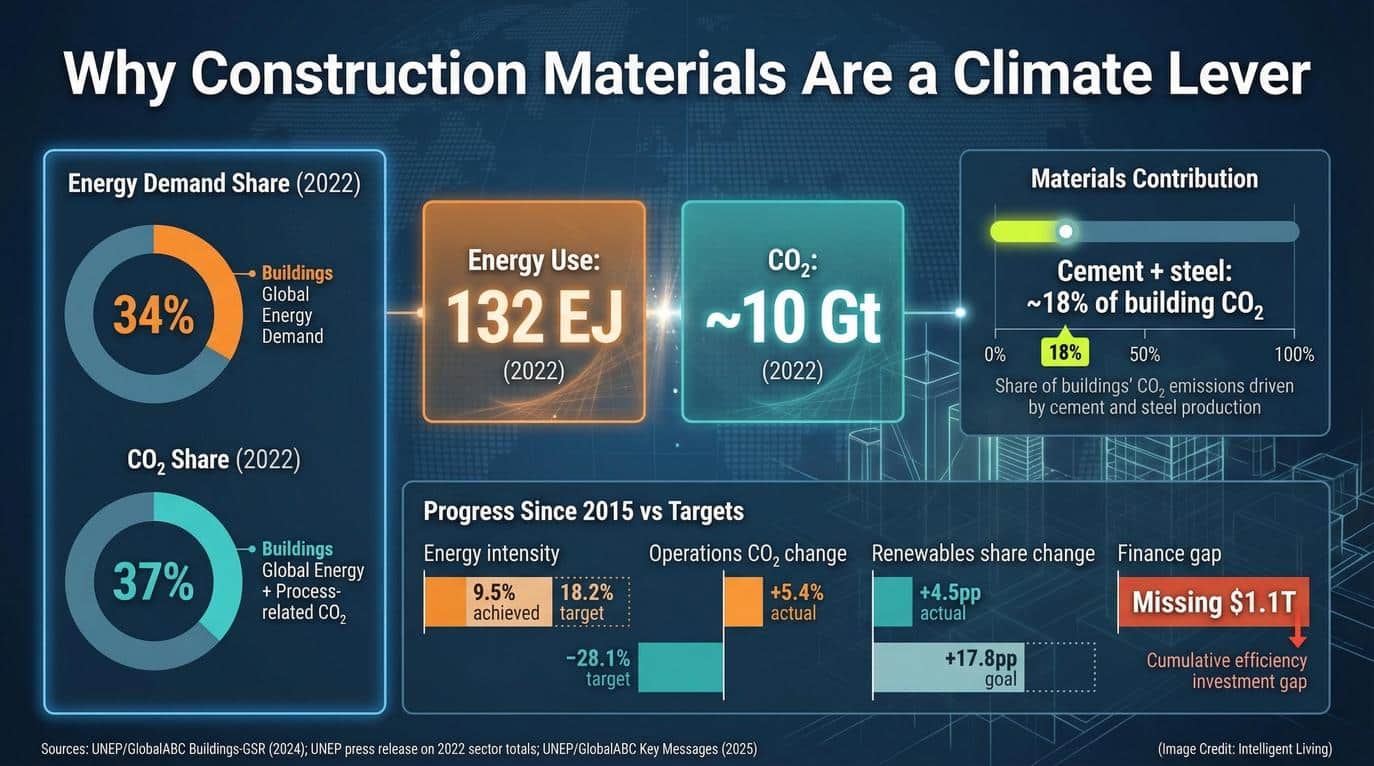
Traditional building methods across the world impose a steep environmental toll. UNEP reports that buildings accounted for 34 per cent of global energy demand and 37 per cent of energy- and process-related carbon dioxide emissions in 2022. Material selection for structural and insulating components serves as the primary driver of building expenses and the enduring environmental legacy of city infrastructure.
Responding to these economic and ecological pressures, MycoTile, a Nairobi-based innovator, utilises an unconventional resource: fungal mycelium. Instead of mining, firing, or heavily processing raw materials, the company grows composite mycelium building panels from farm by-products.
The idea is straightforward yet ambitious. If insulation and interior wall panels can be grown from crop waste at a lower cost and with lower embodied carbon, housing could become both more affordable and more sustainable. In the same spirit, green cement and concrete innovations demonstrate how the most carbon-intensive parts of construction can be rethought without changing what a safe home feels like.

Affordable Housing Innovation in Kenya: Key Facts on Mycelium Building Panels and Construction Emissions
Quick Facts
- Kenya faces a housing deficit of over two million units, with an annual supply of under 50,000 homes compared to a target of roughly 200,000 per year.
- Buildings and construction were responsible for 34 per cent of global energy demand and 37 per cent of energy- and process-related carbon emissions in 2022.
- MycoTile is reported to produce about 3,000 square metres of mycelium-based panels per month using approximately 250 tonnes of agricultural waste per year.
- Peer-reviewed studies suggest mycelium composites can reach thermal conductivity values around 0.035 to 0.05 watts per meter kelvin, a range comparable to common insulation materials in laboratory settings.
A Home Built from what Farms Throw Away
A 15-square-metre home in Nairobi has already used panels grown from farm byproducts and fungal mycelium. During a successful Nairobi pilot build, the homeowner invested approximately 26,880 Kenyan shillings—roughly 208 US dollars—into these innovative mycelium building panel wall systems. This investment proves that affordable wall alternatives are achievable without relying on imported plastics or synthetic foams. These figures offer a practical alternative that resonates more than a generic sustainability slogan.

The Affordable Housing Reality Kenya Can’t Build Around
Affordable housing in Kenya is squeezed from two sides at once. Demand rises as cities expand, while formal supply struggles to keep up, leaving many households to self-build in stages or rent in informal settlements. Local economic conditions dictate whether a family can complete a safe room this year or must postpone the project indefinitely due to the rising price of basic materials.
The Scale of The Housing Gap
Kenya’s persistent housing shortage reflects a long-term structural imbalance rather than a temporary market fluctuation. A World Bank estimate of Kenya’s housing supply gap puts annual need at roughly 200,000 new homes, while formal supply remains under 50,000 units.
The simultaneous escalation of material, logistics, and labour costs disproportionately impacts entry-level housing, placing stable shelter further out of reach for vulnerable families. Comprehensive economic analysis further links this deficit to the high percentage of urban households currently residing in informal settlements, which is why low-cost construction materials matter beyond spreadsheets. For a small contractor pricing a single-room extension, even minor swings in cement, steel, and insulation pricing can change whether the project stays viable.
Why Materials Shape Affordability
Materials dictate affordability across two critical stages: upfront purchase and long-term operation.
- Initial Acquisition: Heavier components increase transport and labour costs during the build.
- Operational Savings: High-performance insulation reduces monthly electricity bills over time.
Selecting appropriate building composites ensures that long-term home ownership remains a viable goal for low-income families. Economic necessity compels developers to revisit local solutions like 3D-printed clay homes, which leverage native soil to eliminate the high costs of international supply chains.
Lightweight mycelium building panels can also reduce the number of vehicle trips needed for a build, which lowers transport costs in cash terms and reduces construction emissions in practical terms. In local neighbourhoods, the primary concern rarely involves complex carbon accounting. Instead, residents focus on achieving thermal comfort without the burden of escalating monthly utility bills.

The Science of Mycelium: Engineering Bio-Based Building Composites
The New Factory is A Farm
Mycelium is the root-like network of fungi that naturally binds organic matter. In controlled production, it can fuse agricultural residues into rigid panels. Utilising sugarcane residue streams and other agricultural byproducts provides a high-volume feedstock for sustainable mycelium building panel composite manufacturing. The production process utilises various agricultural residues as primary feedstocks:
- Sugarcane Bagasse: A fibrous byproduct of sugar milling.
- Coffee Husks: Abundant waste from Kenya’s extensive coffee industry.
- Maize Cobs: High-volume residues from local staple crops.
The manufacturing process follows a precise biological sequence:
- Cleaning and preparing agricultural residues.
- Placing the prepared material into specialised moulds.
- Inoculating the mixture with fungal mycelium.
- Drying the composite to stabilise the natural binder.
This controlled method replaces industrial synthetics with biological growth. Technical precision is vital during the manufacturing stages, specifically regarding consistent particle size, moisture regulation, and uniform curing, because insulation performance changes when density changes.
This fits the same efficiency logic as passive house design, where local, low-toxin materials lower energy demand without relying on high-emissions manufacturing. Mycelium has also served as a binder in experimental builds, including sustainable bricks bound with mycelium for interior wall components.

Comfort You Can Grow: Do Mycelium Panels Keep Homes Cooler, Quieter, and Safer?
Insulation in Plain Terms
Insulation performance is often described by thermal conductivity, measured in watts per metre kelvin. Lower values generally mean better resistance to heat flow. A 2025 peer-reviewed study reported mycelium–coir composites reaching thermal conductivity around 0.035 W/m·K. Similarly, another study identified 0.039 to 0.05 W/m·K prototypes, though these results were accompanied by specific moisture and strength challenges. Performance data suggests that mycelium building panel insulation effectively competes with traditional materials, provided that durability is integrated throughout the engineering phase.
Fire and Moisture Reality Check
Safety claims require evidence. Scientific Reports research found mycelium’s lower peak heat release compared to common polymers in controlled fire testing. However, lab behaviour must still translate into successful code-level testing within occupied buildings. Some fire-resistant insulation materials can also form a protective char layer under heat, which helps explain why mycelium can behave differently from many plastics.
Moisture management remains a significant hurdle. Scientific reviews identify durability as a critical milestone for the widespread adoption of bio-based building composites in high-humidity climates. A moisture-aware wall strategy is already familiar in natural building, where hempcrete is used to avoid trapping dampness inside walls.
Everyday Comfort, Not Just Lab Numbers
Comfort is also about noise and indoor air. In tight urban settings, lighter fibrous materials can reduce echo and soften outside sound. Even compact builds like tiny homes rely on insulation choices to feel liveable. When comparing options, builders and homeowners evaluate natural panels against recyclable alternatives to rubber and foam, alongside conventional insulation standards.
The Hidden Climate Lever: Construction Emissions and The Material Layer
Construction emissions are often treated as a global issue, yet they show up locally as higher material prices and heavier supply chains. The carbon embedded in cement, steel, and foam insulation is created upstream through energy-intensive production, then paid for downstream through cost and climate risk. When a fast-growing city builds millions of square metres of walls and roofs, small changes in material choice can add up to large changes in cumulative emissions and long-term energy demand.
Why Materials Drive Carbon and Cost
The climate impact of housing starts long before anyone moves in.
Mounting industrial emissions highlight the vital role of hybrid waste concrete and biogenic limestone fillers in mitigating the construction sector’s ecological footprint. UNEP’s buildings and construction emissions report links a large share of global energy demand and emissions to how buildings are made and operated.
Africa’s housing shortfall estimate exceeding 50 million units highlights how quickly conventional construction could lock in high-emission pathways.
What Scaling Looks Like in The Real World
Standardised manufacturing practices enable sustainable construction firms to replace conventional products with bio-based materials within a functional circular economy. Scaling mycelium building panels means building a supply chain that behaves like manufacturing, not a one-off demo. The same constraint shows up in modular systems like solar shipping container dorm modules and public infrastructure mixes such as footpaths and roads built with recycled plastic and glass aggregates.
Diverse circular materials are already proving their viability across the industry:
- Recycled Construction Blocks: Solutions like unfired bricks and plastic waste bricks leverage debris for structural components.
- Waste-Based Aggregates: Recycled tyre graphene and shrimp shell waste serve as engineered inputs to strengthen concrete.
- Alternative Concrete Components: Innovations like rubber-aggregate concrete demonstrate the potential of repurposing unrecyclable waste for building codes.
Institutional capacity matters as well. The Kenya Industrial Research and Development Institute is one example of the infrastructure startups often need for testing, tooling, and consistent production. Adoption ultimately depends on third-party validation and builder trust, the same kind of standards pathway as is implied by rubber-aggregate concrete that meets building codes.

From Pilot to People: Jobs, Policy, and Public Trust
Transitioning from a successful pilot to a widespread housing solution requires seamless integration into the daily routines of builders and homeowners. Predictable supply, fair pricing, and professional installers who can work with the product safely and consistently are essential. It also means public trust in the systems that finance housing and the standards that certify new mycelium building panel materials, because families and builders carry the downside risk when something fails.
Sustainable Mycelium Building Panels and Africa’s Affordable Housing Future
To reach thousands of families, new housing materials must integrate with existing financial and delivery systems. The affordable housing law enacted in 2024 establishes the necessary levy-funded structure to support large-scale sustainable initiatives. The Affordable Housing Program framework outlines delivery channels, while the Kenya Revenue Authority’s Affordable Housing Levy collection notice sets out contribution and remittance mechanics that influence what is possible at scale.
The successful implementation of plastic-brick classrooms demonstrates how waste-to-infrastructure transitions function in practice. The same principle is visible in resilience-orientated housing such as a hurricane-resistant home where engineered waste becomes a structural component.
Utilising agricultural residues for mycelium building panel insulation provides a multifaceted solution for expanding African cities:
- Optimised Budgets: Lowering upfront construction costs through local waste upcycling.
- Thermal Habitability: Enhancing indoor comfort through high-performance natural insulation.
- Environmental Impact: Radically reducing the embodied carbon of new residential developments.
This integrated approach ensures that future housing is both economically accessible and ecologically responsible.

Frequently Asked Questions About Mycelium Building Panels and Sustainable Construction
Are mycelium-building panels used for structural support?
MycoTile panels are primarily engineered for green building insulation and interior wall applications rather than load-bearing structural support.
How do these panels impact the Kenya housing deficit?
By utilising agricultural waste upcycling, these panels lower material costs, making entry-level homes more accessible to low-income households.
Do mycelium composites perform well as green building insulation?
Yes, peer-reviewed tests show their thermal conductivity is competitive with traditional foam, keeping homes naturally cooler in tropical climates.
Is fungal mycelium fire-resistant for residential use?
Mycelium naturally forms a protective char layer when exposed to heat, offering superior fire resistance compared to many synthetic polymers.
Can mycelium wall systems withstand high humidity in Kenya?
While moisture resistance is a challenge for bio-composites, proper sealing and breathable wall designs allow these panels to function effectively in humid environments.


