
England’s Glyndebourne Opera in East Sussex will soon install a new sustainable pavilion made from otherwise discarded oyster shells, lobster shells, and wine bottle corks.
History
The Glyndebourne Opera is part of an English country house thought to be about six hundred years old that, since 1934, has been open to the public as an opera house.
Its owners previously installed a 219ft (67m) wind turbine that provides more than enough power for the site, and now they are looking to dive deeper into sustainability.
Structure
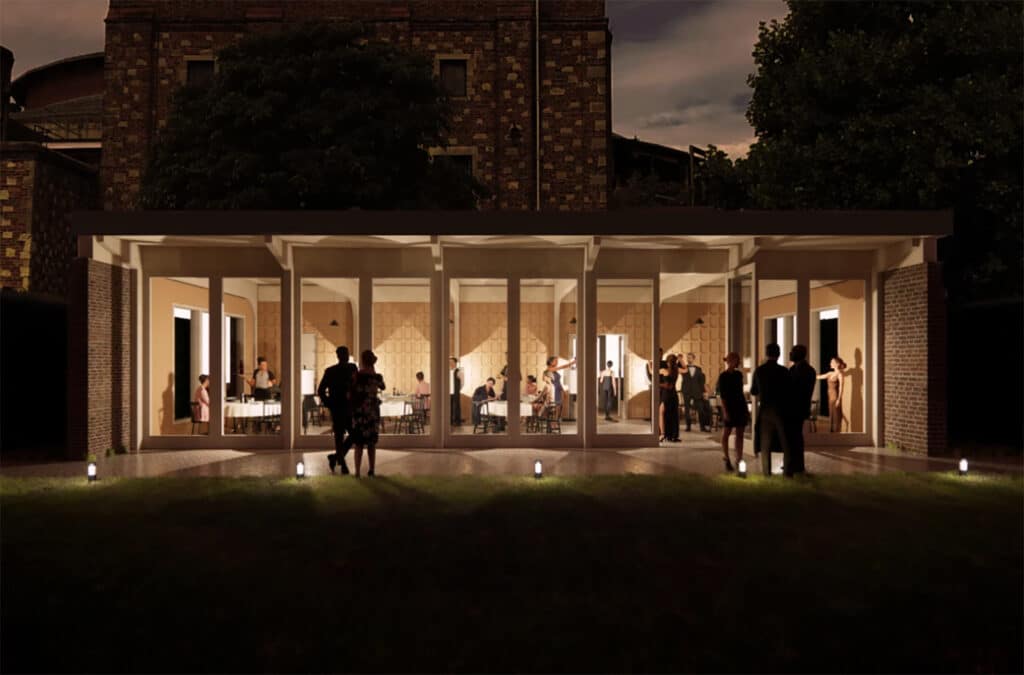
The planned pavilion, designed by BakerBrown Studio, is called the Glyndebourne Croquet Pavilion. The overall design and construction will involve collaborators Braden Timber Structures, Local Works Studio, and Elliot Wood.
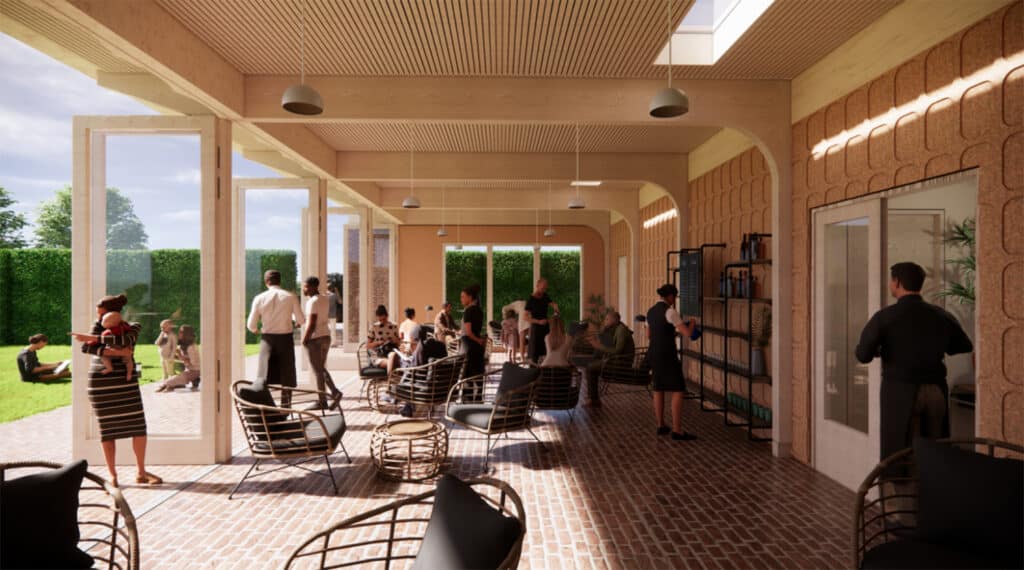
The pavilion will comprise a single-story structure overlooking the South Downs National Park and include a bathroom, kitchen, and seating. It will be constructed to be easy to disassemble, allowing the materials to be harvested again in the future if needed.
Materials
Cork will be collected from the wine bottles opened during this year’s opera season and bound with mycelium from mushrooms to form the bricks used in the pavilion’s interior walls. Food waste comprising lobster shells and oysters will be collected and stowed during the season to be turned into exterior wall tiles.
The pavilion will also make use of local chalk and waste glass. It will use local, sustainably sourced diseased Ash timber to make glued laminated timber, and the insulation will be partially made out of mycelium.
BakerBrown said in a press release:
Underfired bricks from a local brickyard will be used for the interior floor finish. But perhaps the most unusual element will be the building’s insulation. A mycelium mix provided by Biohm will use the site’s grass clippings to grow insulation panels that will perform as well as the best petrochemical products on the market while having its own end of life strategy; it will become compost and not a non-degradable health hazard that is taken to the landfill.
Plans
The Glyndebourne Croquet Pavilion is scheduled to begin construction in September and is expected to be complete by March 2022.
Other Sustainable Pavilions
Last year, we saw several stunning pavilions that integrate sustainability into luxury at the Balinese Ulaman Eco-Retreat. The pavilions and entire eco-retreat are made chiefly from bamboo found directly on the site and the immediate locality, resulting in a carbon-neutral resort.
The resort’s ground-level walls are made with rammed earth, an excellent eco-friendly concrete alternative. Rammed earth is traditionally made out of clay-rich soil, natural stabilizers like animal urine or blood, plant fibers, and water, which is firmly packed down.


