
Every winter, homeowners and renters face the same dilemma: tolerate cold rooms or inflate utility costs with inefficient space heaters. The need for targeted, energy-efficient comfort is critical in older structures, particularly where centralized systems fail to provide stable room temperatures and heating energy savings. You need a practical, dual-purpose appliance capable of reliable year-round climate control that minimizes installation hassle and maximizes thermal energy transfer.
The packaged window heat pump has quickly emerged as the optimal solution, operating with the same simple setup as a standard window AC but offering reversible, two-season functionality. By using the refrigeration cycle, which focuses on moving heat instead of creating it, these units provide both heating for cold weather and cooling in one compact design.
This straightforward, single-window upgrade is proven in field trials to dramatically cut energy consumption while giving residents precise, on-demand room control, making it a compelling alternative to two separate appliances.
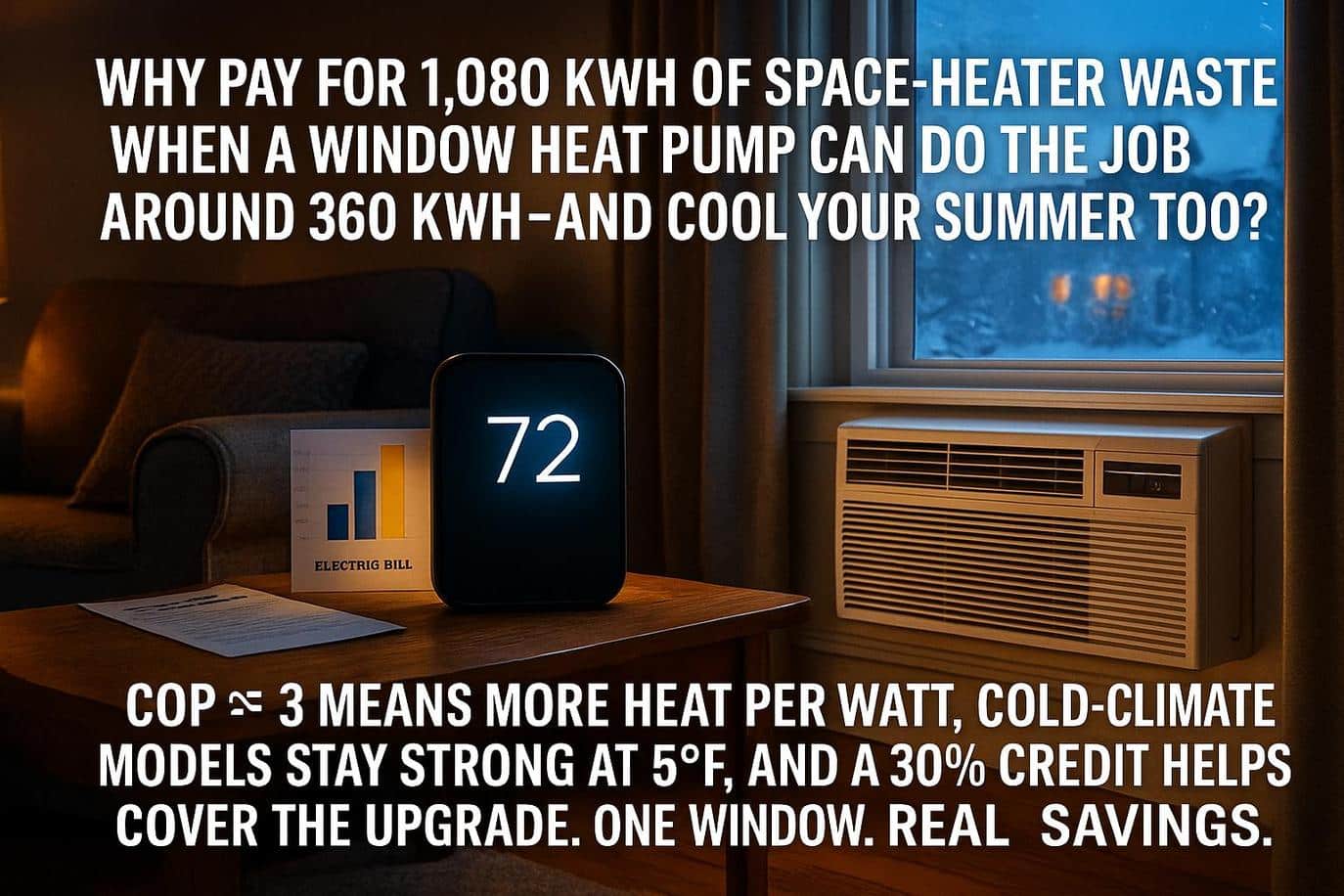
Quick Facts: Window Heat Pump Costs, Comfort, and Cold-Climate Performance
To grasp the full benefits of a window heat pump, review these key specifications. They clearly show how this single appliance delivers both cold-climate performance and long-term heating energy savings in a simplified, targeted form.
- Definition: A single packaged unit hangs over a window and moves thermal energy using a reversible refrigeration cycle. It provides heating and cooling for one room with no major construction.
- Efficiency Advantage: Heat pumps transfer heat instead of generating it, often delivering around three or more units of heat per unit of electricity compared to a space heater’s one-to-one output. Consequently, many households see lower winter usage when switching targeted rooms to a heat pump.
- Cold-Climate Capability: New models meet ENERGY STAR cold-climate criteria and maintain a large share of heating capacity at 5°F. Some packaged window units in pilots delivered strong savings in New York conditions.
- Price Reality: Basic window heat pumps exist at lower prices, but the advanced cold-climate packaged units that combine design, low noise, and cold performance are typically in the $2,800–$3,800 retail range, with costs falling in bulk procurements.
- Installation: Install time can be under an hour for some units when site conditions are suitable. Many users still benefit from a two-person lift and careful sealing around the unit for best results.
- Incentives: U.S. households may qualify for the Energy Efficient Home Improvement Credit worth 30% of qualified costs up to annual limits, with additional state or utility rebates in some regions.
- Best Pairing: The upgrade works even better when combined with basic insulation, focusing on targeted winter draft-sealing techniques so the warmed air stays in the room longer.

What is a Window Heat Pump, Really?
A window heat pump is a compact, all-in-one heat pump designed to sit over a window opening. Functioning like a reversible air conditioner, a window heat pump absorbs heat from outdoor air and moves it indoors during winter, while in summer, it reverses the process to expel indoor heat outside.
Since it moves thermal energy rather than producing it via electrical resistance, the unit consumes significantly less energy for equivalent comfort.
How it compares to other options:
Comparing the packaged window heat pump to common alternatives highlights its unique value proposition as a targeted comfort solution. The core difference lies in the unit’s ability to provide high efficiency in both heating and cooling from a single, low-impact installation.
- Space Heater: Simple to use, but every watt fed to it yields only one watt of heat, whereas a heat pump delivers multiple units of thermal energy per unit of electricity for superior comfort per kilowatt-hour.
- Window AC: This option cools only. A window heat pump does both heating and cooling with a similar footprint, meaning one appliance replaces two separate units.
- Mini-Split or Central Heat Pump: These whole-home systems efficiently serve multiple rooms but require professional installation and higher upfront costs. Conversely, a window unit is room-scale, renter-friendly, and ideal for targeted spaces such as a bedroom, home office, or living room.
Deployment in Public Housing: Real-World Use Cases
Public programs tested and refined packaged window heat pumps to meet the constraints of older buildings and rentals. In New York pilots, staff were trained to install units quickly, and early results led to scaled procurement plans for public housing. That same efficiency also demonstrates how heat pumps are better for the environment than furnaces since they move heat instead of producing it through resistance.
Replacement Solution: Space Heater and Window AC
If you already rely on a space heater plus a window AC, a single window heat pump is a direct, easy-to-understand replacement that often uses far less electricity across the year.

Energy Advantage: Why Window Heat Pumps Exceed Space Heaters
Higher Efficiency per Kilowatt-Hour
Heat pumps move thermal energy rather than making it from scratch. That physics advantage is why one room warmed by a heat pump often needs significantly less electricity than the same room heated by a resistance unit.
In older buildings with leaky radiators or overheated rooms, switching a target room to a controllable heat pump can significantly lower energy waste and provide better comfort.
Early consumer testing of a modern packaged window unit documented fast installation and stable room temperatures through freezing conditions. Crucially, the same unit also handled summer cooling later in the year. That dual-purpose design replaces two appliances with one and lowers clutter and noise in the space.
In New York’s Clean Heat for All work, packaged window heat pumps achieved large heating energy reductions in monitored apartments. The units were designed to fit common window types, plug into standard electrical service where appropriate, and keep disruption low for residents. These design choices make this upgrade highly practical for renters and small-home owners.
Essential Upgrades: Combining Window Heat Pumps with Insulation
Pairing with fabric-first basics is essential to getting the most out of any heat pump by reducing your room’s heat loss. Start with caulking and weather-stripping, then check attic levels and window condition.
For practical guidance on understanding R-value for attic insulation and reviewing evidence from UK green homes easing grid peaks, these steps clarify how fabric-first measures amplify performance.
Product Safety and Due Diligence Checklist
Products evolve in this fast-moving category. For example, a popular U-shaped air conditioner from the same brand family was recalled in 2025 for mold concerns unrelated to the new packaged window heat pump line. This reminds shoppers to always check current recall notices, installation guides, and maintenance steps before purchasing. Shoppers must review issues like the 2025 U-shaped air conditioner recall over mold exposure.
Practical Comfort and Electricity Savings
A window heat pump delivers more heat per unit of electricity, precise room-by-room control, and all-season usefulness. For many households, it is the most practical first step into heat pump comfort.

Do Window Heat Pumps Actually Work in Real Winters?
New Standards for Cold-Climate Performance
The ENERGY STAR cold-climate recognition requires heat pumps to maintain strong output at 5°F and achieve a qualifying efficiency at low temperatures. This provides shoppers with a clear way to identify models designed for real winter conditions.
Field data from public housing. NYSERDA’s field measurement and verification report analyzed packaged window units installed in a Queens development. The study found over 75% heating energy savings per square foot in the first winter season, based on monitored apartments in a typical multifamily setting. Those outcomes helped justify larger procurements designed to reach tens of thousands of residences over time.
Early Adopter Experience: Installation and Noise
A hands-on review of a packaged window heat pump described installation in under an hour, quiet operation, and dependable heating through freezing stretches in upstate New York, with summer cooling handled by the same appliance.
Matching the Unit to Your Climate
If your winters regularly dip well below freezing, choosing a model specifically rated for cold climates is essential. Confirm your window type, electrical circuit, and room size match the manufacturer’s guidance. For renters, this upgrade can deliver control and year-round comfort without waiting for a whole-building retrofit. For larger projects, a complete geothermal heat pump guide explains when ground-source systems make sense.
Window heat pumps are unlikely to replace every boiler or central system, but their plug-and-play convenience and targeted comfort establish them as a reliable option for many apartments and single rooms. With incentives, improved insulation, and careful product selection, this single-window unit significantly enhances home comfort while minimizing heating costs.
Installation Guide: Sizing, Setup, Noise Reduction, and Checklist
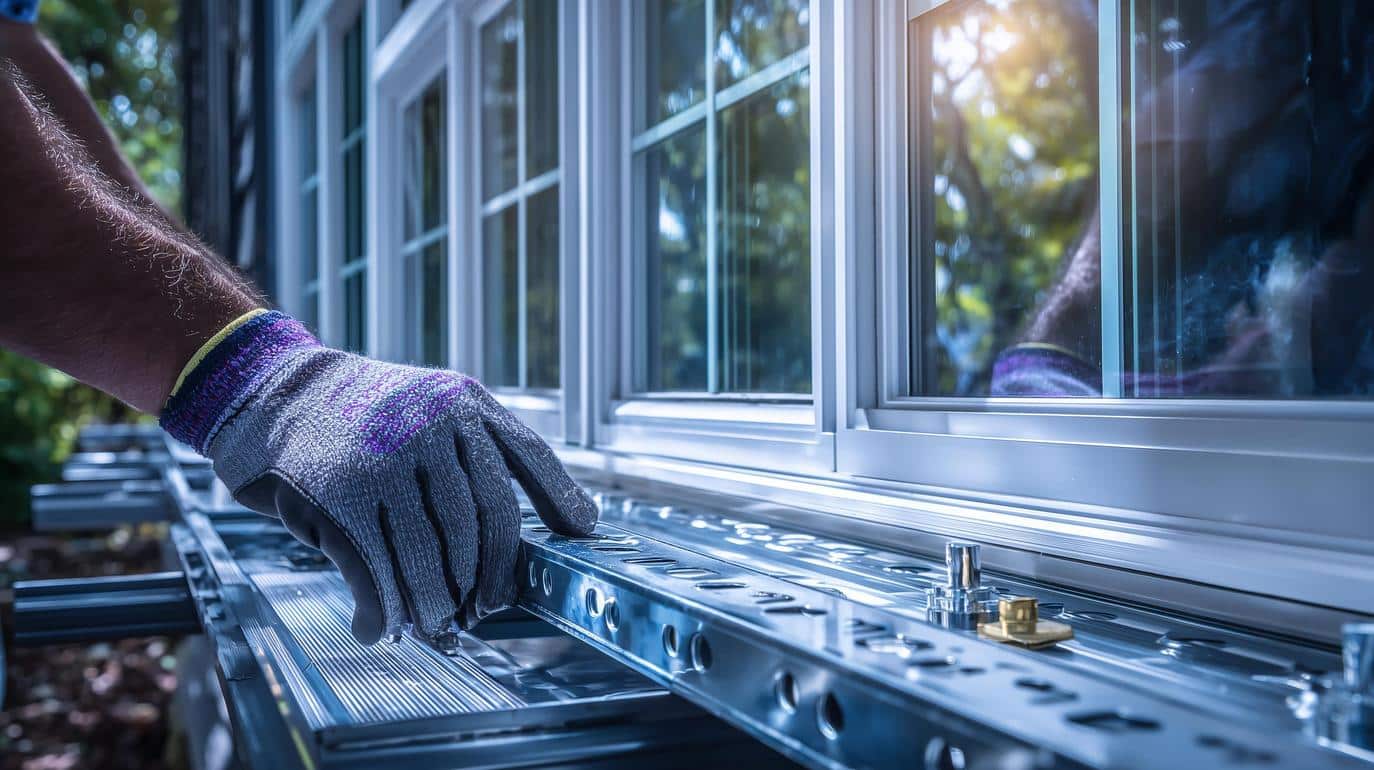
A window heat pump works best when the room and window profile match the unit. Size the unit according to the floor area and exposure, and ensure that there is a sturdy double-hung sill for the bracket and that a two-person lift is possible. Select capacity using the manufacturer’s tables at 47°F, 17°F, and 5°F so output covers your coldest nights.
Tight sealing and trim stop drafts. Pairing the install with roof and insulation efficiency basics locks in warmth. Layouts from biophilic home design hacks help reduce noise and vibration.
Site Audit, Sizing, and BTU Selection
Before you lift a unit onto the sill, run a quick site audit. Map the airflow path so warm air can circulate. Leave several feet of clearance in front of the discharge, and undercut doors for return air if the room is closed off. Avoid oversizing—short cycling reduces efficiency and comfort and negatively impacts the seasonal COP.
Use the manufacturer’s room-size and design-temperature tables; as a practical guide, small bedrooms around 150–250 square feet often pair with 6,000–9,000 BTU classes at 17°F, while 300–450 square-foot living rooms commonly need 9,000–12,000 BTU. For cold-climate models, prioritize published output at 5°F.
Tactics for Noise Reduction and Quiet Operation
To keep bedrooms quiet, look for low-fan sound levels in the low 40 dB range. Add vibration pads under brackets, seal with backer rod plus low-expansion foam, and finish with exterior-grade flashing tape or acrylic caulk to block wind.
Buyer Checklist:
- 120-volt outlet on a suitably rated circuit and room-specific thermostat control.
- Double-hung window with adequate depth; adapters for sliders or casements only if the manufacturer supports them.
- Clear condensate path to the outdoors and exterior kept free of snow and debris.
- Goals align: quieter, more even heat, summer cooling, and room-by-room control without whole-home work.

Costs, Incentives, and Renters: Low-Cost Window Heat Pumps with Public-Housing Proof
Upfront prices range from a few hundred dollars for basic units to about $2,800–$3,800 for cold-climate designs. Life-cycle evidence from the ACEEE life-cycle cost study and an apartment-scale heating cost analysis shows that packaged window units can be the lowest-cost non-fossil option when deep retrofits are unrealistic.
Operating savings come from physics—moving heat rather than making it. This process is fully explained in the International Energy Agency’s overview of how heat pumps work. Incentives help: the Energy Efficient Home Improvement Credit can offset qualifying costs, with some utilities and states adding rebates.
A room currently relying on a 1.2-kilowatt space heater for six hours a day over a 120-day season consumes approximately 864 kWh. A window heat pump delivering a seasonal COP near 2.7 needs roughly 320 kWh for equivalent comfort, resulting in a saving of about 544 kWh.
At $0.18 per kWh, the winter savings land near $98; at $0.30 per kWh, they approach $163. Add summer cooling efficiency and shoulder-season gas reduction, and total annual savings can easily exceed $200.
With the federal credit, a $3,000 cold-climate unit nets around $2,100 before local rebates. Depending on climate, electricity rates, and run hours, the simple payback period typically ranges from 6 to 10 years.
Public Housing Pilots and Renter Application
For renters, the category is proven at scale. New York’s Clean Heat for All initiative deployed packaged window heat pump units in public housing to cut heating energy while adding cooling.
Productive landlord talks focus on safety, peak-demand relief, and clear cost sharing, supported by practical steps from sustainable tenancy habits.

Renter-Friendly Window Heat Pumps for Climate Control
The global energy landscape confirms that heat pumps will continue to serve a rising share of building heat worldwide, and the packaged window heat pump is the crucial entry point for apartments and smaller spaces. While central and ductless systems remain the choice for whole-home retrofits, window models provide a low-disruption path to targeted comfort and cooling where budgets are tight or major electrical upgrades are impractical.
The convergence of easier installation and inherent renter appeal solidifies this unit as a common appliance category for the future. Policy movements and price dynamics, including factors like regional bill trends in Texas, will continue to influence how quickly this shift occurs. However, the core value proposition—reliable, year-round comfort delivered through a simple window bracket—is strong enough to overcome market volatility.
Convenience ensures that cold-climate heat pump technology in a window format will become increasingly normal in dense urban settings with older building stock. If you are ready to swap two single-season appliances for one highly efficient, dual-purpose unit, now is the time to explore a certified model.
Frequently Asked Questions About Window Heat Pump Technology
Are Window Heat Pumps Worth it if I Already have Gas Heat?
They can be, especially for a hard-to-heat room or where you want precise control. You will still use the gas system for the rest of the home, but a window heat pump can cut shoulder-season gas use and provide efficient summer cooling in the same unit.
Can I Install One in a Rental Apartment?
Often yes, with written permission. Choose a model designed for double-hung windows, verify electrical capacity, and agree on who pays for the unit and electricity. Simple ground rules on communication, cost sharing, and maintenance help keep landlord-tenant conversations productive.
How Much Cheaper is It to Run Than a Space Heater?
Many households see lower winter usage because heat pumps move heat instead of creating it. A simple example shows a drop from about 1,080 kWh to 360 kWh per season for an equivalent comfort level, although results vary by climate, insulation, and thermostat habits.
Will it Work in Very Cold Weather?
Look for cold-climate-rated models that publish capacity at low temperatures and carry independent recognition. That specification signals that the unit is designed for real winter conditions.
Do I Still Need Insulation Upgrades?
You will get better comfort and savings if the room leaks less. Sealing, weather-stripping, and attic insulation amplify the benefit. Start with practical steps like sealing, weather-stripping, and adding attic insulation where needed.
Are there Tax Credits or Rebates?
In the U.S., the Energy Efficient Home Improvement Credit can return a portion of qualifying costs. Some states and utilities add their own rebates. Always confirm that a window model meets the criteria before purchase.
What About Noise?
Expect sound levels similar to a modern window AC on low to medium fan. Review decibel ratings and quiet-mode features if you are sensitive to noise, then install with solid sill contact and proper sealing.


