
High-quality construction aggregates and silica sand form the literal foundation of modern infrastructure, yet such mineral assets face a mounting global resource crisis. While desert sand covers vast swaths of the planet, wind-worn grains lack the angular interlock necessary for structural concrete or the purity required for advanced glass manufacturing. Such geological constraints create intense pressure on localised deposits, leading to severe aggregate scarcity in rapidly developing urban hubs.
How can the global market balance these industrial needs against environmental health? Excessive global sand demand now outpaces natural sediment replenishment, turning riverbed extraction into a primary driver of hydrological degradation. As the world consumes approximately 50 billion tonnes of sand annually, the resulting supply chain fragility impacts everything from silicon wafer production to the stability of coastal deltas.
Evaluating the catalysts of aggregate scarcity and the destabilisation of river systems reveals a critical path toward supply chain resilience. Uncovering the mechanisms behind illegal sand mining proliferation highlights the urgency for realistic policy frameworks and circular material adoption. Strategic interventions must prioritise a transition away from virgin materials to safeguard long-term infrastructure stability.

Global Sand Scarcity: Analysing Industrial Demand and Concrete Quality Standards
Essential Global Sand Mining Data and Critical Industry Statistics
Analyse these critical industry metrics to grasp the scale of current geological pressure.
- Annual sand and gravel consumption has reached approximately 50 billion tonnes, creating immense extraction pressure on river systems and coastal regions.
- Standard concrete specifications frequently exclude desert sand due to wind-worn grains being too smooth to provide necessary interlock.
- Rising demand causes sand mining to shift increasingly into riverbeds and coastal zones where ecological risks are highest.
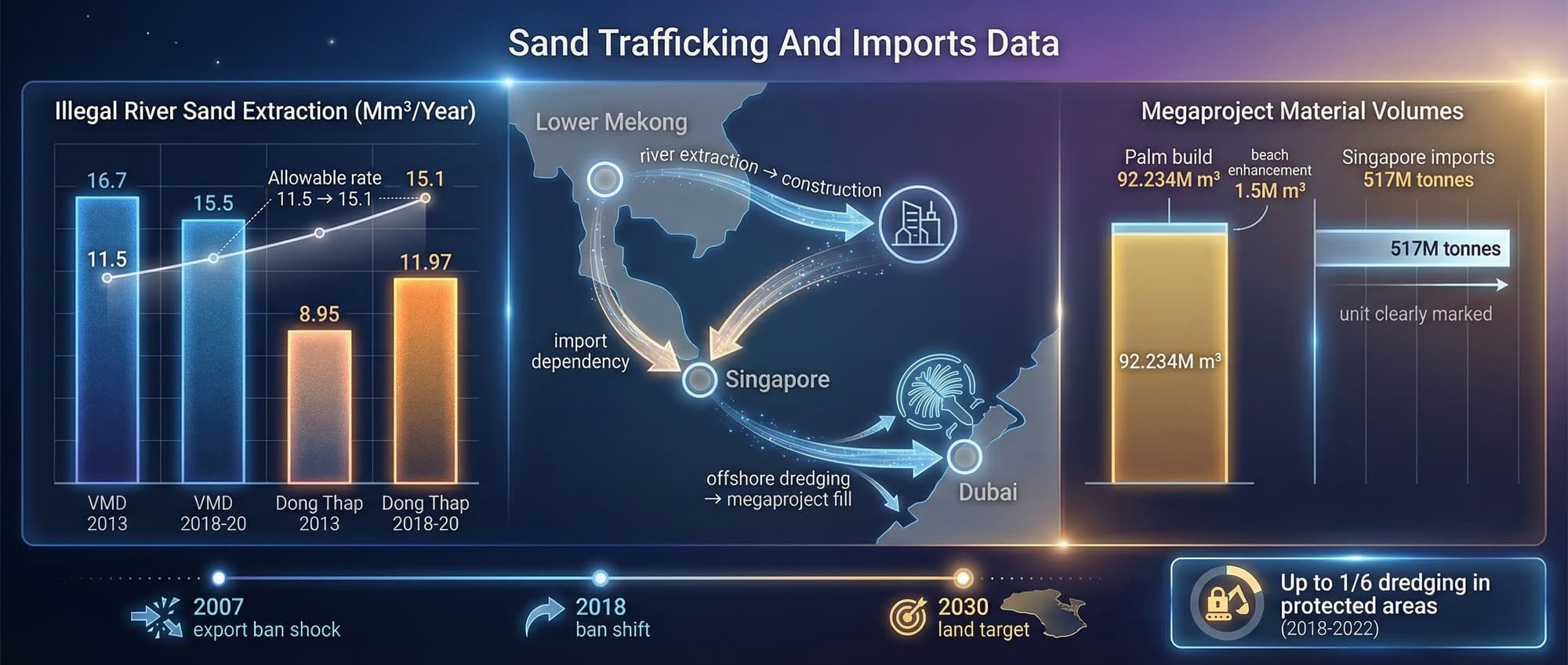
- Recent data quantifying illegal sand mining in the Mekong demonstrates how enforcement gaps lead to direct physical changes in deltas.
- Beyond the construction sector, silica sand supports glassmaking, filtration systems, and other critical industrial applications.
- The energy sector relies on high-purity frac sand as a proppant during hydraulic fracturing operations.
- Data from Marine Sand Watch indicates that billions of tonnes of marine sediment are dredged annually from the world’s oceans.
Not All Sand Works: Why Desert Sand Can’t Build a Skyline
What Engineers Mean by “Good Sand”
Structural integrity in concrete depends on the mechanical interlock of angular aggregates. Builders require a specific range of grain sizes and surface textures that bond seamlessly with cement paste. Minimising contaminants like salts and organics remains essential to prevent the long-term degradation of finished structures.
Notice how aeolian desert sand grains, polished by centuries of wind, tend to slide past each other with minimal friction. This smoothness prevents the bonding necessary for high-strength structural stability. Witness this geological friction in a standard home renovation. While a contractor might point to a faulty cement bag or moisture, the real culprit is often the grain shape—without the right grading, the mortar simply fails to find its bite.
When Desert Sand Can Be Used With Engineering
Desert sand can sometimes work when mixes are redesigned, grains are treated, or desert sands are blended with more angular material. Engineers are evaluating raw desert sand as a fine aggregate to determine how mix-design levels can stabilise durability.
Substitute strategies provide engineered relief, but scaling these alternatives requires consistent supply, quality control, and standards that recognise alternative gradations.

Sand Scarcity Impacts: Why Demand is Exploding And River Mining Weakens Water Security
The World’s Appetite for Sand is Bigger than Most People Realise
Visualising Global Demand Across Infrastructure and Manufacturing Sectors
Concrete remains the primary consumer of construction aggregates, yet demand tracks every facet of the built environment. Roads, bridges, housing, and land reclamation projects all require immense volumes of material. This industrial appetite extends deep into manufacturing, where silica-rich inputs are transformed into glass, ceramics, and critical industrial components.
Within rapidly expanding urban centres, scarcity first appears as a subtle shift in logistics. Project timelines remain fixed, yet the search for viable material forces procurement teams to look toward increasingly distant and obscure sources.
Sediment Replenishment Cycles and the Imbalance of Excessive Extraction
Natural sediment cycles move at a geological pace, far slower than the rapid consumption of modern urban expansion. While rivers naturally sort weathered rock into the precise grain sizes builders require, the replenishment of these deposits simply cannot match the scale of industrial extraction. Evidence suggests that sand replenishment lags significantly behind extraction rates in many regions, accelerating coastal erosion and habitat loss.
We’re “Eating” Our Riverbeds and Paying in Water Security
How Removing Sand Changes Rivers
River and beach sand functions like natural infrastructure. Porous beds store water, stabilise channels, and support habitats. When dredging removes this material, channels can deepen and widen, flow patterns can shift, and fine sediment can cloud the water.
Research linking river sand mining impacts to channel incision and habitat degradation highlights the social and economic harms occurring downstream.
A quiet crisis often begins at the well. When pumps labour longer and irrigation lines lose their pressure, communities feel the shift in their water supply long before they realise the riverbed beneath them has been stripped away.
Hydrological Consequences of Dredging and Instream Mineral Extraction
Riverbeds help regulate groundwater exchange. When that porous layer is stripped away, the local water table can fall, and wells can become less reliable. Case studies illustrate how riverbed deepening disrupts groundwater regimes and lowers aquifers critical for public water supplies.
In the Lower Mekong region, researchers warn that sand-mining-driven riverbed lowering can reshape flood dynamics. The Tonle Sap flood pulse faces a sharp weakening as riverbed lowering alters channel conveyance in the Mekong region.
Groundwater and the “Kidneys” Metaphor
Riverbeds help regulate groundwater exchange. When that porous layer is stripped away, the local water table can fall, and wells can become less reliable.
Coasts, Seawalls, and Unseen Knock-On Effects
When sediment that should replenish deltas and beaches is removed upstream, coastlines often become more vulnerable. That vulnerability is one reason engineers are testing eco-engineered seawalls to help marine habitats recover along hardened and vulnerable shorelines.
Sand Trafficking and Imports: How Illegal Mining and Megaprojects Reshape Supply Chains
Sand Mafias and Sand Wars: When a Basic Material Turns Violent
Why Illegal Extraction Spreads
Explosive demand coupled with fragmented oversight generates lucrative opportunities for illicit market actors. Remote extraction sites and costly monitoring efforts allow illegal materials to infiltrate legitimate supply chains with startling ease.
Assessments identifying conflict risks associated with illicit extraction connect these operations to nonviolent coercion and violent disputes.
A chilling pattern emerges across global hotspots: the roar of engines under the cover of night and the blur of fast-moving trucks, signalling to residents that their landscape is being stolen before the sun even rises.
Drivers of Illicit Markets: Regulatory Gaps and Remote Extraction Sites
Scarcity paired with weak oversight allows intimidation to become a standard cost-control strategy. The damage is not limited to ecosystems. It spills into governance, public safety, and local economies that depend on stable river systems.
When Violence Becomes a Business Model
Scarcity paired with weak oversight allows intimidation to become a standard cost-control strategy.
The Singapore and Dubai Paradox: Sand-Rich Regions Still Import Sand
Why Nearby Sand is Not Always Usable
The paradox is simple. Proximity does not equal suitability, and not all sand meets the grading and cleanliness needed for major projects. Land reclamation and construction also demand volumes that local sources often cannot supply sustainably.
National planning in Singapore reflects these geological constraints. Analysis of alternative reclamation strategies shows why recycled construction materials now play a critical role in Singapore’s land policy.
Dubai and the Long-Distance Supply Chain
Megaprojects in the Gulf have faced severe sand supply dilemmas, pushing procurement teams toward increasingly distant sources.
As offshore extraction expands, it overlaps with wider debates about seabed impacts and calls to pause risky extraction, including arguments supporting a halt on deep ocean mining to prevent irreversible seabed impacts.

Sand in High-Tech and Clean Energy: From Silicon Chips to Solar Glass
High-Tech Material Feedstocks: Transforming Silica Sand into Silicon and Glass
Semiconductors start as mineral feedstock refined into extremely pure silicon, then processed into wafers. The substrate manufacturing process relies on a complex purification chain to convert quartz into high-purity silicon.
On the ground, supply fragility translates directly into high-stakes risk management. Purity specifications and material redundancy become the primary focus as teams scramble to ensure the coming decade’s resources remain stable.
Substrate Manufacturing: Integrating High-Purity Silica into Semiconductor Wafers
Industrial Tension: Balancing Chip Fabrication with Regional Hydrological Realities
Regional hydrological realities now dictate the pace of manufacturing expansion, reminding planners that sand-driven industry remains anchored to local water stability. How Arizona’s megafabs collide with regional water realities has made the tension between industrial growth and water security highly visible.
Photovoltaic Supply Chains: Linking Solar Expansion to Silica Sand Purity
View solar energy infrastructure as a material-intensive system rather than a simple flow of electrons. Photovoltaic modules rely on a complex blend of refined glass, aluminium, and high-purity polymers. Consequently, glass availability serves as a primary driver of global clean energy expansion.
Material Intensity: Evaluating Glass Mass in Global Photovoltaic Deployment
Scaling Decarbonisation: Addressing Glass Supply Bottlenecks for Solar Energy
Deploying solar infrastructure at the multiterawatt scale turns the sector into a massive materials system. A standard photovoltaic module mass breakdown shows that glass constitutes the majority of the weight in many panels. Recent assessments of solar glass supply constraints highlight the long-term implications of rising demand for low-iron materials.
Industrial Chemistry: The Critical Role of Silica Sand in Float Glass Production
High-volume float glass production depends heavily on silica sand and specific chemical additives like soda ash.
Circular Recovery: Enhancing Resource Resilience through Solar Panel Recycling
Establishing specialised solar panel recycling infrastructure turns end-of-life glass and metals into valuable feedstocks. Developing transparent solar coatings for glass allows building facades to produce energy without sacrificing daylight.

What Replaces River Sand at Scale? The Realistic Solution Stack
Sustainable Substitutes: Implementing Manufactured and Recycled Aggregates
No individual substitute currently addresses every application, making material diversification the only realistic strategy. Success depends on integrating manufactured sand, processed demolition waste, and high-performance mineral alternatives into standard building practices.
Extensive testing confirms that manufactured sand can fully replace natural fine aggregate when grading remains stable.
On jobsites, the deciding factor is consistency. When gradation stays stable and crews understand the mix design, the pour behaves predictably. When variability creeps in, confidence drops fast.
Circular Resource Management: Reducing Virgin Material Consumption
While material substitution remains vital, true resource resilience requires a fundamental shift in architectural design. Prioritising building reuse, right-sizing projects, and treating structural assets as material banks can drastically lower global aggregate demand.
- Supplementary cementitious materials and recycled plastics replace part of cement, and aggregates offer a credible pathway for reducing virgin aggregate consumption.
- Recycled plastic and glass aggregates replace virgin base materials in paths and roads demonstrate how waste can replace virgin base materials in road construction.
- Recycled concrete fines are upgraded into lower-carbon construction inputs, helping to decarbonise the building sector while preserving natural sand.
- Unrecyclable glass is processed into a sand substitute for concrete, offering a dual solution for waste management and resource scarcity.
By integrating these materials into standard procurement cycles, developers can significantly decrease their reliance on destructive riverbed extraction. Such innovations demonstrate that urban growth and geological preservation are no longer mutually exclusive goals.
Speciality Routes: Tires, Wood Waste, and New Binders
Niche material innovations currently illustrate the vast potential for the global aggregate solution stack. While some routes remain in the pilot phase, they provide proof-of-concept for shifting the industry away from traditional mining practices. These speciality materials offer unique performance characteristics, such as enhanced flexibility or impact resistance, in specific engineering applications.
- Quality-concrete-made-with-100-year-old-tyre-rubber-aggregate shifts impact behaviour and replaces traditional coarse aggregates.
- Wood-waste-adds-flexibility-strength-to-recycled-concrete provides a flexible and strong alternative for specific engineering applications.
- Bendable concrete made from recycled construction inputs and wood-based materials.
As these technologies mature, they will play a vital role in diversified procurement strategies. Scaling these alternatives requires consistent material standards and a broader industry willingness to experiment with non-traditional binders.
Design for Circularity: Reducing Aggregate Demand through Sustainable Architecture
housing-as-a-service circular economics rewards material take-back and the treatment of buildings as permanent material banks.
olivine-carbon-negative concrete utilising olivine minerals can lower both CO2 emissions and raw material demand. Notice how these dual strategies turn architectural design into a tool for planetary restoration.

The Policy Fix: Treat Sand Like a Strategic Resource
Resource Visibility: Enhancing Global Governance through Data and Monitoring
Effective resource governance integrates rigorous enforcement with restoration mandates and localised community oversight. Neglecting these standards allows sand extraction to remain a destructive cycle that merely shifts environmental damage from one river reach to another. Strategic sand governance recommendations focus on aligning infrastructure growth with planetary limits through rigorous monitoring.
Practical policy implementation relies on improved data collection, transparent permitting, and rigorous restoration mandates. Effective governance also includes procurement rules that prevent extraction in the most sensitive riparian and coastal zones.
Sustainable Procurement: Driving Market Shifts toward Responsible Sourcing
Large buyers can reduce harm by requiring verified sources and recycled content where appropriate and avoiding extraction from active river channels and beach-nearshore systems.
Environmental Accountability: Prioritising Ecosystem Restoration and Local Rights
Good governance pairs enforcement with restoration obligations, public transparency, and meaningful community input. Without that, sand becomes the kind of commodity that keeps producing the same damage in a new location.
Implementing sustainable sand management requires shared standards and a commitment to global demand reduction.
Strategic Paths Forward: Resolving the Global Resource Crisis
Try viewing these mineral assets through a lens of scarcity rather than abundance. Mitigating the environmental impacts of sand extraction requires a systemic shift toward treating construction aggregates as strategic, finite assets. Transitioning to a circular economy in the building sector relies on scaling manufactured sand and high-purity glass recycling to alleviate pressure on active river channels. Pricing the externalities of dredging and riverbed extraction ensures the global market can incentivise the adoption of sustainable alternatives.
- When choosing building materials, ask for recycled aggregate content and documentation that identifies where fine aggregate was sourced.
- Developers and procurement teams can reduce harm by requiring verified supply chains and avoiding suppliers tied to sensitive riverbed extraction.
- Policymakers can treat sand like a strategic resource by mapping, monitoring, pricing externalities, and requiring restoration.
- The most scalable wins combine circular aggregates, longer-lived infrastructure, and rules that reward responsible sourcing.
Establishing robust sand governance frameworks ensures that regional development does not compromise long-term water security or coastal resilience. Prioritising building reuse and right-sizing projects can further dampen global sand demand while fostering innovation in low-carbon binders and mineral substitutes. As transparency in the supply chain grows, the shift toward responsible sourcing will safeguard both industrial stability and the integrity of natural ecosystems.

Frequently Asked Questions About Sand Mining and Resource Management
Why can’t wind-worn desert sand be used for structural concrete?
Desert sand grains are too smooth and rounded to provide the mechanical interlock required for structural durability. This lack of angularity results in weak bonding within the cement paste, making it unsuitable for high-strength building applications.
How does global sand demand affect river stability?
Extracting billions of tonnes of sediment annually causes riverbeds to deepen and destabilise. The extraction process, often driven by intense riverbed extraction, leads to channel incision, bank erosion, and the loss of critical riparian habitats.
What are the primary risks associated with illegal sand mining?
Illicit extraction networks often operate without environmental oversight, leading to rapid ecosystem collapse and the bypass of safety regulations. Organised “sand mafias” frequently resort to intimidation and violence to secure high-value deposits in regions with weak governance.
Can manufactured sand effectively replace natural river sand?
Crushed rock, or manufactured sand, serves as a high-quality substitute when processed to meet specific grading requirements. It provides the angular texture needed for concrete strength while reducing the need for destructive river dredging.
How is silica sand utilised beyond the construction industry?
Silica sand is a critical feedstock for glassmaking, silicon wafer production, and solar panel manufacturing. Purity specifications make it essential for high-tech industrial processes that cannot utilise standard construction aggregates.


