
The software that once only answered questions is now learning to reach, grasp, and move. Evaluating the latest evolving OpenClaw operational defaults reveals how quickly the tool ecosystem is shifting to touch physical systems. OpenClaw shifted the conversation from language-locked assistants to executable agent stacks that can call hardware, creating a powerful, practical shift toward functional embodied AI.
Integrating these systems allows high-level planners to interact with complex environments via standardized ROS2 Control protocols. Instead of brittle, one-off scripts, this architecture promotes a resilient text-to-action loop that can scale from simple wheeled bases to sophisticated humanoid platforms.
This guide explores OpenClaw architecture, the utility of ROS2 bridges, and safe methodologies for local project development. Every recommendation is grounded in primary documentation, peer-reviewed engineering papers, and verifiable security reporting to ensure your project remains both functional and secure.

The Physical Evolution: Transforming OpenClaw AI Agents into Embodied Systems
Operational Workflows: Mapping Natural Language to Verifiable OpenClaw Actions
OpenClaw began as a local-first agent runtime that connects chat surfaces to toolkits and scripts. The leap that matters now is not a single feature but the pattern: route natural language to verifiable actions, then expose those actions to robots through a ROS2-compatible executive layer. Actionable mapping establishes a verifiable chain from intent to physical movement, incorporating mandatory checkpoints for OpenClaw validation.
In practical terms, a Gateway instance accepts an inbound message to initiate the session. The agent then selects the appropriate skill, which maps directly to a ROS2 action or service interpreted by the robot. The architecture turns conversations into sequences of observable operations that can be tested in simulation, audited in logs, and restricted with explicit tool policies. If plugins or automation recipes have ever been used to glue tools together, the idea is familiar, just pointed at motors and sensors instead of spreadsheets.
Local garage builds demonstrate this shift through tangible hardware interaction. A voice command becomes a skill call, the skill triggers a robot action that coordinates arm, hand, and vision subsystems, and the robot reports success or failure back into the session log. The flow is simple to describe and difficult to make safe, which is why embodied AI lives or dies on governance.
Reliable Robot Communication: Why ROS2 Actions Anchor the OpenClaw AI Stack
In ROS2, the long-running jobs that need feedback and cancellation typically live as actions, and the ROS2 action goal feedback and result pattern explains why that primitive fits robot tasks better than a one-shot request.

Architecture Overview: The OpenClaw Stack for Autonomous Robotics
Core Technical Concepts: OpenClaw Skills and ROS2 Integration
- The OpenClaw runtime and workspace layout define how channels, sessions, and a skill registry fit together.
- Skills are code bundles that expose discrete capabilities. They live in the workspace and present clear inputs and outputs, which helps with testing and provenance.
- ROS2 is the robotic middleware that standardizes communication between sensors, controllers, and higher-level planners. For long-running tasks with feedback, ROS2 actions are the right primitive.
- ROSClaw describes an executive-layer approach that adds capability discovery, pre-execution validation, and structured audit logging to agentic robot control.
- OpenGo documents a dispatcher-style model that switches behaviors in real time on a robotic dog, a useful reference pattern for modular autonomy.
Security protocols must prioritize key hygiene and sandboxing. Scalable agent ecosystems frequently expose secrets when configurations are loose, making strict OpenClaw tool allowlists a foundational requirement for safe operation.
Functional Definitions: OpenClaw Runtime Environment Architecture
OpenClaw is a runtime: an execution environment that makes tools discoverable and callable from chat or programmatic endpoints. The runtime has three core pieces: the Gateway, the workspace with skills, and the session state.
OpenClaw Gateway Control Plane: Orchestrating Secure Session Communication
The Gateway acts as the primary control plane for managing secure robot interactions. This centralized interface handles the heavy lifting of session orchestration through several critical tasks:
- Channel Authentication: Validates inbound requests from messaging platforms.
- Policy Application: Enforces configured security rules before execution.
- Context Spawning: Initializes a unique session environment for the agent.
- Control Handoff: Transfers the validated request to the core reasoning engine.
Rigorous Gateway configuration maintains continuous operational cycles, securing the reliability of the integrated AI Agent Stack. A small but important operational safeguard is the gateway local mode safety default, which helps prevent accidental exposure during ad-hoc runs.
Core Gateway behaviors, including channel wiring and session handling, follow the Gateway config reload behavior, which makes it easier to standardize a build across machines.
Securing your environment requires a practical approach to hardware governance. Adopting a hardened posture involves several non-negotiable steps:
- Skill Allowlists: Restrict the agent to a curated set of verified tools.
- Code Isolation: Sandbox untrusted packages to protect the underlying system.
- Physical Confirmation: Require explicit human approval for any action touching physical interfaces.
Prioritizing these constraints prevents the system from behaving like a remote control with missing guardrails.
Modular OpenClaw Skill Registry: The Unit of Reusability for Robot Tasks
Skills are compact code packages that declare their inputs, outputs, and side effects. They function as the unit of reusability. In a robot context, a skill may wrap a ROS2 action call, load camera images, or execute a verified motion primitive. Because skills are code, they are also the primary threat surface, so provenance, versioning, and testing matter as much as the code itself.
Skills function as a library of tested, modular behaviors like “grasp object” or “inspect shelf.” Each behavior operates as a discrete skill with parameterized inputs and clear failure modes.
Structural modularity makes complex composition possible for developers. This architecture underpins the emerging movement toward shareable, installable behavior modules in the robotics community.
A practical integration pattern shows up in robotics SDK work: a robotics SDK wrapper workflow can expose native robot APIs as agent-callable functions while keeping the underlying control stack unchanged.

System Integration: Bridging the Gap Between OpenClaw and Physical Robots
Robotic Middleware: Leveraging ROS2 as the Universal Bridge Language for OpenClaw
Robots are ecosystem animals; without a shared language, every integration requires bespoke plumbing. ROS2 supplies that shared language. It defines topics for streams, services for quick requests, and actions for longer tasks with feedback and cancellation. Standard primitives map cleanly to the kinds of calls an agent might make.
ROS2 Communication Primitives: Topics, Services, and Actions Explained
The ROS2 topics, services, and actions model makes “robot behavior” easier to reason about.
- Topics: Continuous data streams (e.g., camera feeds) suited for high-frequency updates.
- Services: Discrete request-reply operations for rapid, single-shot queries.
- Actions: Asynchronous tasks providing periodic feedback and cancellation options, ideal for arm movement or mobility.
Structural ROS2 alignment provides the technical foundation for scaling OpenClaw across diverse robotic platforms. The agent can treat ROS2 actions as reliable, observable primitives rather than unpredictable manufacturer APIs.
ROSClaw Executive Layer: Implementing Safety Envelopes and Audit Logs
The ROSClaw executive layer design formalizes a pattern that matters for real deployments: capability discovery, observation normalization, pre-execution validation within a configurable safety envelope, and structured audit logging. It also treats model swaps as a configuration change rather than a rewrite, which helps teams avoid glue-code sprawl.
A maker night lesson tends to repeat itself. The first prototype fails, the second version adds logging, and suddenly the robot improves quickly because failures can be replayed like software tests rather than argued about like folklore.
Practical Applications: Current Capabilities of OpenClaw Embodied AI Platforms
The current landscape supports several useful patterns where natural language or agent planning translates into observable robot behavior. Three capability clusters stand out: real-time skill switching, teleoperation with safeguards, and supervised automation for inspection or logistics.
Modular Autonomy: Real-Time OpenClaw Skill Switching for Quadruped Systems
The OpenGo real-time skill switching system describes a robotic dog equipped with a customizable skill library, a dispatcher that selects and invokes skills from language instructions, and a self-learning framework that fine-tunes skills based on task completion and human feedback.
Earlier robot skill training work such as NVIDIA’s Eureka robot training experiments helps explain why skill libraries matter: they let a planner compose learned primitives instead of improvising everything from scratch. That architecture matches how many teams actually build: start with a small library of safe behaviors, then layer planning on top.
Humanoid Robotics: Optimizing the OpenClaw Text-to-Action Execution Loop
Humanoid platforms such as the Unitree G1 make a compelling case study because of their general-purpose limbs and mobility. Low-cost humanoid price signals like the 6K Unitree R1 affordability benchmark help explain why experimentation is spreading beyond well-funded labs. Turning text into coordinated arm, hand, and locomotion sequences is still a frontier, but accessible platforms accelerate iteration. The Unitree G1 hardware constraints help ground expectations around sensing, payload, and repeatability.
Vocal instructions or planner-driven tasks are not yet capable of independent household chores. Functional plumbing now exists through modular skills, observable robot primitives, and a gateway that can enforce policies.
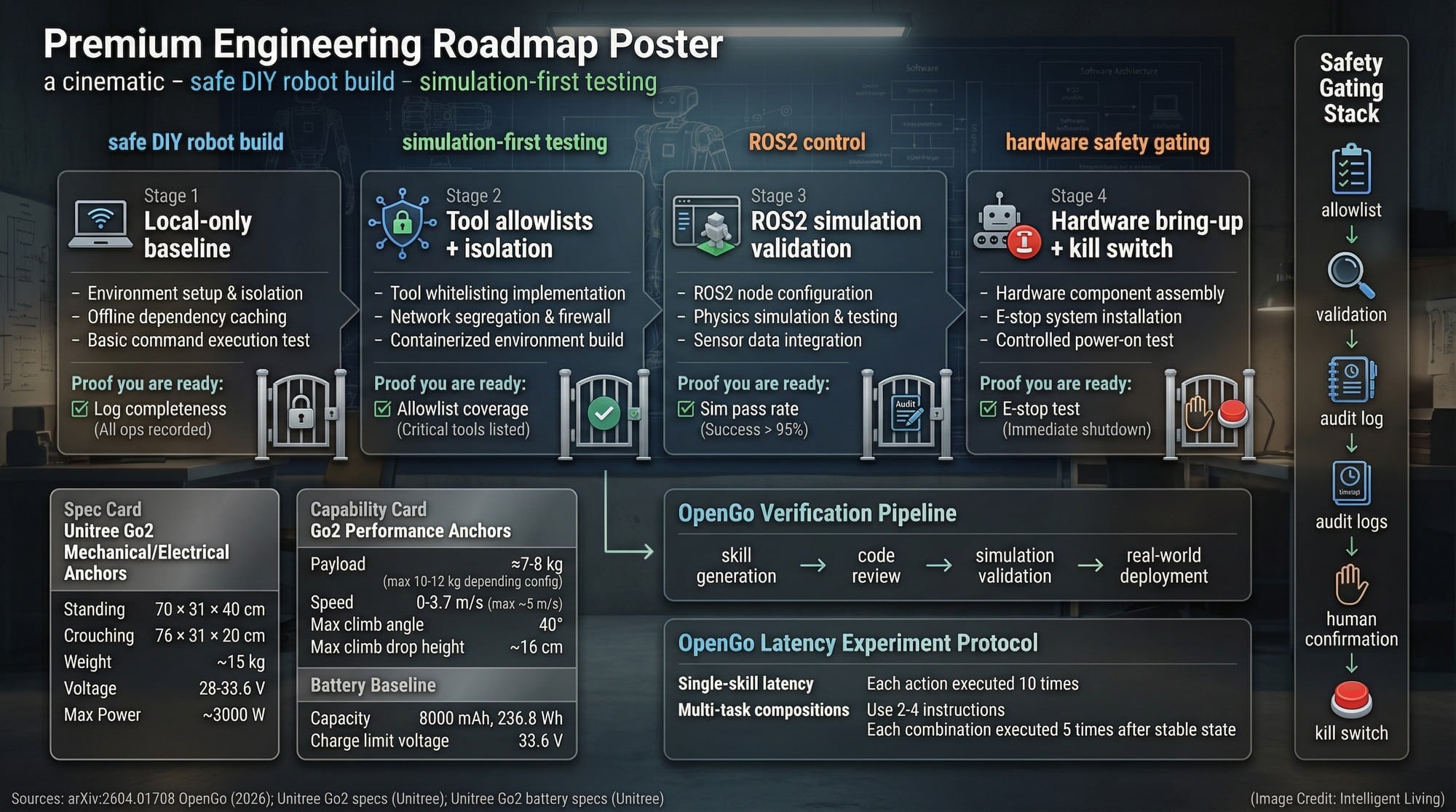
Implementation Roadmap: Building a Safe DIY Robot with OpenClaw
Stepwise, conservative pathways detailed below transition your project from desktop learning to modest physical hardware bring-up.
Stage 1: Initial Deployment Establishing a Local OpenClaw Desktop Testing Baseline
Begin locally to establish a controlled testing environment. A five-minute local Gateway startup provides a clean baseline for evaluating first-run behavior. Specific install options for managed startup clarify how to maintain OpenClaw Gateway stability without leaving the system half-configured.
Install your Gateway instance and connect a single trusted channel, such as a terminal session. Local testing facilitates safe experimentation with OpenClaw session flow and skill invocation without external network exposure.
Stage 2: OpenClaw Security Hardening Restricting Permissions and Tool Allowlists
Before any hardware contact, harden the Gateway with explicit allowlists for skills, restricted outbound network access for untrusted packages, and verbose audit logs. The Gateway configuration controls for tool allowlists make this practical without turning setup into a custom security project.
Design priorities must account for fluctuating OpenClaw usage restrictions as subscription policies impact long-term build stability.
Stage 3: OpenClaw Virtual Validation Using ROS2 Simulation for Logic Verification
Use ROS2 simulation tools to validate the full stack: skill input, action calls, and success or failure reporting. Utilizing a simulated environment for actuator validation provides a safe baseline for verifying sensor feeds without hardware risk. Engineering workflows prioritize extensive virtual trials to ensure software stability prior to physical motor engagement. Simulation enables safe, repeatable tests that allow teams to tune timeouts and recovery logic. This rigorous validation ensures high reliability before physical actuators ever engage.
Stage 4: Physical OpenClaw Activation, Incremental Hardware Bring-Up, and Safety Gating
Legged robots or wheeled platforms are excellent first steps because they are mechanically simpler than humanoids for arm coordination. A Unitree Go2 mobility and payload baseline is often a more forgiving starting point than a humanoid because it lets teams learn perception, navigation, and safety gating first.
Implement limited power settings, accessible kill switches, and mandatory human confirmation protocols for all behaviors operating outside controlled zones. In one lab onboarding week, the unglamorous work paid off first. Sensor calibration and logging discipline came before autonomy, and the early bugs showed up as measurable drift rather than mysterious “AI behavior.”

OpenClaw Operational Security: Managing Risk in Shared Agent Ecosystems
Mandatory OpenClaw Security Layers: Procedural Safeguards for Embodied AI
The most common failure points are not mechanical; they are procedural. Sharing or installing skills without validation, exposing a Gateway to the public internet, and assuming natural language instructions are safe are proven vectors for incidents.
OpenClaw Prompt Injection Protection: Securing the Agent’s Input Stream
The Gateway security hardening guidance emphasizes that OpenClaw does not function as a hostile multi-tenant boundary. Maintaining integrity against adversarial tool-use chains is vital for developers treating embodied AI as production software.
Adversarial prompts and tool-use chains frequently bypass guardrails that appear resilient in isolated testing environments, which is why a broader jailbreak reality check for tool-using agents matters for anyone treating embodied AI as production software.
Vulnerability Management: Analyzing the OpenClaw CVE-2026-25253 Token Exposure
The CVE-2026-25253 WebSocket token exposure describes an issue where older OpenClaw versions could obtain a gatewayUrl from a query string and automatically connect over WebSocket while sending a token value. A dedicated GitHub advisory explains the affected versions, why the token could be exposed, and what fixed builds changed in the UI connection flow, as laid out in the gatewayUrl token auto-connect advisory. In practice, consistent patch cycles remain a core operational requirement rather than optional maintenance.
Lessons from Moltbook: Secrets Management and OpenClaw Infrastructure Integrity
Shared agent ecosystems amplify both good ideas and bad hygiene. Analyzing the Moltbook Supabase exposure incident highlights the necessity of robust secrets management and strict access boundaries for community-driven skill registries. Meta’s Moltbook acquisition timeline adds another signal: registries can become infrastructure fast, which makes standardized regulatory compliance practices relevant even for small teams running experiments on personal hardware.
A governance rule that holds up in practice is simple: treat public skill stores like third-party code. Assume every install needs review, scanning, sandbox tests, and an exit plan.
China Global Context: Analyzing Rapid China Embodied AI Development Cycles
China Development Infrastructure: Scaling Prototypes into Reliable China Datasets
Rapid China experiments in embodied AI leverage concentrated training infrastructure and high robot availability to compress development timelines in applied settings. Intense regional focus drives the frequent early China demos and rapid integration cycles across the ecosystem.
Developing large-scale robotic training infrastructure demonstrates how service networks and repeatable metrics enable rapid pilot deployment.
Some China OpenClaw robot deployments have been described as experiments that push this loop faster, while continuous operational duty cycle maintenance allowing for battery-swapping humanoids illustrates the drive toward round-the-clock autonomy.
China Technical Auditing: Verifying China Capability Beyond Viral Robot Showcases
A second lens is verification discipline. The way viral Chinese robot videos get audited offers a practical checklist for separating choreographed showcases from reproducible capability.
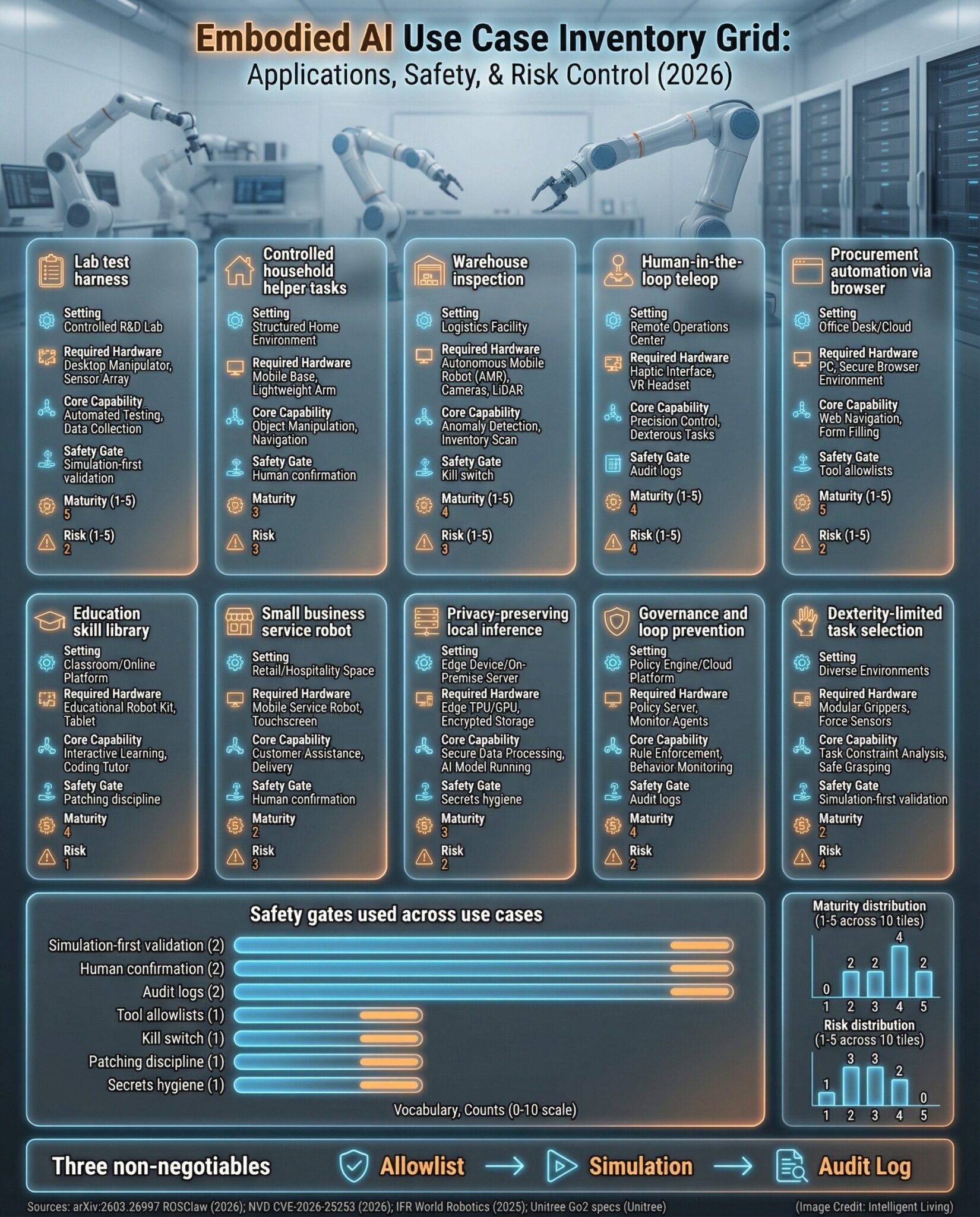
OpenClaw Use Case Inventory: 10 Practical Applications for Embodied AI
Identify optimal deployment strategies for OpenClaw-style embodied AI through these ten practical applications.
- Lab Demo-to-Test Harness: Use an agent to run reproducible test scenarios, log outcomes, and replay failures. Watch for flaky sensors and nondeterministic timing. Start with simulation-first runs and strict action allowlists.
- Controlled Household Helpers: Limited, repeatable tasks such as opening a drawer or fetching a lightweight object. Watch for fragile grasps and environmental variability. Start with fixtures that normalize object position and simplify perception.
- Warehouse Inspection Scripts: Route an agent to inspect aisles, log anomalies, and hand off suspect items to a human reviewer. Watch for stale maps, brittle assumptions, and overbroad permissions. Start with a wheeled base and a depth camera, then expand slowly.
- Remote Teleoperation with Guardrails: Implement human-in-the-loop control protocols where an agent proposes actions and a human approves execution to mitigate latency.
- Browser-Driven Parts Ordering and Procurement: Automate procurement workflows with a heedful browser skill that follows policy. Watch for credential leaks and dynamic web layouts. Start with test accounts and approvals for purchases; headless vs. headful browser automation tradeoffs help frame when a visible browser is safer than a hidden one for dynamic pages.
- Shareable Skill Libraries for Education: Curated modules students can install to learn robotics primitives. Watch for version skew and dependency drift. Start with pinned versions and sandboxed execution.
- Small Business Service Robots: Task-specific automations such as shelf scanning or simple delivery in constrained areas. Watch for compliance, safety, and insurance questions. Start with pilot zones and human oversight.
- Privacy-Preserving Local Inference Routines: Run perception or decision models locally to keep sensitive data on-prem. Watch for thermal load and model drift. Start with the local mini AI supercomputer hardware ladder as a baseline for latency, privacy, and VRAM realities, then scale only when the workload proves it.
- Agent Governance and Scam Prevention: Policies and automation that detect circular incentives or accidental loops in shared agent populations. Watch for emergent incentive traps in skill marketplaces. Start with why agent societies drift toward scams and loops as a map of failure modes, then write explicit loops that block the most common loop triggers.
- Dexterity-Limited Tasks First: Focus on tasks that do not require human-level hand dexterity until tactile hands mature. Watch for assumed precision that the mechanical hand cannot provide. Start with visuo-tactile robotic hands and dexterity limits to pick tasks that do not depend on delicate fingertip feedback.

Strategic Outlook: Future-Proofing Your OpenClaw ROS2 Control Strategy
OpenClaw and ROS2 bridges create a plausible architecture for embodied agents, turning natural language into audited, observable operations. The real work sits beyond demos: robust governance, hardened configuration, simulation-first practices, and incremental hardware exposure. Sustainable adoption prioritizes verifiable humanoid deployment milestones and uptime metrics over choreographed showcases to maintain long-term serviceability.
Ecosystem maturation drives a transition from basic hardware connectivity to sophisticated, autonomous decision-making in real-world environments.
Technical FAQ: OpenClaw and Robotic Integration Details
Technical integration of OpenClaw requires clear awareness of modular skill registries and ROS2 control planes.
How do I connect OpenClaw to ROS2 Control?
Connection is achieved through an executive layer that maps OpenClaw skills to ROS2 actions and services, facilitating reliable bidirectional communication.
Is OpenClaw safe for physical hardware?
Implementing a Gateway control plane with strict tool allowlists, simulation-first testing, and physical kill switches for emergency stops ensures hardware safety.
Can I use OpenClaw for humanoid robotics?
Humanoid platforms like the Unitree G1 are compatible when their native hardware sensing constraints are addressed by wrapping SDKs as modular OpenClaw skills.
What are the hardware requirements for Embodied AI?
Running perception models and low-latency routines locally requires a mini AI supercomputer or a high-VRAM workstation to preserve privacy.
How do ROS2 Actions improve robot reliability?
ROS2 Actions provide feedback and cancellation capabilities, allowing the agent stack to monitor progress and abort tasks if safety thresholds are breached.


