
Robot schools and a codified national standards framework drive a structural evolution in the China robotics boom. Humanoids are transitioning from isolated lab demos into an industrialised framework for testing and commercialising embodied AI systems that can perceive and act in the physical world. Sector growth in robotaxis, warehouse automation, and medical robotics facilitates practical deployments that reshape daily routines faster than conservative forecasts suggest. The next layer of that pipeline is the world model itself: Qianjue’s Polibrain, unveiled in October 2026, predicts how a robot’s actions will change task-relevant states, and its makers argue that access to real scene data from facilities like these decides model performance.
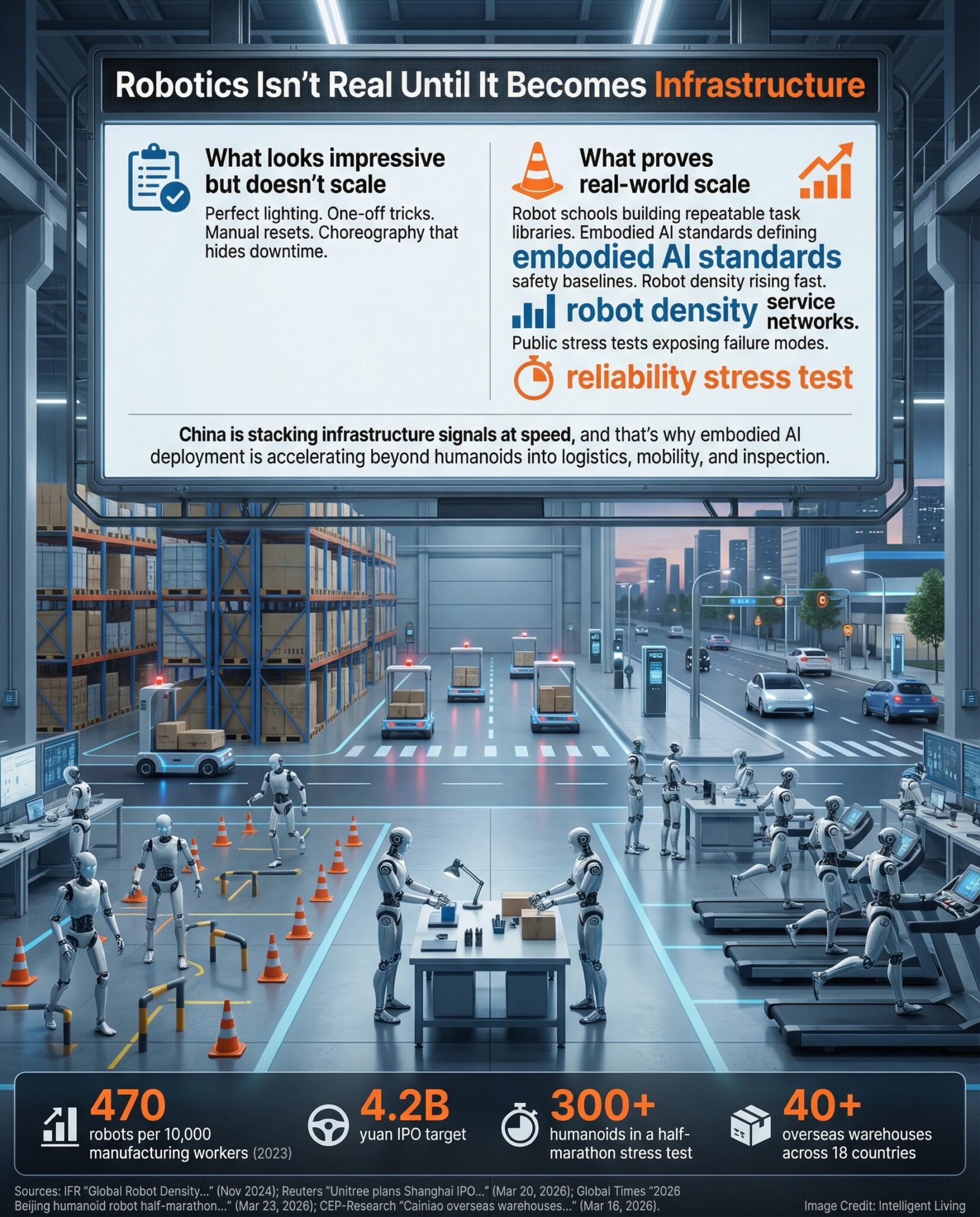
Effective scaling of China’s humanoid robots relies on tracking industrial output rather than curated stage demos. For a reality check on staged clips versus factory reality, see our Chinese robot authenticity breakdown. Success in the critical technology race where robotics is one of the hardest categories to industrialize depends on installed fleets and service networks instead of viral marketing clips. Tracking robot-to-worker ratios and active installed fleets reliably measures the transition from pilot to infrastructure. In the International Federation of Robotics’ World Robotics data, China ranked third in 2023 robot density with 470 industrial robots per 10,000 manufacturing employees, a quick proxy for how routine factory automation is becoming.
China Humanoid Robots: Scaling the Embodied AI Training Pipeline
Monthly China Robotics Boom: Key Milestones and Embodied AI Trends
- Robot schools and specialised training centres have expanded rapidly. These facilities operate industrial-scenario data collection boot camps that convert basic actions—like grasping and placing—into repeatable task libraries for China humanoid robots.
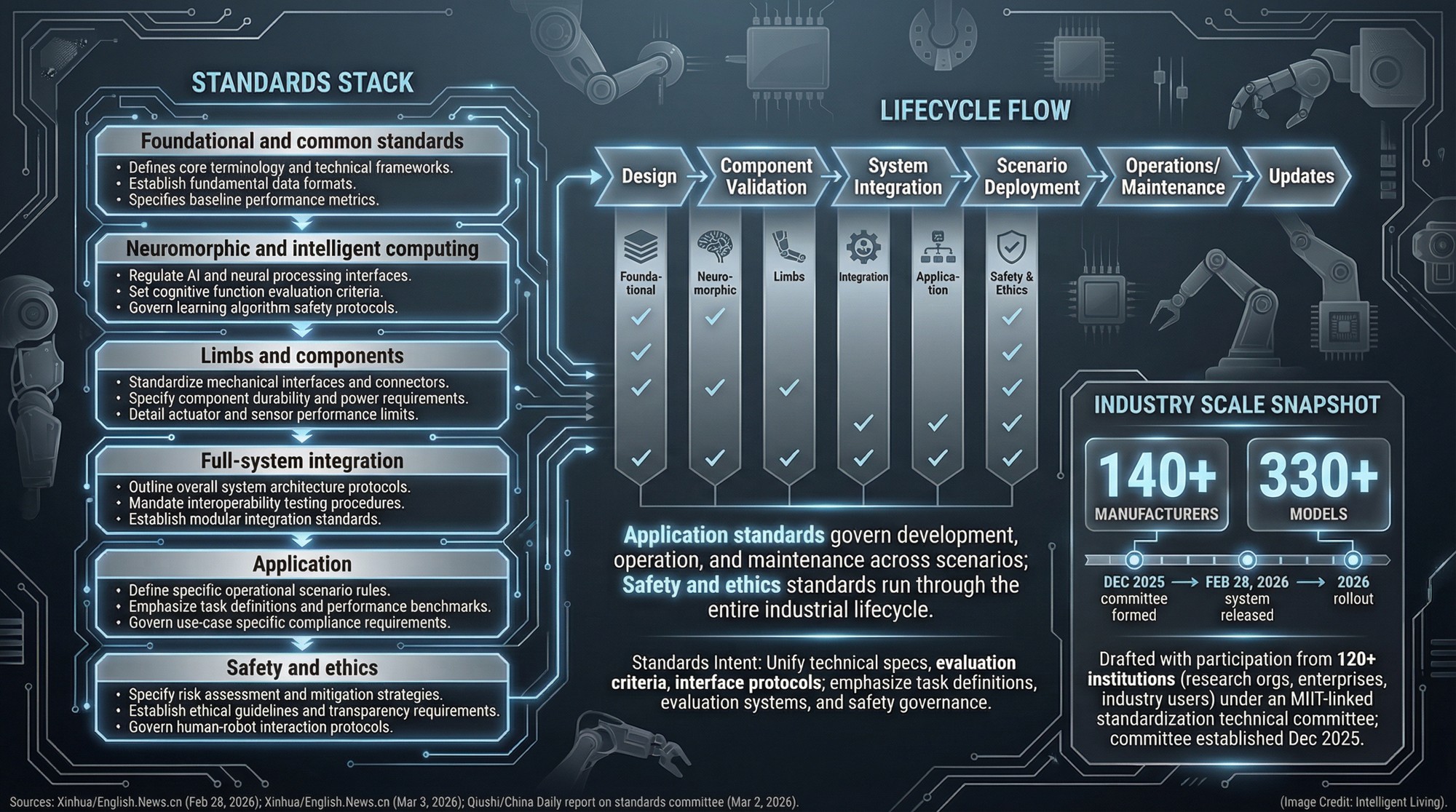
- A recently codified national standard system for humanoid robots and embodied AI systems establishes formal application standards and safety ethics to set clearer baselines for testing and deployment across real-world scenarios.
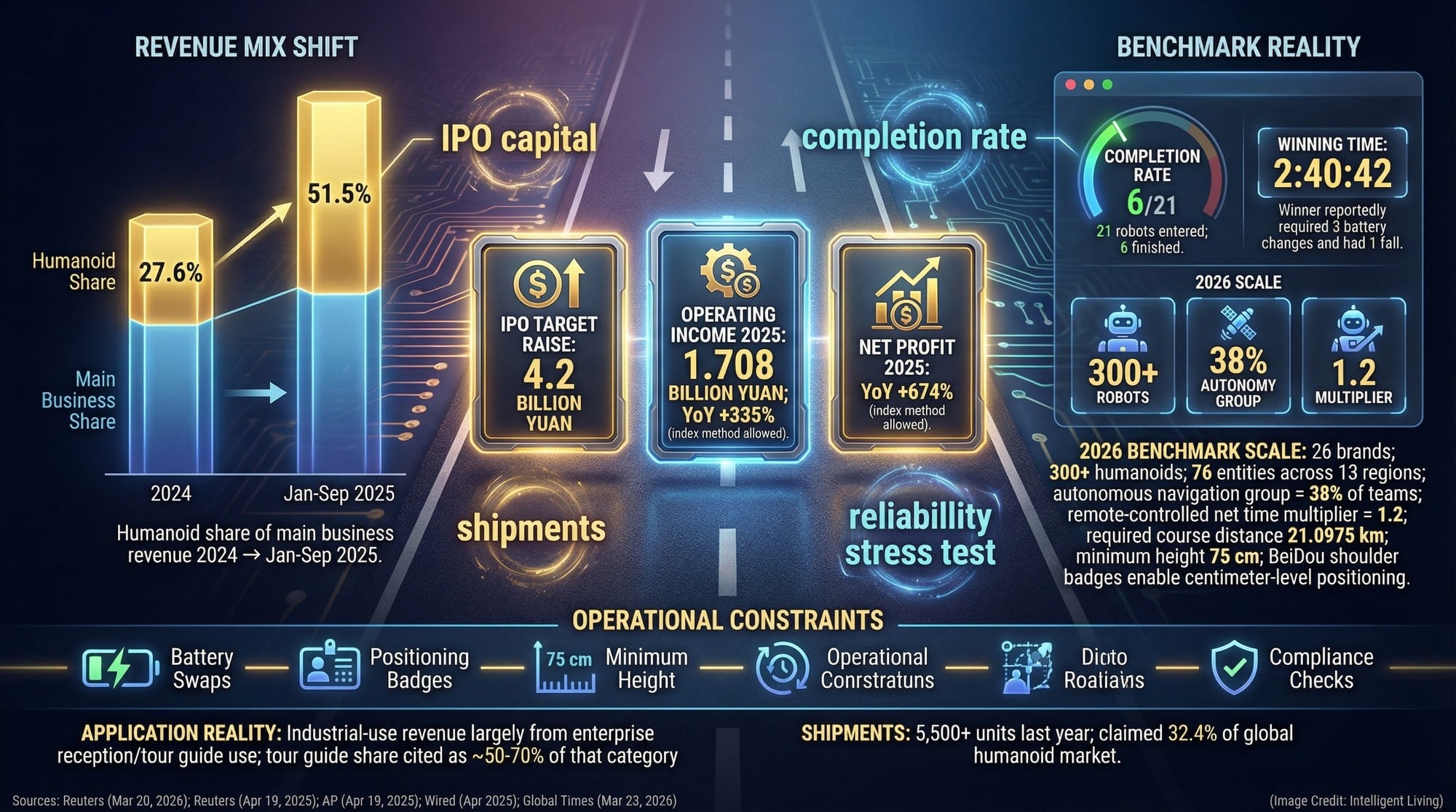
- A STAR Market IPO target signals a pivot for Unitree, positioning humanoids as a commercial category under financial pressure to move past the demo phase.
- Public benchmarks such as the Beijing humanoid half marathon are being staged as large stress tests for reliability, with over 300 humanoid robots expected to line up alongside human runners on the same day and route.
- Acceleration in robotaxis and autonomous logistics includes plans for a global AI robotic warehouse network capable of meeting tightening cross-border delivery schedules.
Training Infrastructure: Building Readiness for China Humanoid Robots
Inside the Robot School Model
High-intensity robot schools prioritise teaching machines repeatable tasks through rigorous teleoperation and controlled scenario practice, moving the industry past isolated capability demos. The training pipeline utilises specific technical stages:
- Technicians employ VR-style teleoperation and motion capture to generate high-fidelity training data.
- Synthesised datasets enable robots to observe and mirror human movements.
- Repeated cycles of iteration allow systems to refine consistency through deliberate practice.
- Teleoperated whole-body imitation systems map human motion into robot control, transforming messy demonstrations into cleaner, industrial-grade policies.
Training environments feature technicians in motion-capture vests guiding humanoids through pick-and-place routines until machines achieve identical hand positions with zero hesitation.
Consistent performance marks the boundary between a curated demo and a behaviour robust enough for an industrial shift.
Training Grounds that Look like Mini Industrial Cities
Advanced training programmes cluster heterogeneous platforms for integrated scenario testing among multiple teams. Key facilities include:
- Shanghai’s Pudong heterogeneous humanoid robot training ground, which mimics complex industrial and service contexts.
- A Henan facility featuring a training base with 140 robots deployed across multiple fields.
- Regional programmes aligned with local industries to focus curricula on operational needs instead of one-off stunts.
Practical scrutiny occurs on the factory floor as maintenance teams evaluate humanoid bolt-tightening routines. Europe is building a parallel model: NEURA’s 4NE1 Gen 4 trains inside the 2,300 sqm TUM RoboGym, a shared facility where companies bring real industrial tasks. Industrial requirements—specifically precision after exposure to dust and vibration—shape the training curriculum far more than public acclaim.
National Standard System for Humanoid Robots and Embodied AI Governance
The national standard system for humanoid robots and embodied AI mandates specific build and evaluation criteria for every development phase, grounding the industry in safety and ethics. Official documentation outlines the six-part structure, which spans core computing, components, full systems, application guidance, and safety and ethics. These frameworks accelerate preparation for mass-market adoption.
National standards achieve two practical goals:
- Fragmentation decreases by establishing shared definitions for testing.
- Procurement simplifies as buyers gain a reliable baseline for comparing specialised products.
Industrial Robot Safety Requirements: The Impact of Unified Testing Standards
Standards accelerate pilots and define safety thresholds for specific use cases, though certification does not automatically prove field readiness in complex environments. Industrial safety baselines rely on frameworks like ISO 10218-1 for industrial robot safety requirements and ISO/TS 15066 for shared human-robot workspaces, regardless of platform evolution. A lab test might define a successful battery swap routine, while real operational uptime still depends on maintenance, environmental conditions, and how the robot is integrated into a workflow.
Procurement dynamics remain complex despite standardised evaluation reports:
- Standardised reports simplify contracting but rarely replace local validation.
- Buyers often despatch engineers to verify performance under site-specific conditions.
- Deployment risk lives in the details of the environment rather than a lack of trust in the hardware.
Commercialisation Milestones: Unitree IPO Capital and Performance Benchmarks
Unitree IPO: Funding Commercial Infrastructure for China Humanoid Robots
What IPO Capital Funds in Real Robotics
Filing for a Shanghai IPO, Unitree signals that embodied systems have matured into investable commercial products rather than research curiosities. While a public offering is no guarantee of immediate scale, the capital secures essential commercial infrastructure:
- Field service networks and regional coverage.
- Spare parts logistics and warranty handling.
- Extended on-site trials verify reliability under actual factory constraints to ensure industrial readiness.
The Investor Checklist: Uptime, Serviceability, and Unit Economics
Because pricing shapes who can experiment with humanoids, the relationship between affordability and adoption is central. The recent shift towards a roughly six-thousand-dollar humanoid price point changes the early adopter pool from elite labs to smaller teams that can justify a pilot budget, which increases the number of real-world environments feeding back failure data.
Evaluation dynamics are clear: mid-size logistics operators prioritise total cost of ownership over flashy capabilities. These teams emphasise minimising downtime, training overhead, and the logistics of replacement actuators. Manufacturers dominating global robotics markets prioritise machine uptime. Industrial success depends on maintaining operational consistency instead of posting impressive marketing clips.
Reliability Stress Tests: The Beijing Humanoid Robot Half Marathon
Public benchmark stress tests identify critical system failure points:
- Battery life during continuous high-load operation.
- Localisation and navigation within dense crowds.
- Robust gait recovery following unexpected slips.
- Total operational overhead including the human supervision required for autonomous stability.
What a Half Marathon Actually Tests
A marathon-format challenge evaluates sustained autonomy and systems engineering, including thermal load over long runs, joint wear under repeated motion, and energy management strategies. Beijing has scheduled a humanoid robot half marathon for April 19, and the event format has been described as a human-robot co-running model on the same course with separation measures, which tends to produce comparative signals on which platforms can handle long-duration operation with fewer interventions.
Athletic benchmarks compress complex control problems into visible, quantifiable tests:
- High-speed perception is required for split-second reactions.
- Predictive control for dynamic path adjustment.
- Coordinated whole-body motion to maintain balance during exertion.
Coordinated whole-body motion and predictive control allow humanoids to learn athletic tennis skills from imperfect human motion data. These learning approaches remain effective even when human demonstrations are incomplete or inconsistent. Kinetic control skills transfer to dynamic handling tasks in factories, prioritising timing and balance over raw strength.
A grounded scene from race engineering looks less glamorous than the videos: engineers patch a navigation stack between heats, then adjust gait parameters after noticing that one surface texture triggers stalls. That kind of iteration, repeated across many teams, is how reliability improves.

China Robotics Boom 2026: Scaling Industrial Automation Beyond Humanoids
Humanoids are the headline act, but other robot categories are quietly reaching practical readiness. Near-term impact occurs in categories solving clear operational problems without requiring humanlike hands.
Robot-to-Worker Ratios: Measuring Infrastructure Maturity in China
Tracking robot-to-worker ratios and active installed fleets reliably measures the transition from pilot to infrastructure. Automation intensity is often measured as global robot-to-worker ratios, a benchmark that compares industrial robots to manufacturing headcount and makes cross-country adoption trends easier to spot. China doubled its robot density within four years of entering the top 10. This rapid diffusion compresses component costs for servos, sensors, and machine vision systems. Rapidly rising density forces suppliers to optimize for volume, driving industrial AI building blocks into logistics, retail automation, and advanced inspection tools.
Robotaxis and Urban Mobility: Operational Design and Safety Cases
The Operational Design Domain and Safety Case
Autonomous ride services are expanding beyond closed-campus pilots into denser markets. Expansion milestones include the following:
- Negotiations for approvals and partnerships to operate in Hong Kong and Singapore.
- Active public road trials in Singapore’s Punggol district to support regional rollout plans.
- Transitioning navigation stacks from controlled environments to unpredictable city streets.
The Sensor and Compute Cost Curve
Cheaper sensors matter, and the Chinese LiDAR price collapse in smart driving shows how quickly high-volume hardware can compress costs for navigation stacks. Regulatory milestones like the first-of-their-kind autonomous robotaxi permits established a framework for expanding pilots into broader service zones. As costs drop, the bottleneck shifts from hardware to fleet operations, remote assistance workflows, and incident response playbooks that keep a service predictable.
A quick example: a municipal mobility planner watching a pilot often focuses less on the novelty of driverless operation and more on basic operations, including kerb management, charging, and how riders report issues. Those mundane workflows determine whether a robotaxi becomes a service or a headache, and they also determine whether a city treats autonomy as a transit layer or a niche tech pilot.
AI-Powered Robotic Warehouses and Global Logistics Automation
Automation delivers immediate ROI in warehouse environments due to the narrow, repeatable nature of the tasks. Fulfilment infrastructure like a global network of robotic warehouses scales capacity while mitigating labour friction during peak seasons. Industry reporting also points to next-generation robotic warehouses paired with AI-powered scheduling as a way to smooth throughput and reduce peak-time congestion, which is often a bigger constraint than raw robot speed.
Operational efficiency depends on primary logistics tools:
- Warehouse tracking systems that monitor stock in real-time.
- RFID solutions for warehouse organisation that streamline picking.
- Advanced inventory management software that reduces mispicks and shrinks error budgets.
Scheduling, Slotting, and the Error Budget
As error rates drop, automation can run closer to capacity without creating downstream customer-service fallout.
A warehouse supervisor’s anecdote captures the real KPI: the quiet value of a robot often appears at 2 a.m. when consistent picking continues with fewer staff available. Reliability, not headline speed, becomes the deciding metric, and that reliability becomes a competitive advantage when cross-border delivery windows keep tightening.
Surgical Robotics in China: Clinical Verification and Domestic Substitution
Medical robotics deployment requires extreme precision. Higher safety thresholds than industrial pilots mandate that outcomes be strictly defensible through clinical evidence. Clinical verification of a domestic orthopaedic robotic arm at West China Hospital marks a milestone in hospital-grade deployment. Local vendors are now transitioning past prototypes into high-stakes medical environments.
Clinical Verification and Domestic Substitution
Domestic orthopaedic robots are active in Chinese hospitals, supporting diverse procedures and marking a shift from imported dependence towards local capability. Evidence of this transition includes:
- Peer-reviewed analysis of robotic and AI-assisted orthopaedic surgery in China detailing clinical adoption.
- Clinical data confirming domestic robots reach outcomes comparable to international brands.
- Strong domestic supply chains paired with clinical evidence that reshapes procurement economics for hospitals globally.
Rugged Field Platforms and the Robot Horse
Wheeled-leg hybrid platforms, sometimes described as robot horses, are designed for inspection, patrol, and emergency response in rough terrain. These platforms bridge the gap between heavy machinery and humanoid dexterity.
Each unit hauls sensors and payloads without requiring delicate manipulation. Category-level design choices such as sealed drivetrains, hybrid gaits, and payload-focused stability are visible in wheeled-leg inspection robot specifications that target patrol, inspection, and emergency response.
Industrial deployments prioritise several critical field-grade traits:
- High IP ratings for protection in harsh environments.
- Agile stair and obstacle handling.
- Stable sensor payloads to prevent destabilisation.
The LYNX line addresses these requirements as a wheeled-legged robot built for extreme industrial environments. Rugged field robotics matters globally by automating inspection in slow, expensive, or dangerous locations, including power corridors, tunnels, and disaster zones.
Personal Care Robots: Overcoming Cost Barriers to Household Adoption
Consumer robotics is still uneven, but the direction is clear: more devices are moving from single-purpose cleaning towards broader, low-risk assistance. Safety expectations for machines that operate around people are often framed by standards like ISO 13482 for personal care robot safety requirements because many home robots are cautious, slow, and constrained by design. In practice, the early winners will be systems that save time without creating new chores, such as setup hassles and constant troubleshooting.
A record number of robots at AWE 2026 revealed a significant pricing gap; specifically, a humanoid displayed at CNY 69,999 confirmed that cost still blocks mass household adoption. High costs ensure most near-term home robots remain task-specific, prioritising safe routines over broad autonomy. Early adopters are paying anyway: UBTECH began delivering the UWorld U1 companion humanoid to homes in September after 13,361 prepaid orders, at prices from 119,800 yuan.
Long-Distance Autonomy: Endurance Testing for China Humanoid Robots
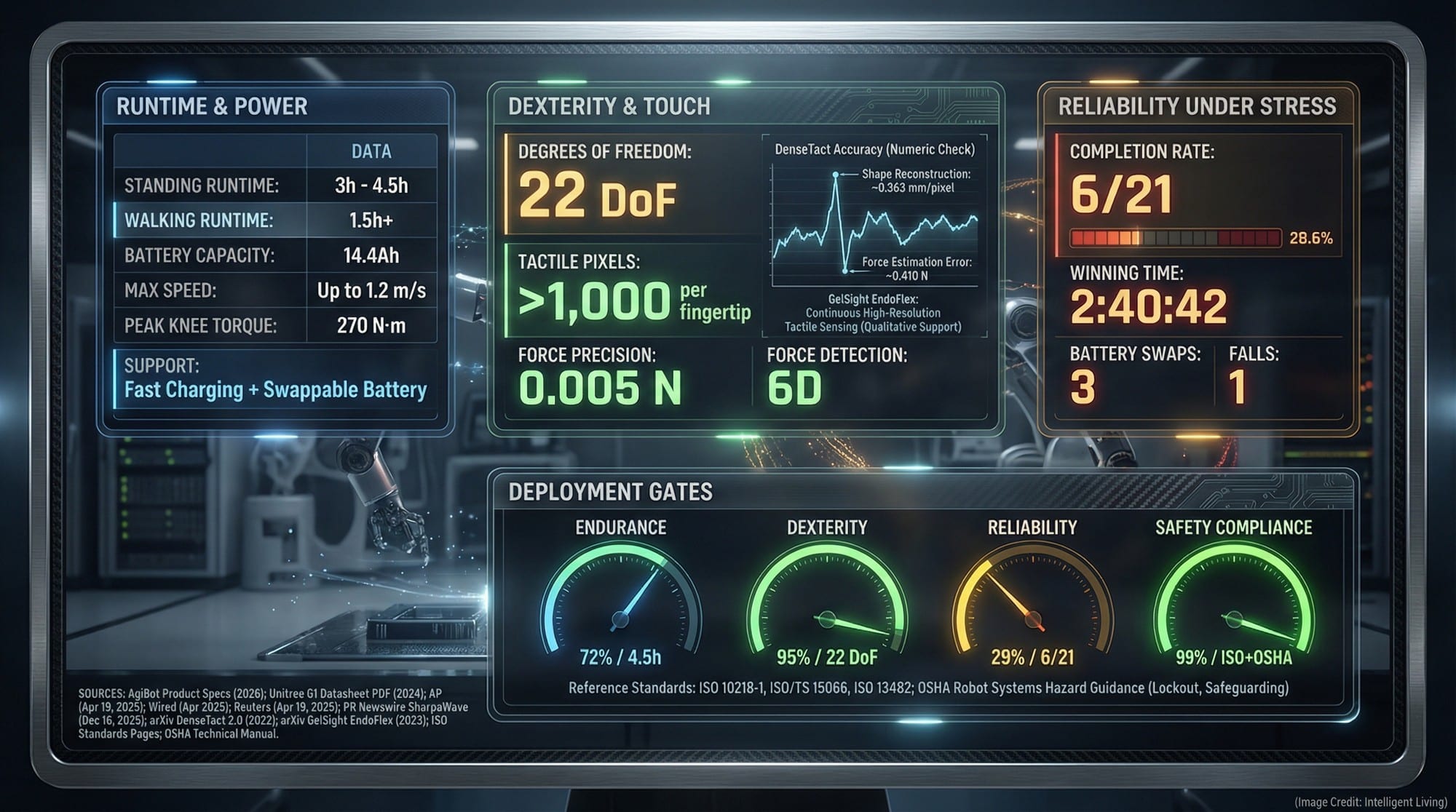
Endurance benchmarks matter because they test whether joints, motors, and control systems can run consistently over long periods without failing. The 66-mile humanoid endurance walk prioritises consistency and power management over raw speed during continuous operation. A related retail endurance test saw six Agibot G2 robots run a Shanghai convenience store for 24 hours, completing a combined 1,730 tasks with four passes and two failures.
Hardware constraints dictate performance envelopes for full-size platforms. Manufacturer specifications prioritise battery design and joint torque, specifically battery life targets for standing versus continuous walking. Global endurance tests expose critical failure points beyond autonomy, revealing mechanical wear, charging logistics, and system calibration precision over extended operational periods.
Technical Bottlenecks: Unsolved Challenges in Embodied AI Deployment
Rapid industrial iteration has yet to resolve core constraints blocking broad deployment. Critical gaps persist across four technical domains:
- Dexterity and tactile feedback for complex manipulation.
- Autonomy transparency between teleoperation and independent decision-making.
- Uptime economics, including maintenance and service networks.
- Governance frameworks covering liability and public acceptance.
Visuo-Tactile Sensing: Advancing Dexterity for China Humanoid Robots
Robotic hands remain a bottleneck for complex factory tasks. Precise manipulation under uncertain contact requires robots to sense shape and force in real time instead of following pre-programmed paths. Visuo-tactile systems, including a robotic hand designed to improve humanoid dexterity, integrate cameras and touch sensors to minimise slipping and over-gripping during contact tasks.
Imitation Learning: Bridging the Gap Between Teleoperation and Autonomy
Diverse training centres employ teleoperation to bootstrap learning. Initial supervision is effective, yet it often hides the autonomy gap: a robot performing well under guidance may fail when making novel decisions independently. Transparent pilots label how much work was autonomous versus remotely assisted. A useful technical backdrop is how imitation learning is being used to train legged robot locomotion because many autonomy claims still depend on how policies are trained, corrected, and stabilised.
Maintenance, Uptime, and Service Networks
Robots are machines that require repair, parts, and scheduled service. Predictable uptime and rapid servicing dictate operational readiness far more than peak demo performance. Systems built for quick energy turnaround, like autonomous battery swapping for humanoid workers, emphasise industrial-grade uptime requirements.
A minimal anecdote captures the mood in many pilots: a warehouse foreman often says a machine’s true value is proven on day twelve of a month-long trial, not on day one of a press demo.

Legal Frameworks: Liability, Workplace Hazards, and Public Acceptance
Autonomous systems raise basic liability questions. Who is responsible when a robot damages property or harms a person—the operator, the manufacturer, or the software provider? Standards help define tests, but liability frameworks need legislation, insurance models, and case law to mature. Industrial safety teams employ the OSHA technical manual on robot systems and workplace hazards for evaluating safeguarding, lockout procedures, and incident response protocols.
Public acceptance dictates pilot longevity. Notable hardware failures or data-capture concerns in public spaces can rapidly stall deployment schedules. Sustainable progress depends on China’s humanoid robots exhibiting reliable performance in unfiltered industrial settings instead of curated videos.
Workforce Redefinition: Technical Skills for the Robotics Era
Automation reshapes roles rather than simply removing them. Success requires training specialised technicians and redesigning workflows instead of simple hardware installation. Workplace planning recognises that automation is redefining work and skills. Pilot success requires training technicians and redesigning workflows, not just installing hardware.
Future Indicators: Monitoring China Humanoid Robot Maturity
- Whether procurement contracts begin to require standardised evaluation reports and labelled compliance.
- Published autonomy-share metrics during pilots, including how often teleoperation is used.
- Standardised field trial reliability metrics require data on uptime, mean time between failures, and recovery intervention frequency.
- How capital is allocated, with a focus on service infrastructure, parts availability, and maintenance capacity.
- Whether manufacturers adopt AI-driven factory systems from Caterpillar and NVIDIA that simulate lines digitally and pressure-test scheduling before hardware changes.
- Cross-category deployment signals that show where robots reach scale first, especially in logistics, mobility, and inspection.
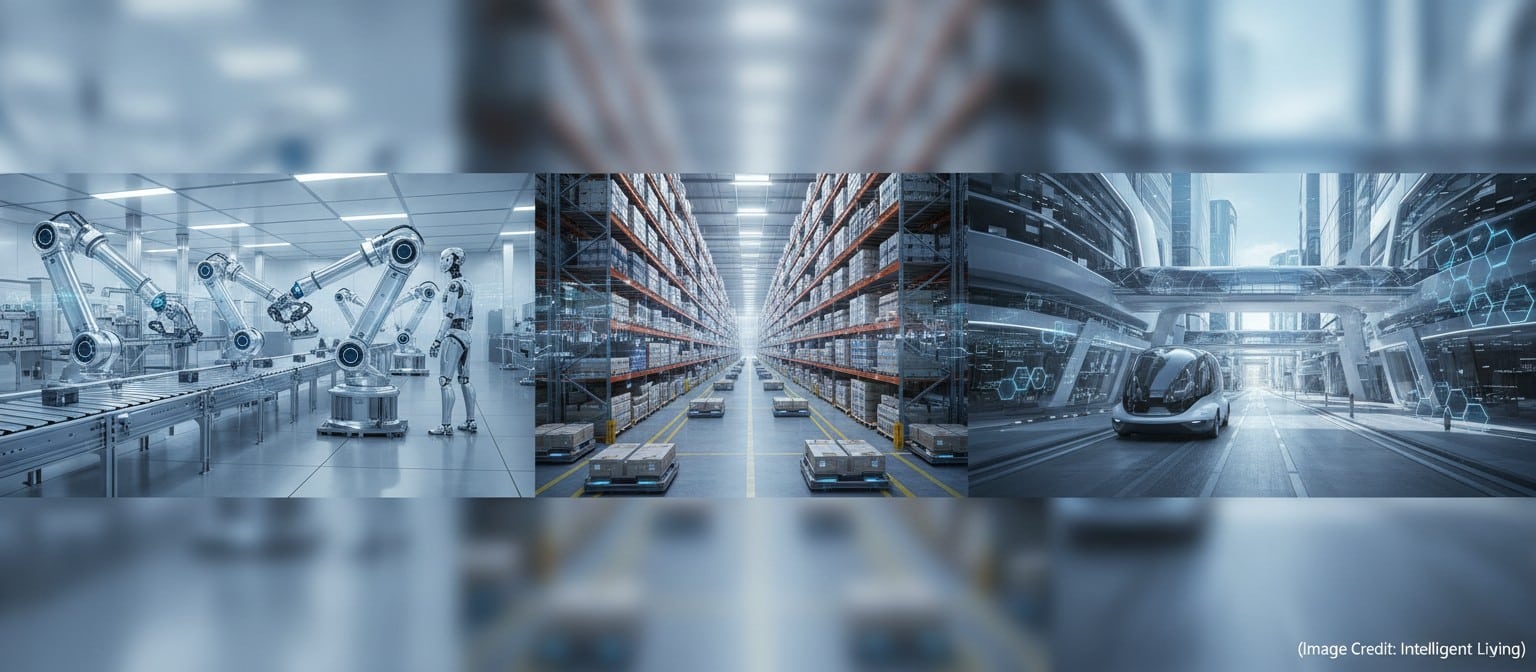
What China’s Humanoid Robot Pipeline Means for Factories, Warehouses, and City Streets
Coordinated expansion across robot schools, safety standards, and commercial capital creates an environment where experimental prototypes convert into repeatable industrial pilots. Industrial expansion aligns with breakthroughs in perception and planning software to significantly lower entry barriers for embodied systems across global supply chains.
Audit measurable pilot results and service networks to separate viable infrastructure from market hype while ensuring China’s humanoid robots maintain consistent uptime. Industrial robot safety requirements and transparent autonomy labelling establish the framework for successful long-term integration. As manufacturers move past the Unitree IPO milestone, the focus shifts to the service infrastructure required to keep machines operational when hardware fatigue or environmental variables intervene.
Separating hype from infrastructure requires auditing measurable pilot results, transparent autonomy labelling, and the service networks necessary for maintaining operational uptime.
Humanoid Robotics Infrastructure: Frequently Asked Questions
What defines the role of robot schools in China?
Robot schools serve as high-density training centres where embodied AI systems learn repeatable tasks through VR-style teleoperation and motion capture to ensure factory readiness.
Are China’s humanoid robots safe for industrial use?
Safety is governed by the new national standard system for humanoid robots, which aligns with industrial robot safety requirements (ISO 10218) to manage human-robot collaboration.
How does the Unitree IPO affect the robotics market?
The Unitree IPO signals that humanoids are now investable commercial products, providing the capital necessary for field service networks and spare parts logistics.
What is the current robot density in Chinese manufacturing?
China currently ranks third globally in robot density, utilising roughly 470 industrial robots per 10,000 employees to automate routine production lines.
When will robotaxis and autonomous warehouses reach scale?
Logistics automation and robotaxis are scaling faster than humanoids because their operational design domains are more restricted, allowing for quicker clinical and safety verification.


