
One of the significant technological revolutions of the twenty-first century is set to reach a turning point with the opening of China’s first completely autonomous, commercial robotaxi trips—without human drivers—in two Chinese megacities: Wuhan and Chongqing.
While driverless robotaxi services have felt like a realistic possibility for a decade, they are now starting to appear on the roads as a choice for paying passengers. In June, GM subsidiary Cruise became the world’s first commercial robocab company to offer rides without a backup driver. The service was introduced to the San Francisco suburbs.
China has now raised the stakes. The two recently issued permits allow Baidu to charge for driverless rides within a 5-sq-mi (13-sq-km) zone in Wuhan from 9:00 am to 5:00 pm and within a larger 11.6 square miles (30-sq-km) zone in Chongqing’s Yongchuan district between 9:30 am and 5:30 pm. So while they are currently set to avoid peak hours, they will mix it up with lots of daytime traffic.
Five fifth-generation Apollo Go cars will operate in each zone, and remote drivers will be prepared to take over if the vehicles get into any problematic situations. In addition, the home base will keep a close eye on the cars through their camera systems, especially in the beginning.
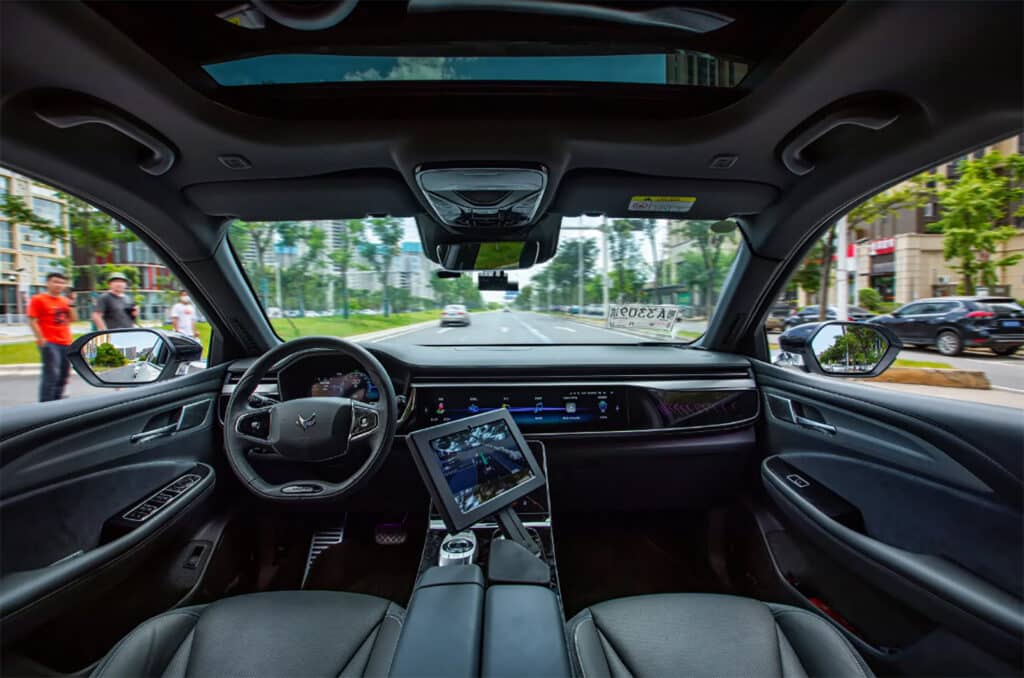
With operations running in all Tier-1 Chinese cities using the same 5th-gen car and backup drivers on board, Baidu’s Apollo Go is already the largest robotaxi company in the world. Moreover, the business just unveiled its 6th-gen design, its first mass-produced completely autonomous vehicle built from the ground up. According to Baidu, the Apollo RT6 will have a manufacturing cost of only RMB 250,000 (around $37,000). When it is made available to the public in 2023, it will be one of the first actual mobility pod-type services thanks to its optional, removable steering wheel and spacious, configurable cabin.
Wei Dong, vice president and chief safety operation officer of Baidu’s Intelligent Driving Group, said in a statement: “This is a tremendous qualitative change. We believe these permits are a key milestone on the path to the inflection point when the industry can finally roll out fully autonomous driving services at scale.”
In order to gather real-world data, the company has tested its driverless vehicles on more than 32 million kilometers (20 million miles) of roads, including highways, expressways, urban streets, rural roads, and mountain passes. To obtain the necessary permits for operating its autonomous taxis, Baidu has gone through several steps of testing and licensing, including tests with a safety operator in both the driving seat and the passenger seat, before obtaining permission to operate fully autonomous rides without any human operators inside the car.
As the only company authorized by some of China’s largest megacities to operate driverless taxis, Baidu’s driverless ride-hailing services come with multiple layers of safety measures, including an autonomous driving system, monitoring redundancies, remote driving capabilities, and robust safety operation systems.
Baidu ranks No. 1 in the cumulative number of autonomous driving patent applications in China, totaling 4 thousand; among them, over 1,500 are global patent families for high-level autonomous driving.
In the upcoming months and years, we’ll likely start to notice an increase in the number of autonomous ride-hailing services kicking off. Each of these is one step closer to a mobility service that may be less expensive, safer, and more convenient. But unfortunately, they also represent the first nails in the coffin of a sizable job sector.
Daxue Consulting estimates that China’s ride-sharing firms employ roughly 30 million drivers alone. That excludes professional drivers, such as taxi drivers, delivery drivers, truck drivers, and bus drivers. In a decade or so, it appears likely that entirely autonomous vehicles will be available for all of these categories, offering robotic drivers that are less expensive, safer, and always on the road. However, governments should consider this a potential societal time bomb in the making, as it will be a sizable group of primarily middle-aged males hitting the streets without generally transferable skills. Permits, not hardware, remain the deciding factor in most markets. Japan, for example, requires a driverless taxi to clear both vehicle certification and a prefectural operating permit, and Tesla’s Cybercab is still at the display stage there. We explained what Japan’s two approval gates will demand of it.


