
Scaling fresh water production without a massive chemical footprint remains the ultimate goal for coastal utilities. Researchers at UC Irvine recently debuted a lab-scale ion pump that uses rapidly switching low-voltage signals to move ions directionally through a nanoporous stack without relying on electrode redox chemistry. While researchers position the device as a low-footprint route to deionization, existing data confirms only a proof-of-concept demonstration rather than a rigorous, plant-scale comparison with reverse osmosis.
How does a ratchet ion pump work for desalination? The process centers on a nanoporous membrane stack where modulated voltage creates a directional bias for salt ions. Bypassing Faradaic reactions reduces operational complexity in remote water systems. Stripping away constant chemical dosing signals a shift toward autonomous, modular water treatment.
Examining the energy efficiency of ratchet ion pumps reveals the gap between lab success and industrial utility. This article explains how the pump works, what the lab results actually show, and which milestones matter most before any claims about more efficient seawater desalination can be tested fairly. We’ll explore the thermodynamic floor and why selective ion separation might be the real winner here.

Electrochemical Ion Pumping: Core Principles and Performance Benchmarks
Essential Data: Ratchet Ion Pump Energy Metrics and Global Applications
- The core mechanism relies on a nanoporous capacitive electrochemical ratchet capable of driving continuous separations without electrode-side redox reactions.
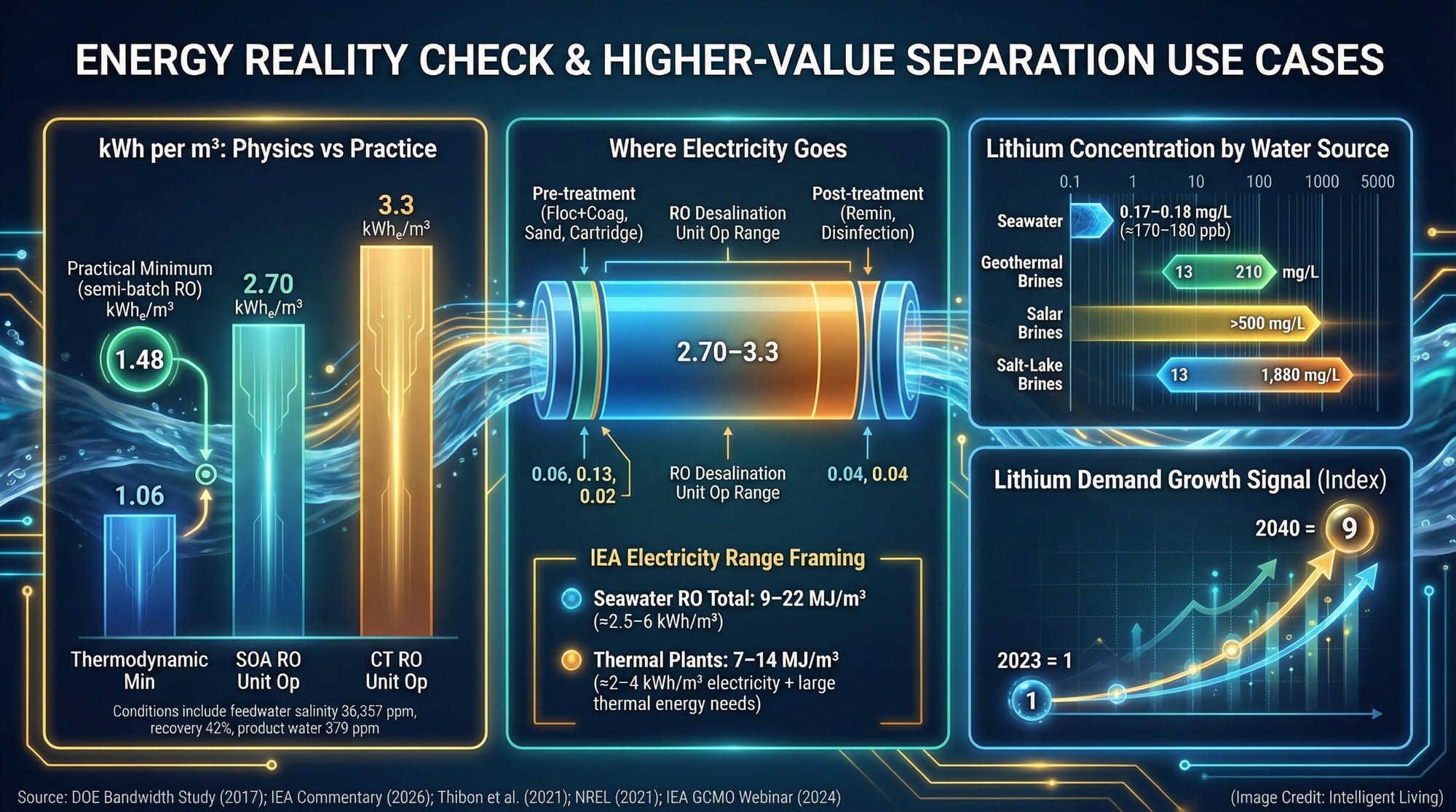
- Seawater reverse osmosis maintains a typical specific energy consumption range between 2.5 and 4.0 kWh/m3. Real-plant totals climb higher once pretreatment is included.
- Broader families of electrically driven ion separations utilize circuit switching and double-layer capacitance to move ions without traditional pressure-driven mechanics.
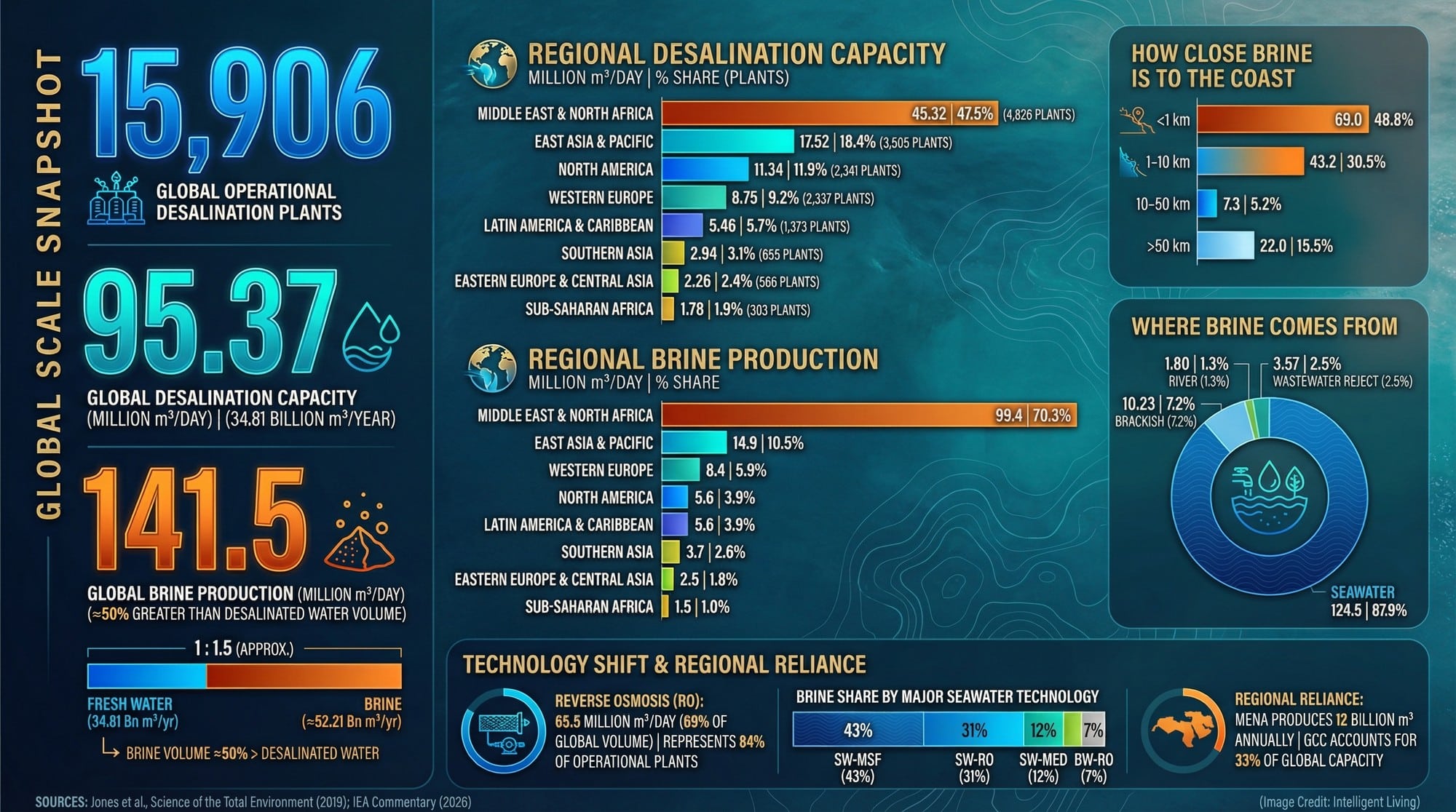
- Desalination sustainability is inextricably linked to the brine output, which is about 50% higher than earlier estimates found in recent global accounting inventories.
- Sustainability in this sector also involves electricity-free solar desalination designs that prioritize simplified deployment in energy-constrained regions.
- “Chemical-free” specifically denotes redox-free pumping at the electrodes. This does not imply a full desalination plant would operate without upstream pretreatment or essential cleaning chemistry.
Technological Overview: Nanoporous Membrane Stacks for Redox-Free Desalination
The Core Mechanism in Plain Terms
The membrane architecture serves as the functional heart of the ratchet ion pump. The core invention is a nanoporous membrane stack with thin conductive layers where an applied voltage profile creates a ratchet-like bias.
This system offers specific operational benefits:
- Modulated voltage signals create a directional bias for salt ions.
- Capacitive cycling ensures ions drift in a preferred direction over repeated sequences.
- Structural layers eliminate the need for chemical redox reactions at the electrodes.
Swapping aggressive chemistry for the precise timing of rapidly switching signals achieves deionization. This shift toward mechanical-electric bias over chemical force distinguishes the proof-of-concept from existing technologies.
Why the Design Could Matter in the Field
Small desalination pilots frequently fail because the logistics of chemical dosing and maintenance are unsustainable in remote environments. A device that reduces electrode-side chemistry burdens remains attractive for operations requiring predictable upkeep, even before proving an energy advantage at scale.
Better desalination necessitates improved brine outcomes, a priority seen in integrated solar dome water projects that treat energy and discharge as a single problem.
Global Desalination Demand and the Evolution of Modern Water Treatment
Economic Drivers of Desalination: Climate Volatility and Water Scarcity
Utilities treat desalination as a vital reliability backstop, transforming seawater into a consistent supply. Climate volatility and surging water demand collide with finite local resources, forcing a reliance on these specialized treatment systems.
The hidden scaling constraints of brine indicate that global desalination generates volumes roughly 50% higher than earlier models predicted. These massive volumes complicate permitting, coastal discharge planning, and overall operating costs.
Coastal managers must evaluate the ecosystem impacts of brine discharge to ensure dilution strategies match local marine conditions.
Water scarcity is fundamentally a governance problem. Shift toward modern water infrastructure management increasingly integrates recycling and conservation as one integrated decision set. Municipalities often pair desalination with advanced water recycling systems to stabilize local supply.
Analyzing Current Desalination Efficiency Gaps and Energy Recovery Methods
Reverse Osmosis in Plain English
Reverse osmosis drives water through a semipermeable barrier, effectively excluding salt ions through high-pressure rejection. Modern seawater RO plants pair high-pressure pumps with energy recovery devices. Essential desalination efficiency benchmarks from the U.S. Department of Energy highlight exactly where plant-level energy is lost.
The same membrane physics applies at a residential scale through home reverse osmosis filtration systems that depend heavily on feed pressure. In contaminated regions, RO remains a primary method for how to filter PFAS and microplastics when maintenance is consistent.
Hardware performance assessments must reflect whole-system accounting to accommodate seasonal turbidity spikes. This variability ensures that new hardware is judged by realistic operation rather than single lab metrics.
Electrodialysis and Electric-Field Methods
Electrical work scales more efficiently than pressure-driven RO at lower salinities, making electrodialysis a primary choice for brackish water. Standard electrodialysis mechanics utilize ion-exchange membranes and electric fields to guide charged particles into separate streams.
Newer salt-free electrodialysis metathesis approaches target brine minimization while turning more feed water into usable output.

Technical Analysis: Signal-Driven Ion Transport in the Ratchet Pump
Architecture and Design: The Nanoporous Capacitive Electrochemical Ratchet
Modulating ionic distributions through switching voltage creates the necessary directional bias. The ratchet-based pump uses nanoporous insulating wafers coated with thin metal films. The timing of this switching ensures ions preferentially migrate across the stack over many cycles.
This technology aligns with broader research into capacitive electrochemical ion transport architectures that rely on high-frequency circuit switching. Physics demonstrations in lab settings often mask the operational failures seen in real seawater. Operators know that biofouling and long runtimes expose failure modes absent from short bench tests.
Defining Redox-Free Operations in Modern Electrochemical Desalination
The patent-pending ion separation method from the University of California characterizes the design as redox-free electrode operation. Eliminating electrode byproducts does not bypass the need for upstream management of scaling or biofilms. Most membrane plants still require antiscalants and coagulants upstream depending on feed conditions.
Evaluating Proof-of-Concept Results Against Plant-Scale Desalination Requirements
Directional ion pumping and electrolyte demixing were the primary outcomes of the team’s published lab demonstrations. Detailed technical proof-of-concept data describes the specific device architecture and dilution cell configurations used in the demonstration.
Dilution cell conductivity drops prove ion removal in controlled settings. Unfortunately, this does not automatically translate into potable seawater output or a fair energy comparison with plant-scale reverse osmosis. Plant engineers tend to trust a new technology only after seeing continuous operation logs that capture fouling and performance drift.
To judge fairly, we need missing system metrics: kWh per cubic meter at full salinity, actual recovery rates, and how the membranes hold up against real-world fouling.
Energy Reality Check and the Higher-Value Separation Use Cases
The Thermodynamic Floor: Bridging the Gap in Real-World Desalination Performance
Physical laws dictate a lower bound on the work required to separate fresh water from seawater. Standard thermodynamic separation limits explain why fresh water recovery from brine requires a non-zero energy input regardless of membrane design.
Real Plants Operate Higher
Operational realities impose energy and maintenance burdens absent from ideal models. Reported real-world desalination electricity costs typically reflect these cumulative non-membrane loads. Think of the thermodynamic limit as a frictionless baseline; real engineering always adds the drag of valves and pumps.
The Bigger Prize: Selective Ion Sorting (Lithium, Heavy Metals, Industrial Separations)
Target specific ions, and the economic outlook shifts dramatically. Extracting lithium or scrubbing heavy metals justifies the premium costs associated with specialized, high-selectivity hardware.
Lithium Recovery and Critical Minerals Demand
Modern lithium extraction research pivots toward high selectivity amidst the complexity of real-world brines. Consequently, lithium extraction techniques from seawater and brine have evolved into a fast-moving field of applied research.
Industrial Brines, Recycling Streams, and Targeted Ion Removal
Intense supply pressure provides the economic engine driving these innovations. Scalable extraction methods dictate the future of the battery supply chain. Extraction scalability must be balanced against lithium supply chain risks and the potential burden on local water resources.
Recycling processes increasingly utilize urban ore and battery recycling pathways that resemble advanced water treatment. A recycler may care less about producing drinking water and more about producing a cleaner, ion-specific feed stream that reduces downstream chemical waste.
Scalability Milestones for Commercial Ratchet Ion Pump Deployment
Operational Criteria for Reaching Industrial Desalination Scenarios
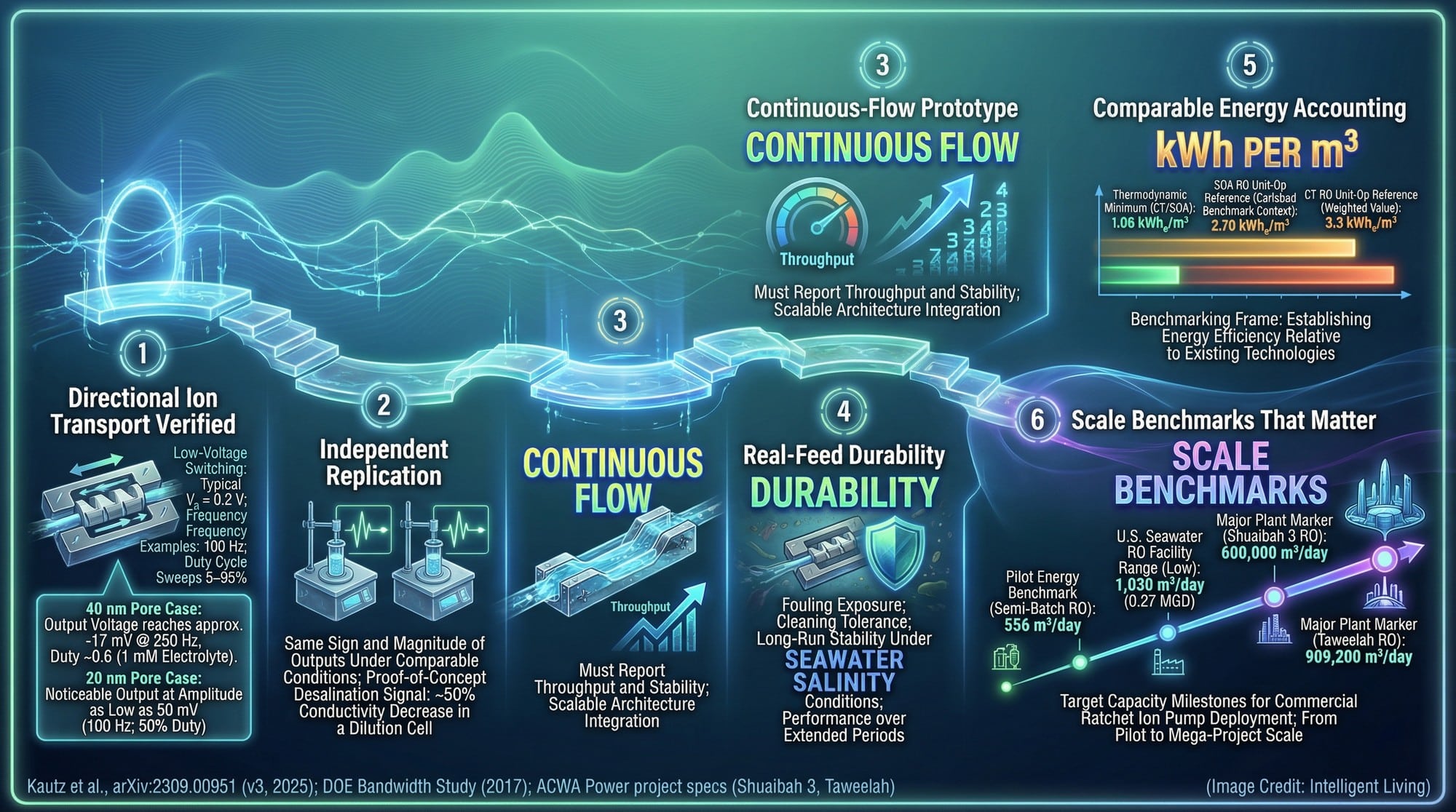
- Validated kWh/m3 accounting at seawater salinity and practical recovery, including all boundary definitions.
- Continuous-flow throughput relevant to real-world production rather than batch or lab cells.
- Durability and fouling resistance under realistic feed-water conditions over long runtimes.
- Economics that pencil out in near-term niches, such as brackish water or industrial ion removal.
- Permitting requires a discharge strategy that accounts for the brine disposal realities inherent to large-scale operations.
Technologies typically prove their worth in ‘ugly water’ niches before attempting municipal-scale seawater applications.
Future Milestones: Independent Replication and System-Level Benchmarking
Independent teams must replicate the ratchet-driven transport across various labs to solidify these findings. Real-feed pilots using seawater or challenging brines in continuous flow must log maintenance, cleaning cycles, and performance drift. System-level benchmarks should report energy, recovery, and quality using comparable accounting boundaries.
Early adopters will likely include brackish-water operators and industrial processors that benefit from selectivity. Focusing on industrial niches first aligns with research comparing electric-field separation performance across different salinity ranges.

The Future of Redox-Free Desalination and Selective Recovery
Demonstrating redox-free ion transport makes the ratchet pump a compelling addition to the electrochemical toolkit. Should these milestones be reached, this technology may well redefine specialized desalination sectors and critical mineral extraction. Precision in the nanoporous membrane stack allows for sorting messy electrolytes without traditional chemistry.
Readers seeking real-world impact should look for replication and long-duration pilot logs as the primary near-term signals. Landing these milestones would reshape specific desalination niches and mineral recovery workflows. Treating seawater as a multi-output resource allows integrated ocean refinery models to integrate co-products and waste heat.
Common Questions on Ratchet Ion Pump Desalination
What is a ratchet ion pump?
Timed low-voltage signals drive directional ion transport through a nanoporous stack without traditional electrode chemistry.
Can ion pumps replace reverse osmosis for seawater?
Promising results in selective separation haven’t yet matched the scale or efficiency required to outperform reverse osmosis.
What makes this technology “chemical-free”?
The pumping mechanism is redox-free at the electrodes, avoiding Faradaic byproducts, though the plant still requires pretreatment.
Why is brine management sustainability a factor?
Brine discharge impacts cost and permitting; any new technology must effectively address these concentrated waste streams.
What are the best uses for this ion pump?
Niche applications like lithium recovery or heavy metal removal justify the premium costs of specialized hardware.


