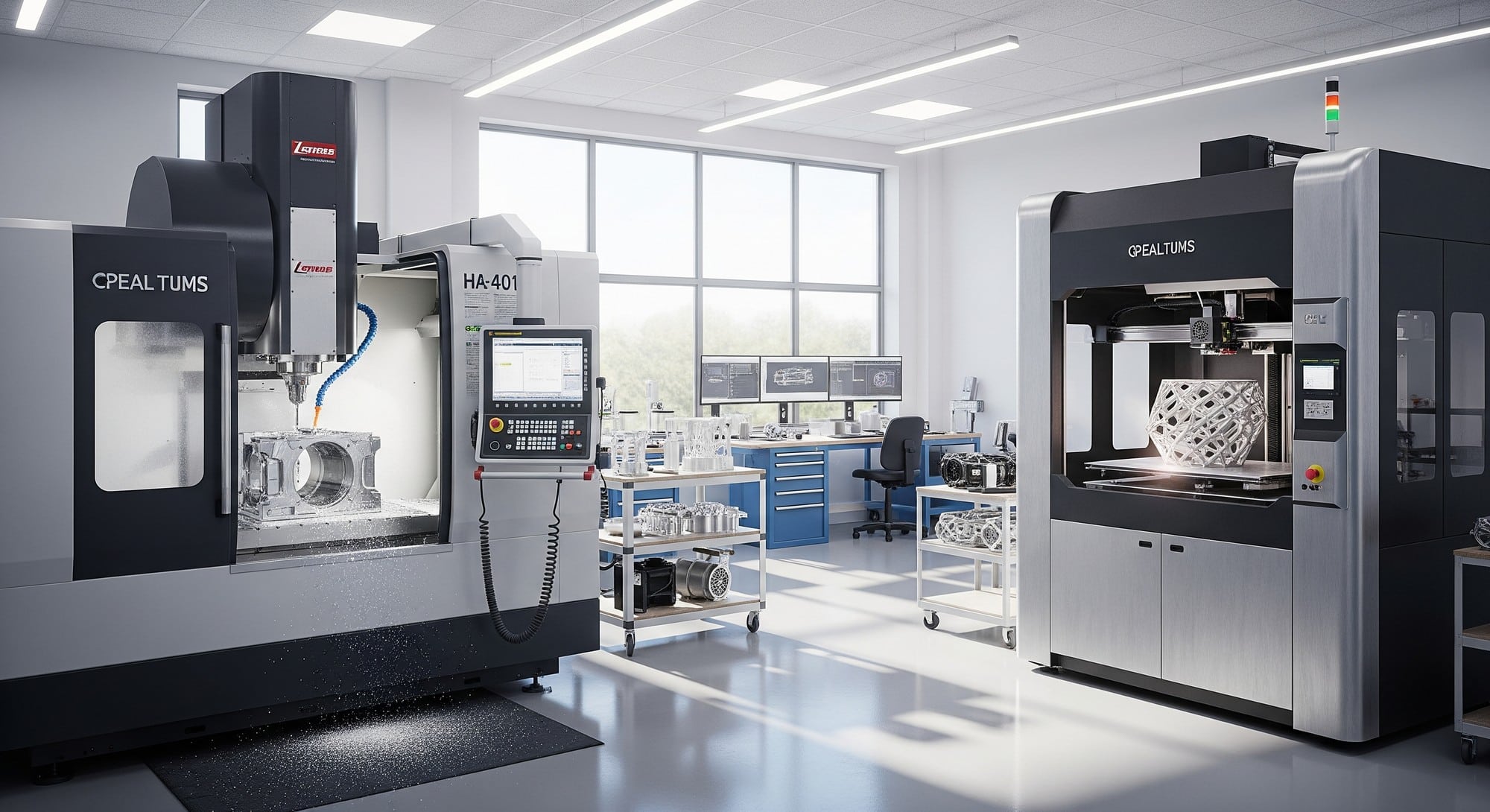
When entering the world of modern manufacturing, a common question arises: CNC machining vs 3D printing. Engineers and designers often weigh the benefits of precision milling against the freedom of additive manufacturing to determine the best fit for specific project requirements.
There is no one-size-fits-all answer. However, understanding how each process works allows for clearer decision-making in product development and industrial production.
This guide breaks down the differences in a practical way to help decide when to use CNC machining vs 3D printing for a given project.
Understanding the Basics of CNC Machining and 3D Printing
Before comparing the two technologies, it is essential to understand the fundamental mechanics of each process.
What CNC Machining Really Does
CNC machining is a subtractive manufacturing process. This means starting with a solid block of material—such as metal, plastic, or wood—and removing material using cutting tools controlled by computer programming. CNC machining is widely recognized for its high precision and speed in creating complex parts.
The power of CNC lies in its precision. It is possible to achieve incredibly tight tolerances, smooth finishes, and high repeatability across large production runs. Many industries rely heavily on CNC because of its consistency and structural integrity.
In the debate of CNC machining vs. 3D printing, CNC typically holds the advantage in terms of durability and surface finish straight off the machine.
How 3D Printing Works in Practice
3D printing is an additive process. Instead of removing material, it builds parts layer by layer from a digital file. This technology enables the creation of complex geometries that would be difficult or impossible to achieve with traditional machining, such as internal channels or lightweight lattice structures.
However, additive manufacturing comes with trade-offs. Surface finish, strength consistency, and material limitations are critical factors when evaluating CNC machining vs 3D printing for functional prototypes or end-use parts.
CNC Machining vs 3D Printing: Key Differences That Matter
The choice between CNC machining vs 3D printing often hinges on core technical differences that impact performance, cost, and feasibility. In real-world manufacturing, the gaps between these methods become evident when analyzing precision and material behavior.
Precision, Tolerances, and Dimensional Accuracy
A major advantage of CNC machining is its ability to deliver extremely tight tolerances. In some cases, advanced CNC setups can achieve tolerances as tight as ±0.005 mm. Because the process is subtractive and uses rigid tools, the final dimensions are highly predictable, making it ideal for components where even minor deviations affect safety.
In contrast, 3D printing builds parts layer by layer, which can introduce slight variations. While modern printers have improved, factors like layer height and material shrinkage influence accuracy. For mechanical components requiring strict dimensional control, CNC machining is often the preferred choice.
Structural Strength and Material Integrity
Strength is a critical differentiator. CNC machined parts are cut from solid material blocks, ensuring the internal grain structure remains intact. This results in higher and more uniform mechanical strength, particularly under load-bearing conditions.
3D printed parts rely on layer adhesion, which creates a directional strength pattern. Parts may be strong in one axis but significantly weaker in another. For instance, a Stratasys study highlighting various manufacturing trade-offs notes that structural integrity can vary. Some reports indicate that the Ultimate Tensile Strength (UTS) for Fused Filament Fabrication (FFF) printing can be as low as 10% of the native material strength depending on orientation.
Design Complexity and Manufacturing Freedom
3D printing excels in design freedom. Because the process does not rely on physical cutting tools, it can produce intricate geometries that would be expensive or impossible to machine. CNC machining is limited by tool access; deep cavities and undercuts often require multiple setups, increasing production time.
Surface Finish and Post-Processing Needs
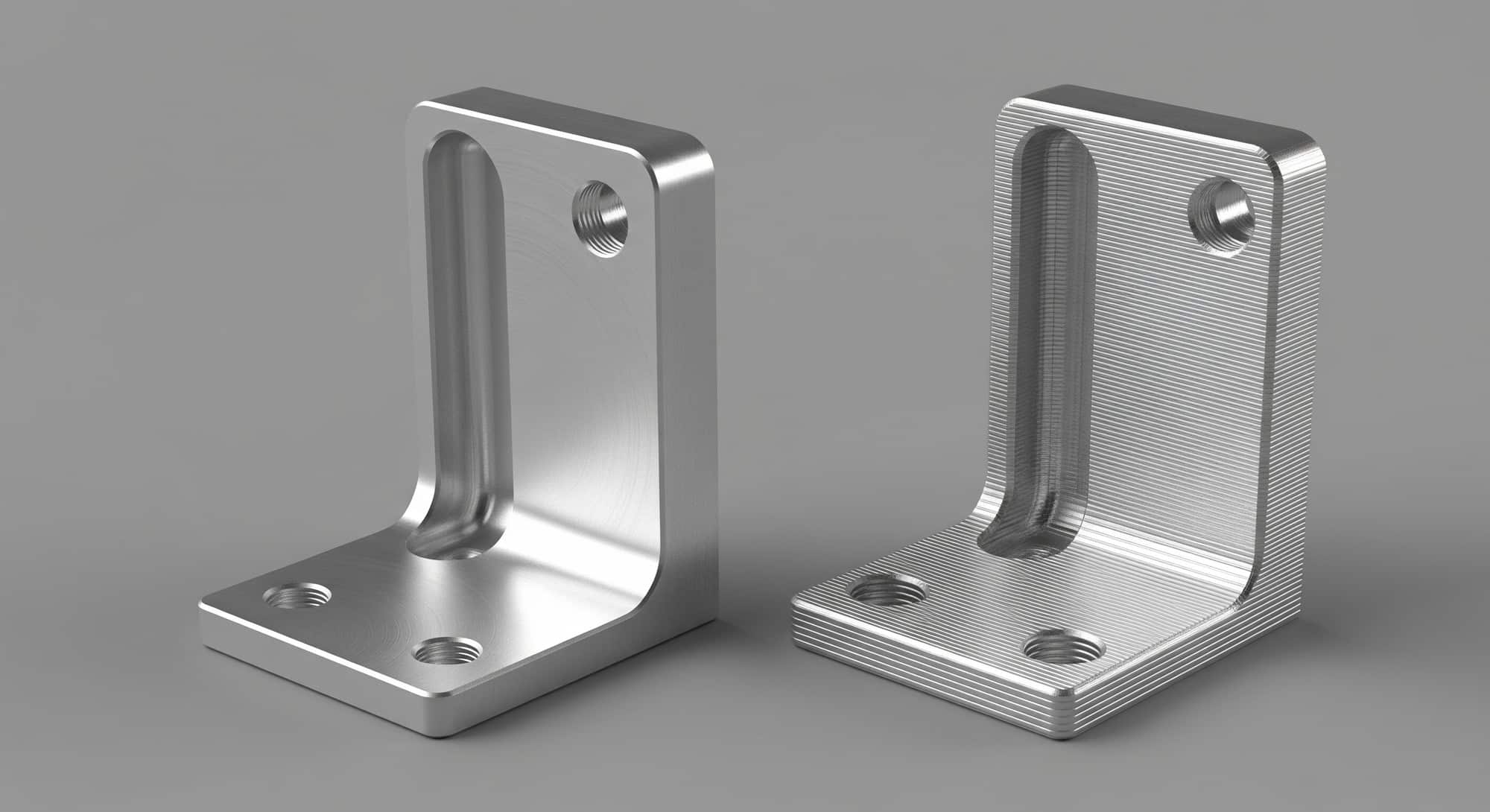
CNC machining typically produces smoother finishes directly from the machine. 3D printed parts usually show visible layer lines and may require sanding, polishing, or chemical smoothing to meet aesthetic or functional requirements, adding time to the workflow.
Production Consistency and Repeatability
CNC machining offers superior repeatability for high-volume manufacturing. Once a program is set, it can produce identical parts consistently. 3D printing is excellent for prototyping, but consistency can vary between batches due to environmental conditions or machine calibration.
Cost Considerations in CNC Machining vs 3D Printing
Project budget often dictates the choice of technology.
When CNC Becomes More Cost-Effective
CNC machining can be expensive for one-off prototypes due to setup time. However, as production scales, it becomes highly efficient. Long production runs allow setup costs to be spread across many parts, making CNC very competitive for high-volume orders.
When 3D Printing Saves Money
3D printing is often the more economical choice for low-volume production. There is minimal setup, no specialized tooling, and almost zero material waste. According to some industrial benchmarks, 3D printing cost-savings can be up to 55% depending on the specific part volume and complexity, though the process can be significantly slower for large batches.
External Resource for Deeper Comparison
For a detailed breakdown of pricing and performance, this guide offers further insights: CNC vs 3D printing.
Speed and Production Efficiency
Speed is a major factor in the CNC machining vs. 3D printing discussion.
CNC Production Speed in Real Use
Once set up, a CNC machine produces parts quickly and consistently. Cycle times are predictable, which is vital for industrial manufacturing. However, initial programming and setup can be time-consuming for complex designs.
3D Printing Speed Advantages
3D printing eliminates most setup requirements, allowing a transition from a CAD file to a physical object in hours. The trade-off is that large or high-resolution parts can take a significant amount of time to print compared to the rapid cutting speed of a CNC mill once it is running.
Material Options and Real-World Limitations
CNC Material Flexibility
CNC machining supports a vast range of engineering materials, including metals like aluminum, steel, and titanium, as well as engineering plastics like nylon and PEEK. This versatility makes it indispensable for demanding industries.
3D Printing Material Range
The range of 3D printing materials is expanding, but it still lags behind CNC in terms of industrial-grade options. While thermoplastics and resins are common, not all materials offer the same long-term durability or heat resistance as their machined counterparts.
Industry Applications: Where Each One Wins
CNC Machining in Heavy Industries
CNC is standard in aerospace, automotive, and medical device manufacturing. When precision and structural strength are non-negotiable, CNC remains the go-to solution.
3D Printing in Innovation and Prototyping
3D printing dominates in rapid prototyping and custom healthcare applications, such as patient-specific implants. It is also favored in design industries where creativity and fast iteration are more important than mass production.
How to Choose Between CNC Machining and 3D Printing
The decision typically rests on three factors: project volume, performance requirements, and budget constraints. CNC machining is ideal for strength and consistency at scale, while 3D printing provides unmatched flexibility for early-stage development.
Many companies now adopt a hybrid approach, using 3D printing for rapid iteration and switching to CNC machining for final production. This synergy represents the future of modern manufacturing.
Final Thoughts on CNC Machining vs 3D Printing
The CNC machining vs 3D printing debate is not about which technology is superior, but which tool is appropriate for the job. CNC machining provides industrial reliability and precision, while 3D printing offers speed and design freedom. By leveraging the strengths of both, engineers can optimize their manufacturing workflows for better results.