
Gabon Infini frames Congo Basin rainforest conservation as a tangible deliverable rather than a vague promise. Utilizing a Project Finance for Permanence (PFP) structure, this initiative ensures that protection remains measurable and funded over the long term. In-depth analysis explores operational mechanics, Gabon’s role as a high-leverage test case, and standard criteria for evaluating conservation finance integrity.
Success rests on institutional predictability. Verified milestones—ranging from patrol frequency to community benefit sharing—trigger capital movement, shifting the burden of proof from donors to implementation results. Unlike traditional grant-based models that often struggle with annual budget volatility, this rainforest protection agreement treats ecological integrity as a contractual obligation.
Global climate resilience hinges on the integrity of Gabon’s landscape. As a forest elephant stronghold with massive carbon sequestration capacity, the region’s health directly influences regional rainfall patterns and global carbon cycles. Structured finance frameworks aim to bridge the gap between ambitious conservation goals and on-the-ground permanence.

Gabon Infini Strategic Overview: Funding Models and Conservation Targets
Core Metrics: Funding Structures and Biodiversity Protection Targets
- Scope: Roughly 34,000 square kilometers sit inside the 34,000-square-kilometer protection agreement, focused on Congo Basin rainforest landscapes in Gabon.
- Funding Frame: The ten-year $180 million funding stack combines about $94 million from partners with about $86 million from Gabon in public resources.
- Model: The Project Finance for Permanence model synchronizes fund disbursements with the verified achievement of predefined policy and implementation milestones.
- Primary Outcomes: New and better-managed protected areas aligned with the 30×30 protected-areas target, expanded ocean protections, strengthened anti-poaching capacity, and ecotourism development tied to local livelihoods.
- Why it Matters: Gabon’s forest-cover profile and its role as key habitat for forest elephants make the success or failure of permanence funding disproportionately consequential for biodiversity and carbon conservation.
The Rainforest Contract: What Gabon Infini Says it Will Do
Establishing Long-Term Performance Triggers and Conservation Locks
Gabon Infini treats conservation as a contract with performance triggers. Instead of dispersing grants wide and hoping for enforcement, establishing performance-based conservation incentives frames funding as something earned through verified delivery rather than something triggered by announcements.
Public and donor capital moves in tranches only when agreed milestones appear in budgets, patrol schedules, and reporting, utilizing transparent biodiversity finance protocols to keep the accounting honest.
Verifying Field Operations and Operational Ranger Consistency
Lodge managers often distinguish ‘staffed’ teams from ‘photo-ready’ ones, noting that a promised ranger team looks fine in a briefing but may lack operational depth. Effective ranger teams demonstrate consistency by patrolling before dawn and maintaining operations throughout difficult rainy seasons. Secure permanence finance relies upon this repeatable, unglamorous reliability.
Integrating Institutional Predictability into Rainforest Governance
Multi-year operating systems represent the goal for everyday protection: trained staff, reliable patrols, local livelihoods that benefit from intact ecosystems, and governance arrangements that can survive political and fiscal shifts.

Analyzing the Project Finance for Permanence (PFP) Mechanism
Project Finance for Permanence is a conservation funding model built around three core elements.
Orchestrating Unified Capital Commitment and Single Closing Protocols
PFP structures synchronize all funding and legal commitments through a single closing agreement rather than a scattered set of parallel projects. Synchronizing donors, national authorities, and implementing partners facilitates a coordinated financing plan that activates when closing conditions are met.
Structural coordination reduces the risk that parts of a plan are funded while the rest are left unfinished. This unified approach prevents the fragmentation often seen in traditional conservation grants.
Managing Disbursement Triggers and Performance Monitoring Frameworks
Verifiable milestones trigger the release of capital. Typical disbursement conditions include:
- Enactment of specific conservation policies
- Hiring and training of certified ranger staff
- Finalization of protected-area management plans
- Deployment of monitoring systems integrated with traceable supply chain compliance to ensure claims remain verifiable.
Verification methods ensure that implementation, rather than mere intent, drives the funding cycle.
Evaluating Independent Trust Fund Structures and Governance Buffers
PFP architectures typically utilize independent funds or trusts to hold and disburse money according to the agreed rules. Providing a governance buffer insulates conservation funding from short-term political decisions.
Such structures often resemble an environmental trust fund structure by separating custody, rules, and reporting. This separation ensures that the rules of the deal remain consistent over time.
Think of the PFP as a construction contract for a park: final invoices remain unpaid until the roof is secure and the doors open. For conservation, the roof and doors consist of functioning patrols, community benefit programs, and verified improvements in protection.
Closing conditions, disbursement rules, and performance monitoring are spelled out in the World Bank PFP guide, which treats permanence as an operating model rather than a slogan.
Essential PFP components, numbering nine in total, break down the architecture behind governance, safeguards, and timebound disbursement conditions as detailed in enduring earth guidelines.

Evaluating the Global Ecological Significance of Gabon’s Rainforest Protection
Identifying Gabon as a Critical Node for Biodiversity Permanence
Analyzing Forest Elephant Strongholds and Carbon Sequestration Value
Ecological scale and species diversity define Gabon’s global significance. Large, connected forests store carbon, stabilize rainfall patterns, and shelter rare species. Scientific genetics-based estimates suggest Gabon is a forest elephant stronghold. This significant biological weight raises the stakes for any financing model claiming permanence.
Aligning Rainforest Integrity with Global Climate Risk Mitigation
Wider evidence regarding degrading terrestrial carbon sinks explains why permanence funding is increasingly treated as climate risk management. When intact forests weaken as carbon sinks, the cost tends to show up later as hotter extremes, damaged agriculture, and higher insurance losses, even far from the rainforest.
Observing Real-Time Shifts in Ecological Pressure and Movement
Rangers often observe critical ecological shifts long before data reaches a spreadsheet. Rangers who track elephant paths often describe how quickly animals adjust when boundaries stop being lines on maps and start being routinely patrolled. Years of repeatable pressure create the early movement shifts a permanence deal aims to lock in.
Optimizing Ecotourism Outcomes for Sustainable Community Livelihoods
Utilizing Ecotourism as a Strategic Revenue Channel for Park Management
The agreement identifies ecotourism as a key measurable outcome, while sustainable travel frameworks define what visitor impact should look like in real communities. Structured carefully, tourism puts income into guiding, transport, lodging, and food supply chains, giving park management a steadier revenue base.
Designing Fiscal Resilience Against Tourism and Market Volatility
Tourism is volatile, and the wildlife conservation potential of Loango captures why Gabon can be compelling for wildlife travel while still depending on infrastructure, access, and global travel cycles. Visitor numbers swing with fuel prices, airline routes, and sudden shocks. Permanence finance leans on endowments, contingency funding, and rules to keep protection running even when visitor seasons go quiet.
Advancements in thermal wildlife surveillance technology demonstrate how enforcement can become more predictable without heavy infrastructure.
Measuring Tangible Cashflow Shifts in Local Community Economies
Ordinary cashflow—not luxury—marks the first meaningful tourism outcome near many protected areas: a co-op supplying breakfast, a driver staying away from extractive side work, or a shop seeing steady demand. These small shifts often turn conservation from an outside project into a local preference.
Auditing Performance Data to Prevent Narrative-Driven Marketing Errors
Sanity-checking ecotourism claims requires looking for auditable numbers: visitor nights, local hires, local procurement, and the share of park budgets covered by predictable revenue. Vague vibes usually replace outcomes when these figures are missing.
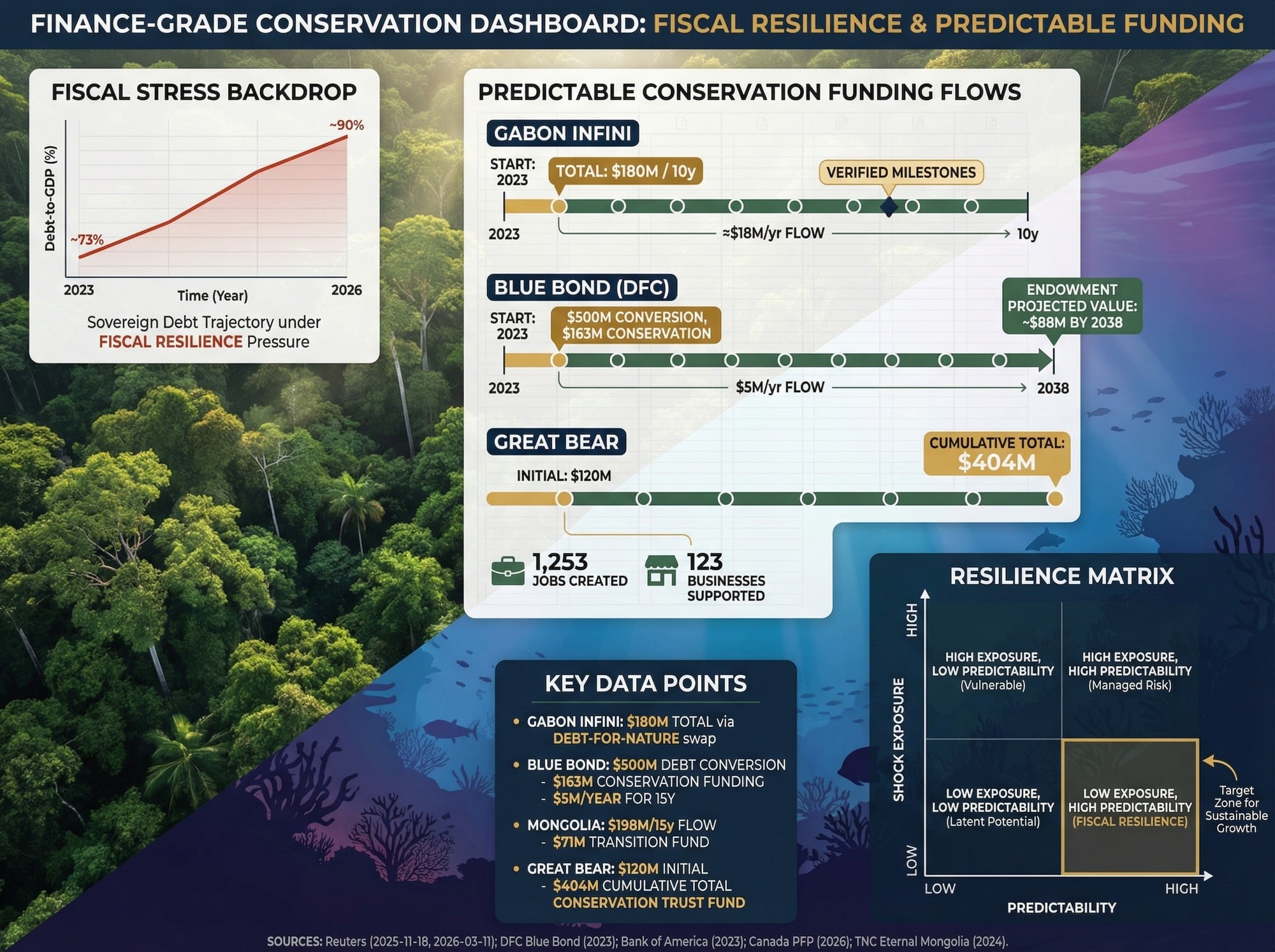
Determining the Scalability and Fiscal Resilience of Conservation Finance
Executing Permanence Stress Tests for Fiscal and Governance Stability
Addressing Macro-Economic Pressure and Annual Budget Turbulence
Real permanence requires financing and governance frameworks capable of weathering political and fiscal shocks. Gabon’s blue bond debt conversion channeled conservation commitments into structured finance. Simultaneously, the FPBG trust fund demonstrates how disbursement rules insulate funding from political shifts.
Refinancing cycles can threaten conservation, but the debt-for-nature refinancing structure shows how contributions and an endowment keep funding alive. Macro signals like the IMF programme request can shrink fiscal space mid-deal, which is why permanence structures separate operations from annual budget turbulence.
Linking Auditability and Transparent Governance to Conservation Success
Weak monitoring or exploitable verification protocols create risks where funding flows without corresponding results. Adopting Natural Capital Accounting standards forces outcomes into a reporting frame that can be audited, compared year to year, and challenged when the numbers do not match reality.
True accountability requires defined metrics: specific indicators, independent auditors, public reporting schedules, and clear consequences for missed milestones.
Assessing the Socio-Economic Impact of Intermittent Protection Failures
Sudden fiscal contractions previously forced unpaid ranger absences, hitting local businesses immediately. When funding later arrived with conditions tied to patrols and community projects, local leaders described it as the difference between intermittent protection and a steady program. Predictable institutions, not just forests, define permanence.
Establishing a Replicable Blueprint for Global PFP Implementation
Defining Integrated Conservation and Community Development Plans
Detailed plans must define protected areas, management activities, and community benefit sharing models. These topical sections serve as the legal basis for measurable milestones.
Verifying Financial Credibility and Closing Protocol Integrity
Credible financing timelines from donors and governments must be sufficient. The closing process tests whether the plan is fundable in practice by aligning those commitments.
Scaling Independent MRV Systems for Performance Validation
Core elements include independent MRV systems. Credible verification prevents perverse incentives and assures funders that results are being purchased.
Governance that Upholds Local Rights and Grievance Mechanisms
Embedding safeguards—community consent, benefit sharing, and dispute resolution—is vital for replication. Practical checklists transform PFP from rhetoric into reality, as seen in Canada’s Great Bear Rainforest PFP, where clear governance and sustained funding matter as much as initial ambition. Checked boxes make the architecture portable; unchecked ones leave the model as a headline without lasting outcomes.
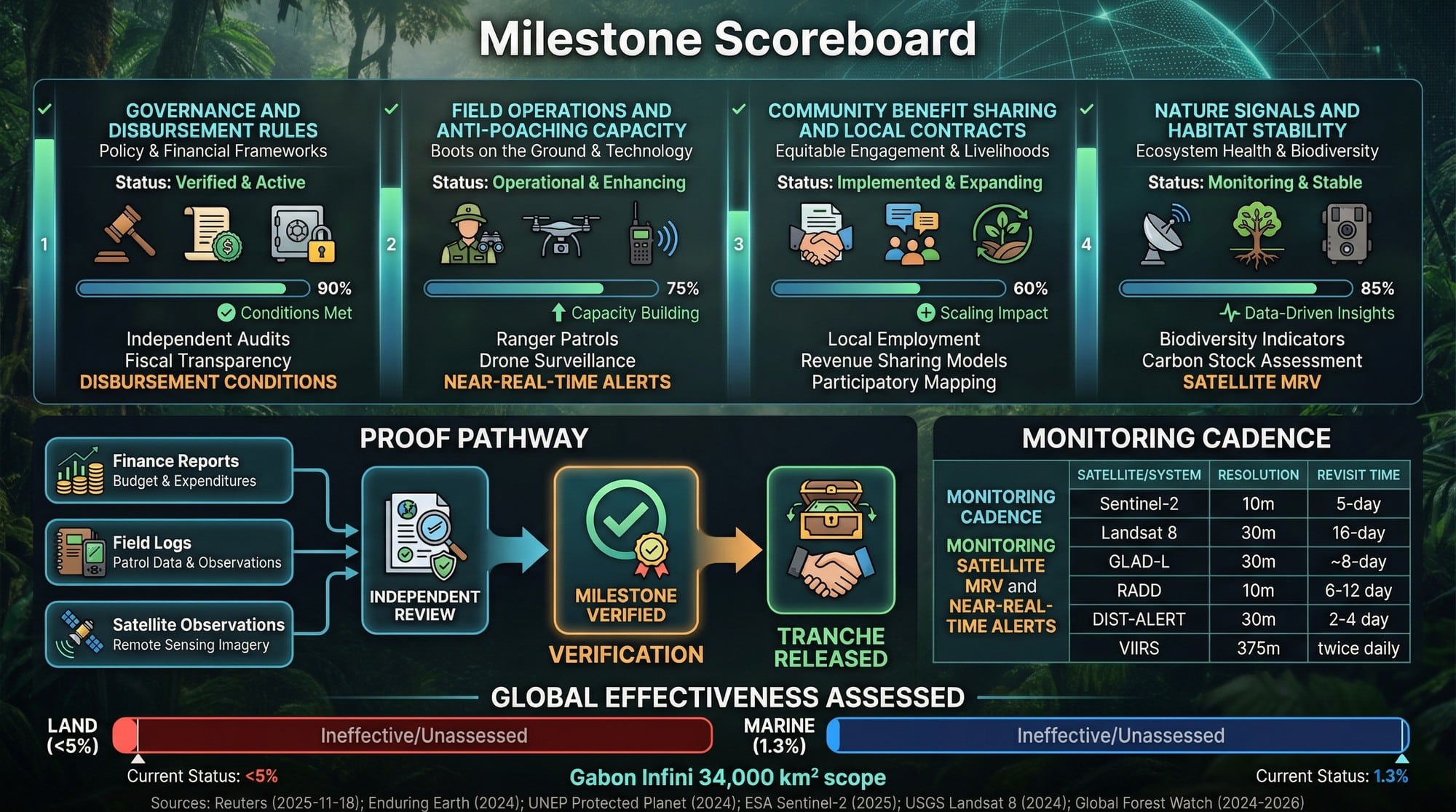
Monitoring Performance Milestones and Post-Agreement Implementation Results
What to Watch Next in Gabon Infini
Operationalizing the Letter of Intent pathway requires monitoring concrete signals that separate delivery from messaging.
- Closing milestones: Watch whether all partners finalize binding commitments and whether the fund’s initial capital call meets targets.
- Verification design: Examine the designated verifier, what metrics will be used, and how often results will be published with a satellite-based MRV architecture that withstands rigorous audits.
- Community Participation: Track whether local actors, including indigenous groups and small businesses, have formal roles in governance and benefit distribution.
- Tourism and Local Enterprise Metrics: Early signals include reported visitor nights, guide certifications, and small-business contracts tied to park services.
Predictability fosters trust in communities adjacent to protected-area boundaries. Leaders utilizing clear schedules for payments, patrols, and contracts view the deal as a functioning system rather than a distant promise.
Applying the Reality Checklist to Differentiate Delivery from Headlines
Standardized reality checklists facilitate the evaluation of new announcements. These are critical as corporate biodiversity risk exposure forces finance teams to demand verified proof instead of pledges. Does the deal name the fund administrator? Are the milestones concrete and measurable? Is independent verification in place? Are community benefit provisions explicit? Is there a plan for downturns in tourism or fiscal stress?
Yes answers indicate a candidate for permanence. Vague answers suggest the announcement is a hopeful first step rather than a finished contract.

Conclusion: Verifying the Future of Rainforest Permanence
Gabon Infini represents a pivotal shift toward results-based biodiversity finance. Connecting capital to verified delivery allows the PFP structure to turn intermittent protection into a reliable operating system. The promise of permanence depends on aligning independent governance, geospatial monitoring, and transparent community benefits rather than just initial funding.
Durable conservation requires moving away from celebratory press releases toward rigorous, audit-based tracking. Future deals should be judged by their fiscal resilience and the clarity of their closing plans. Gabon’s implementation results will establish a global blueprint for whether structured finance can truly secure the Congo Basin’s most critical habitats against global economic pressures.
FAQ: Essential Guide to Gabon Infini and PFP
How does Project Finance for Permanence differ from standard grants?
PFPs release capital only after pre-agreed policy and management milestones are verified, ensuring that funding is tied to actual results rather than intentions.
What are the primary triggers for releasing Gabon Infini funds?
Disbursements are triggered by specific indicators: staffing patrols, enacting protection policies, and confirming community benefit distributions through independent audits.
How does independent governance protect the rainforest?
Using a trust fund structure insulated from daily politics ensures that money remains dedicated to conservation goals even during fiscal or leadership shifts.
Can sustainable ecotourism cover all conservation costs?
Ecotourism provides a vital revenue channel but is rarely sufficient alone; PFPs use layered finance and endowments to smooth over tourism’s natural volatility.
What is the significance of “closing” a PFP deal?
Closing represents the formal legal and financial commitment where all partners sign a unified contract, making the multi-year funding stack operational.


