
Economic growth has long been summarised in a single number. Gross Domestic ‘Product’ measures the value of goods and services produced within a country, and for decades it has served as shorthand for progress. But GDP tracks activity, not durability. It records how fast money moves, not whether forests, fisheries, soil systems, or freshwater reserves are being depleted in the process.
Environmental economic accounting is emerging as the bridge between traditional economic metrics and the physical systems that sustain them. In practice, much of this work is organised through the UN environmental-economic accounting standard, which aligns environmental data with the logic used for national economic statistics. It connects environmental data with national accounts, corporate disclosures, and financial risk frameworks. Environmental-economic integration is being shaped by the global push toward inclusive wealth metrics and by the accelerating integration of nature-related risk into financial reporting standards.
In recent years, the conversation has moved from academic debate to institutional adoption. UNEP’s inclusive wealth framework reframes prosperity around natural, human, and produced capital rather than GDP alone. At the same time, global standard setters such as the International Sustainability Standards Board are advancing nature-related reporting standards that draw on TNFD disclosure recommendations to standardise how companies map dependencies, impacts, and risk. What once sounded theoretical now carries regulatory timelines and balance-sheet implications.
Anyone tracking biodiversity loss, climate risk, or circular design has seen the storyline shift from ideals to implementation. When communities debate whether restoring living coastlines delivers more durable protection than concrete seawalls, it helps to understand how mangrove forests can be treated like infrastructure when risk reduction is measured with the same rigour as engineered defences.

Strategic Outlook: Environmental Economic Accounting and Nature Disclosure Benchmarks for 2026
- Integrating environmental data into national economic accounts through UN SEEA-style frameworks provides a far more complete picture of a country’s true wealth.
- Inclusive Wealth shifts our focus toward maintaining essential capital stocks—natural, human, and produced—rather than simply tracking the flow of GDP.
- ISSB’s current nature agenda, including its biodiversity, ecosystems, and ecosystem services work plan, points toward incremental disclosure requirements with an exposure draft timed to October 2026.
- TNFD’s tooling is designed to fit into existing reporting infrastructure, and its global reporting landscape alignment explains how nature disclosures connect to major standards and regulations across markets.
- Recent UN assessments reveal that 98 countries have implemented SEEA, marking a massive global shift toward environmental-economic integration.
- The EU has adopted updates that expand environmental economic accounts to include modules such as ecosystem, forest, and environmental subsidies, with reporting staged across specific EU environmental measurement windows in official statistical releases.
- Deforestation-free rules are now colliding with trade and commodity flows, including the EU–Mercosur agreement tested against EUDR-style standards in commodity supply chains.

Inclusive Wealth Frameworks: The Measurement Upgrade Fuelling Environmental Economic Accounting
The Scoreboard Problem: GDP Tells You “How Fast”, Not “How Long”
Measuring Depletion vs. Transactional Output
GDP functions like a speedometer. It shows how quickly economic transactions occur, but it does not show whether the fuel tank is running dry. Countries often boost their GDP by harvesting timber or extracting groundwater, yet these transactions frequently mask the reality of rapid resource depletion. Evaluating ocean conservation through a long-run asset lens shows that economic returns for maritime protection are central to fiscal planning, rather than just environmental sentiment.
Distinguishing Economic Flow from Asset Stock
Most families understand that spending savings might boost short-term comfort while gutting long-term security. Ecosystems follow a similar pattern: degrading them might inflate output today, but it inevitably erodes the capacity to produce tomorrow.
Expansion into rural and natural areas makes this tension undeniable, as it directly accelerates biodiversity loss. Concrete evidence of this trade-off is visible in recent research. Studies focusing on rural land expansion and biodiversity loss show that GDP can rise even as ecosystem health declines.
Aligning Environmental Data with National Economic Statistics
Environmental economic accounting addresses this blind spot by aligning environmental data with the same structural logic used for economic statistics. Instead of replacing GDP, it complements it with accounts that track environmental assets and ecosystem services in physical and, where appropriate, monetary terms.
Beyond GDP in Plain English: Inclusive Wealth as a Stock-Based Reality Check
Evaluating Natural Capital as the Foundation of Prosperity
Prosperity, under the inclusive wealth lens, represents the total value of capital stocks. If we deplete natural capital faster than we build infrastructure, our long-term stability weakens—regardless of how much GDP grows.
Categorising Capital: Natural, Human, and Produced Assets
We track natural capital through forests and fisheries, human capital through our collective education and health, and manufactured capital through our machinery and roads. Together, these assets form a national durability test.
Everyday readers find this logic similar to home ownership. Renovating a house can increase its value, but neglecting the foundation eventually undermines the structure. Inclusive wealth attempts to measure that foundation at a national scale.
Sustainability strategies draw directly from this framing. When design choices reduce extraction and waste, they reduce pressure on ecosystems. Circular economy strategies tied to biodiversity outcomes are increasingly discussed as part of long-term resilience rather than as niche environmental preferences.

Repricing Nature: Financial Risk Signals and Global Disclosure Standards
Nature Risk is Balance Sheet Risk Now
Identifying Systemic Nature Risks in the Banking Sector
Financial heavyweights are moving past vague ‘green’ labels and starting to see environmental decay as a tangible threat to solvency and profit.
ECB analysis on nature-related financial stability and price stability reflects a broader shift in institutional thinking. Ecosystem degradation isn’t just an environmental worry anymore; it directly influences inflation pathways, supply reliability, and systemic risk across the entire market. Similarly, the NGFS has published a conceptual framework for nature-related financial risks to create shared definitions that supervisors and financial institutions can use consistently.
Navigating Asset Valuations and Regulatory Compliance
Business leaders can no longer dismiss nature-related shocks as peripheral issues. These exposures, rarely quantified in traditional financial statements, include:
- Supply Chain Disruptions: Ecosystem collapse affecting raw material availability.
- Resource Scarcity: Water shortages halting industrial production.
- Regulatory Shifts: Biodiversity commitments altering asset valuations.
Verifying Site-Level Claims with Satellite Data
Plot-level evidence changes the conversation. Regulatory compliance regimes requiring geolocation have made site-level verification standard practice, often utilising multispectral satellite monitoring to quantify deforestation risk.
In supply chains covered by the EU Deforestation Regulation, digital product passports turn plot-level geolocation into traceable evidence that travels from farm to store.
The Disclosure Stack is Converging: TNFD Adoption and ISSB Standard-Setting
Operationalising the LEAP Approach for Sustainability Teams
As the disclosure landscape tightens, the ISSB is aligning its nature-related disclosure requirements directly with the TNFD framework, reinforcing that nature disclosure is moving toward baseline expectations rather than optional storytelling.
TNFD’s reported adoption and coverage figures provide a measurable signal that organisations are preparing for consistent disclosure expectations. Real-world implementation is moving faster than policy debates.
Practical Implementation: The LEAP Assessment Approach
Sustainability teams are navigating a significant operational shift. Nature reporting is moving from glossy narratives into auditable systems. The TNFD’s LEAP assessment approach captures this logic: locate interfaces with nature, evaluate dependencies and impacts, assess risks and opportunities, and prepare to respond and report.
Practical daily operations highlight the difference between claiming a supply chain is “nature-positive” and proving it. Turning these dependencies into decision-useful information requires natural capital measurement aligned with TNFD logic. In forest regions, the same logic shows up in climate finance experiments built on jurisdictional accounting verified by satellite data.

Global Measurement Architecture: SEEA Standards, EU Regulations, and Verification Proof
SEEA Makes Nature Measurable Without Forcing “Pricing Nature”
Critics often worry that environmental accounting means pricing every tree and river. However, the SEEA valuation guidance is clear: physical data alone provides a robust foundation for analysis without needing a dollar sign. The SEEA Central Framework statistical standard organises environmental flows, environmental asset stocks, and environment-related economic activity in a way that aligns with national accounts. For ecosystems specifically, ecosystem extent, condition, and service-flow accounts extend the framework to habitats, ecosystem services, and changes in ecosystem assets.
SEEA implementation is reaching a massive scale. The SEEA 2025 global assessment reports 98 countries have implemented SEEA-based accounts at different stages of integration and publication.
Wetland restoration debates often serve as an implicit environmental accounting exercise. Standardised accounting helps formalise these comparisons without forcing every policy decision into a single monetary lens.
Mandated Reporting: The European Environmental Economic Accounting Update
Integrating Forest and Ecosystem Modules in Official Statistics
The EU is leaving the experimental phase behind and embedding structured reporting directly into its institutional infrastructure. Regional progress is accelerating as the environmental-economic accounting update law expands national reporting by introducing or strengthening several key areas.
These expanded modules include:
- Ecosystem Services: Tracking the flows and benefits of habitats.
- Forest Accounts: Measuring the health and volume of timber and forest ecosystems.
- Environmentally Related Transfers: Documenting subsidies and financial flows tied to the environment.
Tracking Ecosystem Flows and Environmental Subsidies
Updates to the ledger ensure that member states provide consistent data that can be compared across borders. This is the point where accounting meets financing. City-scale decarbonisation often depends on structured capital stacks, and financing mechanisms like green bonds and infrastructure-aligned loans become more credible when underlying environmental claims can be tracked and compared with standardised accounts.
What Good Nature Reporting Looks Like and How Greenwashing Dies
Traceable Data Lineage and Anti-Greenwash Standards
Mature disclosure requirements strip away the ambiguity. It is now much easier to spot greenwashing when high-quality reports rely on traceable data and strict methodologies. Verified reporting relies on traceable data, clear methodologies, and alignment with recognised standards.
Audit Readiness and ESG Compliance Systems
Today’s reporting systems are built for auditors, not PR departments. This shift is evident as organisations adopt traceable ESG reporting tools that prioritise hard data over vague environmental promises.
Credibility depends on evidence tied to specific geographies. Nature claims become materially stronger when they are connected to site-level monitoring and reproducible measurements. Geospatial MRV architecture has become a recurring pattern in high-integrity biodiversity reporting.
Everyday consumers experience these shifts in subtle but meaningful ways. When a product label claims biodiversity benefits, accounting-grade measurement makes it more likely those claims rest on documented ecosystem data rather than on untestable slogans.
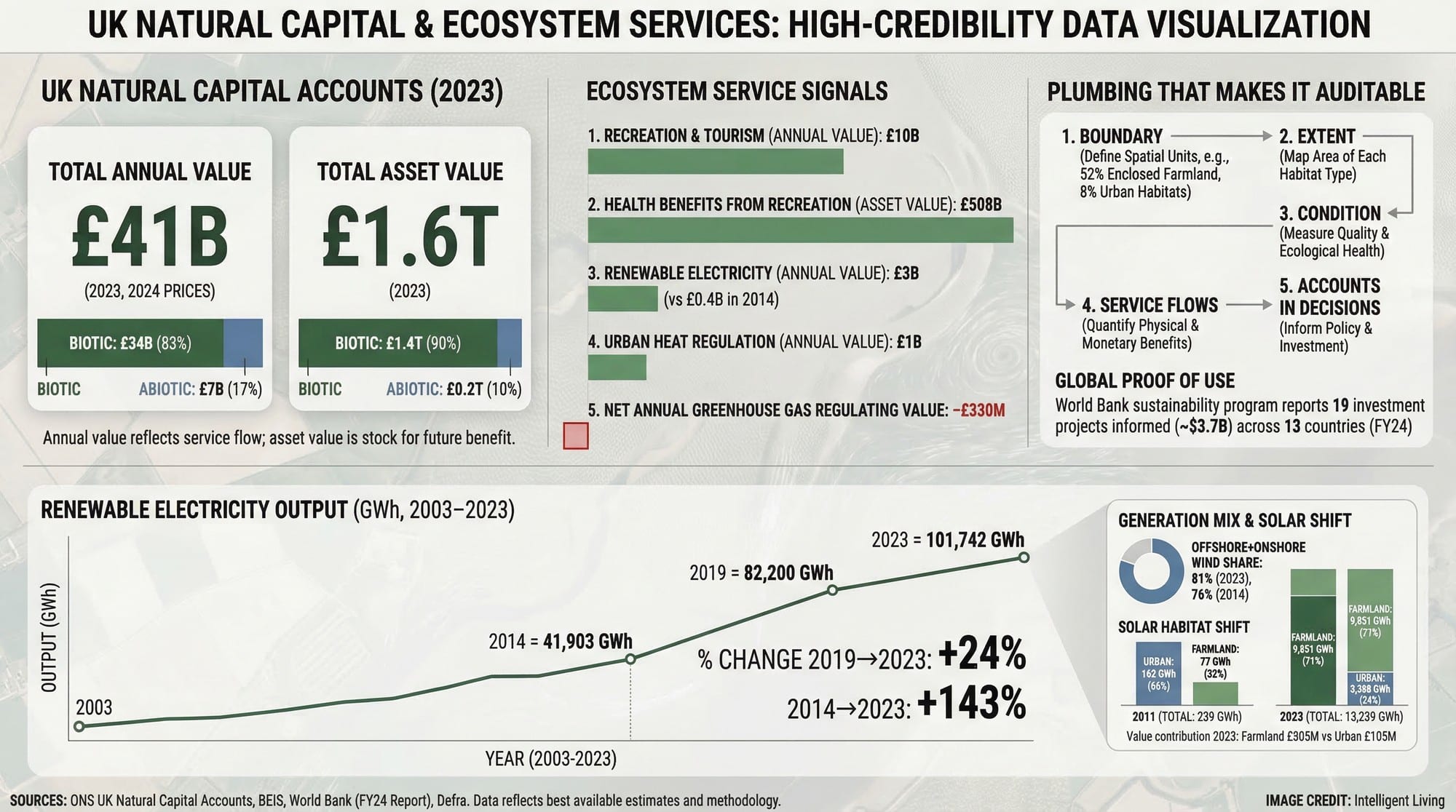
Proof and Plumbing
Proof: This is Already Shaping Decisions
Case Study: UK Natural Capital Bulletins and ONS Methodology
National statistical offices are leading the way. The UK Office for National Statistics, for instance, publishes national environmental accounts that weave ecosystem data directly into the country’s official reports.
Tracking environmental assets alongside standard economic metrics provides the practical depth necessary for informed, long-term decision-making. Accounting details underneath the headline numbers provide the necessary practical depth. In the UK approach, ecosystem service accounts connect habitats to measurable benefits, and the UK ecosystem service valuation methods explain how physical measures and monetary estimates are built from defined data sources and consistent assumptions.
Local Government Applications: Seawalls vs. Nature-Based Solutions
Local decisions often mirror this logic. When a municipality compares a floodplain restoration bid against a higher concrete wall, the question goes beyond simple cost. Leaders must decide whether long-term protection, maintenance burdens, and co-benefits can be translated into a common accounting language.
Analytical work at the international scale reflects this transition. The World Bank’s Global Program on Sustainability FY2024 sustainability programme annual report details projects where natural capital informed investment across multiple borders. In the UK policy ecosystem, Green Book natural capital appraisal guidance signals how natural capital evidence is meant to feed into project appraisal rather than remain a parallel environmental report.
Outcome-based nature finance also depends on clear measurement rules, including dMRV and anti-double-counting safeguards described in anti-double-counting impact credit rules.
Environmental accounting is actively steering where infrastructure money flows and how conservation projects get funded. This is no longer sitting on a shelf as mere theory.
Plumbing: The Data Stack Behind Ecosystem Accounts
Establishing Accounting Boundaries and Condition Indicators
Operationally, ecosystem accounting is a build sequence, not a single dataset. The SEEA Ecosystem Accounting standard is structured to organise habitat and landscape data, measure ecosystem services, track changes in ecosystem assets, and link those changes to economic activity.
A Five-Step Build Sequence for Ecosystem Accounts
- Define the accounting boundary so the same geography is used across time and datasets.
- Compile ecosystem extent using land cover and habitat classifications that can be replicated year to year.
- Select ecosystem condition indicators that can detect degradation or recovery, such as vegetation metrics, fragmentation, soil health proxies, or water quality measures.
- Quantify ecosystem services as flows by linking biophysical production to beneficiaries, including sectors and households.
- Connect flows to decision systems using consistent tables, time series, and transparent quality checks.
Regional planners often see these outputs as a map, yet for an accountant, they represent a vital need for repeatability.
The EU’s INCA project successfully compiled ecosystem service data at scale, proving that these metrics are operationally viable. Technical infrastructure depends on consistent definitions, reproducible methodologies, and coordination across agencies. It also depends on maintenance and governance, the same way physical infrastructure does. Urban planners increasingly treat green and blue systems as durable assets, using nature-based infrastructure design to translate accounting logic into built-environment decisions.
When satellite imagery, biodiversity surveys, and economic statistics converge within a unified framework, nature becomes visible. It moves into the same decision systems that govern fiscal and financial policy.

The New Economic Literacy is Asset Reality, Not Just an Output
Economic literacy is evolving. Rather than just tracking growth rates, investors and policymakers are now checking the health of the assets beneath that growth—asking if they are stable or sliding toward collapse. The convergence of inclusive wealth thinking and nature-related disclosure frameworks signals that this shift is no longer peripheral. With dozens of countries implementing SEEA-based accounts, EU regulations embedding ecosystem modules, and global standard setters setting nature-related disclosure timelines, environmental accounting is becoming structural rather than experimental.
For businesses, governments, and citizens alike, the emerging lesson is straightforward. Measuring progress requires understanding the condition of natural systems as rigorously as financial flows. Clearer public understanding relies on environmental claims guidance that separates real system change from polished marketing slogans.
Essential Natural Capital and Environmental Economic Accounting FAQ
What Defines Environmental Economic Accounting in Modern Economics?
Environmental economic accounting bridges the gap between ecological data and national economic statistics, allowing leaders to track how natural systems and financial activity influence each other within a unified reporting framework.
How Does the UN SEEA Framework Standardise Environmental Accounting?
The UN SEEA provides the primary global statistical standard for organising environmental data into national economic accounts, ensuring consistency across different countries and jurisdictions.
Will Environmental Accounting Mandate Putting a Price on Nature?
Monetary valuation is optional under SEEA guidelines. Most accounts focus on physical measures of ecosystem health and condition, providing robust data without forcing a dollar value on nature.
Why Does Inclusive Wealth Outperform GDP in Measuring Sustainability?
Gross Domestic Product focuses on short-term market transactions. Inclusive wealth evaluates the total value of natural, human, and produced capital to verify long-term economic durability.
How Do TNFD and ISSB Collaborate on Nature-Related Disclosure Standards?
The TNFD provides recommendations for nature-related risk disclosure, which the ISSB is drawing upon to develop global baseline standards for consistent corporate reporting.
Why Is the EU Mandating Comprehensive Environmental Economic Accounts?
European authorities aim to strengthen monitoring of environmental objectives by introducing structured ecosystem, forest, and environmental subsidy accounts that can be compared across member states.
How to Verify the Credibility of Corporate Nature-Related Reporting?
Reliable reporting relies on structured data, transparent methodologies, alignment with recognised standards, and consistency across reporting periods rather than isolated claims.


