
Throughout Earth’s recent history, Africa’s great green belt served as a vital climate ally, passively cooling the planet by soaking up vast amounts of atmospheric carbon. Recent satellite evidence, however, confirms that this balance has fundamentally shifted; many of these essential forests now function as a net carbon source, releasing more carbon than they absorb.
This critical change is documented by a precise continent-wide satellite analysis, which tracked above-ground woody biomass at 100-meter resolution, identifying the 2010–2017 period as the tipping point for this continent-wide flip. Ecological transformation, however, extends far beyond the fate of individual trees in Africa, impacting rainfall stability, food security, wildlife health, and livelihoods across a region already vulnerable to drought and fire.
The challenge is immense, but the world is not without recourse. We now possess sharper tools to measure these changes and deploy practical pathways for ecological repair. This analysis begins by establishing Africa’s frontline reality, then examines three solution pillars: enhanced measurement using satellites and AI, smarter financing for lasting forest protection, and community-led restoration that turns degraded land back into living carbon banks.
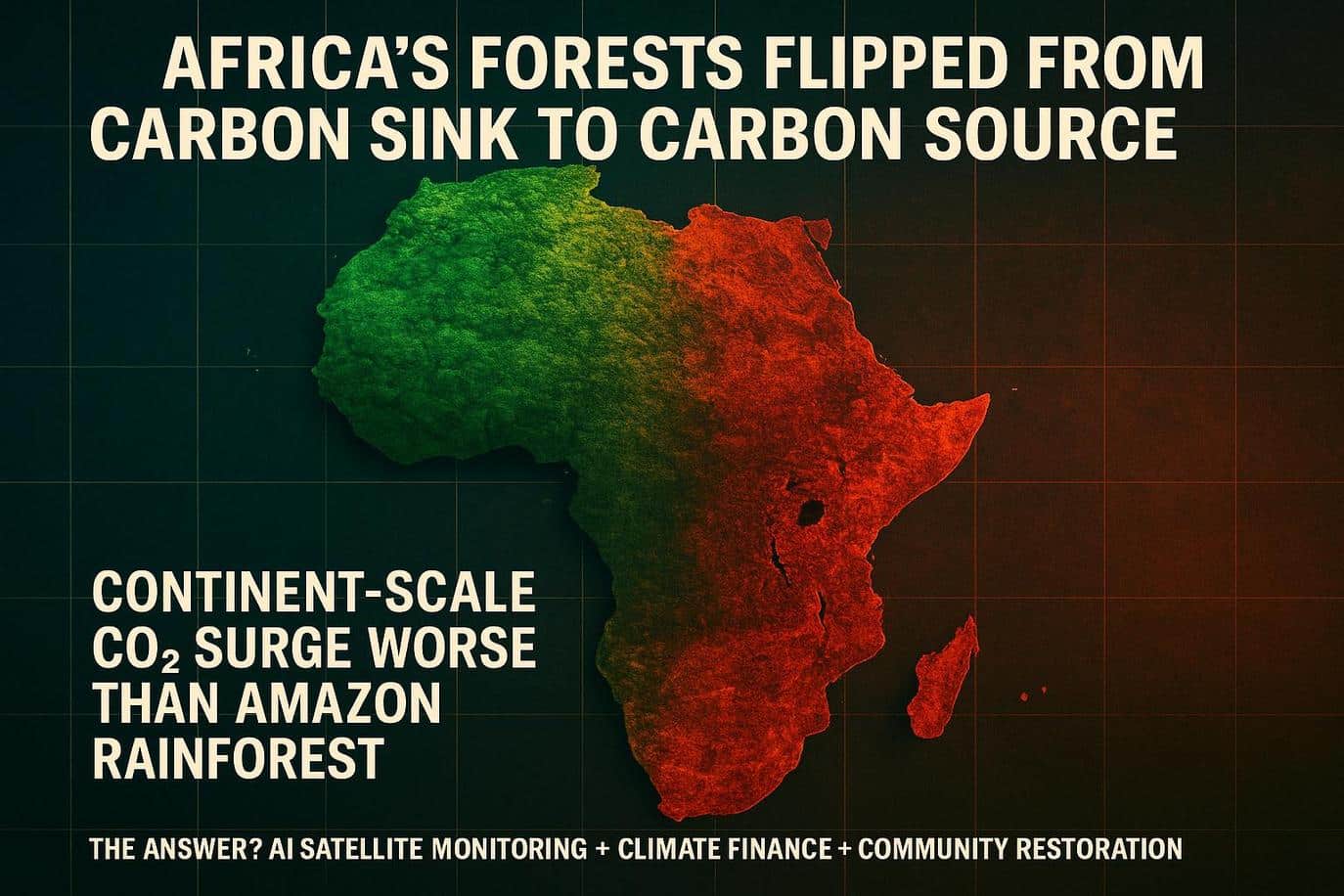
Quick Facts: Africa’s Forest Carbon Flip
Reviewing the precise metrics that define Africa’s carbon budget reversal is essential to understanding its full extent. Scientists used high-resolution satellite data to measure above-ground woody biomass over several years, yielding several key, sobering conclusions about the scale of the transition.
- The continent-wide flip occurred between 2010 and 2017, shifting from a carbon sink to a net source.
- Above-ground biomass loss peaked in the early 2010s, representing a net loss of approximately ~106 billion kilograms annually.
- This conversion translates to a significant ~0.19 gigatonnes of CO₂ per year, dramatically altering Africa’s carbon budget.
- Research confirms that degradation inside standing forests is a major driver, often equivalent to emissions from full clear-cutting.
- The land sink is visibly shrinking, with satellite monitoring documenting more extensive forest fire activity in Africa than the Amazon, particularly in West Africa and the Congo Basin.
These quick facts underscore the urgency of shifting conservation strategies to meet the reality of forest degradation on the continent.

Africa’s Forests Just Crossed a Carbon Tipping Point
From Climate Ally to Carbon Emitter
Africa’s forests and woodlands have long been treated as dependable carbon allies. The new analysis overturns this assumption with empirical data. Between 2007 and 2010 the continent gained ~439 teragrams of biomass per year, yet from 2010 to 2015 it registered losses of ~132 teragrams per year, with losses continuing into 2015–2017.
The team derived those figures from high-resolution biomass maps, which were calibrated with field plots and space-borne LiDAR and subsequently processed using machine learning to capture gains and losses over time. The team’s continental view minimizes localized variance, revealing a clear directional shift toward net emissions according to the Scientific Reports analysis.
What pushed the system over the line varies by country, yet the pattern is consistent. Clearing for smallholder agriculture near roads, demand for fuelwood and charcoal, selective logging that thins canopies, and conversion for commodity crops are the key drivers. The cumulative effect is significant.
In dense tropical moist broadleaf forests, even moderate degradation removes large stocks quickly, while savanna shrub encroachment offers only partial compensation. The result is a net source at the scale that matters for climate.
Fires, Drought, and Wildlife Stress on the Same Frontline
The carbon flip appears alongside a cluster of warning signs that everyday readers already recognize. In southern Africa, recent years brought severe drought at Victoria Falls, disrupting tourism and local income while exposing how water, forests, and livelihoods intertwine.
Recent drought-related economic and livelihood impacts at Victoria Falls show how the drought rippled through the region’s economy and daily life. Concurrently, wildlife indicators have trended downward for decades, with global monitoring showing steep declines in forest-dwelling vertebrates. They are, instead, different faces of the same underlying stress on living systems that regulate climate, water, and biodiversity.
Global Impact: Why Africa’s Forest Degradation Threatens Climate Targets
Part of a Global Forest Sink Slowdown
Africa’s transition reinforces a pervasive global ecological trend. A landmark pantropical study in Science found that, after adding up growth and loss across the tropics, carbon losses exceeded gains, and the main culprit was degradation inside standing forests rather than only clear-cut deforestation.
That finding, published in a landmark pantropical study that exceeded carbon loss expectations, fundamentally altered projections for tropical forest climate services. Africa’s new numbers refine the timeline and confirm a sink-to-source transition in the 2010s. This means all three major rainforest regions are now failing to offset human emissions at the rates policymakers once counted on.
This includes new data confirming the Africa-wide flip, while earlier work has shown that emissions from tropical forest destruction were consistently underestimated. In the Amazon, degraded tracts have already become a net contributor to warming, a finding documented through analyses of damaged Amazon rainforest emissions.
When Natural Buffers Fail, Climate Targets Get Harder
The loss of a natural carbon buffer creates compound challenges. It widens the gap between current emissions and what is required under the Paris Agreement, and it increases pressure for immediate forest protection of the remaining high-carbon stocks.
Independent analyses of Africa’s greenhouse gas budget indicate the land sink is weakening. This places more weight on emission cuts elsewhere, while communities in Africa face the most direct impacts because of Africa’s increasingly shrinking land sink capacity.
Research shows forests’ ability to absorb carbon can decline as CO₂ and heat climb, a pattern that demonstrates how CO₂ overload actively weakens forest carbon uptake. That reality makes protection and sound management prerequisites for planting or restoration at scale.

Precision Measurement: Satellite Monitoring and AI for Forest Carbon Accounting
Weighing Forests from Space
New Earth-observation maps provide current clarity by estimating above-ground biomass at fine resolution. Researchers combine radar and space-borne LiDAR signals with tens of thousands of field plots, leveraging statistical learning to predict biomass across every 100-meter pixel of the continent.
Repeating the process across multiple years reveals the spatial distribution of biomass gain and loss. The Africa study applies exactly this approach and validates its results against independent datasets, so the signal is not a model artifact but a measured change in stored carbon.
Mapping individual canopies, even in drylands, is possible through AI methods that can map every tree worldwide. That work shows how individual canopies can be detected and measured at a continental scale, a building block for precise carbon accounting.
Cities now publish emissions data, including highly granular city-scale emissions maps of America that show where CO₂ comes from down to the neighborhood, another example of remote sensing turning climate claims into verifiable numbers.
From Tree-Level Maps to Credible Carbon Accounting
While remote sensing alone cannot fix a forest, it provides something essential. It creates a shared baseline that governments, communities, and funders can audit. When every square kilometer has a measured biomass value, protection payments and restoration claims can be checked reliably. Furthermore, leakage can be detected when loss shifts from one district to another.
Pantropical analyses that first convinced the world that tropical forests are a net source laid the foundation for this accountability layer. Today’s Africa-specific maps, however, raise the bar on spatial detail and trend confidence. This accountability extends to commodities and buyers through similar efforts in geospatial MRV for supply chains.
There are limits to keep in mind. Very dense canopies can saturate some signals, and above-ground biomass is only one carbon pool among several. The Africa team addresses these constraints directly and still shows a statistically robust transition from sink to source. These results underscore why measurement is the first pillar of any credible plan to halt deforestation, guide finance to where it matters most, and verify that restoration is working in real landscapes.
Systemic Funding Solutions: Climate Finance for Tropical Forest Protection
Inside the Tropical Forests Forever Facility
Reversing the forest carbon ledger requires funding that matches the scale of the problem and the timelines of nature. Brazil has proposed the Tropical Forests Forever Facility, an endowment designed to invest a large pool of capital and use the resulting earnings to pay countries each year for keeping forests standing.
A World Resources Institute explainer details how the facility would work and why it targets about US$125 billion in blended public and private capital, including a portion reserved for Indigenous and local communities, in the original Tropical Forests Forever Facility design. Recent coordination among rainforest nations has intensified, as evidenced by powerful rainforest nation coalitions joining forces.
Real money has begun to move. Independent reporting from Belém confirms multi-billion-dollar early pledges and outlines a public-private structure where governments seed the fund and institutional investors supply the bulk of capital. This plan converts investment returns into per-hectare preservation payments, which are adjusted over time for inflation and performance. This adjustment allows countries to plan for decades rather than budget cycles, according to early pledges from Belém.
From Project Credits to Systemic Protection
For years, much of forest finance flowed through project-based carbon credits. While some projects achieved real protection, fragmented accounting and weak safeguards created significant controversy.
New approaches focus on jurisdictional or national-scale accounting, where leakage is tracked across whole states or countries and where the public ledger is built on satellite biomass maps and independent audits. A useful counterpoint is the LEAF Coalition, which pays for verified emissions reductions at a jurisdictional scale and aims to supplement, not replace, protection funding.
Forest protection of the carbon-dense landscapes must come first, followed by good management of working forests, and finally the restoration of what has been lost where it makes ecological and social sense. The principle of the protect-manage-restore sequence clarifies why permanent finance must precede large-scale tree planting in active frontiers.

Community-Led Restoration: Turning Forest Degradation Back into a Carbon Sink
Success Stories and Real-World Caveats
Communities across Africa are already demonstrating scalable, effective repair solutions. Ethiopia’s national campaign planted more than 353 million trees in 12 hours, serving as a powerful signal of civic momentum that later expanded into longer programs focused on landscape recovery.
The climate benefit depends on survival, species choice, and protection against repeat clearing; however, the social capacity is clearly present, as seen with Ethiopia’s national campaign planting 353 million trees in one day. In agricultural frontiers, targeted retirement of marginal cropland can deliver large biodiversity and carbon gains, a potential demonstrated by research into converting farmland back to nature.
In South Africa, plans for a modern-day “Noah’s Ark” conservation park illustrate how large, connected habitats can secure biodiversity and carbon together when funding and governance are aligned through a detailed modern-day Noah’s Ark conservation plan.
What it Really Takes for Forests to Become Sinks Again
Restoring sink function is less about planting numbers and more about rules, rights, and livelihoods. Communities need secure land rights and access to alternatives to charcoal and frontier farming. Enforcement must focus on the highest-risk frontiers while offering viable income in nearby districts so forest protection does not simply push clearing elsewhere.
High-resolution monitoring turns these principles into practice by detecting where biomass is rebounding and where additional support is required. Regional research shows that parts of Central Africa have remained net sinks in the 2010s because regrowth still outpaced loss in intact areas, which underscores the value of protecting what remains while repairing what is degraded.
Ecological Warning: Lessons from Africa’s Frontline for Future Disasters
The shift of Africa’s forests is far from an isolated event. It sits on the same continuum as drought at Victoria Falls, wildlife declines, and urban heat, which means the lessons extend far beyond the Congo Basin. Recent analysis of the risk of ecosystem collapse facing dozens of countries shows how environmental stress quickly becomes an economic and public health problem when natural buffers fail and governance capacity is thin.
Global Strategy: Applying the Lessons to Other High-Carbon Landscapes
The resulting action plan is straightforward. We must measure change with satellites and field science, pay for verified protection at jurisdictional scale, and invest in people so local economies benefit from forests left standing.
We can apply the same logic to other high-carbon landscapes, from peatlands to mangroves. Protecting existing stocks prevents outsized emissions and helps meet global climate targets through a conceptual carbon stock-first strategy. Coastal forests already exhibit “ghost forest” die-off from sea-level rise, a parallel stress captured by satellites when ghost forests become visible from space.

Africa’s Climate Blueprint: Aligning Finance, Data, and Restoration
The measurable shift of Africa’s forests from a continental carbon sink to a net source in the 2010s confirms that global reliance on nature’s passive capacity to offset emissions is no longer a realistic or viable strategy. This ecological reality demands a coordinated, multi-pillar response that is already taking shape.
Satellites and AI now establish the essential measurement backbone. Climate finance is evolving to reward forest stewardship over resource extraction. Crucially, community-led restoration is demonstrating that landscapes can recover when land rights, local governance, and long-term funding align. Scaling these three pillars is the key to reversing the current trend.
These efforts are intrinsically linked to supporting high-integrity forest protection programs, carefully auditing deforestation-linked supply chains, and backing policies that actively channel targeted finance to the countries and communities that successfully maintain living, carbon-dense ecosystems. If executed with fidelity to local needs and scientific measurement, the lessons learned in Africa can provide the world with a tested, scalable blueprint for avoiding broader ecological disaster.
Essential Questions on Africa’s Forest Carbon Dynamics
1. What defines a forest as a carbon sink or source?
A carbon sink absorbs more CO₂ than it releases, storing it in wood and soil. A carbon source releases more CO₂ than it absorbs. Africa’s forests flipped to a net source after 2010.
2. How did satellite data confirm this carbon shift?
Researchers used radar and space-borne LiDAR with field plots to create high-resolution biomass maps for multiple years. The measured loss of above-ground woody biomass confirmed the net carbon transition.
3. Are specific regions in Africa still acting as carbon sinks?
Yes. While the continent’s overall balance is negative, regional studies show that parts of Central Africa remain net sinks, primarily due to regrowth outpacing losses in intact forest areas.
4. What are the primary human causes of this forest degradation?
Major drivers include smallholder agriculture, fuelwood collection (charcoal), selective logging, and conversion for commodity crops. These actions accumulate, thinning the canopy and reducing carbon storage capacity.
5. How is climate finance working to reverse the trend?
New mechanisms focus on jurisdictional accounting verified by satellite data. The Tropical Forests Forever Facility proposes using an endowment to provide predictable, per-hectare payments for protection.


