
Coastal planners globally face a staggering financial reality: the price of shielding cities with concrete is climbing alongside rising tides. While traditional engineering offers a familiar sense of security, the natural world has already provided a more sophisticated defence system along thousands of miles of coastline. These mangrove forests act as a living flood barrier, yet their role is frequently overlooked until the true economic cost of their absence is calculated.
Far from being a figure reserved for conservationists, this valuation serves as a critical metric for national treasuries and disaster risk managers. Reframing coastal forests as measurable infrastructure allows governments to transition from reactive disaster relief toward proactive asset management that prioritises long-term fiscal stability.
Integrating this $855 billion valuation into annual budgets marks a turning point for climate adaptation. It allows for a precise analysis of flood risk reduction, where every hectare of forest is treated with the same technical rigour as a municipal levee or drainage network. Moving beyond symbolic gestures, this policy-driven approach ensures that coastal resilience is built on the foundation of verified economic dividends, supported by large-scale ecosystem recovery initiatives.
Quantifying The Economic Impact of Global Mangrove Flood Protection
The economic case for mangrove preservation is supported by a series of rigorous global datasets that quantify both the physical and financial scale of these ecosystems. Recent modelling highlights the following critical metrics for national planning:
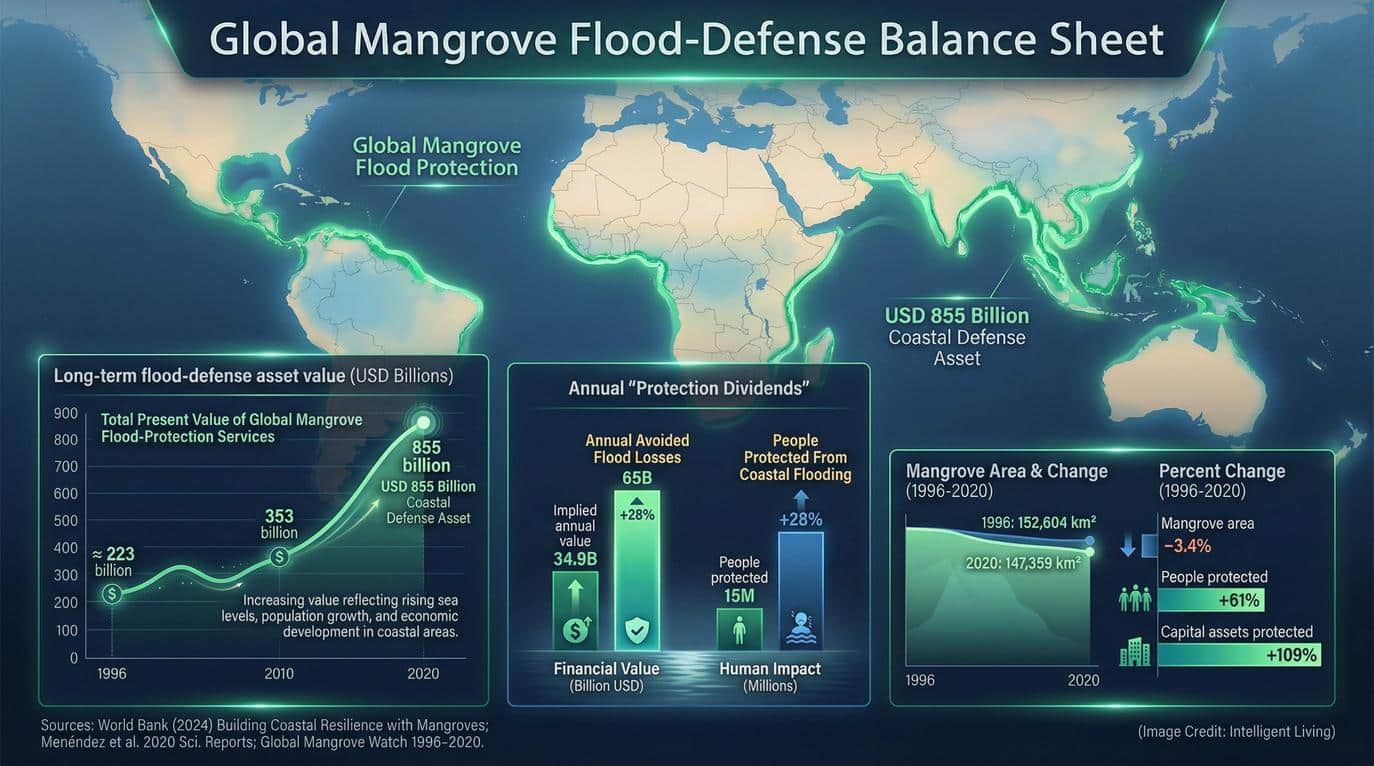
- Global mangrove flood protection is currently valued at approximately $855 billion in present value terms, modelled as a 100-year asset at a 4 per cent discount rate, according to World Bank resilience data and recent global climate modelling.
- Roughly 8.9 million people are shielded annually from catastrophic flooding events due to existing mangrove buffers.
- Peer-reviewed flood simulations find that mangroves reduce global flood damages by more than $65 billion per year and prevent life-altering impacts for approximately 15 million people annually.
- Historical mangrove distribution data estimates that about 147,359 square kilometres of mangroves existed in 2020, providing a measurable baseline for tracking protection gains or losses.
- Restoration costs vary widely by region and method, but a recent global analysis of mangrove restoration implementation costs suggests an average restoration cost of approximately $9,739 per hectare, excluding opportunity costs.
These data points establish a clear technical foundation for treating coastal forests as non-negotiable infrastructure assets.
Operationalising Mangrove Valuations for National Flood-Defence Strategy
The Nature-Based Flood-Defence Balance Sheet
Quantifying Avoided Losses and Dividend Factors
The new global estimate values mangroves as an $855 billion protective asset over 100 years at a 4 per cent discount rate. Economists treat this as the present value of a long stream of avoided flood losses, just as they would value highways or power grids or nature-based solutions that convert farmland back to natural ecosystems to store carbon and reduce climate risk. Using a 100-year horizon at 4 per cent produces an annuity factor of about 24.5, which translates into roughly $35 billion per year in expected protection dividends.
Budgetary Justification for Ecosystem Maintenance
Independent models support these estimates by showing tens of billions of dollars in avoided property damage when mangrove buffers remain intact. Framing mangroves as protective capital makes it easier to justify budgets for conservation and restoration as routine infrastructure maintenance rather than optional conservation spending.
From Global Valuation to National Targets
A pragmatic strategy establishes 2030 no-net-loss targets for mangroves in high-risk zones while aiming to increase both annual avoided losses and the total number of residents shielded by 2035.
Operationalising global valuation into national policy requires a simplified dashboard focused on three primary KPIs:
- Total number of people protected annually from flood exposure.
- Expected annual avoided losses in monetary value.
- Total present value of the mangrove flood-protection asset.
Adopting these metrics ensures that every conservation effort aligns with the specific goal of reducing disaster exposure, supported by standardised natural capital accounting protocols.

Prioritising High-Impact Mangrove Protection and Socio-Economic Equity
Flood Hotspot Triage
Global flood-risk mapping shows that only certain coastal segments generate extremely high protection value from mangroves, with some 20-kilometre stretches preventing more than $250 million in damages each year. Losing even a narrow mangrove belt near a dense urban centre triggers significantly higher economic repercussions than clearing equivalent acreage in remote regions.
Effective hotspot triage utilises three diagnostic questions to guide resource allocation:
- How much annual property damage does a specific mangrove belt prevent?
- How many residents directly rely on this ecosystem for physical safety?
- How rapidly would local flood risk escalate if this specific area were degraded?
Such patterns mirror the way vulnerable coastal property tends to cluster along low-lying, infrastructure-rich coasts. Ranking segments by those criteria directs limited budgets toward the highest-impact protection zones.
Equity Lens: Dollars per Hectare vs People Protected
- While avoided losses per hectare often appear largest in high-income coastal corridors due to infrastructure density, the human impact is frequently greater in lower-middle-income countries.
- In these regions, communities reside closer to the shoreline and depend directly on coastal ecosystems, reinforcing patterns seen in shifting carbon sink dynamics observed in other major global regions.
- Combining both monetary and people-protected metrics helps governments avoid bias toward protecting only expensive real estate and supports flood-resilience strategies that improve economic stability and social equity together.

Scaling Mangrove Restoration and High-Integrity Blue Carbon Markets
Restoration Priorities That Survive Reality Checks
Evaluating Mature Forests versus Young Plantations
Evidence is clear that protecting intact mangroves usually delivers more reliable flood protection and ecosystem services than trying to rebuild degraded systems. Meta-analysis of restoration outcomes confirms that mature forests significantly outperform younger plantings, despite the strong benefit-to-cost ratios of well-designed restoration.
Cost-Efficiency and Strategic Restoration Hotspots
Established root networks and biodiversity layers require decades to provide maximum protective function, a fact that aligns with the importance of coastal ecosystem stability.
Recent modelling finds average restoration costs of about $9,739 per hectare, excluding opportunity costs, and similar soil-based adaptation strategies demonstrate how landscape-scale projects can simultaneously manage water, carbon, and habitat.
The most effective strategy is to protect high-value belts first and target restoration in hotspots where a hectare prevents large annual losses, echoing integrated landscape restoration programmes that successfully manage multiple environmental benefits.
Blue-Carbon Trading Strategies that Don’t Break Trust
Aligning Protection with Global Climate Reporting Standards
Mangroves also act as powerful carbon stores in biomass and soils, and global wetland inventory standards provide the methods for integrating these benefits into national climate reporting.
The blue carbon policy frameworks established by international panels outline how to connect mangrove protection with climate targets while maintaining credible accounting. At the project level, certified wetland restoration methodologies define how to quantify emissions reductions from tidal wetland and seagrass restoration.
Utilising Market Revenue as Strategic Co-Financing
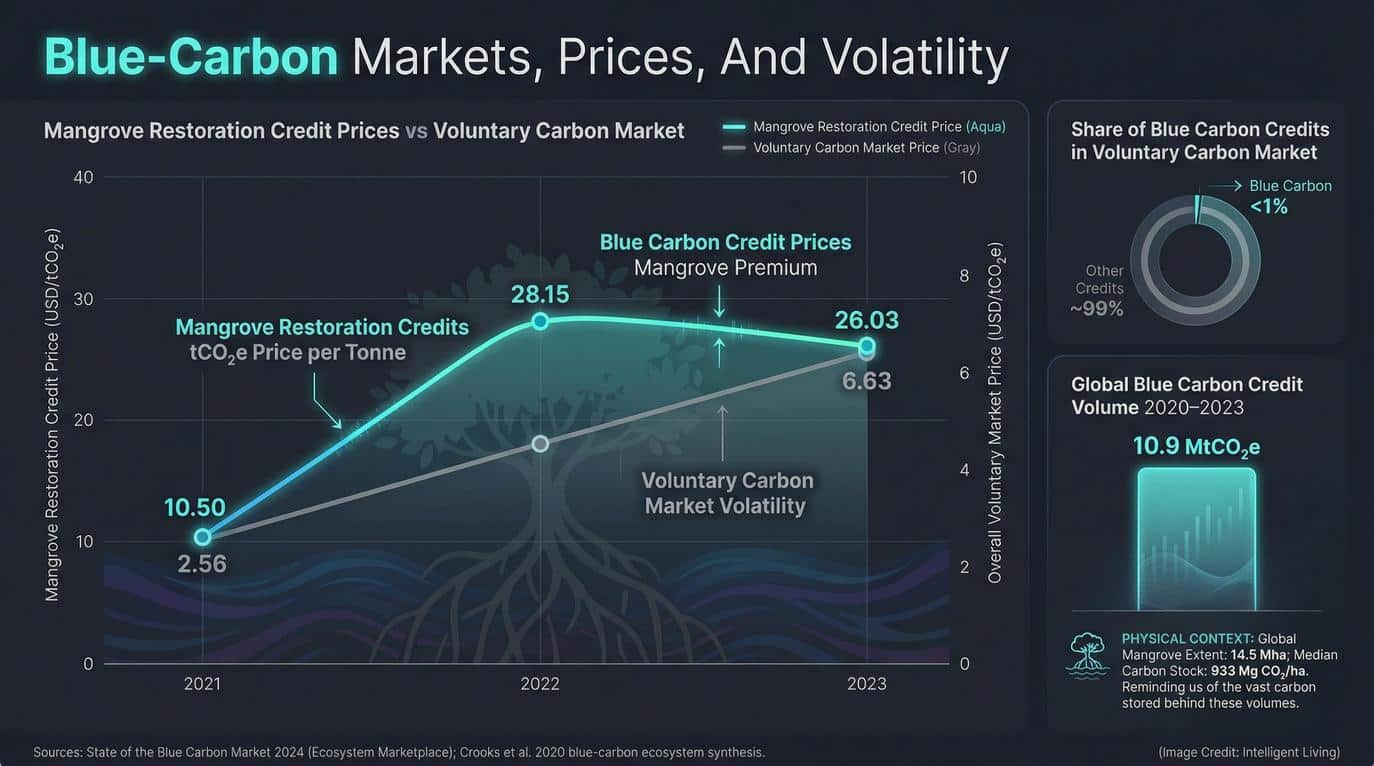
Recent market analysis shows that while prices have risen, transaction volumes remain volatile, which is why blue carbon revenue functions most effectively as co-financing integrated with adaptation budgets, insurance reform, and circular economy financing models that direct credits toward habitat recovery.
Governing Mangrove Protection, Carbon Markets, and Household Flood Risk
Policy Toolkit for Coastal Resilience and Mangrove Protection
Institutionalising Mangrove Maintenance as Public Infrastructure
Treating mangroves as protective capital justifies the allocation of a portion of the annual protection dividend back into conservation and restoration. Allocating protection dividends in this manner mirrors how governments traditionally budget for levee maintenance or critical stormwater upgrades. Framing these expenditures as insurance premiums against future disaster costs aligns with international disaster reduction standards that emphasise exposure reduction.
Connecting National Policy to Local Flood Mitigation
The primary policy toolkit for institutionalising protection includes:
- Zoning regulations that prohibit clearing in high-exposure coastal zones.
- No-net-loss rules requiring equivalent or superior protective function for permitted removals.
- Rigorous enforcement protocols against illegal land conversion.
At the household level, flood risk is experienced through rising premiums, damaged homes, and displacement; the best national strategies link mangrove dashboards to domestic climate risk assessments, localised flood mitigation techniques, post-disaster legal protections, and climate-resilient architectural design specifically optimised for storm-prone regions.
Carbon Market Reality Check: Integrity, Volatility, and Long-Term Trust
Maintaining Transparency and High-Integrity Credit Standards
Blue carbon transaction volumes and prices often swing sharply from year to year. Carbon finance provides the most value when it functions as a complement to long-term public funding and community stewardship rather than a replacement for core adaptation budgets. Well-governed carbon markets can provide co-financing for mangrove protection, but they sit inside a fast-moving integrity debate.
Stabilising Adaptation Budgets against Market Volatility
Global campaigns to meet global ocean conservation targets highlight the need for rigorous standards so ocean-based credits do not become a loophole. Further, high-integrity carbon standards set baseline requirements for transparency, monitoring, and conservative baselines.

Building National Resilience through Professionalised Mangrove Stewardship
The transition from viewing mangroves as passive scenery to recognising them as active financial assets represents a fundamental change in coastal governance. Treating these forests as protective capital allows for a more disciplined allocation of adaptation funds, ensuring that every dollar spent on restoration is anchored in measurable flood-reduction outcomes.
Such a strategy does more than protect property; it provides a transparent framework for equity, where protection is distributed based on human need and long-term economic stability. Coastal nations that successfully integrate natural capital into their national balance sheets will be better positioned to navigate the volatility of a changing climate. Managing a living seawall requires the same commitment to data and maintenance as any other primary infrastructure network.
Governments build more than just physical barriers by committing to this level of professionalised stewardship; they foster a culture of resilience that provides security for coastal economies and the communities that call them home.
Rapidly rising sea levels and expanding coastal exposure dictate that the question is no longer whether mangroves are valuable, but how effectively they are managed. Building a national resilience strategy involves five strategic milestones:
- Establishing a starting point through the $855 billion global valuation.
- Clarifying budget logic by converting valuation into annual protection dividends.
- Directing restoration efforts through high-resolution hotspot mapping.
- Protecting human lives, not just assets, via the integration of equity metrics.
- Enhancing climate co-benefits through high-integrity carbon accounting.
Mangrove Flood Protection FAQ: Valuation, Restoration Costs, and Blue Carbon Explained
What Does The $855 Billion Mangrove Valuation Represent?
It represents the present value of expected flood protection benefits delivered over 100 years, discounted at 4 per cent. It is not a one-time payout but an estimate of the long-term economic value of avoided flood damages.
How Much Flood Damage Do Mangroves Prevent Each Year?
Independent global modelling suggests mangroves reduce flood damages by more than $65 billion annually and prevent millions of people from being exposed to flooding, whereas communities that lose these natural buffers are left to rely on hard infrastructure and structural recovery protocols.
Why Are Some Countries Showing Higher Dollar Values per Hectare?
Higher property values and dense infrastructure increase estimated avoided losses. However, people protected per hectare may be higher in lower-income coastal regions where communities depend directly on shoreline ecosystems.
Is Mangrove Restoration Always Worth The Cost?
Restoration can be cost-effective, but protecting intact mangroves is often more efficient. Costs vary widely by region, scale, and land-use pressures.
Can Blue Carbon Credits Fully Fund Mangrove Protection?
Carbon credits can provide meaningful co-financing, especially when projects meet strong methodological and integrity standards. However, credit prices and transaction volumes fluctuate, so they should complement public funding rather than replace it.
How Can Governments Start Turning Valuation into Policy?
Establishing a national dashboard that tracks people protected, annual avoided losses, and total protective asset value marks a critical starting point. Pair those high-level indicators with proactive emergency preparedness measures so early warnings translate into real behaviour change. Then prioritise hotspot regions, strengthen land-use enforcement, and integrate mangroves into both adaptation and climate mitigation planning.


