
Walk through any modern household and you’ll find the fingerprints of an industrial revolution that never truly slept. From the high-capacity batteries in electric scooters to the sleek casings of budget-friendly smartphones, the world’s consumer engine relies on a manufacturing backbone centered in China and India. Yet, beneath the polished “green” branding of global exports, a more complicated reality persists: the massive, coal-fired heart of the Asia energy transition.
Measuring the success of this shift depends entirely on our ability to track the “invisible coal” embedded in the chemicals, plastics, and steel that define modern life. Governments across the region now promote “sustainable coal” as a bridge to the future, claiming that ultra-supercritical plants and carbon capture can sanitize the fuel’s reputation. A shift of this magnitude involves more than replacing old boilers; it represents a high-stakes struggle to align economic survival with a net zero industrial policy.
Navigating this transition requires looking past the smokestacks to the hard climate arithmetic of supply chain emissions. Recent data regarding the “powered by sustainable coal” narrative captures this tension, illustrating how the world’s factory floor remains coal-reliant despite green imagery. Scrutinizing the real-world performance of cleaner coal technology allows us to determine if the “made in Asia” story is truly heading toward a low-carbon future or merely refining its relationship with a fossil-fuel past.
Both scorecards offer a clearer view of modern coal technology, Asia’s dual coal economy, and the industrial policies currently shaping the “made in Asia” climate narrative.
Asia’s Coal Numbers and the “Sustainable Coal” Story
Key Data on Coal, Carbon Capture, and Asia’s Energy Shift
Current Global Generation Statistics
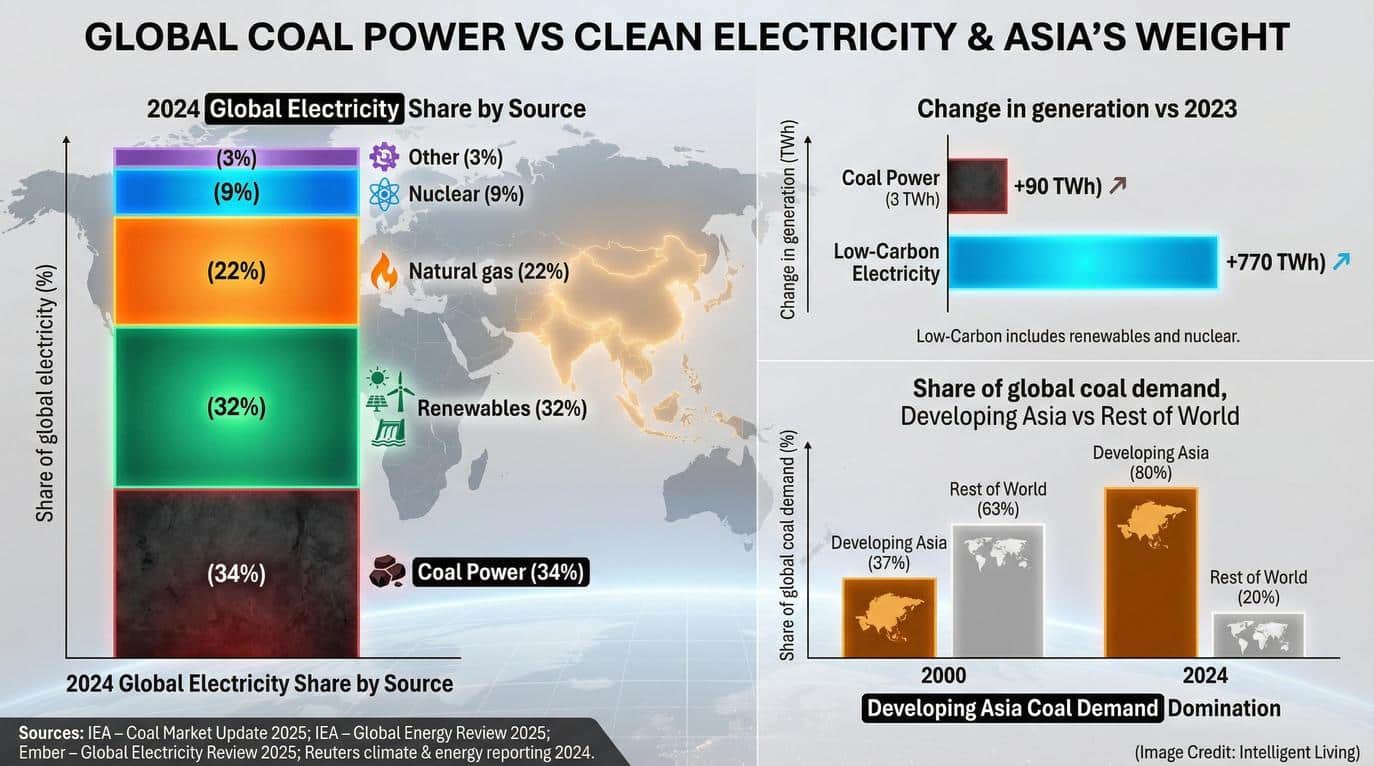
Evaluating the current energy landscape relies on the latest coal generation statistics in its 2025 global energy review. While the shift toward cleaner sources is evident, the legacy of fossil fuels remains heavy.
- Total coal generation reached approximately 10,700 terawatt-hours in 2024.
- Coal-fired electricity accounted for roughly thirty-five percent of global power.
- Output remained higher than previous years despite record-breaking renewable additions.
Such resilience within the global grid highlights a stubborn reality: even as solar and wind scale at unprecedented rates, the demand for reliable power keeps older assets operational.
Renewable Growth and Coal Resilience
At the same time, clean electricity is catching up fast. The most recent analysis of coal and clean power trends indicates that low-carbon sources, including renewables and nuclear, supplied just over forty percent of global power in 2024, with solar generation alone growing close to thirty percent in a single year. Coal remains large, but its share is no longer unchallenged.
Capacity data tells a similar story. Wind, solar, and other renewables added hundreds of gigawatts in 2024, lifting global installed renewable capacity well above four thousand gigawatts.
China and India together accounted for a major share of this clean energy buildout. However, both nations simultaneously permitted new coal capacity to manage industrial demand and ensure grid stability during peak periods. If global coal generation stays near current levels, the world will overshoot the remaining carbon budget for 1.5 degrees Celsius. That is why claims that coal is now “sustainable” deserve careful, data-based scrutiny.
The Global Rise of Sustainable Coal: Industrial Policy and Energy Security
Drivers of the Rebranding Wave
The new wave of sustainable coal branding appears at the intersection of three primary forces:
- Industrial Policy: Aligning domestic manufacturing with climate targets.
- Energy Security: Reducing reliance on volatile global gas markets.
- Public Pressure: Meeting expectations for growth without sacrificing environmental integrity.
Global market expectations increasingly reflect a pivot toward wind, solar, and the role of renewable energy in building a sustainable future and establishing a viable industrial framework. For governments in Asia, coal is still synonymous with security. It is domestic, dispatchable, and deeply embedded in steel, cement, and heavy industry. Global gas price spikes and fragile shipping routes recently forced a tactical retreat. Policymakers doubled down on coal to maintain industrial output while continuing their long-term acceleration of wind and solar projects.
Corporate Reputational Bridging
Utilities and equipment manufacturers maintain a strong incentive to present new projects as climate-aligned, often marketing a specific suite of technological upgrades:
- High-Efficiency Boilers: Targeting lower fuel consumption per unit of power.
- Pollution Control Systems: Including desulfurization and advanced fabric filters.
- Low-Carbon Pathways: Utilizing partial carbon capture or coal gasification.
Project documents market these high-efficiency options as clean coal solutions. These marketing strategies attempt to bridge the reputational gap without requiring a full departure from the underlying fuel mix. At the same time, international investors and consumers are asking tougher questions about supply chain emissions. Imported goods that claim to be climate-friendly look inconsistent if they are made in facilities powered by high-emitting coal plants. Attaching the word “sustainable” to coal is one way companies try to bridge that reputational gap without fully changing the underlying fuel mix.

Cleaner Smoke, Harder Carbon: What Modern Coal Tech Really Delivers
Cleaner Smoke is Real (SO₂, Particulates, Mercury), But It’s Not the Whole Story
Technical Control Efficiencies
Breakthroughs in engineering have revolutionized the way industrial hubs manage stack emissions through advanced wet and dry scrubbers that mitigate local environmental impacts.
- Flue gas desulfurization systems remove over ninety percent of sulfur dioxide.
- Electrostatic precipitators capture both coarse and fine particulate matter.
- Selective catalytic reduction units sharply decrease smog-forming nitrogen oxides.
Advanced filtration systems represent the pinnacle of local air quality control, focusing specifically on atmospheric particulates. When properly maintained, these systems ensure that coal plants operate significantly cleaner than their 20th-century predecessors.
Human Health and Comparative Benefits
Transitioning from coal to wind and solar has historically unlocked significant health benefits of replacing coal by reducing medical costs and premature deaths. Prioritizing these technologies directly supports human health, as lowering sulfur dioxide and fine particles leads to fewer asthma attacks, hospital visits, and chronic heart or lung diseases.
Climate metrics tell a different story. Even with top-tier pollution controls, a high-efficiency coal plant that lacks carbon capture still emits roughly seven to eight hundred kilograms of carbon dioxide for every megawatt-hour of electricity. While essential for air quality, mercury controls and particulate filters fail to address the methane leakage from coal mines or the nitrous oxide emissions tied to associated industrial processes. Local air quality can improve dramatically while the global climate burden stays largely unchanged, which is why focusing only on the air pollution side risks overselling the climate benefits of sustainable coal.
The Challenge of Carbon Capture and Storage: Real-World CCS Performance and Targets
Aspirational Benchmarks vs. Operational Realities
Most sustainable coal narratives quietly assume successful carbon capture and storage. A majority of project summaries describe capture systems as capable of removing ninety percent of a plant’s carbon dioxide. Such a reduction would theoretically lower the climate impact per kilowatt-hour to levels comparable with natural gas plants.
In practice, that ninety percent benchmark is more aspirational than routine. Reliable reporting on CCS performance confirms that real-world capture rates vary widely depending on the age and scale of the facility. Several critical factors frequently prevent facilities from reaching their design capture rates during actual operation:
- Mechanical Downtime: Frequent maintenance required for complex capture solvent systems.
- Enhanced Oil Recovery: Redirecting captured gas to extract more fossil fuels rather than permanent storage.
- Energy Penalties: High parasitic loads from running regeneration units and compressors.
Alternative facilities frequently operate well below that benchmark, experiencing significant downtime or redirecting CO₂ for enhanced oil recovery. Carbon capture systems also come with an energy penalty, because running solvent regeneration units, compressors, and pumps consumes a meaningful share of the plant’s output.
Case Study: The Longdong CCUS Project
China’s Longdong carbon capture, utilization, and storage project is often cited as a proof point that coal-based chemicals can be decarbonized. The facility captures carbon dioxide from a coal-to-chemicals complex and injects it underground in a saline aquifer. Longdong stands as a technically impressive project and one of the largest dedicated storage sites linked to coal-based industry. While the site remains a milestone, its reach remains limited.
Longdong illustrates the scaling gap perfectly: its capture systems currently handle only a fraction of the complex’s total emissions output. The broader landscape of CO₂ capture is evolving alongside emerging CO₂ capture and eFuel pathways that treat carbon as a potential feedstock for next-generation manufacturing. Scaling from a handful of projects like Longdong to the billions of tonnes of CO₂ that would need to be captured globally each year is an enormous engineering, financial, and governance challenge. Improving carbon capture is essential, but it does not yet justify treating coal as a climate-neutral fuel.
Asia’s Dual Coal System: Power, Chemicals, and Gasification
The Economic Shift toward Renewables
Current electricity statistics reveal a global economy caught between two overlapping systems. An older, fossil-dominated grid remains anchored by plants designed for 24/7 baseload power. Parallel to this, a rapidly growing clean energy system is emerging—modular, cost-competitive, and increasingly capable of meeting modern demand.
Solar and wind provide some of the cheapest new power in history in many regions. Their levelized costs have fallen sharply over the last decade, and new projects in China and India often beat new coal plants on price. The same global electricity reviews that track record coal output also highlight that low-carbon sources already supply more than forty percent of global power, with solar and wind delivering most of the recent growth.
Grid Stability and Legacy Assets
Legacy coal assets remain deeply embedded in industrial planning across the region. In China, coal plants are used as both baseload and flexible resources to back up renewable surges, and in India, they still carry much of the evening load. Several U.S. and European grids show a similar pattern, where renewables grow rapidly while coal declines but does not disappear overnight.
Domestic examples illustrate the shift, such as when renewables overtook coal in the United States, proving that industrial power can thrive without heavy carbon reliance. Further modeling demonstrates that local renewable energy jobs that replace coal employment can maintain employment levels while shifting the energy mix. Asia is now navigating its own version of that transition under far higher industrial growth and energy demand.
Unmasking the Invisible Coal: Supply Chain Emissions and Made in Asia Exports
The Invisible Coal: Coal to Chemicals and The “Made in Asia” Supply Chain
Gasification Processes and Industrial Feedstocks
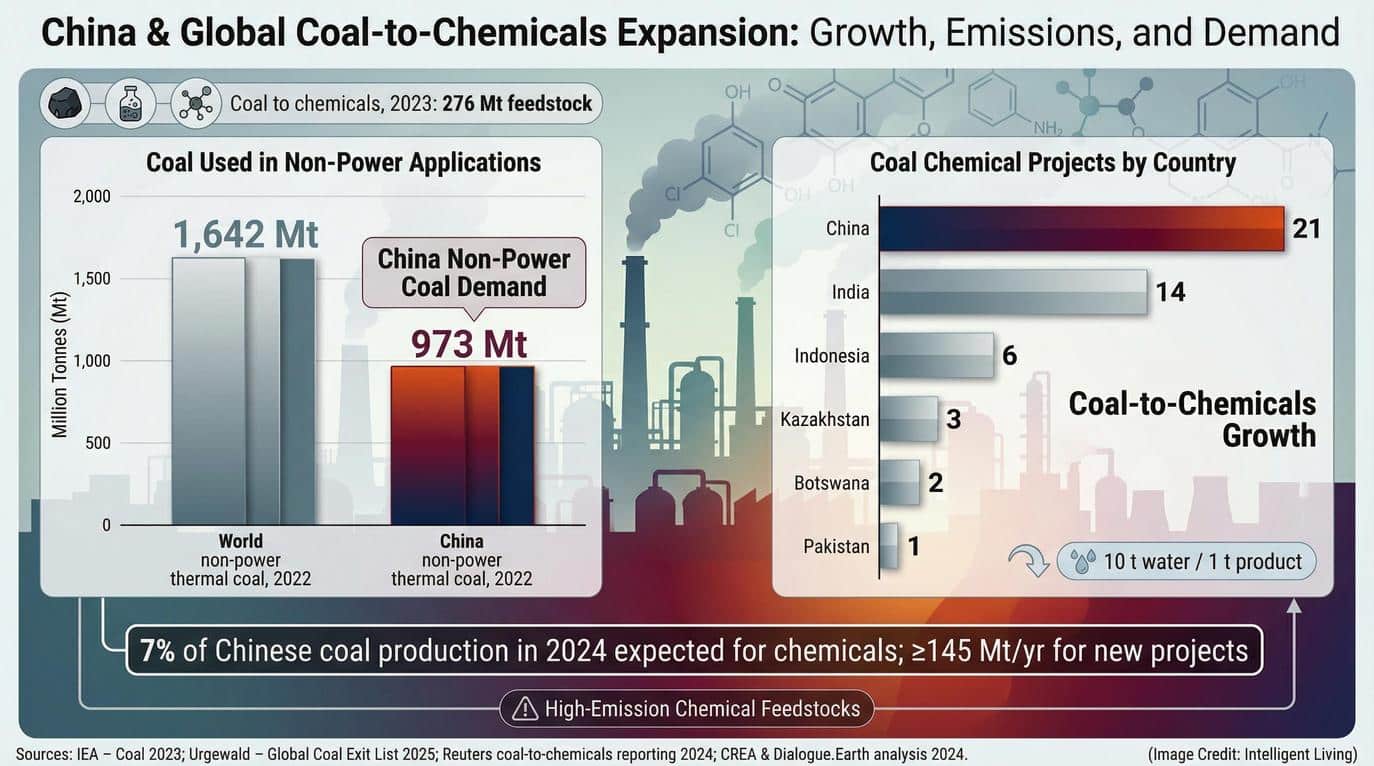
When people picture coal, they often imagine power station stacks. A growing share of coal use in Asia, however, occurs in chemical complexes that produce methanol, fertilizers, plastic precursors, and synthetic fuels. This coal-to-chemicals sector is often invisible to consumers but central to the climate footprint of global supply chains.
Coal gasification plants transform solid fuel into synthesis gas. The unchecked expansion of these complexes presents a major risk, as an analysis of how coal-to-chemicals growth risks national climate goals could easily erase emissions gains from cleaner power generation. Such synthesis gas serves as the foundation for several essential industrial products:
- Ammonia: For agricultural fertilizers and industrial use.
- Methanol: For petrochemical manufacturing and synthetic fuels.
- Precursors: A diverse range of plastics, solvents, and chemical intermediaries.
Facilities like these provide a significant economic boost by converting local resources into high-value export products. However, they also lock in large-scale carbon emissions for decades to come.
Supply Chain Transparency and Embedded Emissions
The result is a pattern where electronics, textiles, and other manufactured goods can claim renewable power on the grid while still depending on coal-derived feedstocks in the upstream chemicals that make their coatings, packaging, and components. Marketing materials rarely acknowledge this “embedded” coal, though it remains a central, if hidden, pillar of the broader Asian energy landscape.
India’s Coal Gasification Mission: The Targets, The Money, and The Tradeoffs
National Capacity Targets and Financial Incentives
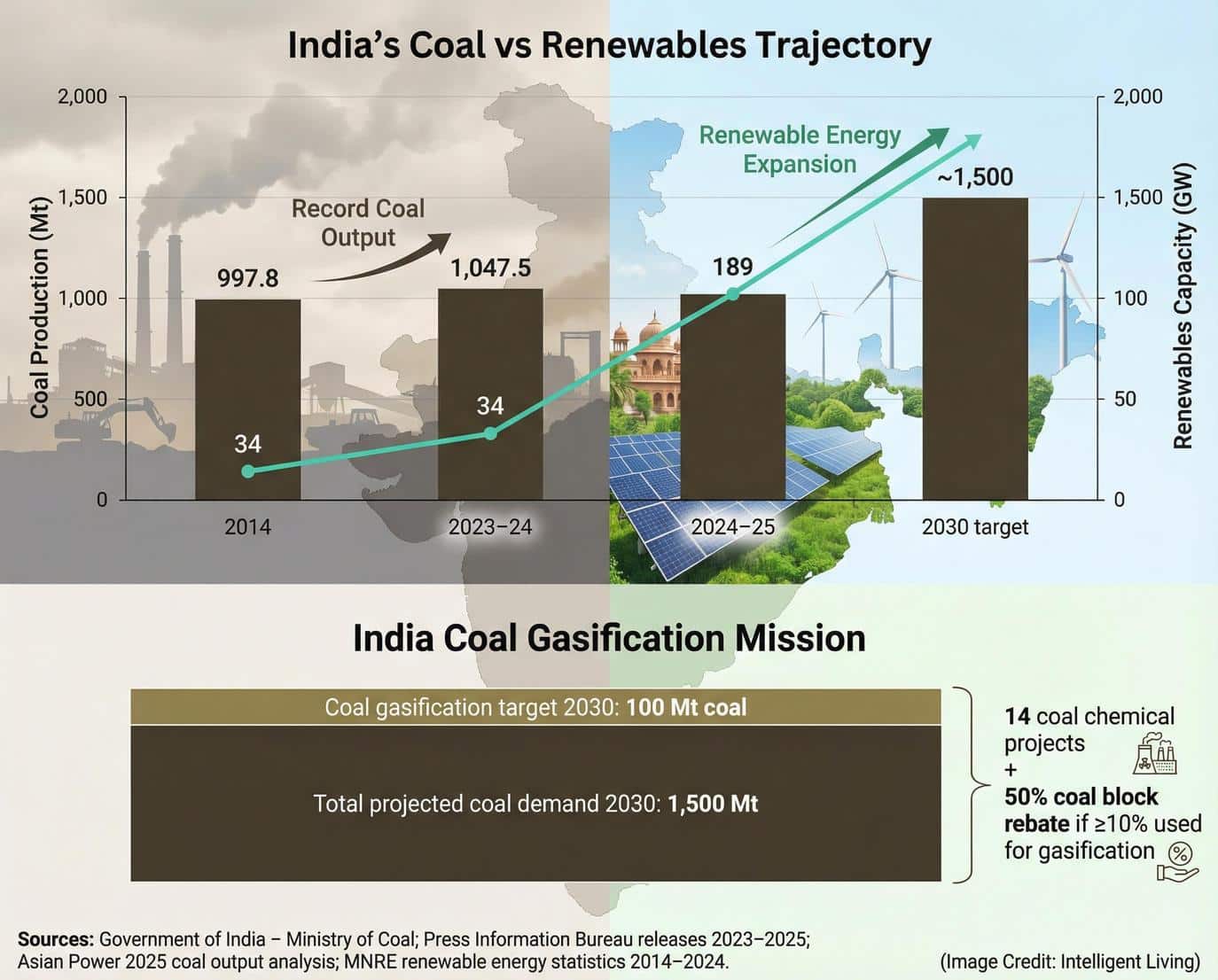
Ambitious financial schemes now offer targeted support for the government coal gasification mission, which sets out clear capacity goals to attract private investment. India’s coal gasification mission illustrates how coal-to-chemicals policy works in practice, converting domestic coal into synthetic natural gas and fertilizers.
Environmental and Social Tradeoffs
The debate surrounding gasification often pits economic gain against environmental reality. While supporters emphasize job creation and resource efficiency, critics argue that shifting coal into the chemical sector does not make the carbon burden disappear. Unless capture rates are very high across the entire chain and storage is permanent, total emissions can remain comparable to or even higher than traditional coal use.
Beyond atmospheric concerns, gasification processes generate solid and liquid waste streams that require meticulous management to prevent ecological contamination. Communities living near proposed sites have raised concerns about cumulative impacts when these projects are added to existing coal mines and power stations. Without rigorous climate accounting and community safeguards, the mission risks expanding coal use in new forms rather than accelerating a shift to cleaner energy.

Fact-Checking Sustainable Coal: Emissions Arithmetic and Industrial Byproducts
Two Claims that Need a Clearer Ruler
Claim One: “Up to 99 Percent Emissions Reductions”
One of the strongest talking points for sustainable coal is the claim that modern plants can cut emissions by up to ninety-nine percent. The phrase usually blends two very different ideas: near-total removal of local air pollutants at the stack and ambitious targets for carbon capture rates.
Such systems represent the pinnacle of local air quality control, yet they address only one side of the climate ledger. On the climate side, however, the numbers are far weaker. Even capture systems that are designed to remove ninety percent of carbon dioxide often deliver lower average performance over a year once maintenance periods, partial loads, and equipment limitations are factored in.
Significant e-fuel breakthroughs that synthesize liquid fuels from captured CO₂ and green hydrogen underscore that carbon capture is only climate-effective when paired with truly circular fuel cycles. If a plant removes ninety-five percent of its sulfur dioxide but only captures fifty to sixty percent of its carbon dioxide on average, it is fair to call it cleaner for local communities. It is not accurate to describe it as near-zero emissions in a climate sense. Collapsing both metrics into a single ninety-nine percent headline hides the difference between health protections and long-term atmospheric impacts.
Claim Two: “Coal Dwarfs Wind and Solar”
Another common narrative is that coal so completely dominates global power that renewable growth remains a rounding error. Initial analysis of historical charts seems to support that view, as coal delivered a record 10,700 terawatt-hours in 2024, far more than solar and wind combined.
Detailed electricity data that highlights record coal output simultaneously reveals that almost all net growth in global demand has been met by renewables. The same global electricity data that highlights record coal output also shows that almost all net growth in global electricity demand over the last few years has been met by solar, wind, and other low-carbon sources, while coal generation has largely plateaued.
Country-level examples make the trend clearer, with renewables already surpassing coal on an annual basis in the United States and coal’s share dropping sharply in Europe as wind and solar scaled. Technological leaps in renewable energy storage solutions are changing the conversation, eroding the traditional argument that only fossil fuels can provide reliable power.
Where Coal Byproducts Can Help (Without Becoming a Climate Alibi)
Even as the world moves away from burning coal, some byproducts from past coal use can play a constructive role in cutting emissions if they are managed carefully. Fly ash and other coal-combustion residues can replace portions of ordinary Portland cement in concrete, which lowers the carbon footprint of buildings and infrastructure because cement production is so emissions-intensive.
Using these materials in moderation improves structural durability while significantly reducing the demand for clinker. This shift is essential for decarbonizing the cement industry. Ongoing work on sustainable concrete technologies that cut emissions in green building shows how recycled materials and industrial byproducts can substantially cut the carbon footprint of future infrastructure. Recent developments in the use of recycled concrete fines to decarbonize construction demonstrate how existing building stock can become a resource for future projects rather than a waste stream.
Effective framing remains the critical factor in this discussion. Using legacy coal ash as a partial cement replacement while aggressively phasing down coal burning is very different from promoting new coal plants on the grounds that their waste will someday be useful. In the first case, coal byproducts are a transitional resource. In the second, they risk becoming a climate alibi.

Decarbonizing the Factory Floor: Asia’s Energy Future
Navigating a successful transition requires a fundamental shift in how industrial success is defined. Moving forward, the region must prioritize several key pillars:
- Emission Verifiability: Moving beyond marketing labels to transparent, third-party climate accounting.
- Renewable Scaling: Accelerating the deployment of cost-competitive solar and wind assets.
- Grid Flexibility: Implementing storage and advanced management systems to handle variable clean power.
Verifying emission reductions and aggressive renewable deployment will allow the region to transform its industrial identity. Success in the Asia energy transition involves embracing the reality that “cleaner” is not synonymous with “clean.” When we move beyond the marketing labels, the hard climate math reminds us that even the most advanced coal infrastructure must eventually give way to carbon-free alternatives. Strengthening the Asia energy transition involves embracing the reality that “cleaner” is not the same as “clean.”
Essential Guide to Asia’s Coal and Climate Transition
Is sustainable coal a real climate solution?
Modern technology significantly reduces local air pollutants like sulfur dioxide, but even high-efficiency plants continue to emit substantial carbon dioxide unless paired with a fully operational carbon capture system.
Can carbon capture make coal climate neutral?
While theoretical designs target high capture rates, real-world performance often fluctuates due to energy penalties and maintenance requirements. Model roadmaps for net-zero carbon global industries that step away from coal-intensive processes emphasize efficiency rather than long-term reliance on captured coal emissions.
Why is India investing in the coal gasification mission?
India utilizes gasification to convert domestic resources into synthetic fuels and chemicals, aiming to bolster energy security while exploring ways to lower the carbon footprint of its heavy industry.
How does the Asia energy transition impact global supply chains?
Asia’s role as the primary hub for global manufacturing means that the carbon footprint of consumer goods is tied to the region’s industrial progress. Asia’s reliance on coal-based feedstocks means that the carbon footprint of everyday consumer goods is often tied to the region’s pace of industrial decarbonization.
Which technologies are replacing coal for grid stability?
Advanced battery storage, flexible gas peaking, and regional grid connectivity are increasingly capable of providing the stability once reserved for coal-fired baseload power. Heavy industry is evolving, as demonstrated by zero-emissions hydrogen steel plants that replace coal in iron ore reduction processes. Cleaner fuels are already taking over roles once reserved for coal, as seen in the maturing green hydrogen supply chain across refineries and heavy industry hubs.


