
Global urban centers are increasingly codifying net-zero targets into law. However, the reality for most districts persists as an inefficient mosaic of aging heating systems and uninsulated building envelopes. The engineering solutions are increasingly well-understood: district heating networks replace fossil gas, while deep energy retrofits slash consumption and integrated solar systems stabilize demand through smart controls. Primary barriers to district transformation remain fiscal rather than technological.
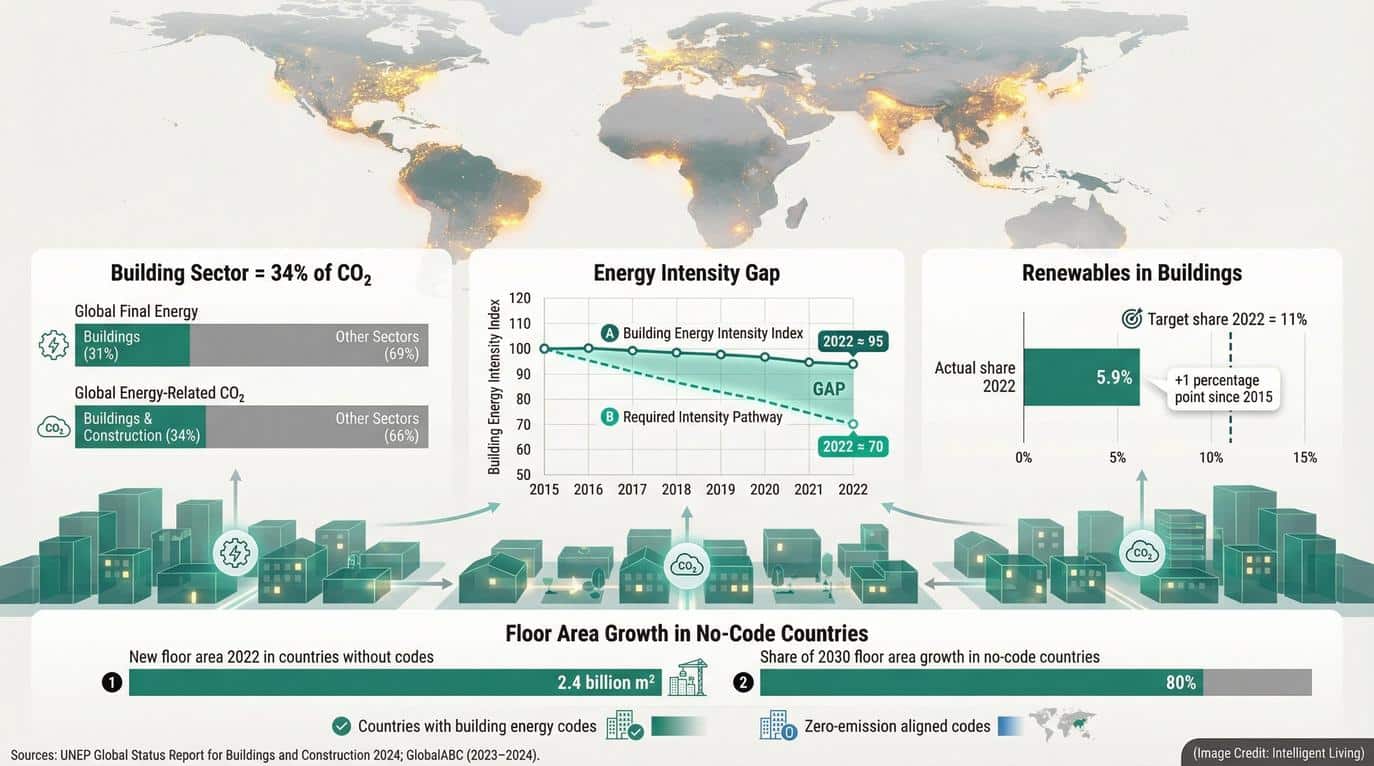
The urgency of this transition is underscored by the United Nations Environment Programme’s data, which identifies buildings and construction as drivers of global carbon emissions, revealing that the sector accounts for roughly 34 percent of CO₂ output.
- Roughly 32 percent of global energy use.
- Approximately 34 percent of global carbon dioxide emissions.
These figures confirm that decarbonizing residential districts is central to any viable net-zero pathway.
So how does a real neighborhood transition from fossil-based heating and inefficient housing stock to a coordinated, low-carbon system? The answer is rarely a single funding source. Funding net-zero neighborhoods is a carefully layered capital stack that blends green bonds, concessional loans, energy-as-a-service contracts, and credit guarantees into one integrated financing structure.
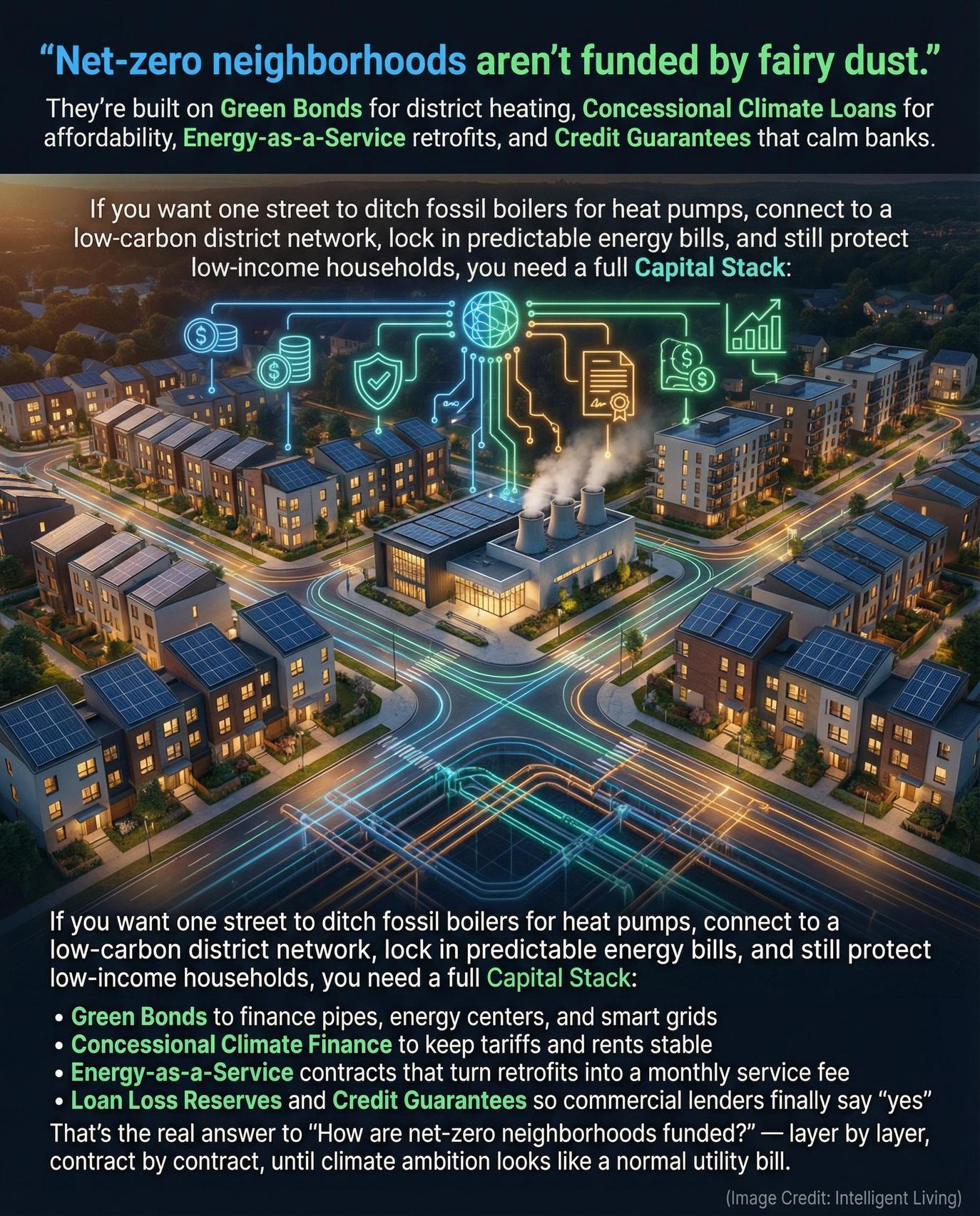
Decoding Net-Zero Neighborhood Finance: Capital Stacks and Risk-Sharing Mechanisms
Net-zero neighborhood financing integrates public and private capital to decarbonize entire residential districts simultaneously. Instead of retrofitting one building at a time, it bundles shared infrastructure, building upgrades, and service contracts into a coordinated program.
The primary goal is to mobilize sufficient capital—at the appropriate price and risk allocation—to construct heat networks and retrofit homes without placing an unsustainable financial burden on residents.
- What gets financed: District heating networks, building-side heat pump conversions, insulation, ventilation, smart controls, and sometimes local solar generation.
- Core instruments in the stack: Municipal green bonds aligned with green bond principles developed by the International Capital Market Association, concessional climate loans with patient repayment terms, energy service agreements that remove upfront costs for residents, and credit enhancements such as loan loss reserves or partial guarantees.
- Digital layer: Integrated smart controls and energy-optimizing artificial intelligence synchronize heating, cooling, and appliance usage in real time to minimize household waste.
- Risk-sharing logic: Performance risk can shift to the energy service provider, credit risk can be partially absorbed through guarantees or concessional tranches, and long-lived public assets sit on municipal or utility balance sheets.
In this context, a net-zero neighborhood functions less as a collection of buildings and more as a sophisticated capital stack layered directly over an engineering blueprint.
The structure of the financing determines who can participate, how fast the program scales, and how resilient it is to interest-rate shocks. When the instruments are well-combined, the result is a neighborhood-scale decarbonization program that is financially robust instead of improvised.
A Real-World Reference Point: What “Neighborhood Scale” Net-Zero Funding Looks Like
To see what neighborhood scale actually looks like, consider two European programs that electrify and decarbonize heating. The Sustainable Homes and Sustainable Heat initiative in Zuid-Holland and industrial-scale river heat pump projects in Germany demonstrate how district thermal networks can effectively replace legacy fossil infrastructure.
- Investment volume: Regional data for the Sustainable Homes initiative indicates approximately €84.6 million in neighborhood implementation investment for fewer than 4,000 homes.
- Heat networks: Four district heating networks spanning about 15 kilometers of pipe and around 10 megawatts of renewable heat capacity.
- Buildings upgraded: 3,931 residential units receiving energy-efficiency improvements and/or connections to renewable heat, representing roughly 309,000 square meters of floor area.
- On-site renewables: About 1.3 megawatts of solar photovoltaic capacity, generating roughly 1.15 gigawatt hours per year.
- Annual outcomes: Nearly 15 gigawatt hours of energy savings, more than 27 gigawatt hours of renewable generation, and around 8,557 metric tons of carbon dioxide avoided each year.
These figures underscore the capital-intensive nature of neighborhood decarbonization and the measurable outcomes achievable through aggregation. Such results reflect a broader European trend where public support and private lending converge to finance climate infrastructure, even when specific capital stacks remain confidential.

The Dual-Track Funding Strategy: Coordinating Infrastructure and Building Upgrades
Visualizing net-zero neighborhood financing as a two-lane system clarifies the distinct funding requirements.
Lane one funds the backbone:
- District heating mains, energy centers, distribution pipes, and other shared infrastructure that serve many buildings at once.
- Assets that function like public utilities with long lifetimes.
- Projects typically financed through municipal or regional borrowing and sometimes utility balance sheets.
Because of their scale and lifespan, these investments behave more like infrastructure than individual building equipment.
Lane two specifically targets building-side improvements, including:
- Advanced heat pumps and internal substations provide superior energy efficiency over traditional gas furnaces, cutting both operational costs and local emissions.
- Comprehensive building fabric upgrades, such as high-performance insulation, glazing, and ventilation that significantly reduce thermal demand.
- Integrated smart controls installed within individual residences to optimize comfort and energy consumption in real time.
When AI-driven smart city infrastructure coordinates backbone networks and building demand, districts can achieve deeper emission cuts and more robust financial performance.
Repayment structures diverge based on the asset type:
- Backbone infrastructure: Repaid through heat tariffs or concession-style revenues tied to municipal planning.
- Building upgrades: Repaid via energy savings or service payments that replace traditional utility bills.
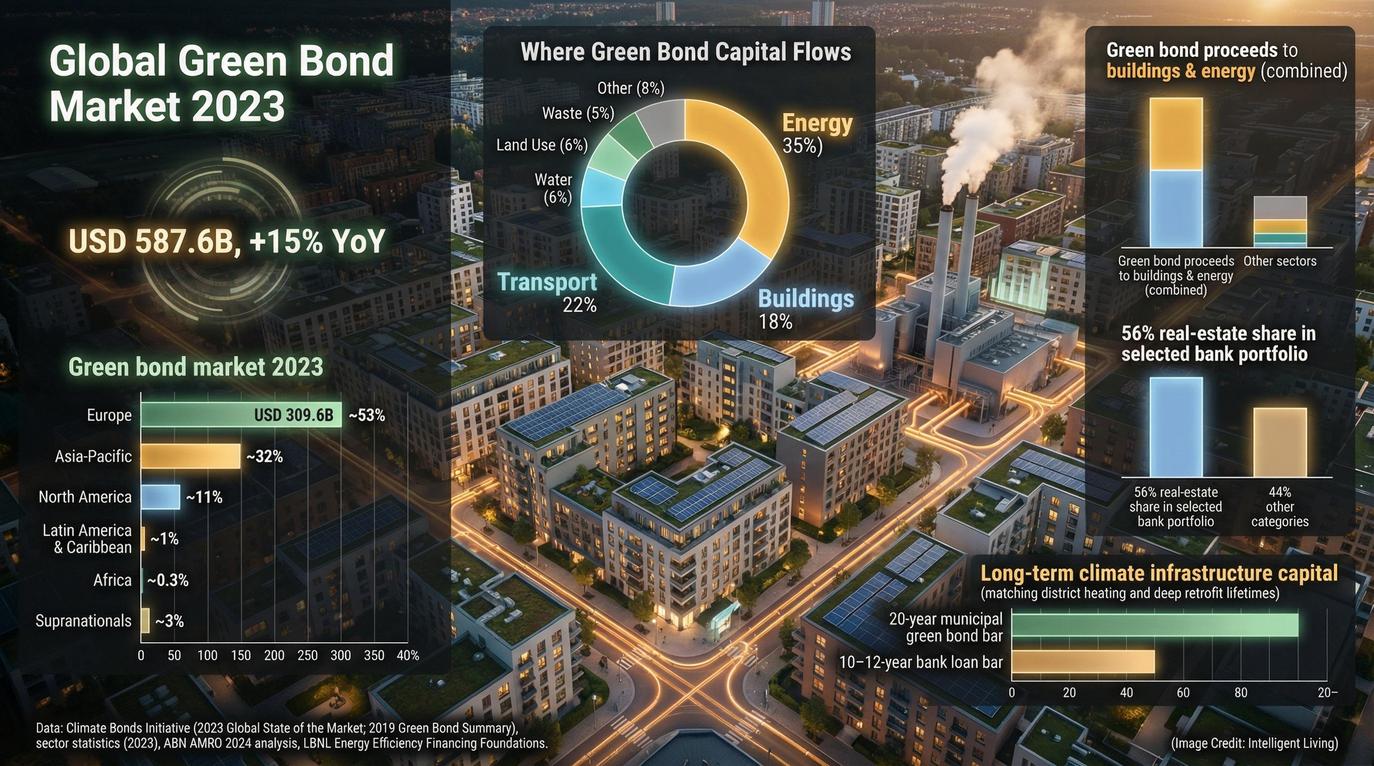
Building Block 1: Mobilizing Infrastructure Capital Through Green Bonds
Green bonds are one of the primary tools for funding the public-facing infrastructure of a net-zero neighborhood. They are debt instruments whose proceeds are earmarked for environmentally beneficial projects, usually under frameworks such as green bond principles that set standards for use of proceeds, project evaluation, management of funds, and impact reporting.
Standardizing Transparency with ICMA Green Bond Principles
Municipalities increasingly align their debt issuances with the ICMA Green Bond Principles to ensure rigorous transparency and accountability in project evaluation. Issuers must clearly define which projects qualify as green and report on environmental outcomes.
In the context of a neighborhood decarbonization program, eligible uses of proceeds can include district heating infrastructure, large-scale building efficiency upgrades, renewable energy installations, and enabling grid improvements. These fiscal instruments reinforce the broader transition toward decentralized renewable energy systems, where grid-integrated solar and wind projects are designed for community-level resilience.
Tapping into Institutional Markets for Municipal Infrastructure
Creditworthy cities can leverage specialized municipal climate finance tools to tap institutional bond markets and fund sustainable infrastructure upgrades at scale. By tapping into institutional investors seeking labeled sustainable assets, municipalities can raise substantial capital upfront and repay it over long maturities that match the life of infrastructure assets.
Green bonds typically secure the backbone lane for net-zero neighborhoods, providing a transparent use-of-proceeds structure for district heating networks, centralized energy facilities, and large-scale public retrofits.
Bond markets provide investors with stable fixed-income returns while enabling regional authorities to secure capital at scale. This collective approach delivers infrastructure improvements that remain financially out of reach for individual building owners.
Building Block 2: Concessional Loans That Keep The Neighborhood Affordable
Bond financing alone cannot always close the affordability gap. Deep retrofits often incur high upfront costs that challenge lower-income districts or pioneering pilot projects. Concessional finance enters the picture at these pressure points.
Enhancing Project Viability with Below-Market Capital
Typically provided by development finance institutions at below-market rates, concessional loans utilize patient repayment terms to enhance project economics, thereby facilitating the viability of broader blended financing structures. Their purpose is not to replace private capital but to improve the overall economics of a project so that blended financing becomes viable.
Strategic Application in Low-Density and Social Housing Districts
Climate Policy Initiative’s analysis of global concessional climate finance highlights the role of such capital in mobilizing larger volumes of private investment by absorbing part of the risk or lowering the blended cost of capital. When concessional tranches sit alongside commercial debt, they can make heat tariffs or service payments more affordable for residents while still allowing private lenders to participate.
In a neighborhood context, concessional loans may support the early expansion of district heating into areas where customer density is initially low, or they may help finance building upgrades in social housing where payback periods are longer, including HVAC-focused retrofit programs designed to lower household energy bills and carbon footprints through modernized heating and cooling systems. By extending loan tenors and reducing overall costs, concessional finance provides the necessary fiscal flexibility for climate projects to reach maturity and scale.
Combined with green bonds for infrastructure and service-based contracts for buildings, concessional capital anchors the financial architecture of a net-zero neighborhood. This fiscal buffer prevents ambitious climate targets from devolving into regressive cost burdens for local residents.

Building Block 3: Energy-As-A-Service Turns Retrofits Into A Monthly Service
High initial capital requirements, rather than technological limitations, represent the primary obstacle to neighborhood decarbonization. Even when long-term energy savings are clear, many building owners remain hesitant to finance deep retrofits out of pocket.
Bridging the Upfront Capital Gap with Energy Service Agreements
Energy-as-a-service (EaaS) bridges this financial gap through structured energy service agreements. By shifting the focus from ownership to outcomes, EaaS allows communities to deploy clean technologies without the friction of upfront investment. Under an energy-as-a-service model, customers pay for an energy outcome rather than purchasing equipment outright.
An issue brief from Resources for the Future on the energy-as-a-service business model describes how this structure allows customers to receive clean energy technologies without making a large initial capital investment, instead paying over time for the delivered service. In practice, that might mean a building owner pays a monthly fee that replaces or reduces a previous utility bill while a third-party provider designs, installs, owns, and maintains the equipment.
Performance-Based Contracts and Guaranteed Savings Models
A detailed review by the American Council for an Energy-Efficient Economy explains that many energy service agreements are structured as pay-for-performance contracts. The service provider finances the retrofit and is repaid from measured energy savings. Under federal performance contracting standards, service companies can guarantee specific energy savings, assuming financial responsibility if those technical targets are not met. This guarantee structure shifts performance risk away from the building owner and toward the technical operator.
Transitioning Residents from Asset Ownership to Service Subscriptions
In a net-zero neighborhood, this mechanism is critical for the building lane. Heat pumps, internal substations for district heating, insulation, ventilation systems, and smart controls can be bundled into service contracts. Instead of asking each homeowner to become a project financier, the neighborhood program partners with an energy service provider that aggregates upgrades across hundreds or thousands of units.
The International Energy Agency’s guidance on ESCO contract structures outlines how these contracts can be structured as shared savings or guaranteed savings models, each with different risk allocations but the same core principle of performance-based repayment.
The result is a fundamental shift: residents transition from managing aging fossil assets to subscribing to a low-carbon energy service. This model converts high capital expenditures into predictable operating costs while centralizing technical performance risk with the service provider.
Removing the participation barrier allows backbone infrastructure to connect with buildings at the scale necessary for long-term financial viability.
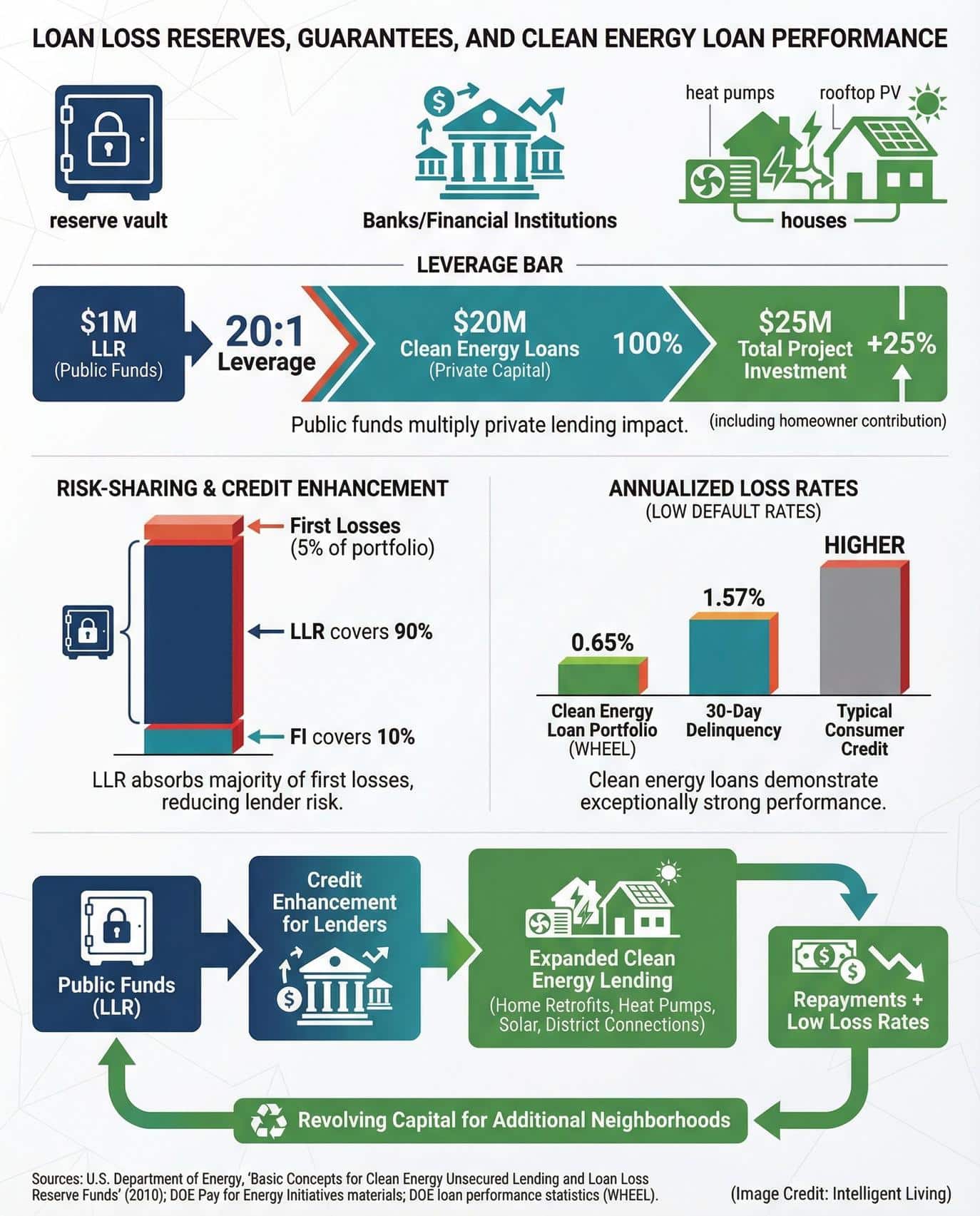
Building Block 4: Guarantees And Reserves That Make Banks Say Yes
Strict risk evaluation remains a constant factor for lenders, with interest rates dictated by credit, performance, and policy exposures. To mitigate these pressures, credit enhancement tools—such as loan loss reserves and partial guarantees—reshape the risk profile to attract mainstream clean energy investment.
Absorbing Loss Exposure through Dedicated Reserve Pools
A loan loss reserve is a pool of capital set aside to cover a portion of potential defaults in a loan portfolio. The United States Environmental Protection Agency’s guidance on loans and credit enhancements for clean energy programs explains that in some public energy programs, a reserve may cover losses up to a defined percentage of the total principal, for example, around ten percent. That reserve does not eliminate risk, but it reduces the expected loss exposure for lenders.
Partial credit guarantees operate at a similar level but often cover a defined share of losses on specific loans or bond issuances. Research presented through OECD and Climate Policy Initiative materials indicates that partial guarantees commonly cover a range of potential losses, often between roughly twenty and eighty percent depending on structure and policy goals. By reducing downside exposure, guarantees can lower interest rates, extend loan tenors, and expand eligibility for borrowers who might otherwise be excluded.
De-Risking Private Capital through Institutional Enhancements
Public agencies utilize subordinated capital and guarantee structures to mobilize private investment into nascent clean energy markets, bridging the gap for mainstream lenders. These instruments do not fund infrastructure directly. Instead, they reshape the risk profile so that commercial banks, pension funds, and institutional investors are more willing to participate.
In a net-zero neighborhood, guarantees and reserves often support the building lane. Guarantees and reserves typically support the building lane by backstopping homeowner retrofit loans or aggregating energy service agreements into investable vehicles.
This approach creates a multi-layered risk management system: technical performance is managed by the service provider, while credit risk is absorbed by reserves, ensuring the remaining exposure meets the requirements of mainstream lenders. This strategic deployment of reserves and guarantees serves as the primary interest-rate lubricant for neighborhood decarbonization. By structuring rather than ignoring risk, cities can drive down the cost of capital and transform marginal projects into bankable realities.
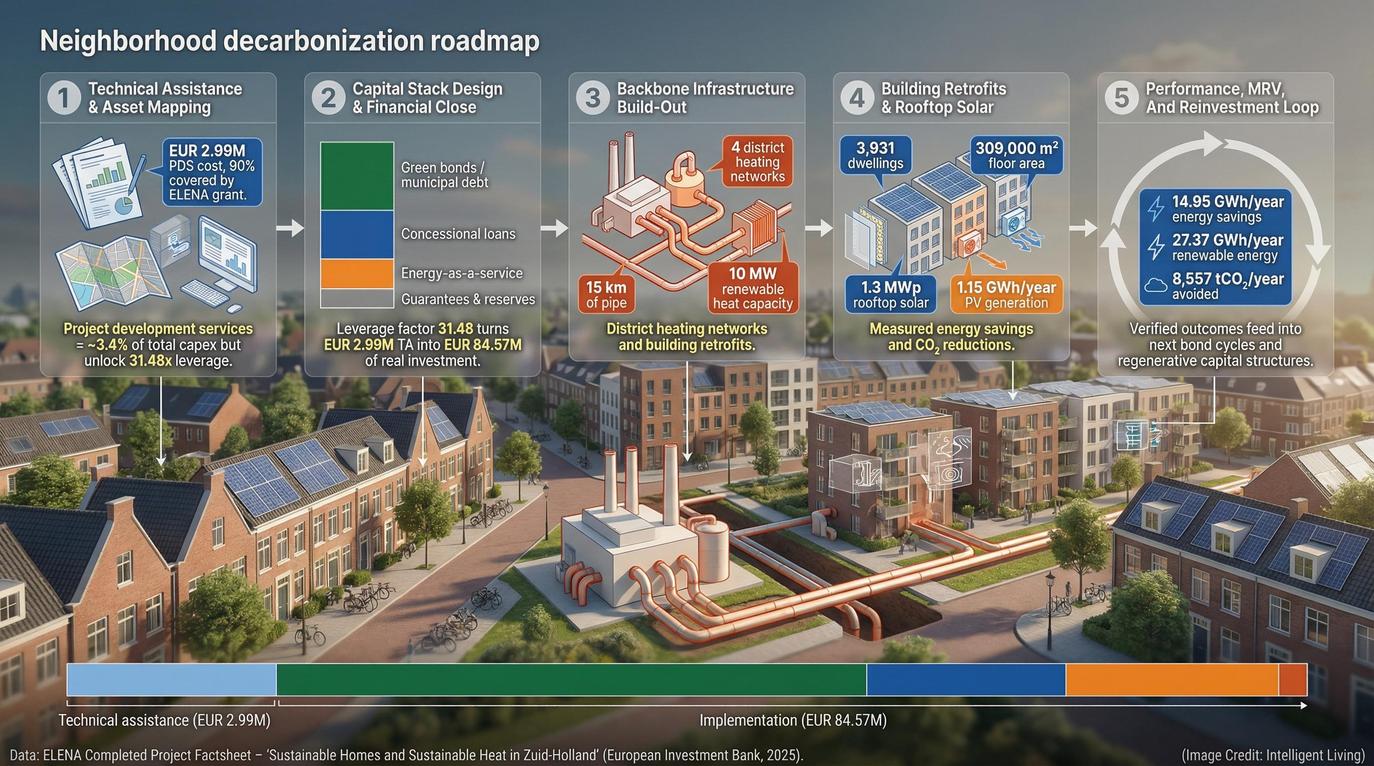
The Project Deployment Sequence: Constructing a Bankable Decarbonization Roadmap
Bringing these elements together requires coordination. A net-zero neighborhood does not emerge from isolated contracts. It is assembled through a deliberate sequence.
Step 1: Net-Zero Asset Map and Thermal Storage Design
First, planners define the asset map. This includes shared infrastructure such as district heating pipes and energy centers, along with building-level upgrades like heat pumps, insulation, and controls; and thermal storage solutions like sand batteries for net-zero city heating, which provide low-cost seasonal storage for district-wide networks. Using a reference scale similar to the Zuid-Holland program documented by the European Investment Bank, the total capital requirement may reach tens of millions of dollars for just a few thousand homes.
Step 2: Green Bond Financing for Backbone Infrastructure
Second, the public backbone is financed. A municipality or regional authority can issue a green bond aligned with the Green Bond Principles, earmarking proceeds for district heating infrastructure and major retrofit components. The World Bank’s guidance on local government climate finance highlights how such instruments allow creditworthy cities to mobilize large sums while committing to transparent reporting.
Step 3: Concessional Climate Capital for Affordability and Risk
Third, concessional capital is layered into the structure where affordability gaps or first-of-kind risks appear. This tranche reduces the blended cost of capital and lengthens repayment horizons, ensuring that heat tariffs or service payments remain within reach for residents.
Step 4: Energy-as-a-Service for Building-Level Retrofits
Fourth, the building lane is activated through energy-as-a-service contracts. Instead of requiring individual homeowners to secure loans and manage contractors, an energy service provider aggregates upgrades across the neighborhood. Recent data from British net-zero residential developments illustrates how combining airtight building envelopes with heat pumps and rooftop solar can effectively ease peak strain on local power grids. Payments are structured around measured performance, and technical guarantees protect participants from underperformance.
Step 5: Credit Enhancement Tools
Fifth, credit enhancement tools are deployed. Loan loss reserves or partial guarantees support portfolios of building loans or service agreements, effectively lowering the perceived risk for institutional lenders.
The low cumulative loss rates of energy efficiency loan portfolios support the logic that modest reserves are sufficient to unlock significant private capital. These findings reinforce the logic that even modest reserves can unlock significant volumes of private capital.
Step 6: Monitoring, Reporting, and Verification for Replicable Impact
Finally, reporting and verification close the loop. Green bond frameworks require ongoing disclosure of environmental impact. Energy service agreements rely on measurement and verification protocols. Together, these reporting systems build credibility, enabling replication in additional neighborhoods.
What emerges is not a single funding source but an ecosystem. Bonds finance the backbone. Concessional loans stabilize affordability. Service contracts remove upfront barriers. Guarantees reduce credit friction. Each layer supports the others.

Supportive Overlay: Regenerative Capital that Scales from Pilot to Portfolio
For net-zero neighborhoods to move beyond isolated pilots, the financing model must be repeatable. This is where the broader concept of regenerative capital becomes practical rather than philosophical.
This approach aligns with emerging frameworks for circular economics and regenerative capital, which prioritize sustainable abundance over traditional scarcity-based financial models. In the neighborhood decarbonization context, that philosophy translates into disciplined aggregation and technical assistance.
Reducing Early-Stage Friction with Project Development Support
The European local energy assistance (ELENA) program illustrates how dedicated technical assistance can de-risk the early design and procurement phases of neighborhood projects. Technical assistance funding helps municipalities design business plans, coordinate procurement, and structure financing before major capital is committed. This preparatory work increases the likelihood that projects will reach financial close.
Unlocking Institutional Scale through Financial Aggregation
Aggregation is equally important. Establishing investable portfolios through financial aggregation allows cities to bundle numerous small-scale retrofits into standardized, institutional-grade assets. Instead of financing one neighborhood at a time in isolation, cities can standardize contracts, reporting, and credit enhancement structures across multiple districts. That portfolio approach attracts institutional investors seeking scale.
Scaling these models enables the creation of local climate exchanges for urban energy assets, allowing neighborhoods to trade renewable heat, power, and verified impact data. Repayments from earlier projects can seed subsequent rounds. Guarantees can be recycled or resized as performance data accumulates. What begins as a single demonstration becomes a programmatic pipeline.
Scaling is therefore not only a matter of engineering replication. It is a matter of financial architecture. The capital stack must be designed with iteration in mind, allowing lessons from one neighborhood to inform the next.

Net-Zero Neighborhood Finance: A Scalable Capital Stack for Climate-Resilient Communities
While frequently categorized as visionary urban concepts, net-zero neighborhoods are ultimately grounded in disciplined financial contracts and risk allocation. This civic-utility mindset also supports the development of robotized modular housing as climate infrastructure, leveraging green bonds to deliver energy-efficient homes at an industrial scale. In reality, they are structured financial undertakings grounded in contracts, risk allocation, and measurable performance.
Green bonds mobilize large pools of capital for shared infrastructure. Concessional loans protect affordability and reduce blended financing costs. Energy-as-a-service contracts convert complex retrofits into manageable monthly services. Guarantees and reserves reshape risk so that mainstream lenders can participate with confidence.
When these instruments are combined thoughtfully, a neighborhood transitions from fossil dependence to coordinated, low-carbon infrastructure without placing unsustainable burdens on residents. The transformation is not driven by a single funding breakthrough. It is driven by disciplined stacking of complementary financial tools.
Success in urban decarbonization demands that financial architecture match the rigor of engineering design. Structured capital allows net-zero neighborhoods to transition from theoretical concepts into high-performing, investable assets.
Expert Guide to Neighborhood Decarbonization Financing
How do green bonds accelerate city climate goals?
Green bonds provide the large-scale, upfront capital needed for major shared infrastructure like district heating, allowing cities to fund net-zero targets through transparent, project-specific debt in line with recognized standards such as the Green Bond Principles.
How does energy-as-a-service remove financial barriers?
Energy-as-a-service removes the need for residents to pay upfront for heat pumps or insulation; instead, they pay a monthly service fee based on actual energy performance and savings delivered by a third-party provider.
How do concessional loans ensure community affordability?
Concessional loans offer below-market interest rates and longer repayment terms, reducing the blended cost of capital to ensure heat tariffs and service payments remain accessible for all residents.
Why are credit guarantees necessary for mainstream investment?
Guarantees and loan loss reserves absorb a portion of potential losses, providing commercial lenders the confidence to offer lower interest rates and better terms for climate-smart infrastructure.
Is district heating viable in established neighborhoods?
Yes, district heating is a proven solution for retrofitting dense urban areas, replacing individual fossil-fuel boilers with a central, renewable thermal backbone that serves multiple residential blocks.
Can this model work outside Europe?
Yes. While many documented examples come from European programs such as those supported by the European Investment Bank, the underlying instruments are globally recognized. Municipal green bonds, concessional climate finance, energy service agreements, and credit enhancement tools are used in multiple regions. The key requirement is coordinated project design and transparent reporting.


