
Educators throughout Latin America now grapple with a pressing, high-stakes paradox. Teachers are expected to close learning gaps that widened during the pandemic while managing overcrowded classrooms, administrative burdens, and limited instructional time. The arrival of sophisticated artificial intelligence tools has reignited an old anxiety: the potential obsolescence of the human educator. These tools build on broader trends in machine learning applications for students across online and in-person classrooms.
Recent regional analysis suggests a more constructive framework: rather than seeking to replace human educators, these innovative digital tools for teachers act as “co-teachers” that support lesson preparation, differentiated instruction, and feedback while educators retain full pedagogical authority. A 2025 analysis from the Brookings Institution emphasizes that the most promising uses are complementary, not substitutional, particularly in heterogeneous classrooms where one pace rarely fits all learners.
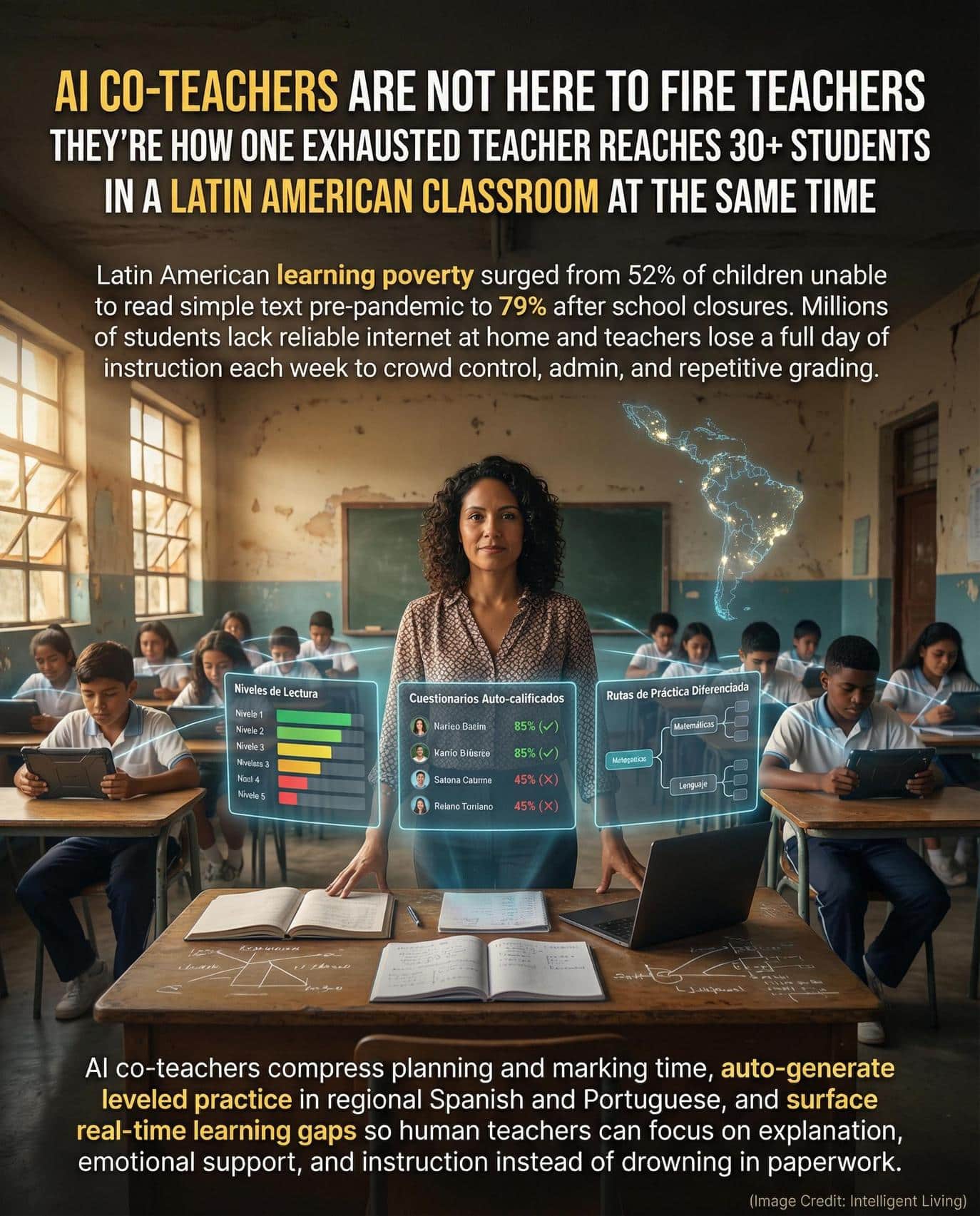
The urgency behind these shifts stems from a persistent, well-documented learning crisis.
The World Bank’s regional education program on Latin America and the Caribbean reports that learning poverty in the region was approximately 52 percent before the pandemic and may have risen significantly following extended school closures and digital access gaps.
Against this backdrop, AI co-teachers are being tested in Latin America not as automated instructors but as structured digital assistants designed to reduce routine workload and help teachers tailor instruction. Far from signaling displacement, the actual narrative focuses on weaving technology into public systems with firm human oversight, in line with evolving digital instructional models.
Analyzing Latin America’s Learning Crisis and The Strategic Growth of AI Co-Teachers
To grasp the magnitude of this challenge, we must examine the current educational landscape through regional data that highlights both the depth of the learning crisis and the urgent drive for digital innovation.
- Learning poverty in Latin America and the Caribbean stood at roughly 52 percent pre-pandemic, according to World Bank regional estimates, with the risk of further increases due to disruption and digital inequality.
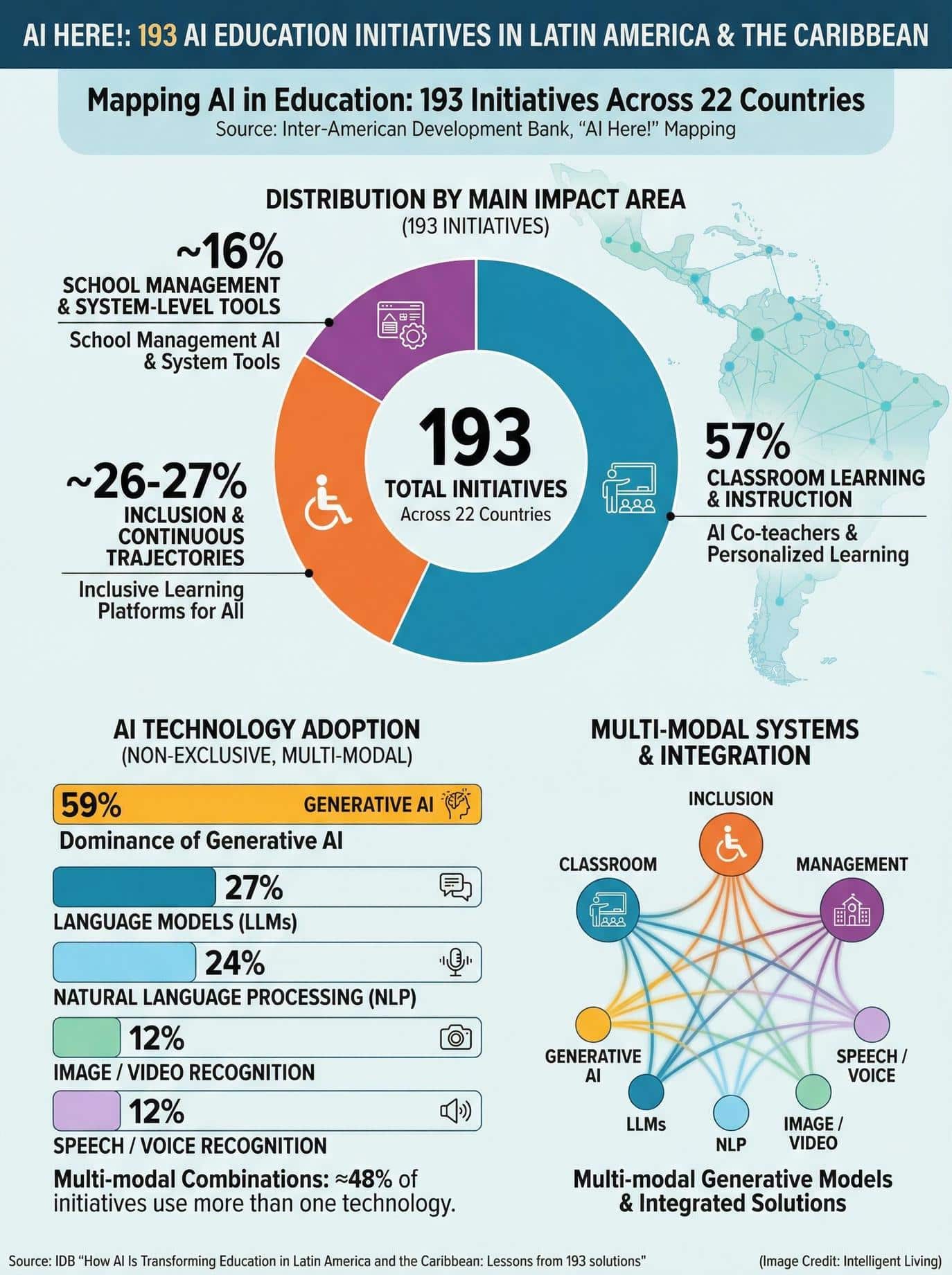
- The Inter-American Development Bank’s “AI Here!” mapping exercise documented 193 artificial intelligence initiatives across 22 countries in the region, indicating that AI in education is already active rather than hypothetical.
- The IDB’s 2025 technical framework groups classroom AI use into four instructional functions: content preparation, explanation, practice and feedback, and motivation or exploration.
- UNESCO’s updated guidance on generative AI in education underscores that teacher oversight and human-centered governance are essential for safe adoption.
- Public platforms such as Uruguay’s Plan Ceibal digital education initiative have begun piloting AI-supported tools within national systems while maintaining teacher authority and evaluation processes.
These initiatives represent a broader trend toward integrating AI co-teachers in Latin America. By analyzing these key facts, schools can better prepare for a human-centered path toward educational innovation.
Reclaiming Teacher Time: Why AI Support is Essential for Modern Classrooms
Public school teachers in Latin America often manage classes of 25 or more students within short instructional blocks. Students step into these classrooms with vastly divergent reading skills, varied home lives, and unequal access to the digital world.
Such staggering diversity—defined in research as “classroom heterogeneity”—renders standardized, one-size-fits-all instruction obsolete. This complexity strengthens the case for student-centered learning and assessment models that treat progress as more than a single test score. Teachers must simultaneously support students who are struggling to read at grade level and others who are ready for more advanced material.
Addressing The Scale of Proficiency Gaps in Reading and Math
The World Bank’s analysis of recent PISA results for adolescents in Latin America and the Caribbean illustrates the scale of this challenge, noting widespread proficiency gaps in reading and mathematics across multiple countries.
Teachers remain vital, yet they are drowning in administrative complexity. We must ask how digital platforms can strip away administrative drudgery to reclaim time for essential human interactions: empathy, judgment, and emotional support.
The Brookings analysis argues that AI’s most constructive role is to assist teachers with preparation and differentiated practice rather than to deliver fully automated instruction.
This perspective aligns with broader conversations about the limits of automation in human-centered professions, including analyses of which jobs AI is least likely to replace that emphasize the resilience of roles grounded in care, judgment, and complex human interaction.
Defining The AI Co-Teacher: Core Instructional Functions and Human Oversight
The term “AI co-teacher” can sound abstract. In practice, it refers to structured digital tools that assist with specific instructional functions, leveraging interactive educational technology to maintain teacher authority.
The Four-Function Classroom Model
The Inter-American Development Bank’s 2025 framework for generative AI in Latin American classrooms identifies four primary functions that define responsible classroom integration.
To foster learning recovery through differentiation, AI systems can draft lesson outlines and generate varied explanations that meet diverse curriculum standards. This does not eliminate teacher planning. It accelerates the drafting process.
Second, explanation. AI tools can rephrase concepts in multiple ways, offering simpler language or additional examples when students struggle with comprehension.
Third, practice and feedback. Systems can generate practice questions and provide immediate formative feedback, allowing teachers to identify patterns of misunderstanding more quickly.
Fourth, motivation and exploration. Interactive prompts or simulations can encourage curiosity and experimentation, especially in subjects like mathematics and science.
Collectively, these functions define a co-teacher that supports rather than dictates, ensuring that educators maintain total responsibility for selecting content, verifying accuracy, and aligning technology with local curricula.
Maintaining Teacher Authority within the Digital Framework
A global call from UNESCO urges the adoption of human-centered policies ensuring that human oversight remains non-negotiable.
In practical terms, teacher-in-the-loop means that educators review AI-generated materials, adjust them for cultural and linguistic relevance, and decide when and how tools are used in class. AI may draft a worksheet, but the teacher determines whether it fits the learning objective.
This approach reflects a broader shift in how schools are thinking about digital integration, echoed in emerging teachers and parents acting as AI coaches for learners rather than passive users of algorithms.

Maximizing Productivity through Workload Compression and Automated Feedback
One of the clearest near-term benefits of AI co-teachers is workload compression. Modern teaching involves far more than simple classroom delivery, requiring educators to balance multiple high-pressure responsibilities daily.
- Comprehensive lesson planning and curriculum alignment.
- Detailed assessment design and individual grading.
- Systematic reporting and communication with families.
- Differentiated feedback for varied student learning levels.
By stripping away these administrative hurdles, teachers can refocus their energy on student engagement. This automation of repetitive tasks is already transforming classrooms across the region, where education technology in Latin America streamlines lesson creation and reclaims vital instructional hours.
Automating Repetitive Drafting and Test Marking
Brazilian platforms like Teachy illustrate this shift, garnering regional attention for their ability to provide automated support. Similarly, Nova Escola’s WhatsApp-based lesson planning tool demonstrates how AI support can be delivered through platforms already familiar to educators, an important factor in regions with uneven broadband access.
Lowering the grading burden is never synonymous with compromising academic standards. AI can generate first-pass feedback on objective exercises, flag common errors, and group students by misunderstanding patterns. Teachers then use this information to provide targeted support.
This structured approach mirrors analyses of AI-assisted mathematics learning that identify specific conceptual gaps rather than replacing human teaching.
In this model, AI handles repetition. Teachers handle judgment, empathy, and adaptation. The result is not automation of teaching; it reflects automation’s impact on classroom learning dynamics when it is aligned with human-led instruction. It is amplification of teacher capacity under clearly defined boundaries.

Learning Recovery through Differentiation
Latin America’s learning crisis is not simply about overall averages. It is about distribution. In a single classroom, one student may still be decoding basic reading passages while another is ready for analytical writing. School closures significantly intensified this variation by disrupting learning continuity across socioeconomic groups and pushing more students toward hybrid and online education models.
According to the World Bank’s regional education program data on learning poverty, more than half of children in parts of Latin America were unable to read and understand a simple text by age ten even before the pandemic.
Scaling Personalized Growth in Heterogeneous Environments
In heterogeneous classrooms, differentiated instruction becomes essential. Differentiation means adapting content, pace, and assessment to meet students at different levels. Traditionally, this requires significant planning time and the ability to produce multiple versions of explanations and exercises.
The Inter-American Development Bank’s framework for generative AI in education outlines how AI tools can assist in producing varied explanations, scaffolded practice sets, and formative feedback loops tailored to different learner profiles.
When used responsibly, AI can generate alternative explanations in simpler language, create additional practice questions for struggling students, or offer enrichment challenges for advanced learners. Teachers then select, edit, and contextualize these materials. The technology expands options. The educator makes the decisions.
Why Language and Cultural Context Matter for Differentiation
Differentiation is not only about academic level. It is also about linguistic and cultural relevance. Many classrooms in Latin America include students who speak regional dialects or indigenous languages at home.
Recent reporting on the development of Latam-GPT, a regional open-source model trained on Latin American Spanish and Portuguese, highlights the importance of linguistic representation in AI systems.
If AI tools are trained primarily on data from other regions, they may miss cultural nuances or misinterpret local expressions. Regionally adapted models increase the likelihood that AI-generated explanations align with students’ lived experiences.
This emphasis on bridging linguistic and digital divides builds on broader conversations about transforming education in Latin America and the Caribbean through inclusive connectivity and digital skills.
Differentiation supported by AI therefore depends not only on algorithms, but on whose language and context are represented in the underlying data.
Evaluating 193 AI Initiatives: Transitioning from Regional Pilots to Proven Models
AI in Latin American education is not theoretical. The Inter-American Development Bank’s “AI Here!” mapping exercise identified 193 initiatives across 22 countries, spanning classroom learning tools, administrative systems, and inclusion-focused platforms.
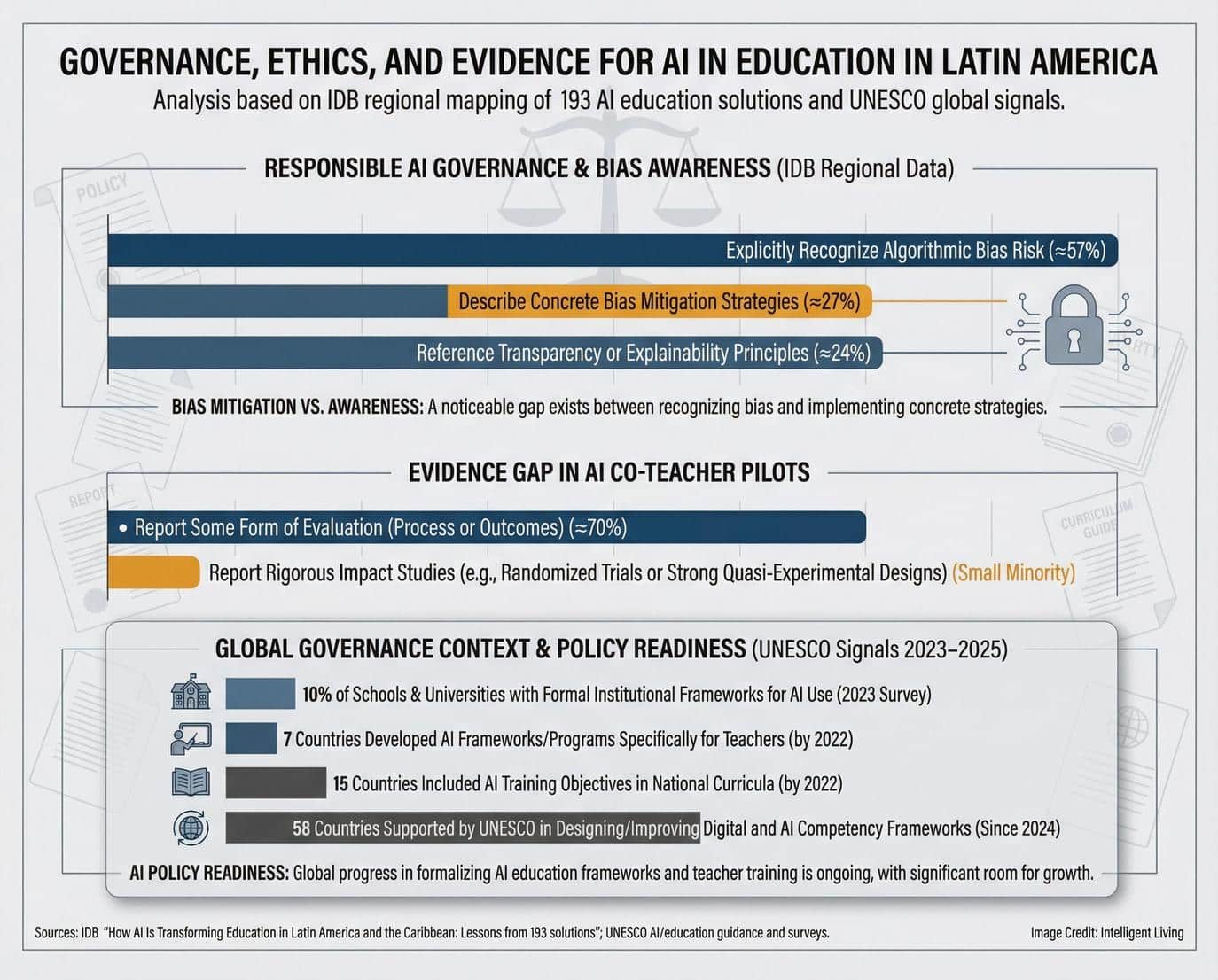
This level of activity signals experimentation and policy interest. However, mapping adoption is not the same as demonstrating impact. Many initiatives remain in pilot phases, and only a subset have undergone rigorous evaluation.
The IDB analysis notes that while a majority of initiatives acknowledge risks such as algorithmic bias, far fewer describe concrete mitigation strategies. This gap between awareness and implementation underscores the need for stronger governance frameworks and practical approaches to responsible AI that emphasize transparency, accountability, and privacy safeguards.
UNESCO’s updated guidance on generative AI in education calls for human-centered policies that address data privacy, transparency, teacher training, and student agency before large-scale deployment.
Essential Governance Standards for Sustainable Educational Innovation
Moving from pilot to proof requires three elements. First, clear evaluation metrics tied to learning outcomes and teacher workload. Second, procurement standards that require transparency and interoperability. Third, sustained investment in teacher digital competency development.
Regional research on teachers’ digital competencies in Latin America emphasizes that effective technology integration depends on structured professional development, not just tool availability.
Without these foundations, AI risks becoming another short-lived initiative rather than a durable support system.
Equity and Inclusion
Numerous AI initiatives across the region now prioritize inclusion as a core objective.
Inclusion in this context refers to supporting students with disabilities, those in remote communities, and learners from low-income households who may lack consistent digital access.
AI can assist by generating adaptive materials and supporting alternative communication formats. These tools also offer practice exercises that students can access asynchronously. Meanwhile, early versions of ambient intelligence in smart schools test how continuous sensing can support learning without compromising privacy. Access alone, however, does not guarantee equity.
Inclusive Pedagogy and the Push for Regional Data Representation
The IDB’s generative AI framework cautions that patterns of use are not neutral. If advanced tools are available only in well-resourced schools, gaps may widen rather than close.
Equity remains inseparable from linguistic representation. Projects like Latam-GPT represent a vital effort to ensure algorithms understand the nuanced rhythms of local speech.
Sustaining the shift from initial experiments to permanent infrastructure requires a deep commitment to fairness. For public systems to thrive, equity and inclusion must remain the priority for every student, irrespective of their home language or digital access, as seen in early adaptive learning models where design choices determine whether gaps narrow or widen. Innovation in the region is not limited to AI either. In Bogotá, a public school has shown what socio-emotional design can do without any new technology, cutting bullying to zero and coexistence incidents by 85 percent through peer mediation and emotional well-being programming.
A Practical Checklist for Schools Piloting AI Co-Teachers
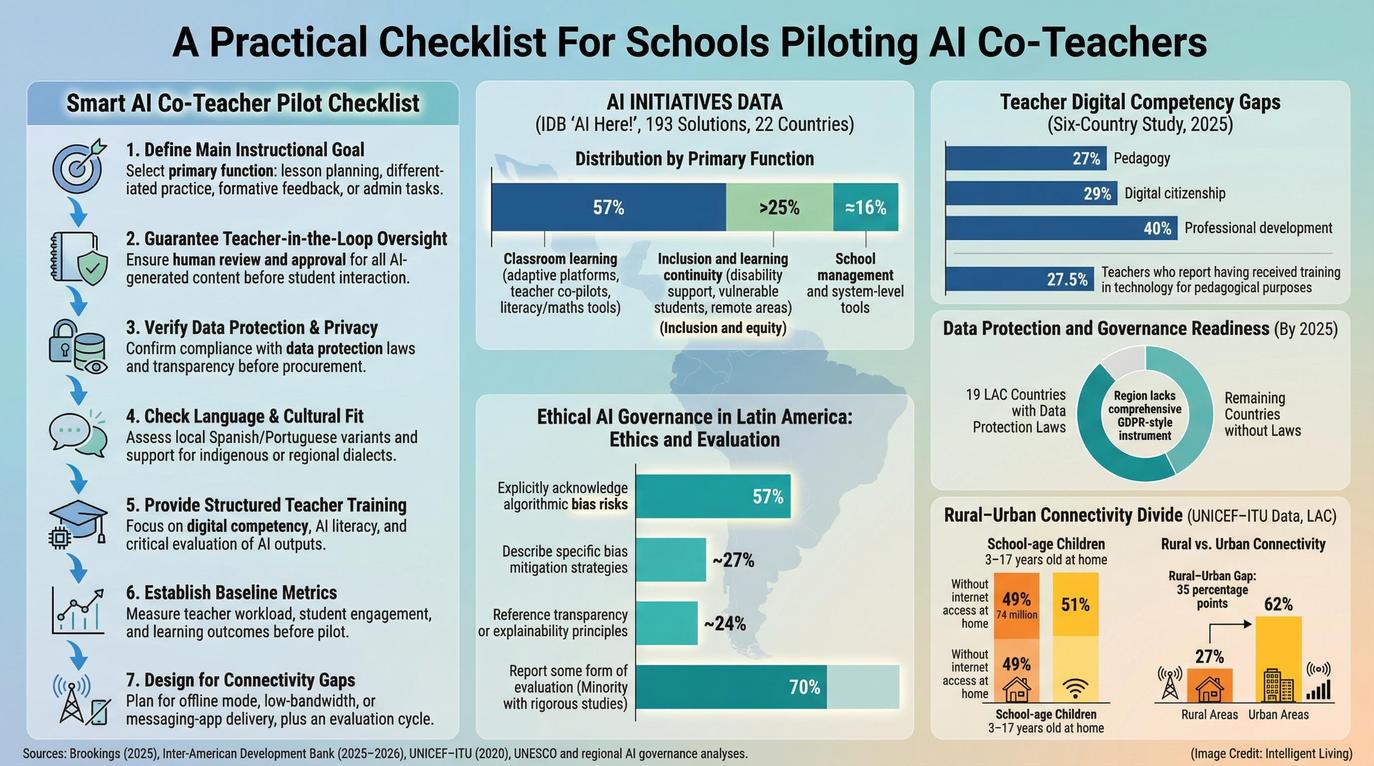
For school leaders considering AI co-teacher pilots, a structured checklist can reduce risk and clarify expectations. These steps ensure that technology serves as a bridge rather than a barrier to student success.
- Define The Instructional Goal: Identify whether the tool supports lesson planning, differentiated practice, feedback, or administrative tasks.
- Require Teacher-in-The-Loop Oversight: Ensure that educators review and approve all AI-generated materials before classroom use, aligning with human-centered AI guidance from organizations such as UNESCO.
- Evaluate Data Privacy and Transparency: Confirm how student data is stored, processed, and protected.
- Assess Language and Cultural Fit: Verify that tools support local languages and dialects relevant to the student population and align with neighborhood-level education models that center local learning.
- Provide Structured Teacher Training: Use professional development frameworks to build digital competency and critical evaluation skills described in regional research on teacher readiness.
- Establish Baseline Metrics: Track teacher workload indicators and student learning benchmarks before and during implementation.
- Plan for Connectivity Gaps: Ensure that tools function in low-bandwidth environments or through familiar platforms such as messaging applications.
Following these guidelines ensures that AI adoption remains a managed process. By focusing on these core areas, schools can navigate a successful rollout of education technology in Latin America.

Achieving A Human-Centered Path for AI Co-Teachers in Latin America
Evidence emerging from regional pilots suggests a pragmatic path forward for schools. Rather than a total revolution or a robotic replacement, the integration of AI co-teachers in Latin America provides a balanced framework for supporting differentiated instruction and reducing routine teacher workloads. Success now hinges on robust governance, language representation, and sustained training for educators.
When we treat technology as a supportive instrument under pedagogical authority, we strengthen the classroom’s heart rather than sidelining the teacher. Sustaining the shift from initial experiments to permanent infrastructure requires a deep commitment to fairness.
For public systems to thrive, equity and inclusion must remain the priority for every student, irrespective of their home language or digital access. By embracing this collaborative model, Latin American schools can transform the current learning crisis into an opportunity for personalized growth, ensuring that technology serves the teacher and empowers the learner.
Frequently Asked Questions About AI in Latin American Classrooms
As schools across the region begin to pilot these digital tools, educators and parents often share common concerns regarding efficacy, safety, and the future of the teaching profession. Below are answers to the most frequent inquiries regarding AI co-teachers in Latin America.
Will AI Replace Teachers in Latin American Schools?
No. Current research emphasizes augmentation over substitution. These tools act as digital assistants for planning, while teachers maintain emotional support and authority.
How Does AI Support Differentiated Instruction in Overcrowded Classrooms?
AI systems generate varied explanations and practice sets tailored to different student levels. This addresses classroom heterogeneity effectively without hours of manual lesson preparation.
What Are the Main AI Education Initiatives in the Region?
The Inter-American Development Bank has documented over 190 initiatives across 22 countries, including Uruguay’s Plan Ceibal and Brazil’s Teachy, focusing on workload compression.
Why is Linguistic Representation Important for Latin American AI?
Regional models like Latam-GPT ensure content respects cultural nuances and local dialects. This is essential for how AI is reshaping progressive learning environments and ensuring students in diverse communities can flourish.
How Do Schools Ensure Data Privacy During AI Pilots?
Governance frameworks from organizations like UNESCO provide guidelines for oversight. Schools prioritize transparency and teacher-in-the-loop validation to protect student rights and data integrity.


